


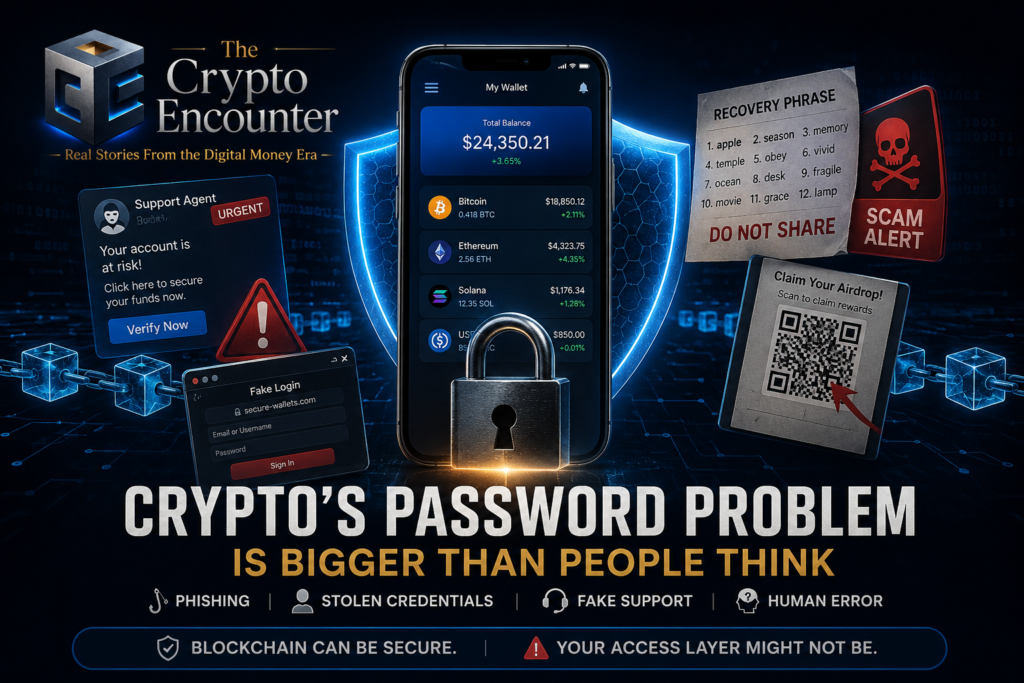
A blockchain can be extremely difficult to attack while the person using it remains surprisingly easy to fool. That gap is at the center of crypto’s password problem.
A criminal does not necessarily need to break Bitcoin, Ethereum, or a wallet’s encryption. Sometimes it is easier to imitate a support agent, steal an exchange password, send a convincing phishing link, compromise an email account, or persuade someone to reveal a wallet recovery phrase.
That distinction matters because crypto can shift more security responsibility onto the individual. The Federal Trade Commission warns that if a digital wallet is stolen or compromised, a password is lost, or crypto is sent to the wrong person, there may be nobody who can step in and recover the funds.
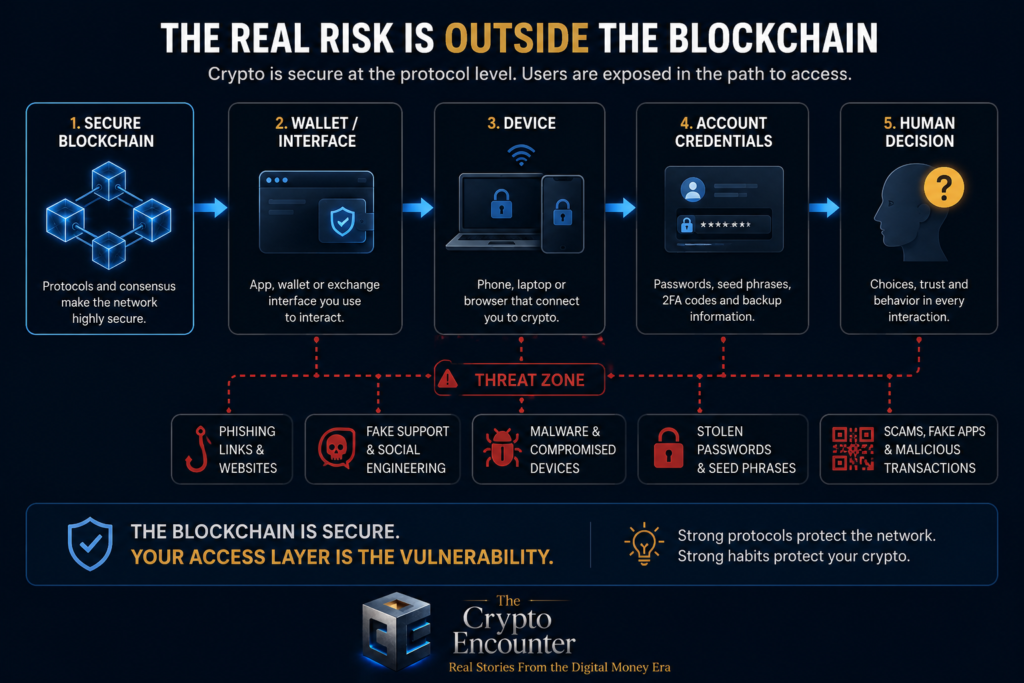
The real security question, therefore, is larger than whether a blockchain can be hacked. It is whether the entire path between the blockchain and the human being using it can be trusted.
Key Takeaways
| Security issue | What it means for users |
|---|---|
| Strong blockchain security | Does not automatically protect a user’s exchange, wallet, email, browser, or device |
| Password theft | Can expose accounts, particularly when a password is reused or used without stronger authentication |
| Phishing | Can trick users into voluntarily handing credentials to an attacker |
| Seed phrase theft | Can give an attacker control of a self-custody wallet |
| Fake support | Uses trust and urgency rather than attacking blockchain cryptography |
| Malicious links and dApps | May seek passwords, recovery information, wallet connections, or dangerous approvals |
| Human error | Can bypass technical protections that otherwise work correctly |
Why Crypto’s Password Problem Is Not Really Just About Passwords
The phrase crypto’s password problem can be misleading if it makes people picture nothing more than a weak login.
There are several different secrets involved in crypto.
An exchange account may have a conventional username and password. Your email account has another login. A phone or computer has a PIN or password. A self-custody wallet may be protected locally by a password while also having private keys and a recovery phrase.
These credentials do different jobs.
A password usually proves that you are authorized to enter an account or unlock an application.
A private key is cryptographic information that can authorize blockchain transactions.
A seed phrase, sometimes called a recovery phrase, is commonly a sequence of 12 or 24 words from which wallet keys can be recovered. The FBI describes it as a series of words generated by a cryptocurrency wallet that gives the user access to the crypto associated with that wallet.
That difference is crucial.
Someone who steals your streaming-service password might watch your account. Someone who obtains the recovery phrase for a self-custody wallet may be able to restore that wallet elsewhere and control its assets.
That is why crypto’s password problem extends far beyond choosing a clever password.
The Blockchain Can Work Perfectly While You Still Lose Crypto
One of the most important distinctions in crypto security is between protocol security and user security. This distinction also connects to the broader question of how secure cryptocurrencies really are, especially once exchanges, wallets, custody, and user behavior enter the picture
Imagine a heavily protected bank vault.
The walls are reinforced. The locks work. The alarm system works. Nobody breaks into the building.
Then someone calls the owner, convincingly pretends to be an employee, and persuades that person to hand over the combination.
The vault did not fail.
The security process surrounding it did.
Crypto can create a similar situation. A blockchain may process exactly the transaction that a valid private key authorizes. If an attacker has obtained the necessary credentials or deceived the legitimate owner into approving something harmful, the underlying network may have no way of knowing that deception occurred.
This is one of the hidden mechanisms behind crypto’s password problem: cryptographic systems are designed to validate credentials and signatures. They cannot reliably determine the human circumstances under which those credentials were obtained.
Why Phishing Can Be More Useful to a Criminal Than Breaking Encryption
Modern cryptography presents attackers with difficult mathematical problems.
Human beings present different opportunities.
A message saying your wallet has been suspended, your account was compromised, or verify immediately can create urgency. A website can imitate a familiar service. A fake support representative can sound patient and professional.
The FBI documented one example involving fraudulent NFT airdrops. Criminals directed users to malicious websites that could request passwords, wallet connections, security information, or seed phrases. Once victims provided the information, criminals could use it to steal cryptocurrency.
This reveals something important about crypto’s password problem.
The attacker may not be trying to discover a secret mathematically. The attacker may be trying to convince you to provide it.
NIST makes the underlying weakness explicit: passwords are not phishing-resistant.
A complicated password can therefore be excellent protection against guessing while offering little protection if its owner types it directly into a convincing fake website.
A Seed Phrase Is Closer to a Master Key Than a Password
This is where public understanding becomes especially important.
A wallet recovery phrase should not be treated like an ordinary password.
With a self-custody wallet, the recovery phrase can be the backup that allows the wallet’s keys to be reconstructed. That makes possession of the phrase extremely powerful.
Wallet providers repeatedly warn users about this risk. Ledger states that its recovery phrase backs up the private keys stored in a wallet and that anyone obtaining it could restore the wallet. Coinbase likewise warns users never to share a recovery phrase and says it will not ask users for one.
This creates a peculiar security model.
In traditional finance, a suspicious transfer may sometimes be stopped, investigated, or reversed depending on the circumstances. With self-custodied crypto, there may be no institution holding a second copy of the key or waiting to verify whether the person initiating a valid transaction is really the rightful owner.
That independence is part of self-custody’s appeal.
It is also why crypto’s password problem becomes a custody problem.
The Security Chain Is Only as Strong as the Account Around It
Consider someone who uses a crypto exchange with a strong, unique password.
That sounds secure.
But what protects the email account connected to the exchange?
What protects the phone receiving authentication codes?
What happens if the user enters the exchange password into a fake login page?
What happens if malware compromises the device?
What happens if a scammer impersonates customer support?
The attack surface extends outward from the blockchain.
This is another reason crypto’s password problem deserves broader treatment. Users often think about the security of the asset while forgetting the security of the infrastructure they use to reach it.
A person’s practical crypto-security perimeter can include their:
- email account
- exchange login
- wallet software
- browser
- smartphone or computer
- authentication method
- recovery phrase
- cloud accounts
- links they click
- people they decide to trust
A blockchain’s security cannot compensate for every weakness in that chain.
Why One Password Should Not Stand Between an Attacker and Your Account
Password-only security creates a simple problem: once the password is compromised, the attacker has the credential the system expects.
Multi-factor authentication, or MFA, adds another requirement.
NIST explains that MFA can provide an additional layer of protection because compromising the password alone is no longer sufficient. It also notes that authentication methods differ in security and that text-message codes are particularly vulnerable compared with stronger alternatives.
Passkeys represent another important development. Instead of asking users to repeatedly type a reusable secret, passkeys use cryptographic credentials associated with a device. NIST says passkeys are substantially harder to steal through conventional phishing and do not require users to memorize passwords.
Where passwords remain necessary, NIST recommends password managers because they can generate and store long, unique passwords. Its consumer guidance also recommends passwords of at least 15 characters when users must create them themselves.
These protections do not eliminate crypto’s password problem, but they reduce dependence on one reusable secret.
Scammers Attack Trust Because Trust Is Valuable
Cybersecurity discussions can become too technical.
Scammers often work in the opposite direction.
They exploit authority, urgency, fear, greed, loneliness, familiarity, or confusion.
The scale of the broader problem is substantial. FTC data show consumers reported losing $12.5 billion to fraud in 2024, including $5.7 billion to investment scams. Cryptocurrency was the second-highest payment method by reported fraud losses that year, at approximately $1.4 billion.
The problem has continued. FTC data released in 2026 show reported losses to investment scams exceeded $7.9 billion in 2025, with a median reported individual loss above $10,000.
These figures should not be interpreted as losses caused solely by stolen passwords. They illustrate the broader fraud environment in which crypto users operate.
Impersonation is particularly relevant. The FTC reported $3.5 billion in imposter-scam losses in 2025, and some of the costliest schemes began with fake security alerts.
A scammer who convinces someone that an account is under attack can turn the victim’s instinct to protect their money into the mechanism used to steal it.
The Dangerous Moment Often Happens Before the Transaction
One overlooked aspect of crypto’s password problem is timing.
People tend to focus on the moment crypto disappears.
Security analysis should start earlier.
A typical chain of events might look like this:
Message → trust → link → credential → wallet access → transaction
The blockchain appears only near the end.
The decisive security failure may have happened minutes earlier when the victim trusted the wrong message, visited a fake page, revealed a password, entered a seed phrase, or approved an unexpected wallet interaction.
This changes how users should think about protection.
Transaction security starts before a transaction exists.
What Better Crypto Security Looks Like in Practice
The goal is not to become suspicious of every digital interaction. It is to reduce the number of situations in which one mistake can expose everything.
A practical defense is layered. Use unique passwords for important accounts and a reputable password manager where appropriate. Enable strong MFA when a service supports it. Consider phishing-resistant options such as passkeys when available. Protect the email account connected to financial services as carefully as the financial account itself. NIST recommends MFA, password managers, and long passwords as core protections.
Treat recovery phrases differently from ordinary passwords. Do not disclose one because a caller, direct message, email, pop-up, or alleged support representative asks for it. The FBI specifically advises users not to provide passwords, seed phrases, or one-time passwords in response to unsolicited outreach.
Before following a security alert, independently open the service’s official app or manually navigate to the service rather than trusting the supplied link. Verify unexpected requests through a separate, trusted channel.
Most importantly, treat urgency as information.
If someone needs you to transfer crypto, reveal credentials, scan a QR code, or “secure” funds immediately, the pressure itself deserves scrutiny. The FTC warns that scammers frequently impersonate businesses and government agencies and may instruct victims to move money or cryptocurrency supposedly for protection.
A Simple Crypto Security Risk Matrix
| Situation | Main danger | Better response |
|---|---|---|
| Unexpected wallet-support message | Impersonation | Contact support through a verified official channel |
| Website requests a seed phrase | Wallet takeover | Stop and verify why the phrase is supposedly required |
| Same password used across accounts | Credential reuse | Use unique credentials |
| Password-only exchange login | Account takeover | Enable stronger MFA or passkeys where supported |
| Unexpected token or airdrop link | Phishing or malicious interaction | Verify through the project’s official channels |
| “Move your crypto to keep it safe” request | Impersonation scam | Do not transfer funds based on unsolicited instructions |
| Urgent account-security warning | Fear-driven decision | Independently check the account before acting |
The Bigger Lesson Behind Crypto’s Password Problem
The crypto industry has spent years discussing decentralization, cryptography, consensus mechanisms, hardware wallets, and network security.
Those things matter.
But ordinary users experience crypto through interfaces, passwords, smartphones, browsers, exchanges, wallets, messages, QR codes, and other people.
That is where crypto’s password problem becomes much larger than password strength.
A technically secure blockchain cannot stop someone from revealing a recovery phrase. A hardware wallet cannot make every website trustworthy. Encryption cannot determine whether the person on the phone really works for customer support. A complex password cannot protect a user who voluntarily enters it into an attacker-controlled page.
Security therefore has two layers.
The first asks: Can the system resist attack?
The second asks: Can the user recognize when someone is trying to bypass the system entirely?
For millions of ordinary crypto users, the second question may be the one that matters most.
FAQs
What is crypto’s password problem?
Crypto’s password problem describes the wider security gap between strong blockchain technology and the passwords, recovery phrases, devices, accounts, websites, and human decisions surrounding it. A blockchain can remain secure while an individual user loses access through phishing, credential theft, impersonation, or another form of compromise.
Is a crypto wallet password the same as a seed phrase?
No. A password may protect access to an account or wallet application. A seed phrase can allow a compatible self-custody wallet and its keys to be recovered. Anyone obtaining the recovery phrase may therefore gain control over the associated wallet.
Can a strong password protect me from phishing?
Not necessarily. A strong password helps against guessing and some credential attacks, but NIST states that passwords themselves are not phishing-resistant. If a user gives a strong password to a fake website, its complexity does not prevent the attacker from receiving it.
Is multi-factor authentication worth using for crypto accounts?
Yes, where supported. MFA means a stolen password alone may not be enough to access an account. NIST recommends MFA while noting that some methods are stronger than others.
What should I do if someone claiming to be wallet support asks for my recovery phrase?
Do not provide it based on unsolicited contact. Independently contact the company through a verified official channel. The FBI advises users not to provide passwords, seed phrases, or one-time passwords when they did not initiate the interaction.
Can crypto be secure if users can still be scammed?
Yes, but “secure” needs to be defined carefully. Protocol security, account security, device security, wallet security, and human behavior are separate layers. A secure blockchain does not mean every service, device, website, or interaction around it is equally secure.
Conclusion
Crypto’s password problem exposes an uncomfortable but useful distinction: protecting a blockchain and protecting a person are different engineering problems.
The strongest cryptography in the world cannot prevent every fake website, stolen credential, compromised device, malicious link, impersonation attempt, or moment of misplaced trust.
For ordinary users, crypto safety therefore depends on more than creating a difficult password. It requires layers of authentication, careful recovery-phrase handling, independently verifying unexpected requests, securing connected accounts, and recognizing that the person asking for a secret may be a bigger threat than someone trying to crack it.
Crypto security does not end at the blockchain.
For most people, that is where it begins.