


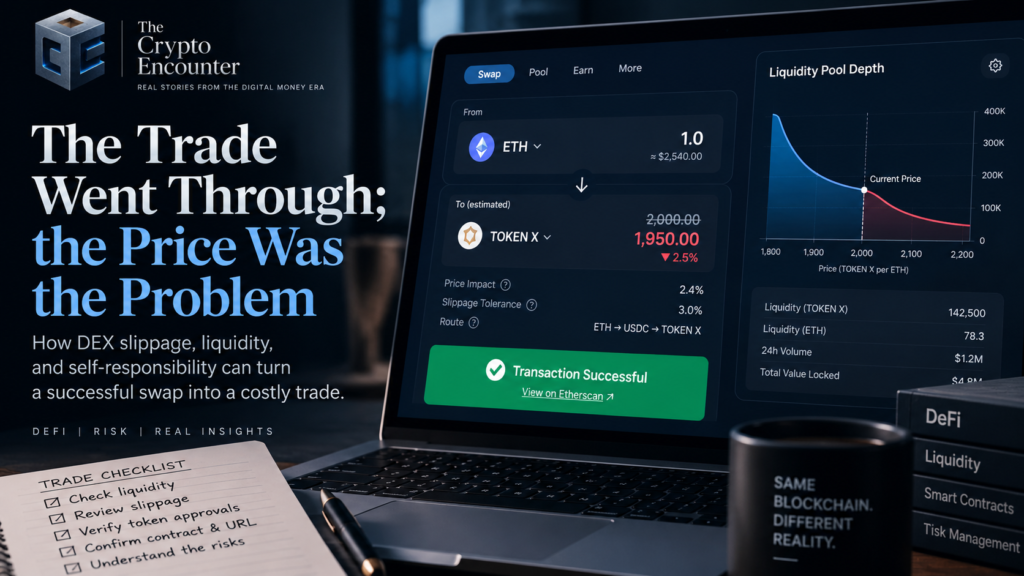
A decentralized exchange can execute your trade exactly as designed and still leave you with a worse result than expected. That is the central problem behind DEX slippage. The transaction succeeds. The blockchain records it. The tokens arrive. Yet the amount you receive may be lower because liquidity was thin, your order moved the pool price, or market conditions changed before execution.
This distinction matters because decentralized finance changes where responsibility sits. A DEX can reduce dependence on corporate custody, but it does not remove smart-contract risk, liquidity risk, token approvals, execution risk, or user error. Instead, users must understand what the transaction will actually do before signing it. The Crypto Encounter’s broader guide to decentralized exchange risks explains that shift in responsibility in more detail.
The lesson behind DEX slippage is therefore simple: a successful transaction and a successful financial outcome are two different things.
DEX Slippage in Plain English
DEX slippage is the difference between the price or token amount you expect when preparing a swap and the result you actually receive when the trade executes.
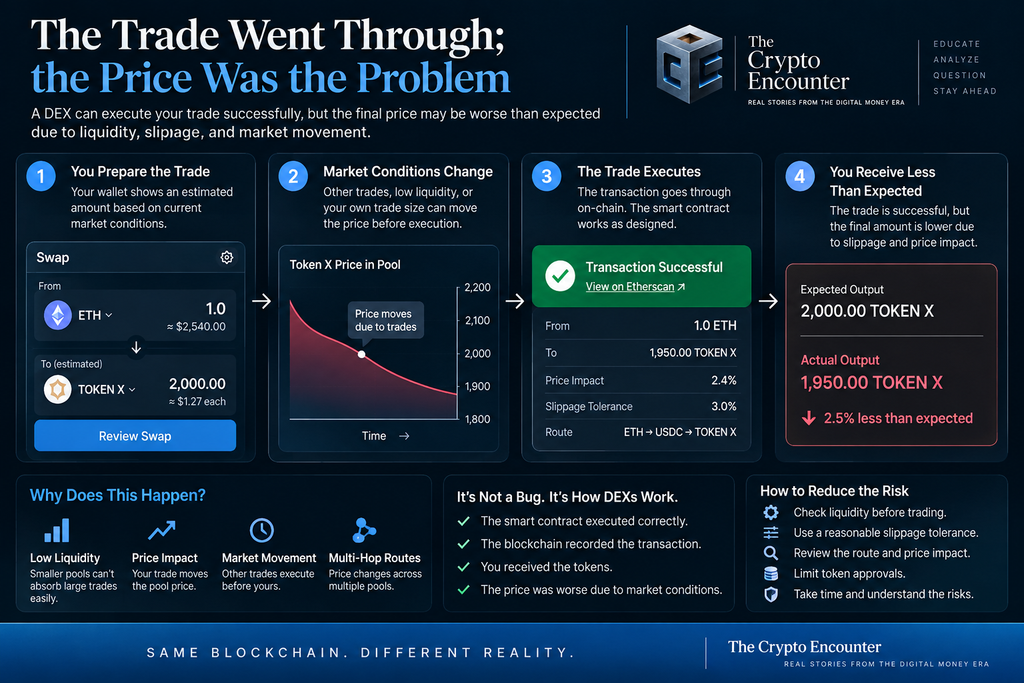
Imagine that a swap interface estimates that 1 ETH will buy 2,000 units of Token X. You approve the transaction. However, by the time the swap executes, you receive 1,940 tokens.
Nothing necessarily broke.
Your wallet worked. The smart contract executed. The blockchain processed the transaction. Nevertheless, your effective price was worse than the initial quote.
That 60-token difference can arise from several factors. Liquidity may be shallow. Your own order may move the pool price. Other trades may execute first. Moreover, the route may pass through multiple pools.
Uniswap’s technical documentation shows why this happens. In automated market makers, prices depend on the assets available in liquidity pools, while larger trades can move those pool prices. Its documentation also explains that multi-hop trades can experience slippage at more than one stage.
Therefore, DEX slippage is not automatically evidence of a scam, hack, or malfunction. Sometimes, it is simply the economic result of trading against available liquidity.
Why DEX Slippage Can Happen Even When Everything Works
A centralized exchange often uses an order book. Buyers and sellers place orders at different prices, and the exchange matches them.
Many decentralized exchanges work differently. They use automated market makers, or AMMs, where traders swap against pools of tokens.
Suppose a pool contains Token A and Token B. Its smart contract uses a mathematical rule to determine how much of one asset a trader receives for the other. As a trade removes one token and adds another, the balance changes. Consequently, the exchange rate changes too.
This creates price impact, which is closely related to DEX slippage but is not exactly the same thing.
Price impact describes how much your own trade changes the pool price. DEX slippage describes the difference between the expected and executed result.
That distinction becomes especially important in shallow markets.
A $100 swap may barely affect a large liquidity pool. In contrast, a $20,000 swap against a much smaller pool could materially move the price. The interface may still process both transactions successfully.
For that reason, the question should not stop at, “Will my transaction execute?”
Users also need to ask, “At what effective price will it execute?”
A Simple DEX Slippage Example
Consider this simplified scenario:
| Stage | What the user sees |
|---|---|
| Initial quote | 1 ETH = 2,000 Token X |
| Expected output | 2,000 Token X |
| Market/liquidity changes | Quote worsens before execution |
| Actual output | 1,950 Token X |
| Transaction status | Successful |
| Economic result | 50 fewer tokens than initially expected |
The blockchain has done its job.
However, the user has still paid more per token than the original quote suggested.
This example shows why DEX slippage can confuse newcomers. People often associate “successful” with “correct.” On-chain systems use a narrower definition. A successful transaction generally means the requested instructions executed without reverting. It does not mean the trade achieved the economic outcome the user hoped for.
That difference between technical execution and economic outcome is one of the most important concepts in DeFi.

Liquidity Is the First Place to Look When DEX Slippage Rises
Liquidity describes how easily an asset can be traded without causing a large price movement.
Deep liquidity generally gives traders more room. Shallow liquidity gives them less.
Consequently, DEX slippage can become severe when a token trades in a small pool. Even an order that looks modest in dollar terms can represent a significant share of the available liquidity.
This issue becomes more important during volatile markets. Traders may rush toward the same exit while liquidity providers remove capital. As a result, the pool can become less capable of absorbing trades just when users most want to sell.
The CFTC’s DeFi report identifies liquidity risks among the broader vulnerabilities facing decentralized financial systems. It also highlights smart-contract, oracle, technological, governance, and market-integrity risks.
The Crypto Encounter’s guide explaining why liquidity pools are not savings accounts provides another useful perspective. Liquidity is active market infrastructure. It should not be confused with money sitting passively in an account.
Meanwhile, liquidity providers face their own exposure. The mechanics behind impermanent loss in DeFi show that the people supplying liquidity can experience different outcomes from traders using the pool.
DEX Slippage and Price Impact Are Related but Different
These terms often appear together, so separating them helps.
Price impact comes from the size of your trade relative to available liquidity.
DEX slippage measures the difference between the result you expected and the result you ultimately received.
For example, suppose a large swap itself pushes a pool from $1.00 per token toward $1.05. That movement reflects price impact.
Now suppose other transactions also change the pool before your transaction executes. The final difference between your quoted result and executed result contributes to DEX slippage.
Therefore, checking only the headline token price can be misleading.
The relevant figure is the price available for your particular trade size, route, pool, and execution conditions.
This is why the article’s title matters literally: the trade can go through while the price remains the problem.
Slippage Tolerance Is a Protection, Not a Promise
Many DEX interfaces allow users to choose a slippage tolerance.
Suppose you set a 1% tolerance. In simple terms, you are telling the transaction that you will accept execution within a specified range around the quoted output. If conditions move beyond the permitted limit, the swap may fail rather than execute at an even worse rate.
However, the setting involves a tradeoff.
Set the tolerance too tightly, and volatile conditions may cause the transaction to fail. Set it too loosely, and you may accept a much worse execution price.
Therefore, increasing tolerance simply to “make the transaction work” can be dangerous.
DEX slippage tolerance should be treated as an economic boundary. It defines how much deterioration you are prepared to accept before the transaction should stop.
That distinction also connects to maximal extractable value, or MEV. Transaction ordering can influence execution outcomes in public blockchain markets. The Crypto Encounter’s guide to MEV and the hidden cost of a DEX trade explains how transaction ordering can create costs even while users retain custody of their assets.
DEX Slippage Shows Why Self-Custody Does Not Remove Risk
Self-custody solves a particular problem: it lets users control assets through their own keys instead of depending entirely on a centralized custodian.
That control is meaningful. However, it changes the risk model rather than eliminating risk.
The distinction becomes clearer when comparing DEX trading with crypto exchange custody. On a centralized exchange, users may depend on the company for custody, solvency, account access, withdrawals, and operational security.
With self-custody, some of those dependencies disappear. Yet others become more important.
Now the user may need to evaluate smart contracts, approvals, liquidity, wallet security, transaction details, and DEX slippage personally.
That is why understanding the difference between owning crypto and controlling crypto matters. Control over private keys gives a user authority. It does not automatically provide protection against a poor trade.
Smart Contracts Can Execute a Bad Economic Decision Perfectly
A smart contract is software that executes predefined logic on a blockchain.
It does not know whether you misunderstood the interface. It does not know whether you intended to trade a smaller amount. Nor does it know whether DEX slippage makes the final price unattractive to you unless the transaction parameters explicitly impose a limit.
That is an important distinction.
Ethereum’s smart-contract security guidance stresses the need for robust access controls and secure contract design because contracts can control valuable assets.
Meanwhile, the CFTC’s DeFi research notes that decentralization can leave unclear lines of responsibility and limited avenues for recourse when something goes wrong.
So, decentralization can remove one intermediary without creating a replacement help desk.
This issue becomes even clearer when examining how a DeFi website can betray an otherwise functioning protocol. The protocol, interface, wallet, liquidity pool, and user are separate parts of the transaction chain.
A failure or misunderstanding at any one layer can create losses.
Token Approvals Add Another Risk Before DEX Slippage Even Matters
Before swapping an ERC-20 token, users may need to approve a smart contract to spend it.
An approval does not necessarily transfer the token immediately. Instead, it gives another address or contract permission to use a specified amount.
That distinction can create a hidden exposure.
Ethereum warns that unlimited token approvals can increase risk because a malicious or compromised contract may retain spending permission. Moreover, simply disconnecting a wallet from a website does not revoke an existing approval.
Therefore, a trader could carefully control DEX slippage and still face a completely different risk through an excessive approval.
For unfamiliar DeFi activity, The Crypto Encounter’s DeFi wallet separation rule offers a practical risk-containment framework. Separating experimental activity from larger long-term holdings can limit how much one mistake exposes.
Likewise, crypto security versus crypto safety explains why technically secure infrastructure does not guarantee that every user interaction is safe.
Why High-Yield DeFi Makes the Tradeoff Harder to See
High yields attract attention because the potential return appears first.
Risk often sits underneath it.
A liquidity pool may offer trading fees or token incentives. A lending protocol may advertise attractive rates. However, users can simultaneously face token volatility, smart-contract failures, liquidation, oracle problems, liquidity shortages, approval risk, and DEX slippage when entering or exiting.
The CFTC’s DeFi report specifically identifies operational, technological, security, liquidity, governance, and market-integrity risks within decentralized systems.
Therefore, an advertised yield should not be viewed separately from the mechanism generating it.
A 20% return opportunity, for example, tells you little about the amount of risk required to pursue it. The percentage alone does not explain whether incentives come from organic fees, token emissions, leverage, or another source.
Moreover, leaving a position may itself become expensive when liquidity deteriorates.
The Crypto Encounter’s reporting on how DeFi losses can extend beyond token prices illustrates how technical, organizational, liquidity, and market risks can overlap.
DEX Slippage Is Only One Layer of the Transaction
For ordinary users, it helps to break a decentralized trade into separate risk layers.
| Risk layer | Plain-English question | Possible consequence |
|---|---|---|
| Wallet | Am I controlling the correct wallet securely? | Unauthorized transactions |
| Interface | Am I using the legitimate website? | Malicious transaction request |
| Approval | How much can this contract spend? | Tokens remain exposed |
| Smart contract | Does the code behave as expected? | Loss or locked funds |
| Liquidity | Is the pool deep enough for my trade? | Large price impact |
| DEX slippage | How far can execution move from my quote? | Worse final price |
| Transaction ordering | Can other activity affect execution? | Additional execution cost |
| Token | Is there a liquid market after I buy? | Difficult or costly exit |
| User decision | Do I understand what I am signing? | Irreversible mistake |
This framework explains why calling a protocol “non-custodial” answers only one question.
It tells you something about custody.
It does not tell you whether the contract is secure, the token approval is sensible, the pool has adequate liquidity, the interface is authentic, or DEX slippage is acceptable.
Similarly, a technically secure blockchain cannot protect users from every poor decision. The Crypto Encounter’s analysis of how user habits become a crypto security weakness explores that human layer.
How to Check DEX Slippage Before You Sign
Users do not need to become smart-contract developers to make more informed decisions. However, they should slow down enough to understand the transaction.
First, compare the quoted output with the amount you will actually accept. Then, check the estimated price impact. A large percentage deserves attention.
Next, examine liquidity. Thin pools deserve greater caution, particularly for larger trades.
Also review the route. A swap may travel through several pools rather than one direct market. More steps can introduce additional execution considerations.
Then inspect the slippage tolerance rather than automatically increasing it after a failed transaction.
Finally, read wallet prompts carefully. A transaction approval and a token spending approval can create different permissions.
These checks cannot eliminate DEX slippage or smart-contract risk. However, they can make the economic consequences more visible before a transaction becomes difficult or impossible to reverse.
That mindset fits a broader principle explored in Why Crypto Rewards Confidence and Punishes Overconfidence: knowing how to use a tool should not be confused with understanding every risk created by using it.
When DEX Slippage Becomes a Warning Sign
Some DEX slippage is a normal feature of market execution.
Extreme DEX slippage deserves closer examination.
For example, unusually high price impact may indicate that the pool is very small relative to the trade. It could also mean liquidity has suddenly disappeared.
Likewise, a token may show an attractive quoted market price while offering little practical depth for someone trying to sell a meaningful position.
That creates an important public-facing lesson: displayed value is not always realizable value.
A wallet may show that a token holding is worth $10,000 based on a quoted price. Yet if available liquidity cannot absorb a $10,000 sale anywhere near that price, the holder may not actually be able to realize that valuation.
Therefore, liquidity matters twice. It affects the entry, and it affects the exit.
This is one reason a polished application should never substitute for understanding the underlying transaction. As The Crypto Encounter explains in When a Crypto App Looks Safer Than It Is, a familiar interface can simplify complexity without removing the risks underneath it.
DEX Slippage Changes What “Successful” Means
Traditional consumer software trains users to see a green confirmation screen as good news.
Blockchain transactions require a more precise interpretation.
“Success” tells you that the network accepted and executed the transaction according to its rules.
It does not necessarily tell you:
- whether you received a competitive price,
- whether your approval was appropriately limited,
- whether the asset remains liquid,
- whether the contract is safe,
- or whether the decision made financial sense.
DEX slippage exposes this distinction particularly well because the trade can be technically flawless and economically disappointing.
That is also why comparing decentralized systems with banks or centralized exchanges requires care. The Crypto Encounter’s guide explaining why crypto exchanges are not banks shows how protections, access, custody, and responsibilities can differ even when the interfaces look familiar.
Conclusion: DEX Slippage Is the Price of Understanding Execution
DEX slippage reveals one of DeFi’s most important tradeoffs. Decentralized tools can reduce corporate custody and give users direct control. At the same time, they transfer more responsibility for smart contracts, approvals, liquidity, execution settings, and transaction decisions to the person holding the wallet.
Therefore, a completed transaction should never be the only measure of success.
Check the amount you expect to receive. Understand price impact. Review liquidity. Set DEX slippage tolerance deliberately. Inspect approvals. Most importantly, remember that code can execute your instructions correctly even when those instructions produce a poor financial result.
The trade went through.
The blockchain worked.
The price was the problem.
And understanding why is part of the responsibility that comes with decentralized control.
FAQs
What is DEX slippage?
DEX slippage is the difference between the expected result of a decentralized exchange trade and the result received when it executes. Liquidity conditions, price movement, trade size, routing, and transaction ordering can all contribute.
Is DEX slippage the same as price impact?
No. Price impact describes how your own trade changes the market or pool price. DEX slippage describes the difference between the expected and actual execution result. The two can interact, especially in shallow liquidity.
Does DEX slippage mean a DEX malfunctioned?
Not necessarily. A decentralized exchange can function exactly as designed while a trade receives a worse price than initially quoted. The transaction parameters and available liquidity determine whether execution remains acceptable.
Can setting higher DEX slippage help a transaction execute?
A wider tolerance can make execution more likely during changing market conditions. However, it also means accepting a wider range of potential outcomes. Therefore, increasing the setting is not a free fix for a failing trade.
Can self-custody protect me from DEX slippage?
No. Self-custody concerns control of assets and private keys. It does not guarantee good execution. A user can retain complete custody and still receive an unfavorable swap price.
Why does DEX slippage matter more for low-liquidity tokens?
A shallow liquidity pool cannot absorb large trades as easily as a deep pool. Consequently, a relatively small order can create substantial price impact, while changing market conditions can widen DEX slippage further.
Disclaimer
This article is for informational and educational purposes only. It does not provide financial, investment, legal, tax, or accounting advice. Cryptocurrency and digital asset markets involve risk, including possible loss of capital. Readers should conduct their own research before making any financial decision.