


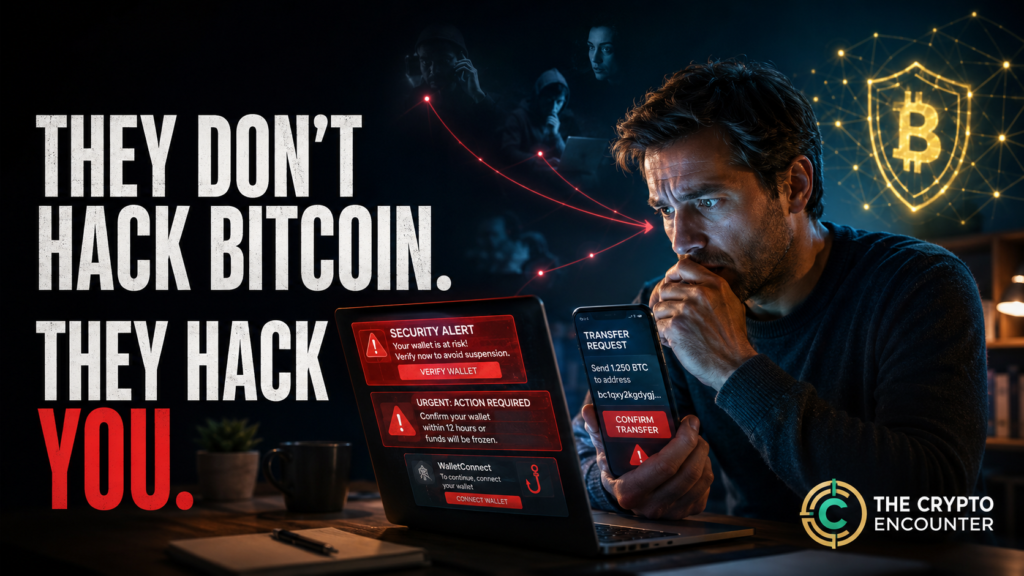
Bitcoin’s network may be highly secure, but criminals rarely need to break its cryptography. Manipulating a person, compromising a device, stealing a password, or creating a convincing fake platform is usually much easier.
TL;DR
- Bitcoin’s protocol has strong cryptographic security, but that protection does not automatically cover every wallet, exchange, device, application, or user.
- Most crypto theft begins outside the blockchain through phishing, impersonation, malware, fake investments, stolen credentials, and social engineering.
- A technically valid Bitcoin transaction can still result from fraud or manipulation.
- Anyone who obtains a private key or recovery phrase may be able to control the associated crypto assets.
- Scammers frequently exploit urgency, fear, trust, greed, authority, affection, and confusion.
- Unique passwords, strong multifactor authentication, verified links, offline recovery backups, and test transactions can reduce exposure.
- Victims should act quickly, preserve evidence, protect their remaining assets, contact relevant platforms, and report the incident.
- Recovery scammers often target people who have already lost money.
Crypto Security at a Glance
| Security layer | What it protects | What can still go wrong |
|---|---|---|
| Bitcoin protocol | Transaction validation and ledger integrity | It cannot detect deception, coercion, or buyer’s remorse |
| Private key | Authority to spend funds | It can be stolen, exposed, or voluntarily surrendered |
| Wallet application | Access to and use of private keys | It may be fake, compromised, or poorly secured |
| Exchange account | Custodial access and trading activity | Credentials may be phished or the platform breached |
| User device | Wallets, passwords, and communications | Malware or remote-access software may expose sensitive information |
| Human judgment | Decisions about links, people, and payments | Fear, trust, excitement, and urgency can influence authorization |
| Recovery process | Restoration after loss or device failure | Fake recovery agents may target previous victims |
The Biggest Misunderstanding About Bitcoin Security
“Can Bitcoin be hacked?” sounds like a simple question. The answer depends on what someone means by Bitcoin.
Bitcoin can refer to the underlying network, coins held in a wallet, an exchange balance, a wallet application, or the broader industry of trading and investment services. These components do not share the same security model.
The Bitcoin network uses cryptography, decentralized transaction verification, mining, and consensus rules to maintain a public ledger. An attacker attempting to rewrite confirmed transaction history would face enormous technical and financial barriers.
A criminal who wants one person’s bitcoin has much easier options.
They can send a fake security alert, impersonate an exchange employee, create a fraudulent investment website, infect a computer, steal an email account, replace a copied wallet address, or convince the owner to disclose a recovery phrase.
In each case, the criminal attacks the person or the infrastructure surrounding that person. Bitcoin’s core cryptography may remain intact throughout the theft.
This distinction matters because people often interpret “Bitcoin is secure” as “my bitcoin cannot be stolen.” The first statement concerns a protocol. The second depends on custody, software, devices, accounts, and every decision made before a transaction.
Readers who want a wider examination of these layers can explore our detailed guide to cryptocurrency security, wallets, exchanges, and decentralized finance.
The safest vault in the world offers limited protection when its owner gives a convincing stranger the key.
The Network Verifies Authorization, Not Intention
Bitcoin nodes examine whether a transaction follows the network’s technical rules. They verify whether the sender has provided the required cryptographic authorization.
The network does not know what happened before that authorization appeared.
It cannot determine whether:
- A caller frightened someone into moving funds.
- A criminal posed as an exchange employee.
- The recipient promised an investment that never existed.
- Malware replaced the intended wallet address.
- A fake website captured the victim’s credentials.
- A family member sent money under emotional pressure.
- The owner misunderstood the transaction.
- A thief obtained the private key.
If the transaction satisfies the protocol’s rules, the network can process it.
This is one reason cryptocurrency fraud can be so damaging. A payment created through manipulation may look technically identical to a legitimate transfer. Both carry valid authorization.
Traditional financial institutions may pause unusual transactions, investigate disputed payments, or reverse certain charges. Bitcoin has no universal customer-service department with the authority to undo confirmed transfers.
The network may function exactly as designed while the victim loses money because of deception that occurred before the transaction reached it.
Plain-English Definitions Every Crypto User Needs
Public address
A public address is a destination that can receive cryptocurrency. It resembles an account number because another person can use it to send funds.
Sharing a public address does not reveal the private key. However, Bitcoin’s ledger is public, so an address can expose transaction history and may eventually become connected to its owner’s identity.
Private key
A private key is a secret cryptographic credential that authorizes spending from an associated address.
Anyone who controls the relevant private key may be able to transfer the funds. Unlike a conventional bank password, the key may have no central recovery department behind it.
Seed phrase or recovery phrase
A recovery phrase is a sequence of words used by many wallets to restore access to a collection of accounts.
It should be treated as a master key. Someone who obtains the phrase may be able to recreate the wallet elsewhere, even without knowing the password used to unlock the original device.
Wallet password
A wallet password may unlock an application or encrypt wallet information on a particular device.
It does not necessarily replace the underlying private keys or recovery phrase. Changing the application password after the recovery phrase has been stolen may fail to stop the thief.
Self-custody
Self-custody means the user directly controls the keys associated with the assets.
This provides greater financial independence, but responsibility for backups, recovery, security, and transaction accuracy also moves to the owner.
Custodial exchange
A custodial exchange holds assets and manages private keys on behalf of customers.
Users can often reset forgotten passwords through the exchange. However, the account remains exposed to phishing, credential theft, platform failure, withdrawal restrictions, security breaches, and internal abuse.
Why Criminals Prefer People Over Cryptography
Security is partly an economic contest. Criminals generally select the cheapest method that produces the desired result.
Breaking the cryptography supporting a mature blockchain would require rare expertise, substantial computing resources, and the ability to overcome a global network. Sending thousands of phishing messages costs considerably less.
A scammer does not need every recipient to respond. A small percentage of successful targets can make the campaign profitable, particularly when criminals identify people holding meaningful savings.
Human attacks also scale effectively. Criminal organizations can reuse:
- Fake exchange websites
- Fraudulent advertisements
- Stolen identity documents
- Customer-support impersonation scripts
- AI-generated profile photographs
- Deepfake videos
- Fake trading dashboards
- Wallet-draining software
- Lists of previous fraud victims
The scale of the damage appears in official reporting. The FBI’s 2025 Internet Crime Report recorded $7.2 billion in reported U.S. losses from cryptocurrency investment fraud alone.
Reported losses still provide an incomplete picture. Some victims remain silent because they feel embarrassed, fear legal trouble, misunderstand what happened, or believe reporting will make no difference.
The broader public conversation should therefore move beyond whether Bitcoin’s code is secure. The practical question is whether the entire path between the user’s decision and the final transaction can withstand manipulation.
Eight Ways Hackers and Scammers Target People
1. Fake Exchange Security Alerts
A text message, email, or phone call claims that someone has accessed the victim’s exchange account.
The message creates urgency by mentioning a suspicious withdrawal, password reset, or login from another country. A link directs the victim to a page that closely copies the exchange’s official website.
The victim enters a username, password, and multifactor authentication code. The criminal uses those details immediately on the genuine platform.
More sophisticated scammers remain on the phone while the theft happens. They sound patient and professional, address the victim by name, and describe familiar security procedures. The victim feels protected while unknowingly helping the attacker bypass each safeguard.
An alert that looks genuine still requires independent verification. Open the official application directly or use a trusted bookmark. Avoid entering credentials through a link delivered in an unexpected message.
2. Seed Phrase Theft
A fake wallet website, browser extension, technical-support agent, or airdrop page asks the user to “verify,” “synchronize,” or “restore” a wallet.
The requested information is the recovery phrase.
Once the victim enters those words, the criminal can recreate the wallet and transfer the assets. No legitimate maintenance process requires a support agent to view the phrase.
Recovery phrases can also leak without direct deception. People photograph them, email them to themselves, place them in cloud storage, or save them in ordinary notes applications. Malware and compromised browser extensions can search for these digital copies.
The opposite danger also exists. Someone who loses the only accurate backup may permanently lose access after a device failure.
The recovery phrase must remain private while still being recoverable by its rightful owner. That balance is one of self-custody’s most demanding responsibilities.
3. Fake Investment Platforms
A fraudulent investment platform may look more professional than many legitimate financial websites.
It can display charts, live prices, account statements, transaction records, customer support, and steadily rising profits. None of these visual elements proves that genuine trading is taking place.
The victim sends real cryptocurrency to an address controlled by the scammer. The website then displays an invented balance.
Some operations permit a small early withdrawal. That payment becomes powerful evidence in the victim’s mind. Once trust develops, the scammer encourages larger deposits.
Trouble begins when the victim attempts to withdraw a meaningful amount. The platform demands a tax, compliance deposit, insurance fee, liquidity charge, or account upgrade. Each additional payment expands the loss.
The Federal Trade Commission’s cryptocurrency scam guidance identifies guaranteed profits, unexpected crypto demands, fake investment managers, and impersonation as major warning signs.
A successful small withdrawal proves only that the operator returned some money. It does not prove that the platform invested anything.
4. Relationship-Based Financial Manipulation
The first message may have no apparent connection to cryptocurrency.
It can begin through a dating application, professional network, social platform, or supposed wrong-number text. The stranger appears friendly, patient, and attentive.
Over time, the conversation becomes personal. The scammer discusses work, family, travel, or plans for the future. Cryptocurrency enters the conversation later through a story about successful trading or a relative with special market knowledge.
By the time money is mentioned, the victim feels they are dealing with a trusted person instead of a financial promoter.
This approach exploits affection and emotional commitment. Victims may reject warnings from family members because accepting the truth would mean losing both their savings and the relationship they believed was genuine.
5. Impersonation and Fake Authority
Criminals pretend to represent exchanges, banks, tax departments, law-enforcement agencies, wallet companies, celebrities, project founders, or government departments.
The stories vary, but the instruction remains familiar: send cryptocurrency immediately.
Funds may supposedly need to move into a secure wallet. A tax must be paid to avoid arrest. A relative requires emergency assistance. An exchange needs a payment to protect the account.
Authority shortens the victim’s decision-making process. People may hesitate to challenge someone who sounds official or appears to know personal information.
End the conversation and contact the organization through a separately verified phone number, website, or application.
6. Malware and Compromised Devices
Sometimes attackers use code, but the target is the user’s phone or computer rather than Bitcoin’s network.
Malware can:
- Record keystrokes
- Capture screenshots
- Read clipboard contents
- Steal browser cookies
- Search files for wallet backups
- Install remote-access tools
- Replace copied wallet addresses
- Redirect users to fake websites
- Extract passwords from insecure storage
Pirated software, unofficial wallet downloads, fake browser extensions, fraudulent updates, and email attachments are common delivery methods.
A wallet may use strong encryption while running on a compromised device. Once an attacker can observe the screen, control the keyboard, or alter copied information, the owner’s keys and transactions may be exposed.
7. Clipboard Hijacking and Address Substitution
Bitcoin addresses are long, which encourages people to copy and paste them.
Clipboard malware waits for a cryptocurrency address to be copied and replaces it with one controlled by the attacker. If the sender checks only the first or last few characters, the substitution may go unnoticed.
A related technique uses transaction history. The criminal sends a tiny amount from a lookalike address so it appears among the victim’s previous transactions. The victim later copies the deceptive address from that history.
Before sending a meaningful amount, verify the complete address through a trusted source. A small test transaction can confirm the destination, although the address should be checked again before sending the remainder.
8. Recovery Scams
A victim who has already lost money becomes an attractive target.
Fraudsters search social media posts, complaint forums, and public comment sections for people requesting assistance. They claim to be investigators, ethical hackers, lawyers, blockchain specialists, or government recovery agents.
The promise is simple: the stolen funds can be recovered after the victim pays an upfront fee.
Once paid, the supposed investigator invents another expense. A tracing fee, court charge, release tax, or wallet activation payment follows. Some criminals request the recovery phrase and steal whatever remains.
Blockchain investigators can trace activity across public ledgers. Exchanges and law-enforcement agencies may freeze or seize funds in specific circumstances. None of this supports a guaranteed private recovery service.
The Psychological Buttons Scammers Press
Technical knowledge helps, but it cannot fully protect someone whose emotions have been captured.
Scammers deliberately create situations that weaken careful judgment:
- Urgency: “Your account will be emptied within ten minutes.” Pressure prevents independent verification.
- Fear: “Your wallet is connected to criminal activity.” Fear makes immediate compliance feel safer.
- Greed: “This automated system earns 3% every day.” Extraordinary profits distract from missing evidence.
- Authority: “I am calling from the fraud department.” Official language and copied branding create credibility.
- Affection: “I want us to build our future together.” Emotional trust weakens normal financial caution.
- Scarcity: “This private opportunity closes tonight.” The victim receives no time to investigate.
- Social proof: Fake screenshots and fabricated testimonials create the appearance of widespread success.
- Sunk cost: Another payment feels easier than accepting the original loss.
- Secrecy: The victim is told that relatives, banks, or advisers will interfere with the opportunity.
Education cannot eliminate these vulnerabilities. Experienced traders, executives, engineers, retirees, and digitally confident young adults can all become victims. The criminal simply adjusts the approach to the individual.
Good security depends on procedures that continue working when someone feels frightened, excited, lonely, tired, or under pressure.
A Practical Crypto Safety System
Before Buying or Holding Bitcoin
- Understand custody. Know whether the bitcoin sits in a self-custody wallet or an account controlled by an exchange.
- Secure the connected email account. An attacker controlling the email may be able to reset exchange credentials.
- Use unique passwords. Never reuse an exchange password on another service.
- Enable strong multifactor authentication. An authenticator application or hardware security key generally offers stronger protection than SMS alone.
- Protect recovery information offline. Never photograph, email, upload, disclose, or type a seed phrase into an unsolicited website.
- Keep software updated. Install operating-system, browser, wallet, and security updates through official sources.
- Remove unnecessary extensions. Every browser extension creates another potential access point.
- Avoid pirated software. Modified applications are a common route for credential-stealing malware.
- Learn with small amounts. Practice receiving, sending, backing up, and recovering a wallet before storing serious value.
- Separate savings from spending. Keep long-term holdings away from wallets used for frequent activity.
Before Sending a Transaction
Pause and answer these questions:
- Who requested this payment?
- Was the contact unexpected?
- Is someone rushing or frightening me?
- Have I verified the person through a separate channel?
- Did I obtain the address from a trusted source?
- Have I checked the complete address?
- Could malware have changed the copied address?
- Am I sending the asset over the correct network?
- Does the recipient support that asset and network?
- Can I send a small test amount first?
- Have I confirmed that the test arrived?
- What happens if the payment cannot be reversed?
- Would I still send it after waiting 30 minutes?
A legitimate opportunity can usually survive basic verification. A scammer will often try to prevent it.
When Someone Claims to Be Support
- End the incoming call or chat.
- Open the official application or bookmarked website yourself.
- Locate the support channel independently.
- Never disclose a password, authentication code, private key, or recovery phrase.
- Reject requests to install remote-access software.
- Never move funds to a “safe wallet” provided by the caller.
- Request a case number and verify it through the official channel.
When Using DeFi Applications
Wallet activity becomes more complex when users enter decentralized lending, trading, yield, and collateral markets. Our coverage of Kraken’s interest in Aave and the expansion of DeFi credit markets shows how quickly these financial products are evolving.
Before interacting with a DeFi application:
- Navigate through a verified bookmark.
- Check the complete domain name.
- Research the project, operating history, contracts, and audits.
- Treat an audit as supporting evidence rather than a guarantee.
- Reject permissions that exceed the intended action.
- Limit token allowances when possible.
- Review and revoke old approvals regularly.
- Keep valuable holdings in a separate wallet.
- Read every wallet prompt before confirming it.
Even advanced infrastructure requires careful user authorization. The emergence of confidential DeFi products on Ethereum may improve privacy, but encryption cannot protect someone who grants a malicious contract permission to move assets.
When Evaluating a Crypto Investment
Look for evidence outside the promoter’s website.
Research the company’s registration, regulatory status, named leadership, legal jurisdiction, custody arrangements, withdrawal rules, revenue model, wallet addresses, independent reporting, ownership concentration, and user complaints.
Professional design carries limited evidentiary value. Criminals can produce polished websites, artificial trading results, fake media coverage, fabricated endorsements, and convincing support departments.
Guaranteed returns deserve immediate suspicion. Fixed daily profits, private trading professors, secret mining packages, and demands for further payments before processing a withdrawal are established warning signs.
Regulatory status can also affect the protections available to users. Our analysis of how crypto regulation is becoming a major market filter explains why licensing, jurisdiction, custody, and compliance structures deserve close attention.
What to Do After a Scam or Suspected Theft
Speed matters, but another rushed decision can make the situation worse.
1. Stop All Payments
Do not send another tax, recovery fee, verification deposit, or unlocking charge. A request for additional money usually indicates that the theft is continuing.
2. Preserve the Evidence
Save the following information:
- Transaction IDs
- Wallet addresses
- Screenshots
- Website addresses
- Emails and headers
- Phone numbers
- Usernames
- Advertisements
- Payment receipts
- Chat histories
- Dates and times
- Names used by the suspects
Keep original files whenever possible.
3. Protect the Remaining Assets
If a private key or recovery phrase was exposed, treat the wallet as compromised. Create a new wallet on a clean, trusted device and carefully transfer the unaffected assets.
Never reuse the compromised recovery phrase.
Change the passwords for affected exchange, email, cloud, and social accounts. Remove unknown devices and active sessions, then strengthen multifactor authentication.
4. Contact Relevant Exchanges
If the funds reached a centralized exchange, contact its official fraud or compliance department quickly. Provide the transaction details and any available law-enforcement report.
The exchange may be able to flag or freeze an account under its policies and legal obligations. Success is never guaranteed, but delays can reduce the chance of intervention.
5. Report the Crime
Contact local law enforcement and the appropriate national cybercrime, financial, or consumer-protection authority.
Reporting helps investigators connect wallet addresses, domains, identities, bank accounts, and criminal networks. A single complaint may contain evidence relevant to many victims.
6. Warn Affected Contacts
If the attacker accessed an email or social account, inform anyone who might receive fraudulent messages from it.
7. Prepare for Recovery Scammers
Do not trust unsolicited offers to retrieve the funds. Never provide wallet access or pay cryptocurrency in advance for a guaranteed recovery.
Bitcoin’s Wider Market Role Does Not Remove Personal Risk
Bitcoin has developed into a major global asset influenced by institutional flows, monetary policy, regulation, and investor sentiment.
Its relationship with traditional finance can be seen in the way Bitcoin reacts to Federal Reserve policy and global liquidity. Growing institutional involvement can improve access and market depth, but it does not remove the security responsibilities facing ordinary users.
Even governments and major institutions must manage custody and transfer risks. Bhutan’s reported transfer of sovereign Bitcoin to an exchange raised broader questions about sovereign Bitcoin custody and treasury management.
The size or sophistication of the holder changes the controls required. It does not eliminate the need to verify addresses, protect credentials, separate responsibilities, and prepare for human error.
Readers can follow further security reporting and public-facing crypto analysis through The Crypto Encounter.
The Final Word
Bitcoin’s security protects the integrity of its ledger. It cannot protect people from every lie told before a transaction enters that ledger.
The network cannot recognize a fake romantic relationship, copied exchange website, frightened retiree, fabricated profit dashboard, or criminal pretending to be customer support. It receives cryptographic instructions and processes valid transactions according to established rules.
That design gives Bitcoin valuable properties. Users can transfer value without requesting permission from a bank. Confirmed transactions become extremely difficult to alter. Holders can control assets directly through their private keys.
Greater control brings greater personal responsibility.
Crypto safety begins with the device someone uses, the link they open, the address they verify, the recovery phrase they protect, and the pressure they refuse to accept. A deliberate pause can sometimes provide more protection than another security application.
Hackers may understand code, but many of their most profitable weapons are deeply human: fear, trust, hope, loneliness, ambition, and confusion.
Bitcoin does not need to fail for a person to lose everything. One manipulated decision can be enough.
Frequently Asked Questions
Can hackers break into Bitcoin itself?
A direct attack against Bitcoin’s underlying network would be extremely difficult and expensive. Most criminals target wallets, exchanges, devices, passwords, private keys, and users. Reports that “Bitcoin was hacked” frequently describe a failure in the surrounding infrastructure rather than the protocol.
Can someone steal bitcoin without obtaining the seed phrase?
Yes. A criminal might compromise an exchange account, steal a private key, infect a device, replace a receiving address, or convince the owner to authorize the transfer. Protecting the recovery phrase is essential, but it represents only one part of security.
Is it safe to share a Bitcoin address?
A public address is designed to receive funds, and sharing it does not reveal the private key. However, its transactions may be publicly visible. Publishing an address can connect balances and financial activity to the owner’s identity.
Will legitimate wallet support ask for a recovery phrase?
No legitimate support agent needs the recovery phrase. Anyone requesting it should be treated as a potential thief. End the conversation and contact the provider through its verified website or application.
Can a confirmed Bitcoin transaction be reversed?
Confirmed Bitcoin transactions generally lack bank-style chargebacks. The recipient can voluntarily return the money, while authorities or exchanges may sometimes intervene when funds pass through centralized services. Senders should assume that a completed transfer will be final.
Does a small successful withdrawal prove an investment platform is genuine?
No. Fraudulent platforms sometimes permit small withdrawals to build confidence before encouraging much larger deposits. Independent verification matters more than an early payment.
Should I send a test transaction?
A small test transfer can reduce the risk of sending a large amount to an incorrect address or unsupported destination. Confirm its arrival and recheck the address before sending the remaining balance.
Can stolen cryptocurrency be traced?
Activity on public blockchains can often be traced. Investigators may follow funds through multiple addresses and identify connections to centralized services. Tracing does not guarantee recovery.
What should I do if I entered my recovery phrase on a website?
Assume the wallet is compromised. Using a clean device, create a new wallet with a new recovery phrase and move the remaining assets carefully. Never reuse the exposed phrase or request help through an unverified channel.
Are hardware wallets completely safe?
Hardware wallets can reduce exposure by keeping private keys away from ordinary internet-connected environments, but they cannot prevent every loss. Users can still disclose the recovery phrase, approve a fraudulent transaction, use compromised software, or send funds directly to a scammer.