


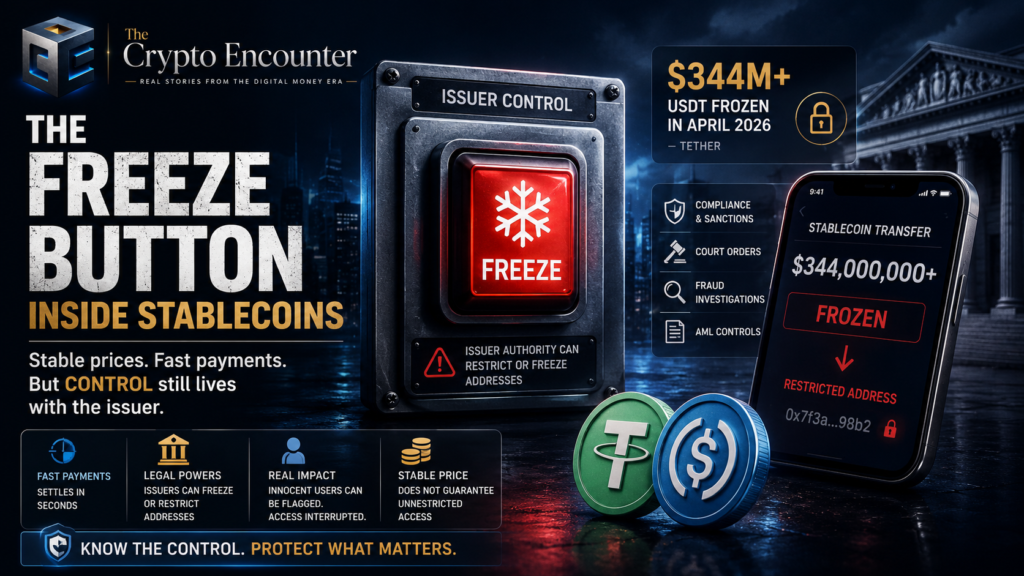
Crypto payments can look almost like cash when a stablecoin stays near $1 and moves across a blockchain in seconds. Yet the code behind that payment may contain a stablecoin freezing control that many users never consider: the issuer can restrict certain addresses or stop tokens from moving. That is the stablecoin freeze mechanism.
It can support sanctions enforcement and fraud investigations, but it also means a token used as digital money is not always independent of its issuer. The Crypto Encounter puts this overlooked control alongside the broader security questions readers should understand before relying on crypto for everyday payments.
What Is a Stablecoin Freeze?
A stablecoin freeze means an issuer blocks, restricts, or otherwise prevents specific tokens or addresses from being transferred or redeemed. The exact method depends on the stablecoin and blockchain. Centralized stablecoins can include administrative controls over their token contracts or redemption systems.
Circle’s current USDC terms say it may block certain addresses and freeze associated USDC in specified circumstances, including suspected prohibited activity or a valid government order. Tether’s current terms likewise allow it to freeze Tether Tokens where required by law or where its rules permit such action.
Why the Stablecoin Freeze Mechanism Exists
The stablecoin freeze mechanism exists partly because stablecoins operate close to regulated financial infrastructure. Issuers may need to respond to sanctions, court orders, fraud investigations, anti-money-laundering controls, and other legal obligations. The Financial Action Task Force’s updated guidance on virtual assets and VASPs specifically addresses how its anti-money-laundering and counter-terrorist-financing standards apply to stablecoins.
There are documented examples. In April 2026, Tether said it supported U.S. authorities in freezing more than $344 million in USDT across two addresses connected to unlawful conduct. Circle also states that USDC can be frozen in response to certain compliance concerns or valid government orders.
This control can help stop suspected illicit funds from moving. But it creates a trade-off for ordinary users. If an address is incorrectly flagged, receives funds connected to a risky address, or becomes subject to legal proceedings, access may be interrupted.
Stablecoin Freezing Can Affect Everyday Payments
Consider a worker sending $500 in stablecoins to family overseas. The transfer may arrive quickly, but the recipient still depends on an exchange, wallet provider, bank, or issuer to convert and use that value. If compliance screening flags the destination or transaction, the recipient may face a review, delay, or stablecoin freezing.
That matters because stablecoin freezing is increasingly relevant to payment and remittance tools. The BIS says stablecoins may support faster, programmable payments, while also raising concerns about redemption, financial stability, and financial integrity.
Stablecoin freezing risk can also differ between native and bridged tokens. Circle’s terms for bridged USDC explain that Circle may not control the bridge contract in the same way it controls native USDC. Users therefore need to identify the exact token they hold, who controls it, and how redemption works.
The Freeze Button Is Only One Layer of Risk
Stablecoin freezing is only one layer of risk. Reserves, liquidity, operational systems, and legal terms can also affect access and redemption.
The Financial Stability Board recommends clear redemption rights, stabilization mechanisms, and prudential requirements for global stablecoin arrangements. The BIS similarly emphasizes reserve quality and liquidity because large redemptions can test an issuer’s ability to maintain value.
So a stablecoin can remain near its intended price in normal conditions while still carrying issuer, redemption, compliance, custody, and operational risks.
What Users Should Check Before Sending Stablecoins
Users should ask a few practical questions.
Who issued the token? A centralized issuer may have blacklist or freeze powers.
Which blockchain and token version am I using? Native and bridged versions can have different controls and redemption arrangements.
What happens if my address is flagged? Read the issuer’s current terms before relying on a stablecoin for essential payments.
How does redemption work? A $1 market price alone does not guarantee immediate redemption for one dollar.
What protections apply where I live? Rules and consumer protections vary by jurisdiction.
Can I access funds without an intermediary? Self-custody changes wallet control, but may not remove issuer-level restrictions.
Stablecoin Freeze Risk Does Not Make Stablecoins Useless
The point is not that stablecoins are automatically unsafe. Their speed and programmability can make them useful for payments. We need to understand what kind of money people hold.
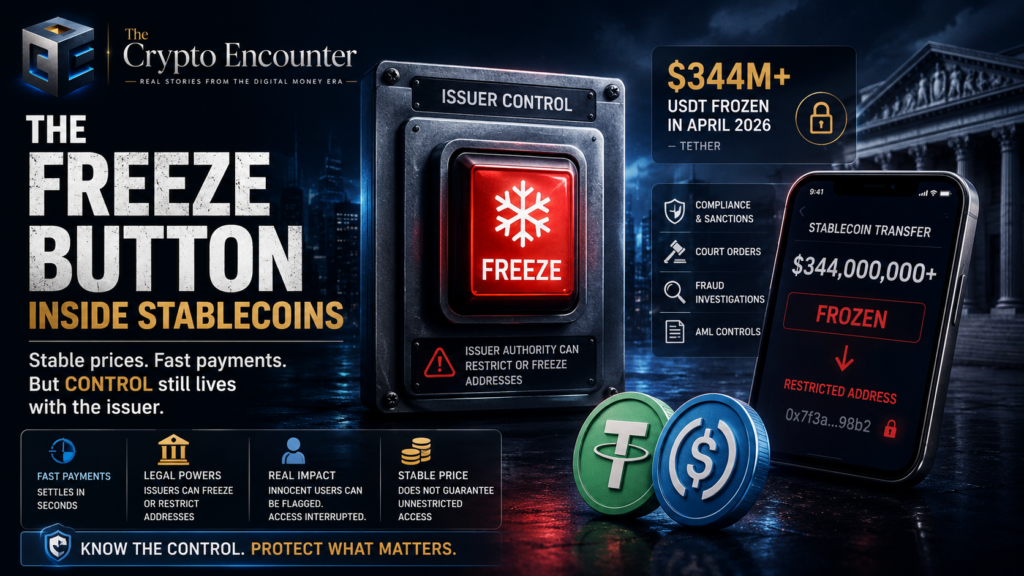
A bank deposit, cash balance, stablecoin, and tokenized asset can all represent dollar value while giving the holder different legal rights and technical controls. For a broader look at how regulation can shape crypto products and user protections, read How Crypto Regulation Is Becoming the Market’s Next Big Filter. The word “stable” describes an intended price relationship, not every condition surrounding access.
Conclusion
The real lesson behind stablecoin freeze risk is simple: blockchain settlement does not automatically mean unrestricted access. Issuers can have powers above the transaction layer, while reserves, redemption rules, compliance systems, and intermediaries can add further conditions.
For users, informed use means checking the issuer, token version, redemption process, jurisdictional rules, and freeze provisions before sending money a household or business genuinely needs. Stablecoins may make payments faster, but understanding their controls is part of understanding the payment itself.
FAQs
Can an issuer freeze a stablecoin?
Yes. Some centralized issuers can restrict addresses or tokens under stated conditions.
Does a freeze reverse a transaction?
No. Regulators may restrict the token while the transaction remains recorded.
Are stablecoins protected like bank deposits?
Do not assume so. Protection depends on issuer and jurisdiction.
Can stablecoin freezing affect remittances?
Yes. Compliance reviews can delay access or redemption.
What should users check?
Review issuer terms, token version, redemption rules, reserves, and protections.
Disclaimer
This article is for general educational and informational purposes only and does not constitute financial, investment, legal, tax, or payment advice. Stablecoins involve issuer, reserve, redemption, liquidity, compliance, technical, custody, and regulatory risks. Price stability does not guarantee access, redemption, or protection from loss. Rules and issuer policies can change. Review current official terms and applicable laws, and seek qualified professional advice before making decisions involving digital assets or payments when funds are needed for essential household or business expenses.