


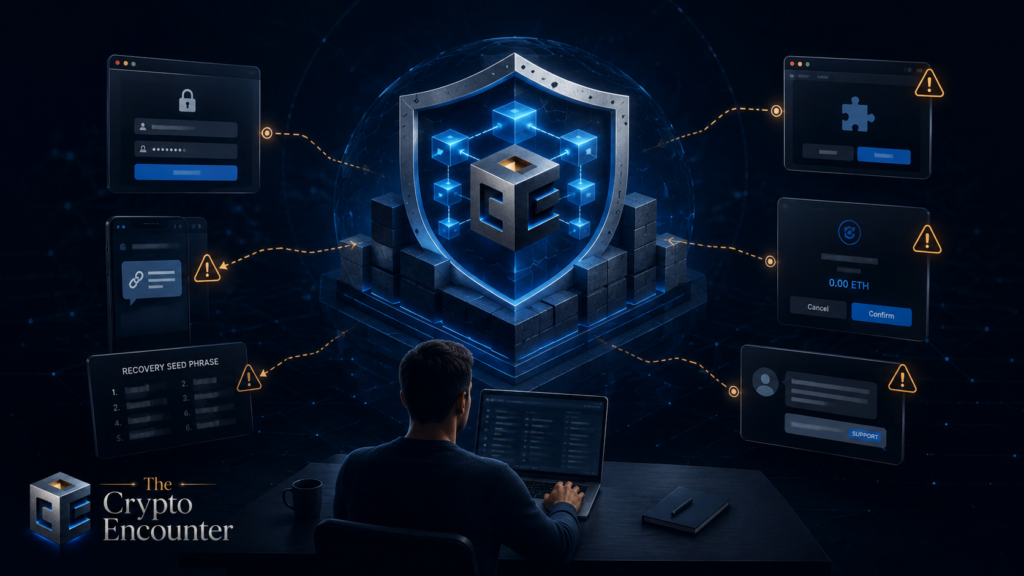
A blockchain can work exactly as designed while the person using it loses everything. That contradiction sits at the center of crypto security. Networks protect transaction records, but crypto security protections do not stop a user from entering a seed phrase into a fake website, approving a harmful wallet request, installing fraudulent software, or sending funds to an impersonator.
The gap between experts and ordinary users is not simply a gap in intelligence. It is a gap in crypto security systems, habits, and expectations. Experienced users treat crypto security as a chain of protections across wallets, devices, accounts, applications, and behavior. Beginners are often handed irreversible financial tools without being shown how one weak link can defeat every other safeguard.
This crypto security guide explains the gap, common scams, and practical safeguards.
Key Takeaways
- Strong blockchain protection does not automatically create strong crypto security for the individual.
- Most consumer scams target trust, devices, passwords, recovery phrases, or wallet permissions rather than blockchain cryptography.
- Experienced users separate funds and limit exposure because they assume mistakes will happen.
- A hardware wallet can improve crypto security, but it cannot protect someone who reveals a recovery phrase or approves a deceptive transaction.
- Safer products and clearer interfaces are necessary because education alone cannot close the gap.
The Crypto Security Paradox
People hear that Bitcoin or Ethereum is secure and may assume every interaction involving those networks must also be safe. That assumption confuses protocol protection with personal crypto security.
A blockchain checks whether a transaction follows network rules and carries a valid digital signature. It cannot know whether the person signing was frightened by a fake support agent, deceived by a copied website, or confused by an unclear approval screen. A transaction can therefore be technically valid and personally disastrous. Bitcoin and Ethereum transactions rely on private-key signatures to prove authorization, but a valid signature cannot reveal whether deception influenced the person approving it.
This is why crypto security cannot stop at the protocol layer. The network may record an instruction correctly even though the user never understood what it allowed. Effective crypto security must protect both the transaction system and the decisions leading to a transaction.
Our broader guide to what cryptocurrency security really protects explains why strong cryptography cannot remove wallet, exchange, application, and human risks
Bitcoin payments also illustrate why user decisions matter. Once confirmed, a Bitcoin transaction cannot be unilaterally reversed by the sender. A refund depends on the recipient returning the funds. That finality can be useful, but it leaves little room to correct fraud or an address mistake.
Five Layers of Crypto Security
| Layer | What it protects | Common failure |
|---|---|---|
| Blockchain | Transaction history and network rules | Protocol weaknesses or network attacks |
| Wallet | Private keys, seed phrases, and transaction signing | Seed phrase theft, malicious approvals, or unsafe backups |
| Device | Phone, computer, browser, wallet app, and extensions | Malware, fake apps, harmful extensions, or outdated software |
| Account | Email, exchange login, phone number, and recovery channels | Password theft, phishing, SIM swapping, or account recovery abuse |
| Human decision | Choices involving links, permissions, payments, and trust | Urgency, fear, greed, impersonation, or confusion |
Reliable crypto security depends on all five layers working together. A strong network cannot compensate for a stolen recovery phrase. A hardware device cannot compensate for confirming an attacker’s address. Multifactor authentication cannot protect an exchange account if its recovery email is already compromised.

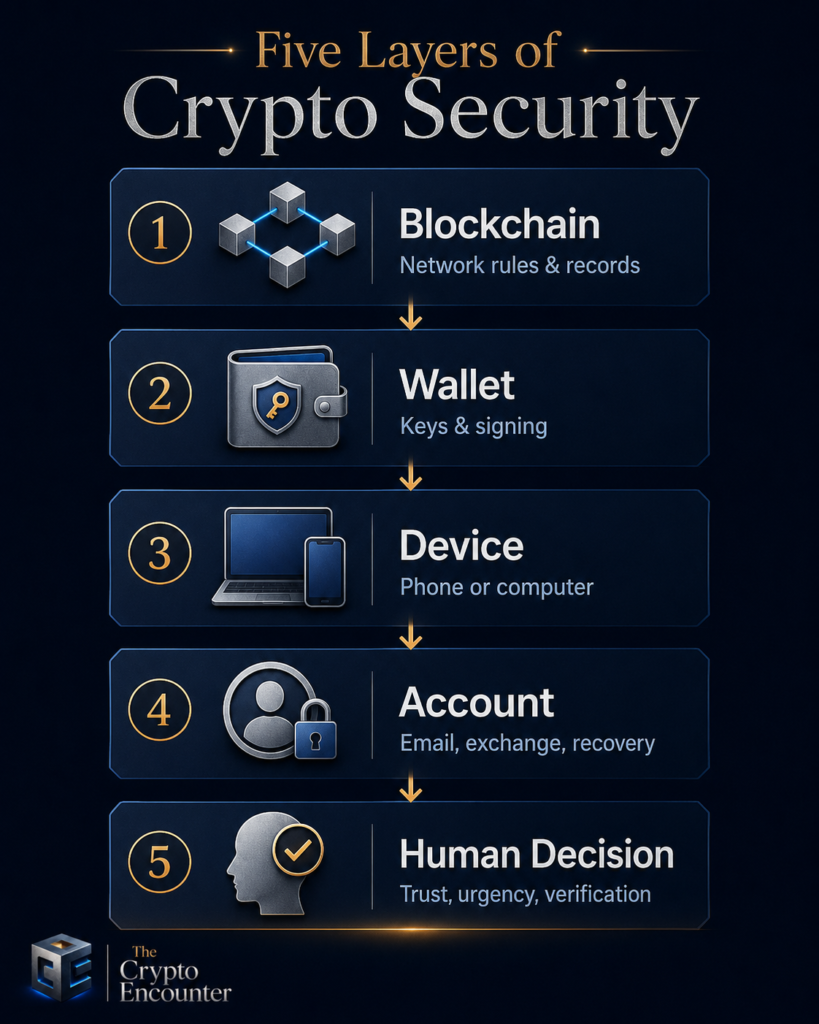
Experts understand that no single product solves crypto security. They combine controls so that a failure in one layer does not become a total loss. This approach makes crypto security a system rather than a product purchase.
Plain-English Definitions Every User Should Know
Private key: A secret value that authorizes transactions. Whoever controls it can generally control the associated assets.
Seed phrase: A list of words used to restore access to a wallet and its private keys. It should never be shared with support staff, entered into an unsolicited website, or stored in an ordinary cloud note.
Self-custody: Managing your own wallet keys instead of relying on an exchange or another custodian.
Hot wallet: A wallet used on an internet-connected device for frequent activity.
Cold wallet: A setup designed to keep signing keys away from routine online activity.
Phishing: A deceptive message, page, call, or application designed to steal information or trigger a harmful action.
Token approval: Permission allowing a smart contract to access a specified token balance.
Social engineering: Manipulating someone through trust, urgency, fear, greed, or authority rather than breaking cryptography.
These terms form the basic language of crypto security. Clear definitions matter because users cannot protect controls they do not understand. A person who cannot distinguish a wallet password from a seed phrase may misunderstand which secret actually controls the funds.
Ethereum’s wallet guidance explains that a seed phrase can restore a wallet and should be written down and stored safely rather than kept on a computer. It also warns that transactions cannot easily be reversed.
Why Criminals Target Users Instead of Blockchains
Attacking people is often cheaper than attacking a major network. Breaking mature cryptography may require enormous resources. Creating a copied login page, impersonating customer support, or building trust through messages can be far easier.
The FBI’s 2025 Internet Crime Report recorded 181,565 cryptocurrency-related complaints and approximately $11.37 billion in reported losses. Those figures represent reported complaints and should not be read as a complete global measure of crypto-related crime.
For criminals, the weakest point in crypto security may be a recovery email, browser session, cloud note, phone number, or rushed decision. Practical crypto security must therefore protect the systems surrounding the wallet, not only the wallet itself.
Attackers commonly try to obtain one of four things:
- A secret, such as a password, private key, or seed phrase
- A permission, such as a token approval
- Account control, through email compromise or SIM swapping
- The victim’s voluntary cooperation in sending funds
SIM swapping shows how an apparently separate service can affect crypto security. The Federal Communications Commission defines SIM swapping as the hijacking of a mobile number so an attacker can receive the victim’s calls and texts, potentially including account-recovery codes.
How Human Behavior Becomes a Vulnerability
Many scams use the same behavioral sequence:
- Create urgency.
- Establish authority or trust.
- Narrow the victim’s attention.
- Demand an irreversible action.
- Prevent independent verification.
A caller may say funds must be moved to a “safe” wallet. A fake investment dashboard may display profits and demand another payment before withdrawals are released. The Federal Trade Commission warns that scammers may promise guaranteed returns or tell victims to send cryptocurrency to protect their money.
Strong crypto security interrupts this sequence. Behavioral crypto security creates a pause before an irreversible decision. It requires a second check and limits how much one action can expose. Urgency should increase verification, not reduce it.
How a Wallet Drain Can Happen Without a Blockchain Hack
Consider a user who receives a message announcing a limited token claim. The link opens a site resembling the project’s official page. The user connects a wallet and sees a technical approval request. Believing it only confirms eligibility, the user approves it.
The permission actually allows a malicious contract to transfer certain tokens. The attacker later removes them. No seed phrase was revealed, and the blockchain was not broken.
This example shows why transaction literacy is central to crypto security. Wallet prompts are a crypto security control, not a routine formality. Users should verify the requesting domain, question unlimited allowances, and avoid signing requests they cannot explain.
MetaMask advises users to review token approvals and revoke permissions that are unnecessary or potentially harmful. It also explains that disconnecting a wallet from a decentralized application does not automatically remove existing token approvals.
This distinction matters. Disconnecting ends the active interface connection, but an earlier permission may remain recorded on the blockchain. The application or contract may still retain the authority granted through that approval.
What Experts Do Differently
Experts are not protected by perfect judgment. Their advantage comes from containment.
| Experienced practice | Why it matters |
|---|---|
| Separate savings and activity wallets | One risky application cannot reach every asset |
| Keep limited funds in a hot wallet | A compromise produces a smaller loss |
| Use bookmarks for important services | Reduces exposure to copied domains |
| Test unfamiliar transfers with a small amount | Helps detect address or network mistakes |
| Limit and revoke token allowances | Restricts contract access |
| Use unique passwords and stronger authentication | Reduces account-takeover risk |
| Prepare an incident plan | Prevents panic from controlling the response |
This approach turns crypto security into risk management. Mature crypto security assumes human error cannot be eliminated. Experts expect that a device may fail, a website may be copied, an approval may be misunderstood, or a moment of distraction may occur.
Better crypto security uses concrete limits, separate accounts, verified access points, and practiced recovery steps. The goal is preventing one mistake from exposing every asset.
An ordinary user may keep all funds in the same wallet used to explore unfamiliar applications. A more experienced user may keep long-term assets in a separate wallet that rarely interacts with websites. That separation does not prevent every attack, but it limits the amount exposed to one compromised session.
Four Scenarios Users Should Recognize
Fake Customer Support
A user posts publicly that a wallet transfer failed. An account using the project’s logo replies and offers help through a private message. The impersonator sends a “wallet validation” page asking for the recovery phrase.
Legitimate support does not need the phrase that controls the wallet. Any request for it should trigger an immediate crypto security warning. Bitcoin.org similarly warns that legitimate support teams will not ask for a seed phrase or private key.
The attacker does not need to break the wallet software. The victim provides the information required to recreate the wallet somewhere else.
An Account-Protection Call
A caller claims a bank or exchange account is under attack and instructs the user to move funds into cryptocurrency for safekeeping.
The caller may sound professional, know personal details, and use spoofed contact information. None of those signals proves legitimacy. The FTC states that real companies and government agencies will not tell consumers to buy cryptocurrency to solve a problem or protect money.
A Relationship That Becomes an Investment Pitch
A person builds trust through a dating app, professional network, or messaging service. Later, the person introduces a trading platform where the displayed balance rises. Withdrawals eventually require taxes, deposits, or unlocking fees.
The dashboard may be fictional. Healthy crypto security includes skepticism toward platforms introduced through personal relationships, particularly when the other person discourages outside advice.
The scam works because trust develops before the financial request. The victim may interpret caution from friends or financial institutions as interference rather than protection.
A Recovery Scam After the First Loss
After a victim reports stolen funds, another person claims they can recover the assets for an advance fee. The second scam works because the victim is distressed and desperate to reverse the damage.
Incident response is therefore part of crypto security. Users should preserve evidence, contact official services directly, and distrust anyone promising certain recovery in exchange for another payment.
A blockchain investigator or law-enforcement agency may be able to trace transactions, but tracing does not guarantee that funds can be frozen, seized, or returned.
A Practical Crypto Security Checklist
Protect the Seed Phrase
- Keep it offline in a physically secure location.
- Do not store it in ordinary cloud notes, screenshots, email drafts, or chats.
- Never enter it into a website because someone claims the wallet needs verification.
- Treat any exposed recovery phrase as permanently compromised.
- Make sure trusted heirs or emergency contacts can follow a carefully designed recovery plan without exposing the phrase during normal use.
Ethereum warns that anyone with access to a seed phrase may gain access to the assets it protects. Its security research also identifies insecure seed-storage practices, including plaintext and cloud storage, as a continuing user risk.
Protect Accounts and Recovery Channels
- Use unique passwords and a reputable password manager.
- Secure the email linked to exchanges and recovery processes.
- Enable multifactor authentication.
- Prefer passkeys or physical security keys where available.
- Ask the mobile carrier about an account PIN or port-out protection.
- Review which devices and sessions remain logged into important accounts.
- Remove recovery phone numbers or email addresses that are no longer under your control.
These controls strengthen crypto security because attackers frequently enter through accounts surrounding the wallet. Account recovery is part of crypto security even when no wallet application is involved.
CISA recommends strong, unique passwords, password managers, and multifactor authentication to make account takeover more difficult.
Reduce Wallet Exposure
- Use a separate wallet for routine decentralized-application activity.
- Keep long-term holdings away from unfamiliar websites.
- Limit token approvals to the amount required.
- Revoke permissions that are no longer needed.
- Use small test transfers before large payments.
- Confirm the network, asset, amount, and destination.
- Avoid using the same wallet for experimentation and long-term storage.
- Review active connections and permissions periodically.
The purpose of crypto security is not to remove all uncertainty. It is to reduce the number of ways one error can become catastrophic.
Verify Before Acting
- Open important services from bookmarks or verified documentation.
- Read the complete domain instead of trusting a logo.
- Avoid wallet downloads reached through unsolicited messages.
- Verify urgent claims through a separate official channel.
- Never grant remote device access to an unknown support agent.
- Ask another trusted person to review an unusual high-value request.
- Confirm wallet addresses on the signing device where possible.
- Be suspicious when someone tells you not to speak with family, support staff, or a financial institution.
Verification is one of the least glamorous parts of crypto security, but it is also one of the most effective.
What to Do After a Suspected Compromise
- Stop interacting with the suspicious person, website, or application.
- Do not send another fee, tax, deposit, or recovery payment.
- Use a clean device to change affected passwords.
- Revoke suspicious token approvals where appropriate.
- If the seed phrase was exposed, create a new wallet through verified software and move remaining assets carefully.
- Contact the relevant service through its official website or application.
- Save transaction hashes, wallet addresses, domains, emails, phone numbers, and messages.
- Report the incident to the appropriate authority.
In the United States, the FBI’s Internet Crime Complaint Center accepts reports of cyber-enabled fraud and scams. Fast action supports crypto security, but recovery is never guaranteed. A written response plan can make crypto security more effective during a stressful incident.
Users should preserve evidence before deleting messages or resetting affected devices. Transaction hashes and receiving addresses may help investigators or exchanges identify where funds moved, even when the recipient’s real identity is not immediately known.
Better Product Design Must Close the Gap
The responsibility cannot rest entirely on users. Crypto security is also a design responsibility. Wallets, exchanges, and decentralized applications often present complex permissions through interfaces that assume technical knowledge.
Better crypto security design may include:
- Plain-language transaction summaries
- Suspicious-domain warnings
- Limited approvals by default
- Transaction simulation
- Delayed high-value transfers
- Trusted-contact recovery
- Daily spending limits
- Phishing-resistant login methods
- Warnings when an address has never been used before
- Separate permission levels for routine and high-risk actions
Ethereum’s account-abstraction roadmap explains that smart-contract wallets can support more flexible crypto security and recovery features. The Ethereum Foundation has also described spending controls, alternative authentication, and recovery mechanisms as potential account improvements.
No interface can eliminate deception. Still, mainstream crypto security should not require every user to interpret opaque transaction data or understand smart-contract permissions at an expert level.
A well-designed wallet should make the financial consequence of an action clear before the user signs it. A request that can move an unlimited token balance should not look almost identical to a harmless login request.
The Real Difference Between Experts and Ordinary Users
Experts still make mistakes. The difference is that experienced users expect errors and build boundaries around them.
They separate savings from spending. They distrust urgency. They confirm addresses. They protect recovery channels. They use stronger authentication. They assume a familiar logo can be copied and an apparently harmless signature may carry financial consequences.
That mindset is the most transferable lesson in crypto security. Tools work best when users understand what each one protects and what it cannot protect.
A blockchain can be secure while the surrounding experience remains dangerous. Usable crypto security must become the default. Closing the gap requires safer products, clearer explanations, and habits that limit human error. Until those protections become standard, crypto security will remain as much a problem of behavior and design as a problem of cryptography.
Frequently Asked Questions
Is Crypto Security the Same as Blockchain Security?
No. Blockchain security concerns the network and transaction record. Crypto security also includes wallets, devices, accounts, recovery systems, websites, applications, permissions, and user decisions.
Can Crypto Security Prevent Every Scam?
No system can prevent every scam. Strong crypto security reduces exposure, improves verification, and limits how much one mistake can compromise.
Does a Hardware Wallet Guarantee Crypto Security?
No. A hardware wallet can keep private keys away from ordinary internet-connected devices, but it cannot stop a user from sharing the seed phrase, approving a harmful request, or sending funds to an impersonator.
Why Is a Seed Phrase Important to Crypto Security?
The seed phrase can restore access to a wallet and its keys. Anyone who obtains it may be able to control the associated assets, making private offline storage essential.
What Is the Best First Step for Better Crypto Security?
Separate long-term holdings from everyday activity, secure important accounts with unique passwords and strong authentication, and never act on an urgent financial request without independent verification.
Who Is Responsible for Crypto Security?
Responsibility is shared. Users must protect keys and verify actions, while wallet providers, exchanges, developers, and regulators should reduce confusing interfaces, unsafe defaults, misleading services, and preventable consumer risks.
Disclaimer
This article is for informational and educational purposes only. It does not provide financial, investment, legal, tax, or accounting advice. Cryptocurrency and digital asset markets involve risk, including possible loss of capital. Readers should conduct their own research before making any financial decision.