


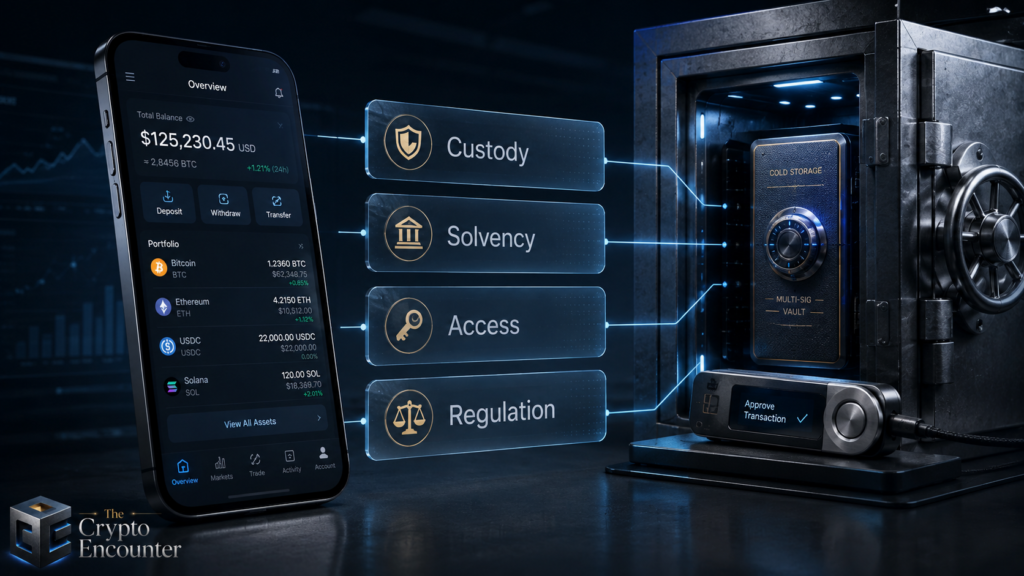
A crypto exchange can show a clean balance while leaving one crucial question unanswered: can you actually move those assets when you need them? That gap sits at the center of exchange token risk. Beginners often treat a number on an exchange screen as proof of direct ownership. However, a centralized platform normally controls the private keys, processes withdrawals, applies account rules, and responds to legal or technical restrictions. Therefore, exchange token risk is not only about whether a coin rises or falls. It also covers custody, solvency, liquidity, regulation, security, and platform control. Understanding those layers can prevent a simple account balance from creating a false sense of certainty.
Key Facts About Exchange Token Risk
| Question | What beginners may assume | What actually matters |
|---|---|---|
| Do I own the token? | The balance proves full control. | Legal title and practical control can differ. |
| Can I withdraw anytime? | A visible balance is always movable. | Withdrawals depend on platform systems, policies, liquidity, and law. |
| Is the crypto insured like bank cash? | A major exchange offers bank-like protection. | Crypto assets generally do not receive FDIC deposit insurance. |
| Does regulation remove the risk? | A regulated platform cannot block access. | Regulation can improve safeguards, but legal and compliance controls can still restrict access. |
| Does self-custody solve everything? | Holding the keys removes all danger. | It removes some intermediary risk while creating personal security and recovery risk. |
The easiest way to understand exchange token risk is to separate ownership, control, and access. Those ideas overlap. However, they are not identical.
Exchange Token Risk Starts With Ownership Versus Control
Suppose you buy 0.2 BTC on a centralized exchange. Your account now displays 0.2 BTC. At first glance, the situation feels straightforward. You bought it, so you control it.
In practice, however, the platform may hold customer crypto in shared wallets while tracking individual entitlements through an internal ledger. The exchange then controls the private keys that can authorize an on-chain transfer. You control an account and can request a withdrawal. Yet the exchange usually signs and broadcasts the blockchain transaction.
Coinbase provides a useful current example. Its U.S. user agreement states that supported digital assets in a customer wallet remain customer property. At the same time, Coinbase retains control of the private keys associated with addresses it operates while those assets remain on its platform. The agreement also makes withdrawals subject to factors including outages, downtime, protocol requirements, processing time, and applicable policies.
That structure creates exchange token risk even when the platform recognizes your legal ownership. In other words, exchange token risk begins before any obvious failure occurs.
Therefore, legal title can remain with a customer while immediate technical control remains with the custodian. That distinction is one of the most important parts of exchange token risk.
For a deeper look at this distinction, read our guide explaining why your exchange balance is not the same as your crypto.
For a deeper explanation of this distinction, The Crypto Encounter’s guide to why your exchange balance is not the same as your crypto examines how internal account records differ from direct private-key control.
Exchange Token Risk Exists Across Four Layers of Access
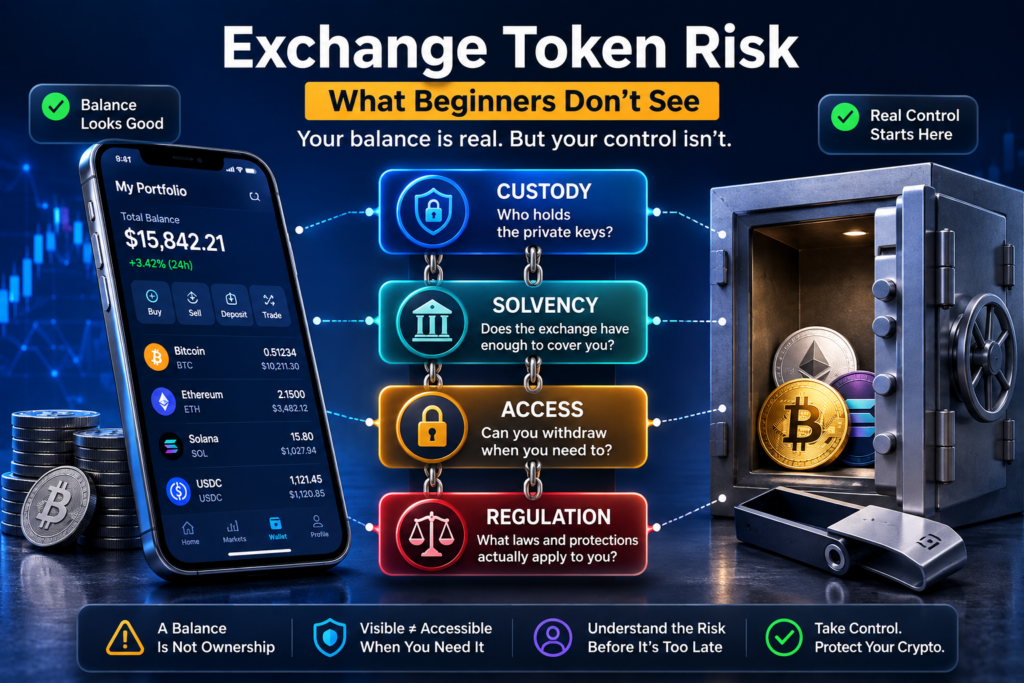
A beginner may think the balance itself is the asset. More accurately, a centralized exchange balance sits inside a stack of dependencies.
First, the platform must correctly record what it owes or holds for you. Second, the custodian must control the necessary private keys securely. Third, the platform must have enough available assets and liquidity to honor withdrawals. Finally, its systems and compliance controls must allow the transfer to proceed.
If any layer fails, exchange token risk can turn a visible balance into an inaccessible one.
This four-layer model explains why an account can still display crypto during a withdrawal pause. It also shows why exchange token risk can exist even when the dashboard looks normal.
The accounting record may remain intact while another layer stops working.
Consequently, exchange token risk should be judged by more than the app interface. A polished dashboard says very little about custody architecture, liabilities, liquidity, or emergency controls.
The Four-Layer Access Test
| Layer | What must work | What failure can look like |
|---|---|---|
| Account record | Your balance must be recorded correctly | Missing or disputed entitlement |
| Custody | Private keys and wallets must remain secure | Theft or inability to move assets |
| Solvency and liquidity | Assets must exist and remain available | Delayed or suspended withdrawals |
| Platform permission | Systems and legal controls must permit access | Account freeze, outage, or compliance hold |
This framework adds an important distinction. A user can have ownership on paper while losing practical access in reality.

Why Solvency Changes Exchange Token Risk
Custody and solvency are different.
Custody asks whether a platform can safeguard the assets or keys it controls. Solvency asks whether the business has enough assets to cover what it owes. Meanwhile, liquidity asks whether enough of those assets remain available when customers want to withdraw.
A platform can have strong cybersecurity and still face a financial shortfall. Therefore, exchange token risk cannot be measured by cybersecurity claims alone.
Likewise, a solvent institution can experience a temporary operational or liquidity problem. As a result, the question “Is this exchange secure?” does not tell users everything they need to know.
This distinction makes exchange token risk harder to judge from the outside. A user sees an account balance. Yet that screen does not necessarily reveal liabilities, related-party exposures, borrowing arrangements, or other financial dependencies.
For that reason, proof of assets should not automatically be confused with proof of solvency. Reserves matter. Liabilities matter as well.
The Crypto Encounter has explored that distinction separately in Proof of Reserves Is Not Proof of Safety, which examines why asset snapshots cannot, by themselves, answer every question about an exchange’s financial position.
FTX Showed Exchange Token Risk Under Extreme Stress
The collapse of FTX remains a direct example of exchange token risk becoming a customer-access crisis.
In August 2024, the U.S. Commodity Futures Trading Commission announced a $12.7 billion judgment against FTX and Alameda. The order required $8.7 billion in restitution and $4 billion in disgorgement. According to the CFTC, the court found that FTX and Alameda made material misrepresentations and omissions to customers. The regulator also stated that customer funds had been commingled and misappropriated despite representations concerning custody and segregation.
The lesson goes beyond one failed company. More broadly, exchange token risk becomes dangerous when users assume the internal balance proves external availability.
Customers could see numbers in their accounts before FTX collapsed. However, those displayed balances did not guarantee that equivalent customer assets remained available for withdrawal. The CFTC’s findings demonstrate why custody representations, internal accounting, and actual asset handling must all align.
That is why exchange token risk becomes most visible during stress. Normal operations can hide weaknesses for long periods. Then a surge in withdrawals can quickly test whether custody, liquidity, and accounting systems work together.
Importantly, FTX should not be used to imply that every centralized exchange operates the same way. Instead, the case shows what can happen when users depend heavily on an intermediary and critical controls fail.
Platform Controls Add Another Exchange Token Risk
Not every withdrawal restriction signals insolvency.
An exchange may limit withdrawals because of an outage, wallet maintenance, a blockchain disruption, a security investigation, identity verification, sanctions screening, a legal order, or another compliance requirement. Some restrictions can protect users or satisfy legal obligations.
Still, the result matters. That practical loss of control is a core form of exchange token risk.
You may own the asset under the platform’s terms and still lack the ability to transfer it immediately.
Coinbase’s U.S. agreement illustrates this operational side of exchange token risk. It states that customers can instruct Coinbase to withdraw supported assets, while also making withdrawals subject to outages, downtime, protocol requirements, blockchain processing, and applicable agreements or policies. Moreover, Coinbase continues controlling the relevant private keys while the crypto remains in custody.
Therefore, exchange token risk includes access risk, not simply the risk that assets disappear.
That distinction matters because temporary inaccessibility can have real consequences. A user may want to move assets to another wallet, sell elsewhere, provide collateral, or simply regain direct control. A balance that cannot move may still exist, but its practical usefulness has changed.
Regulation Can Reduce Exchange Token Risk, but Rules Differ
Regulation can strengthen custody protection. However, the safeguards depend heavily on the jurisdiction, license, product, and legal entity serving the customer.
The European Union’s Markets in Crypto-Assets Regulation provides a useful example. MiCA Article 75 requires crypto-asset service providers offering custody to maintain client position records and custody policies. It also requires procedures for returning client assets.
More importantly, Article 75 requires custodians to segregate client crypto from their own holdings. It also requires legal segregation from the provider’s estate under applicable law so that the provider’s creditors cannot pursue those custody assets in insolvency. Under MiCA Article 75, crypto custodians must maintain client records and custody policies while keeping client crypto-assets legally segregated from their own holdings
Those safeguards directly address exchange token risk. Even with stronger rules, exchange token risk never falls to zero.
Cyber incidents can still happen. Operational systems can fail. Users can lose credentials. Legal disputes can arise. Furthermore, a platform operating under one regulatory regime may provide different protections from a platform or affiliate operating elsewhere.
Therefore, users should identify the actual legal entity that holds their account rather than assuming a global exchange brand creates identical protections in every country.
Exchange Token Risk Is Different From Price Risk
Crypto users naturally focus on prices. Yet a token can keep roughly the same market value while its owner temporarily loses access to it.
Imagine Bitcoin’s market price barely changes during a particular day. Meanwhile, your exchange account enters a compliance review and withdrawals stop.
Your market exposure may have changed very little. However, your exchange token risk has increased because your ability to move the asset has changed.
The reverse can happen too.
You could have perfect access to a token whose market price falls sharply. That represents market risk rather than custody risk.
Separating the two helps readers ask better questions. Price risk asks:
What could this asset be worth?
Exchange token risk asks:
Can the intermediary safeguard, account for, and return the asset when I need it?
Both risks matter. However, they require different protections.
FDIC Insurance Does Not Remove Exchange Token Risk
A familiar banking interface can create the wrong mental model.
In the United States, the Federal Deposit Insurance Corporation identifies crypto assets among financial products that are not covered by FDIC deposit insurance. FDIC protection applies to qualifying deposits at insured banks, not to the value of crypto assets simply because someone bought them through a financial platform.
Therefore, exchange token risk should not be evaluated as though a crypto balance were an ordinary insured savings deposit.
Some platforms may hold certain customer cash through banking arrangements. Even so, exchange token risk remains separate from any protection that may apply to eligible fiat deposits.
Accordingly, users should distinguish between cash held through a banking arrangement and crypto held through an exchange custody arrangement. Those are different assets with different legal and insurance questions.
The SEC’s Office of Investor Education and Advocacy has also warned that accounts with crypto entities may not carry the same protections available to bank deposits or securities held through regulated broker-dealers.
Self-Custody Changes Exchange Token Risk Rather Than Removing All Risk
Moving crypto to a wallet you control can remove many platform dependencies.
Once a successful withdrawal places assets under keys that you independently control, you no longer need that exchange to authorize ordinary blockchain transfers. You also remove direct exposure to that exchange’s solvency for the assets already withdrawn.
However, self-custody creates a different responsibility stack.
You must protect private keys or recovery phrases. Therefore, reducing exchange token risk requires accepting more personal responsibility.
Users must also verify addresses, protect devices, understand transaction networks, avoid phishing, and prepare for recovery. In other words, self-custody converts third-party custody risk into personal operational risk.
The Crypto Encounter’s broader security analysis makes the same structural point: self-custody can reduce exchange dependency, but it transfers responsibility for keys, recovery, and transaction security to the user.
As a result, reducing exchange token risk can increase another kind of risk if a user lacks the knowledge to manage private keys safely.
The better question is not whether exchanges or self-custody are universally safer. Instead, users should ask which risks they understand, which risks they can manage, and how much value they need to expose to each custody model.
How to Measure Exchange Token Risk Before You Need Your Funds
Beginners do not need to audit an exchange like professional accountants. Still, they can ask better questions. A simple exchange token risk review can reveal where the biggest dependencies sit.
1. Who Controls the Keys?
If the platform controls the private keys, you rely on its custody system.
That is the foundation of exchange token risk.
Your password may grant access to the exchange account. However, the password is not the private key that authorizes the underlying blockchain transaction.
2. What Do the Terms Say About Ownership?
Read how the platform describes custody and legal title.
Also check whether different products allow lending, pledging, staking, collateral use, or other treatment of customer assets.
Do not assume that every service inside the same app follows identical custody terms.
3. Can You Withdraw Normally?
A small withdrawal can help users understand the process, fees, network selection, and security checks.
However, one successful transfer does not prove future solvency.
Therefore, treat a test withdrawal as an operational check rather than proof that all exchange token risk has disappeared.
4. What Happens During Stress?
Look for clear policies covering outages, security incidents, blockchain changes, account reviews, and withdrawal restrictions.
Exchange token risk often becomes most important when ordinary procedures stop.
Additionally, examine whether the platform clearly explains how customer assets are held and what happens if the company fails.
5. Which Law Governs the Account?
Identify the legal entity serving you and the jurisdiction governing the relationship.
Regulation, segregation requirements, insolvency treatment, and complaint procedures can differ substantially. MiCA’s custody requirements, for example, establish specific segregation protections for qualifying EU crypto-asset service providers.
6. Are You Keeping More on the Platform Than You Need?
Active trading may require assets on an exchange.
Long-term storage has different needs.
Consequently, users can think about exposure according to purpose rather than treating every crypto holding identically.
Exchange Token Risk Is Really a Dependency Chain
The deepest exchange token risk is dependency.
An exchange balance depends on more than your password. It relies on an internal ledger, secure key management, adequate assets, available liquidity, working infrastructure, compliance systems, and enforceable legal rights.
Most days, those dependencies remain invisible. Trading works. Withdrawals settle. The balance looks normal. Consequently, exchange token risk often feels abstract until a platform comes under pressure.
However, stress changes the picture.
A hack tests custody. A withdrawal rush tests liquidity. Insolvency tests legal rights. An identity or sanctions issue tests access controls. An outage tests operations.
Therefore, exchange token risk works like a chain. Reliable access depends on every critical link continuing to function.
This is also why the phrase “I own the coins” can be incomplete. Ownership may answer the legal question, while custody and platform control answer the operational one.
How Beginners Can Reduce Exchange Token Risk Without Overreacting
Reducing risk does not require abandoning centralized exchanges.
Instead, start by matching the platform to the task.
Keep trading funds where you actually need trading access. Meanwhile, consider whether longer-term holdings need the same level of exchange exposure.
Next, learn how withdrawals work before a crisis forces you to learn quickly.
Strengthen account security as well. Protect the email account connected to the exchange. Use strong authentication. Stay alert for phishing. In addition, save transaction records and account statements.
Users who want to explore self-custody should learn gradually. Small test amounts can help build familiarity with wallet recovery, network selection, and transaction verification before significant value is involved.
These actions cannot eliminate exchange token risk. Nevertheless, they can reduce unnecessary dependence and make the remaining risks easier to understand.
For another practical comparison, The Crypto Encounter’s discussion of crypto’s password problem explains why exchange credentials, wallet passwords, private keys, and recovery phrases perform very different security functions.
Conclusion: Exchange Token Risk Begins Where the Screen Ends
Exchange token risk is easy to miss because a centralized exchange can make crypto feel like ordinary online banking. The balance appears instantly. Buy and sell buttons work. Withdrawals often feel routine.
Yet the screen represents only the visible layer.
Behind it sit custody arrangements, private keys, solvency, liquidity, platform rules, regulation, security systems, and operational controls.
Therefore, exchange token risk does not mean every centralized exchange is unsafe. Instead, it means a displayed balance and direct control are different things.
Once beginners understand that distinction, they can make more deliberate custody choices. They can also limit unnecessary platform exposure and prepare for situations where access becomes more important than the number displayed on the screen.
Most importantly, understanding exchange token risk replaces an assumption with a question that every crypto user should know how to answer:
Who actually controls access to my assets right now?
Frequently Asked Questions
What Is Exchange Token Risk?
Exchange token risk is the possibility that crypto shown in an exchange account becomes difficult or impossible to access because of custody, solvency, liquidity, security, legal, operational, or account-control problems.
Do I Own Crypto Held on an Exchange?
The answer depends on the platform’s terms and applicable law. Some exchanges explicitly state that customers retain legal title. However, the platform may still control the private keys and process each withdrawal. Coinbase’s current U.S. agreement provides one example of that distinction.
Can a Regulated Exchange Freeze Withdrawals?
Regulation does not guarantee uninterrupted withdrawal access. Platform terms, technical conditions, security controls, and legal requirements can affect whether a transfer proceeds at a particular time.
Does Self-Custody Remove Exchange Token Risk?
Self-custody removes direct dependence on the exchange for assets that have already been successfully withdrawn. However, it introduces private-key security, recovery, transaction, device, and user-error risks.
Is Exchange Token Risk the Same as a Token Losing Value?
No. Price risk concerns changes in the market value of an asset. Exchange token risk concerns whether the intermediary can safeguard, account for, and return the asset when the user wants access.
Disclaimer
This article is for informational and educational purposes only. It does not provide financial, investment, legal, tax, or accounting advice. Cryptocurrency and digital asset markets involve risk, including possible loss of capital. Readers should conduct their own research before making any financial decision.