


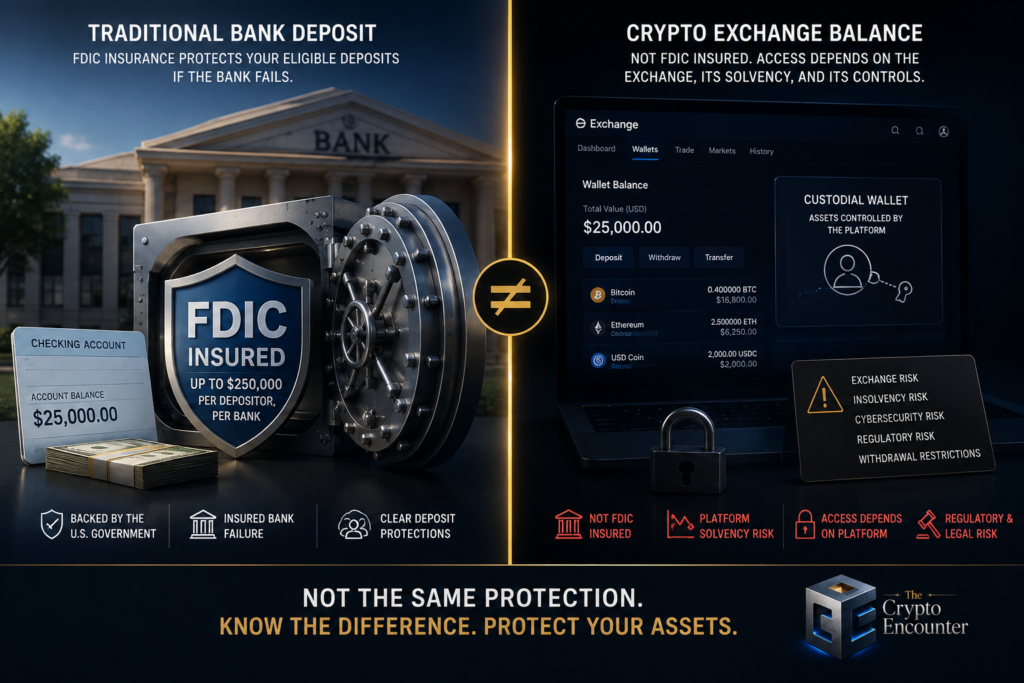
The FDIC myth in crypto starts with a simple misunderstanding. A user deposits dollars or crypto on an exchange, sees a balance on screen, and assumes those assets carry protections similar to money in a bank account. However, that assumption can fail when protection matters most. FDIC insurance protects qualifying deposits at insured banks when those banks fail. It does not insure crypto assets, and it does not cover the bankruptcy, insolvency, theft, or operational failure of a crypto exchange. Therefore, understanding the FDIC myth in crypto requires users to separate four questions: what they own, who controls access, where their cash sits, and what happens if the platform fails.
The FDIC Myth in Crypto Begins With a Banking Assumption
For many users, an exchange account looks familiar. There is a dollar balance, transaction history, a login, and sometimes a payment card. Because the interface resembles online banking, users can easily treat the account like a bank account.
However, the FDIC myth in crypto begins precisely at that point. A banking-style interface does not create banking-style deposit insurance.
The Federal Deposit Insurance Corporation protects eligible deposits at FDIC-insured banks and savings associations if one of those institutions fails. The standard insurance amount is $250,000 per depositor, per insured bank, for each ownership category. Importantly, the FDIC explicitly lists crypto assets among products it does not insure.
Moreover, the agency says FDIC insurance does not protect customers against the default, insolvency, or bankruptcy of nonbank companies such as crypto exchanges, custodians, brokers, wallet providers, or neobanks. Therefore, the FDIC myth in crypto cannot be resolved by simply finding an FDIC logo or learning that an exchange works with a bank.
Instead, users need to know exactly which asset receives protection and which institution actually holds it. Seen clearly, the FDIC myth in crypto is a category error: protection for bank deposits gets mistaken for protection of an entire crypto account.
What FDIC Insurance Covers and What It Does Not
To understand the FDIC myth in crypto, first separate a bank deposit from an investment or digital asset.
FDIC insurance generally covers checking accounts, savings accounts, money market deposit accounts, certificates of deposit, and certain other deposits held at insured banks. In addition, the insurance becomes relevant because the insured bank itself fails.
By contrast, the FDIC does not insure Bitcoin, Ether, stablecoins, stocks, bonds, mutual funds, commodities, or other investment products. Furthermore, it does not compensate someone simply because a crypto platform suffers fraud, theft, insolvency, bankruptcy, or a withdrawal freeze.
The FDIC guidance on crypto companies also makes clear that deposit insurance does not protect customers against the default, insolvency, or bankruptcy of a crypto exchange, custodian, broker, or wallet provider.
That distinction explains much of the FDIC myth in crypto. Several different risks frequently get compressed into a single word: “safe.”
Yet bank failure, exchange failure, market losses, cyber theft, fraud, and loss of private keys represent different events. Consequently, they also involve different protections.
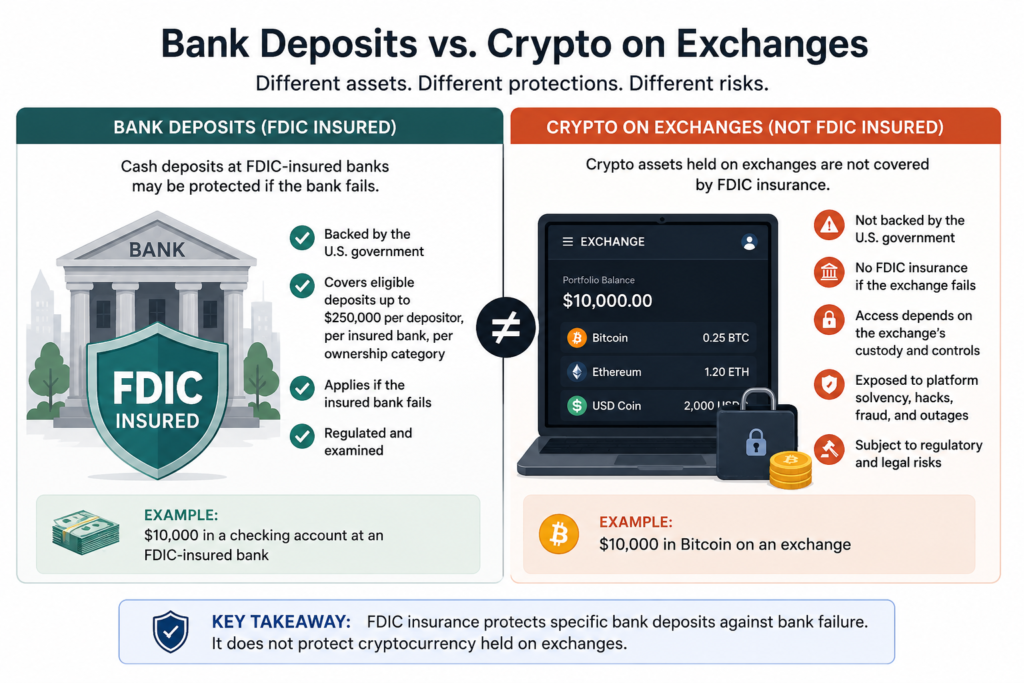
The FDIC myth in crypto effectively turns one narrow form of federal protection into something much broader than it really is.
The FDIC Myth in Crypto: A Quick Reality Check
| Event | Main Risk | Does FDIC Insurance Apply? |
|---|---|---|
| An FDIC-insured bank fails | Loss of eligible bank deposits | Yes, subject to applicable limits and rules |
| A crypto exchange fails | Withdrawal freeze, insolvency, or bankruptcy | No |
| Bitcoin or another crypto asset falls in price | Market loss | No |
| An exchange suffers theft or fraud | Asset loss or restricted access | No |
| A user loses a private key | Loss of access | No |
| Eligible cash sits at an insured partner bank | Failure of that insured bank | Potentially, for qualifying deposits |
The table exposes the central problem behind the FDIC myth in crypto. Deposit insurance protects particular deposits against the failure of an insured banking institution. It does not create a general federal safety net around a cryptocurrency exchange account.
Therefore, asking whether an exchange “has FDIC insurance” is often too vague. A better question is: Which specific money is insured, where is it deposited, and which failure triggers the insurance?
Once users ask that question, the FDIC myth in crypto becomes much easier to identify.
Exchange Balances Do Not Always Mean Direct Control
The FDIC myth in crypto also hides a second issue: custody.
When users choose self-custody, they control the private keys that authorize transactions. However, when they leave cryptocurrency with a centralized exchange, the exchange or its custodian generally manages those keys.
The account dashboard may display a balance. Nevertheless, the platform controls the infrastructure required to process a withdrawal.
That difference becomes critical during financial stress. An exchange can restrict withdrawals because of liquidity problems, insolvency, cybersecurity incidents, legal restrictions, technical failures, or internal controls.
Accordingly, a visible number on a screen does not guarantee immediate access to the underlying asset.
In December 2025, the SEC’s Office of Investor Education and Assistance warned retail investors that third-party crypto custody can create access risks if a custodian gets hacked, shuts down, or goes bankrupt. It also encouraged users to examine whether custodians commingle assets, subcontract storage, or use deposited assets as collateral.
For that reason, the FDIC myth in crypto concerns more than insurance. It also concerns control.
The practical cost of the FDIC myth in crypto appears when a user assumes an account balance means both legal protection and unconditional access. Neither assumption should be automatic.
FTX Showed Why Platform Risk Matters
FTX provides a real example of what can happen when custody, platform solvency, and customer expectations collide.
Before its 2022 collapse, FTX represented that customer assets were held in custody and segregated from company assets. However, the Commodity Futures Trading Commission later alleged that customer assets were commingled with Alameda Research funds and misappropriated. The CFTC’s original enforcement action alleged losses of more than $8 billion in customer deposits.
Later, in August 2024, a federal court entered a $12.7 billion judgment against FTX and Alameda in the CFTC case, including restitution and disgorgement obligations.
The FDIC myth in crypto matters here because customers could have balances recorded inside the platform while their ability to withdraw depended on FTX’s financial condition and operational controls.
FDIC insurance did not restore customers’ cryptocurrency balances. FTX was not an FDIC-insured bank, while cryptocurrencies themselves did not qualify as FDIC-insured deposits.
Thus, the FDIC myth in crypto exposes an important difference between an account record and independent control of an asset.
A platform can record what it owes a customer. However, the customer’s ability to retrieve that asset may still depend on the platform remaining solvent, functional, and willing or legally able to process withdrawals.
Again, the FDIC myth in crypto blurs a critical boundary between having an account balance and having protection from the custodian’s failure.
Cash on an Exchange Can Be Different From Crypto
A particularly confusing part of the FDIC myth in crypto involves U.S. dollars.
Some nonbank financial companies use FDIC-insured banks to hold certain customer cash balances. Depending on the legal structure and satisfaction of applicable deposit-insurance requirements, qualifying funds held at those banks may receive deposit insurance.
However, this does not convert the crypto company into an FDIC-insured bank. More importantly, it does not extend FDIC coverage to cryptocurrency.
Consider a simple example. Suppose an exchange account displays $5,000 in U.S. dollars and $5,000 worth of Bitcoin.
If the $5,000 cash balance qualifies as an insured deposit at an FDIC-insured partner bank, federal deposit insurance could become relevant if that bank fails. Meanwhile, the Bitcoin remains outside FDIC coverage because the FDIC does not insure crypto assets.
The FDIC myth in crypto develops when users assume the same protection follows both balances simply because one application displays them together.
Instead, users should determine which bank holds the cash, whether that bank carries FDIC insurance, how the funds sit within the banking arrangement, and which assets the platform’s insurance statement actually covers.
Viewed legally, the FDIC myth in crypto can turn a limited statement about deposited cash into a much broader assumption about cryptocurrency that the statement never supported.
Regulation Does Not Automatically Mean FDIC Insurance
Regulatory status can reinforce the FDIC myth in crypto because consumers sometimes treat “regulated” and “insured” as interchangeable ideas.
They are different concepts.
A cryptocurrency company may hold licenses, register particular activities, operate through regulated subsidiaries, or maintain relationships with regulated banks. However, those facts do not automatically transform the assets available through its platform into FDIC-insured bank deposits.
Moreover, regulators themselves have confronted misleading representations in this area.
In August 2022, the FDIC issued cease-and-desist letters to five companies over false or misleading representations involving deposit insurance, including crypto-related claims. The agency stated that federal law prohibits people or companies from suggesting that uninsured products carry FDIC insurance.
Then, in January 2024, the FDIC demanded corrective action from another group of entities over representations involving insured status, uninsured financial products, or the extent of FDIC coverage.
Therefore, the FDIC myth in crypto has become a genuine consumer-protection concern rather than a purely theoretical misunderstanding.
For users, the FDIC myth in crypto can cause a regulated banking relationship to appear broader than it actually is. The banking relationship may be genuine while the customer’s interpretation of the protection remains incorrect.
The FDIC Myth in Crypto Is Really a Custody Question
Once users understand deposit insurance, custody becomes the next question.
Crypto custody describes how and where someone stores and accesses crypto assets. More specifically, wallets hold the private keys that authorize blockchain transactions rather than physically storing coins inside the wallet itself.
The FDIC myth in crypto distracts from this mechanism because the word “insurance” can sound like a complete answer to safety.
In reality, custody determines who controls the ability to move assets. Meanwhile, solvency affects whether a centralized provider can continue meeting customer obligations.
Exchange custody offers obvious convenience. Users can trade rapidly, recover passwords through conventional account processes, and avoid personally managing every private key.
However, that convenience introduces counter party risk. Customers depend on the exchange’s cybersecurity, internal controls, asset-management policies, financial condition, legal structure, and withdrawal infrastructure.
The FDIC myth in crypto also obscures this trade-off because a user may focus on deposit insurance while overlooking the actual custodian.
By comparison, self-custody removes much of the centralized platform risk. Nevertheless, it creates personal operational risks involving private keys, seed phrases, devices, wallet software, backups, phishing, and transaction mistakes.
Therefore, correcting the FDIC myth in crypto does not mean declaring self-custody superior for every user. Instead, it means understanding where each custody method places responsibility.
How to Check Whether Exchange Cash Is Actually Protected
The easiest way to challenge the FDIC myth in crypto is to verify insurance claims before relying on them.
First, determine whether the platform itself is an insured bank or a nonbank company. Next, identify the actual bank that supposedly receives customer cash.
Users can then verify that institution through the FDIC’s official BankFind database. FDIC BankFind Suite
Afterward, read the platform’s legal terms carefully. Look for an explanation of where cash gets deposited, which legal entity holds customer funds, and whether the insurance language applies only to fiat balances.
In addition, check your other deposits at the same insured bank. The FDIC’s standard limit applies per depositor, per insured bank, for each ownership category. As a result, consumers should not automatically assume that balances reached through separate apps always receive separate $250,000 limits.
The FDIC myth in crypto becomes far easier to detect once users stop treating all “funds” inside an exchange account as the same financial product.
Likewise, the FDIC myth in crypto weakens when users verify the underlying institution instead of relying on a marketing phrase.
What Exchange Users Should Ask Before Leaving Crypto on a Platform
Better due diligence provides the strongest defense against the FDIC myth in crypto.
Users should ask who controls the private keys, how the custodian stores assets, and whether customer cryptocurrency gets segregated or commingled. They should also review whether the provider can lend, pledge, rehypothecate, or otherwise use deposited assets.
Furthermore, legal terms matter. Customers should understand what those terms say about asset ownership, withdrawals, insolvency, insurance, and the rights of account holders if the custodian fails.
If a platform advertises private insurance, users should identify which losses the policy covers. Private crime or cybersecurity insurance can address specific events, but it does not become FDIC insurance merely because both products use the word “insurance.”
Consequently, the FDIC myth in crypto should encourage more precise questions rather than broader assumptions.
Active traders may reasonably need funds on an exchange. Meanwhile, long-term holders may decide that another custody structure better suits their circumstances.
Either way, the FDIC myth in crypto should not determine the decision. Understanding custody and counter party risk should.
Why “Safe” Needs a More Precise Definition
Marketing language can keep the FDIC myth in crypto alive because “safe” can describe several unrelated protections.
For example, a platform might store much of its cryptocurrency offline. Separately, it could place customer cash at an insured bank. It might also maintain reserves or purchase private cyber insurance.
However, those protections do different jobs.
Strong cybersecurity does not guarantee solvency. Likewise, a relationship with an FDIC-insured bank does not insure Bitcoin.
Proof of reserves may provide information about assets, yet it does not necessarily explain every liability or legal claim against those assets. Similarly, regulatory oversight does not remove all operational or counter party risk.
Once those protections are separated, the FDIC myth in crypto becomes much harder to sustain.
Instead of asking whether an exchange is generally “safe,” users can ask which specific risk each safeguard reduces. Ultimately, the FDIC myth in crypto survives when different forms of protection get blended into one vague promise of security.
Conclusion: The FDIC Myth in Crypto Is About Ownership, Access, and Protection
The FDIC myth in crypto matters because users can easily confuse a visible exchange balance with protected ownership. Yet access to exchange-held assets depends on custody arrangements, platform solvency, legal rights, operational controls, and the type of asset involved.
FDIC insurance remains an important protection for the banking system. However, its role is specific. It protects qualifying deposits at insured banks when those banks fail, subject to applicable rules and limits. It does not insure cryptocurrency or rescue customers from the failure of a nonbank crypto exchange.
Understanding this distinction is part of understanding the wider financial risk in crypto, where asset ownership and financial protection can depend on very different systems.
Therefore, the best response to the FDIC myth in crypto is precision. Know whether the balance represents cash or crypto. Understand who controls the private keys. Identify the legal entity holding the asset, and verify exactly what any insurance statement covers.
Most importantly, the FDIC myth in crypto reminds users that ownership, access, custody, solvency, and insurance answer different questions. Treating them as the same thing can create a dangerous sense of protection exactly when an exchange comes under stress.
FAQs
Is crypto on an exchange FDIC insured?
No. The FDIC myth in crypto often comes from confusing an exchange’s banking relationship with insurance on cryptocurrencies. The FDIC explicitly states that crypto assets are not FDIC-insured deposits.
Can U.S. dollars on a crypto exchange receive FDIC insurance?
Potentially, depending on how qualifying cash deposits are held and whether applicable requirements are met. However, users should verify the actual insured bank and the terms governing their funds. The protection does not extend to cryptocurrency.
Does FDIC insurance protect customers if a crypto exchange goes bankrupt?
No. The FDIC myth in crypto does not change the scope of federal deposit insurance. The FDIC states that its insurance does not protect against the bankruptcy, insolvency, or default of a nonbank crypto exchange.
Does regulation make a crypto exchange as safe as a bank?
No. Regulation may impose important legal, operational, or consumer-protection requirements. However, it does not automatically make an exchange account an FDIC-insured deposit account.
Is self-custody safer than keeping crypto on an exchange?
It depends on the risks a user can manage. Self-custody reduces reliance on an exchange but makes the user responsible for private keys, seed phrases, wallet security, backups, and transaction errors. The SEC’s investor education office identifies meaningful risks under both self-custody and third-party custody.
What is the easiest way to avoid the FDIC myth in crypto?
Ask one precise question: What exact asset is insured, by which institution, and against what type of failure? That question separates deposit insurance from exchange custody, crypto ownership, and platform risk.
Disclaimer:
This article is for informational and educational purposes only. It does not provide financial, investment, legal, tax, or accounting advice. Cryptocurrency and digital assets involve significant risks, including market losses, custody failures, cybersecurity incidents, platform insolvency, and loss of access to funds. FDIC coverage depends on the type of asset, institution, account structure, and applicable requirements. Readers should verify current information with the FDIC and relevant service providers and conduct their own research before making financial or custody decisions.