


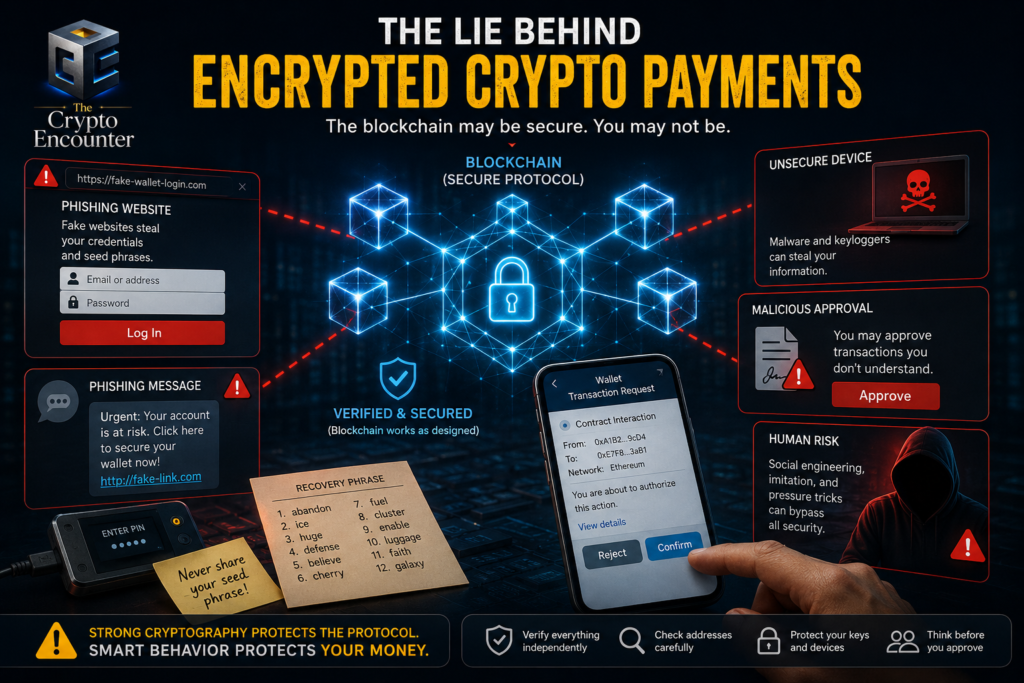
Some of the strongest available cryptography can protect an encrypted crypto payment and still leave your money in a scammer’s wallet.
That apparent contradiction sits behind one of cryptocurrency’s most misunderstood security claims. Blockchains such as Bitcoin and Ethereum use cryptographic techniques to authenticate transactions and protect the integrity of their networks. But that does not mean every crypto payment is encrypted, private, reversible, or safe from fraud.
In fact, transaction details on many public blockchains are deliberately visible. The greater danger often appears before a transaction reaches the blockchain: a fake website, compromised device, stolen recovery phrase, malicious wallet approval, impersonation scam, or simply a convincing lie.
The blockchain can process exactly what a user authorized while the user is being deceived.
That is the security gap ordinary crypto users need to understand.
The Short Answer: What Does “Encrypted Crypto Payment” Actually Mean?
Calling ordinary cryptocurrency payments “encrypted” can be misleading.
Encryption has a specific technical meaning. The U.S. National Institute of Standards and Technology defines encryption as transforming readable data into ciphertext so that its original meaning is concealed. Cryptography is the broader discipline that includes encryption but also digital signatures, hashing, authentication, and other security mechanisms.
Bitcoin, Ethereum, and other blockchain systems rely heavily on cryptography.
That does not automatically mean their transaction records are hidden.
The Federal Trade Commission warns consumers that cryptocurrency transactions are typically recorded on public blockchains. Depending on the network, information such as wallet addresses and transaction amounts may be visible. In some circumstances, those records can later be connected with information that identifies a person.
So there are several ideas that should never be treated as synonyms:
| Term | What it actually means | What it does not guarantee |
|---|---|---|
| Cryptography | Mathematical techniques used to protect information and authenticate actions | That a payment is private or scam-proof |
| Encryption | Concealing information so unauthorized parties cannot read it | That the person receiving money is trustworthy |
| Digital signature | Cryptographic proof that a transaction was authorized using the relevant key | That the person signing understood the transaction |
| Blockchain security | Rules and cryptographic mechanisms protecting the network and transaction history | That the wallet, device, website, or user is secure |
| Private key | Secret information that gives control over a crypto account | Protection if the key is stolen or exposed |
That last distinction explains much of crypto fraud.
A Blockchain Can Work Perfectly While You Lose Everything
Imagine receiving a message that appears to come from your wallet provider.
It warns that your account is at risk and sends you to a website that looks almost identical to the real one. You connect your wallet and approve what appears to be a security request.
The blockchain receives a correctly signed transaction.
It verifies the signature.
It processes the instruction.
Your assets disappear.
From the blockchain’s perspective, nothing necessarily malfunctioned. The network received an authorized instruction and executed it according to its rules.
The failure occurred at the human interface.
Ethereum’s own security guidance warns that phishing websites can imitate legitimate wallets, exchanges, and decentralized applications. These sites may trick users into entering recovery phrases or connecting wallets in ways that expose their assets. Ethereum also warns that anyone obtaining a recovery phrase can access the associated accounts.
This creates a crucial distinction:
Protocol security protects the system’s rules. User security determines who gets to issue the instructions.
A mathematically valid transaction can still represent a catastrophic human mistake.
The Most Dangerous Moment May Be When You Click “Approve”
Crypto security discussions often focus on hackers “breaking” blockchains.
Many attacks require nothing so dramatic.
Sometimes the attacker only needs the victim to approve something they do not understand.
That problem has become serious enough that the Ethereum ecosystem is working directly on it. In May 2026, an Ethereum working group involving wallet developers, security companies, and the Ethereum Foundation announced a Clear Signing standard intended to reduce “blind signing,” where users authorize transactions without meaningfully understanding what those transactions will do.
That development exposes an uncomfortable weakness in the way crypto security is often presented.
A digital signature can prove which key authorized an action.
NIST describes digital signatures as mechanisms for verifying origin authenticity and data integrity.
But cryptography cannot determine whether the human controlling that key was:
- looking at a fake website,
- manipulated by an impersonator,
- misunderstanding a wallet prompt,
- approving a malicious contract,
- operating an infected device, or
- sending money voluntarily to a fraudster.
The signature may be technically genuine even when the decision behind it was disastrously misinformed.
That is one of the most important limitations of cryptographic security.
Your Wallet Is Part of the Security System Too
A blockchain does not exist in isolation.
Ordinary users reach it through layers of technology:
Person → phone/computer → browser/app → wallet → transaction request → blockchain
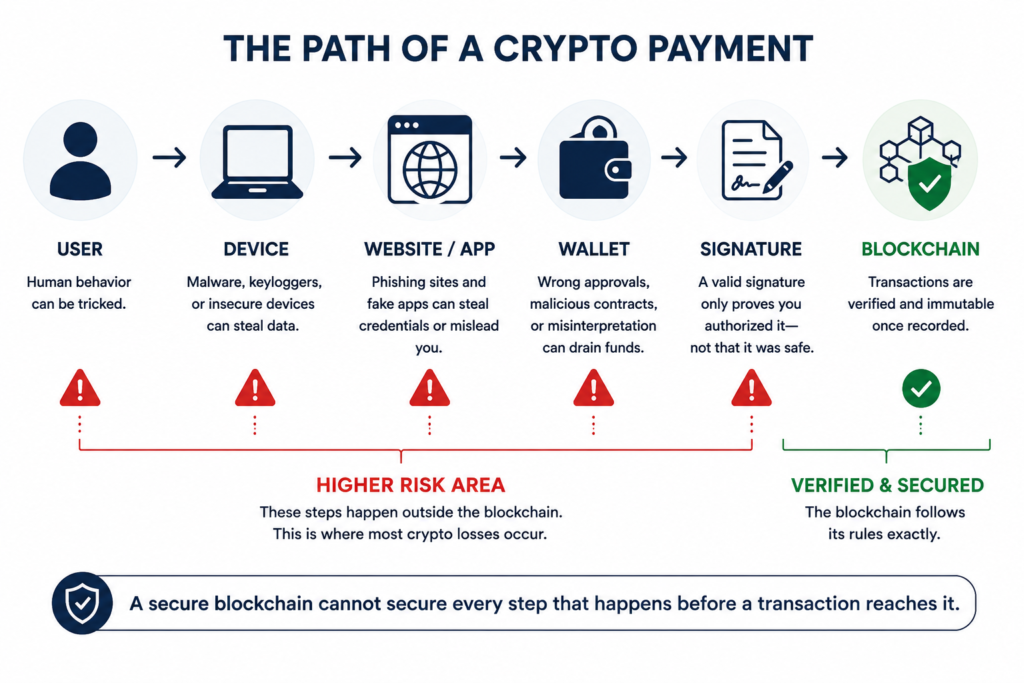
Every step introduces another potential attack surface.
A blockchain does not exist in isolation. As we explain in What They Never Told You About the Security of Cryptocurrencies, blockchain security is only one part of the wider security environment surrounding digital assets.
Ethereum’s security guidance calls a recovery phrase the “master key” to a wallet and warns that anyone who obtains it can access the associated accounts. It also advises against storing recovery phrases or private keys in screenshots because cloud synchronization can create another avenue for compromise.
The security of the protocol therefore cannot compensate for poor security around the key controlling the assets.
Think of a bank vault with an extraordinarily strong door.
The engineering of the door matters.
But if someone persuades the owner to hand over the combination, nobody needed to break the vault.
Crypto changes the technology behind that analogy, but the human problem remains.
Why Scammers Like Crypto Even Without “Breaking” Cryptography
Crypto offers scammers an important advantage: successful payments can be extremely difficult to undo.
The FTC says cryptocurrency payments typically do not carry the same legal protections as credit and debit card payments and generally cannot be reversed unless the recipient sends the money back.
That changes the economics of fraud.
A criminal who convinces someone to send cryptocurrency does not necessarily need malware, advanced cryptanalysis, or an exploit against a blockchain.
The scammer needs the victim to make one valid payment.
This is why fake investments, romance scams, government impersonation, fraudulent support messages, phishing links, and other forms of social engineering remain so dangerous.
The FTC specifically warns about scammers impersonating government agencies or companies and telling victims to buy cryptocurrency and transfer it to a supposedly “safe” wallet. The wallet actually belongs to the scammer.
Technically, the cryptocurrency infrastructure may perform exactly as designed.
Financially, the victim has been robbed.
The Scale of the Human Security Problem Is Enormous
This is not a theoretical edge case.
According to the FBI’s 2025 Internet Crime Report, complaints involving cryptocurrency produced the highest reported losses among Americans who filed complaints involving crypto: 181,565 complaints totaling more than $11 billion. The FBI said investment fraud remained the largest driver of scam-related losses overall.
Those figures require an important qualification.
They are reported complaint figures, not proof that $11 billion was stolen because blockchain cryptography failed.
Quite the opposite.
The numbers illustrate why distinguishing network compromise from user manipulation matters. Criminals can exploit trust, identity, urgency, relationships, fake platforms, compromised accounts, and authorization processes without defeating the underlying cryptographic protocol.
The FBI describes schemes in which criminals first build apparently genuine professional, friendly, or romantic relationships before introducing victims to fraudulent cryptocurrency investments.
The vulnerability is often trust.
The payment rail simply makes the resulting loss difficult to recover.
Public Blockchain Does Not Mean Anonymous Money
Another misconception often travels alongside the “encrypted payment” claim: if crypto uses cryptography, transactions must be anonymous.
That conclusion does not follow.
Many blockchain networks use addresses rather than a person’s legal name, but pseudonymity and anonymity are different things.
The FTC notes that cryptocurrency transactions may appear on public ledgers and that transaction information can sometimes be combined with other information to identify the people involved.
Imagine Alice sends cryptocurrency from address A to address B.
The blockchain may not display:
Alice Smith paid Bob Jones.
But it may publicly preserve the addresses, transaction amount, time, and subsequent movement of those funds.
If address A later becomes associated with Alice through an exchange account, merchant record, public post, court filing, or another source, historical transactions may become easier to interpret.
Cryptography can authenticate a transaction without concealing its existence.
That distinction is fundamental.
Four Security Layers Users Should Think About
Instead of asking, “Is crypto encrypted?”, a more useful question is:
“Which part of this transaction is actually protected, and from what?”
| Security layer | Main protection | Typical weakness |
|---|---|---|
| Blockchain protocol | Transaction integrity and network rules | Does not determine whether the user’s decision was wise |
| Wallet/key layer | Control of crypto assets | Seed phrase theft, exposed private keys, malicious approvals |
| Device/account layer | Access to wallet apps, exchanges and communications | Malware, weak passwords, account compromise, phishing |
| Human layer | Judgment before authorizing an action | Impersonation, urgency, fake investments, social engineering |
This layered model explains why saying “blockchain is secure” is an incomplete answer to the question ordinary users actually care about:
Can I lose my money?
Yes.
A secure blockchain does not eliminate the risks surrounding its use.
What Crypto Security Cannot Protect You From
Cryptography is exceptionally useful at answering mathematical questions.
Is this signature valid?
Has this data changed?
Does this key correspond to this authorization?
Those are problems computers can test.
Other questions are fundamentally different.
Is the person messaging you really an exchange employee?
Is the investment website genuine?
Did your friend actually send that link?
Should this smart contract have access to your tokens?
Are you sending money to the correct address?
Is someone creating artificial urgency so you act before thinking?
No cryptographic primitive can reliably answer all of those questions for a user.
That is why security education matters even when the underlying protocol is technically strong.
A Practical Crypto Payment Safety Check
Before sending cryptocurrency or approving a wallet request, users should treat the decision itself as a security checkpoint.
A practical routine is to verify the recipient independently, inspect the destination address carefully, distrust unsolicited links and direct messages, never reveal a recovery phrase or private key, read wallet authorization prompts rather than clicking through them, and question anyone creating artificial urgency around a payment.
For accounts that support it, stronger multifactor authentication can add another layer of protection. CISA ranks physical security keys as offering particularly strong phishing resistance and notes that text or email codes provide weaker protection than stronger MFA methods.
Hardware wallets can also reduce private-key exposure because keys remain local to the device rather than residing on an internet-connected computer, although a hardware wallet cannot prevent a user from deliberately authorizing a malicious transaction. Ethereum recommends hardware wallets for stronger private-key protection.
The objective is not to distrust every transaction.
It is to recognize that authorization is often the final security boundary.
What If You Already Sent Crypto to a Scammer?
Speed matters, but recovery is uncertain.
The FTC says cryptocurrency transactions are typically irreversible. It nevertheless recommends contacting the company used to send the cryptocurrency, reporting the fraudulent transaction, and asking whether reversal is possible.
Victims should preserve transaction hashes, wallet addresses, screenshots, messages, usernames, websites, dates, payment details, and other evidence before accounts or pages disappear.
There is another danger after the initial theft.
Ethereum’s scam guidance warns about recovery scams, where someone claiming to be a blockchain investigator or crypto recovery specialist contacts an existing victim and promises to recover stolen assets in exchange for another payment.
A victim who has just lost money is emotionally vulnerable.
Scammers know that.
The second fraud can begin immediately after the first.
The Real Lesson Behind “Encrypted Crypto Payments”
Cryptocurrency’s use of cryptography is real.
The misleading part begins when technical security is translated into a much broader promise of personal safety.
A blockchain may resist unauthorized modification while a phishing website steals a recovery phrase. A digital signature may be mathematically valid while its owner has been manipulated. A hardware wallet may keep a private key offline while its owner approves the wrong transaction. A public ledger may preserve transaction integrity while exposing transaction information for anyone to inspect.
Security therefore has to be understood end to end.
The protocol matters.
So do the wallet, device, interface, authentication method, website, recipient, and person making the decision.
The strongest cryptography in the world cannot determine whether you are trusting the wrong person.
That is the real risk hidden behind the phrase “encrypted crypto payments.”
FAQs
Are cryptocurrency payments actually encrypted?
Not necessarily in the way ordinary users understand the word. Crypto networks use cryptography extensively, but transaction information on many public blockchains can remain visible. Encryption specifically refers to concealing information, while cryptography covers a broader set of security techniques.
Can someone hack a crypto payment while it is being sent?
Different attacks are possible against wallets, devices, accounts, applications, and users, but an attacker does not necessarily need to compromise the blockchain itself. Phishing, stolen keys, malicious approvals, and social engineering can lead to losses even when the underlying network operates normally.
Are Bitcoin and Ethereum transactions anonymous?
They should not automatically be treated as anonymous. The FTC notes that cryptocurrency transactions can appear on public blockchains and that transaction information can sometimes be combined with other data to identify participants.
Can a hardware wallet prevent crypto scams?
A hardware wallet can significantly reduce private-key exposure by keeping keys offline, but it cannot determine whether every transaction a user chooses to approve is legitimate.
Can stolen cryptocurrency transactions be reversed?
Usually not. The FTC says cryptocurrency payments typically cannot be reversed, although victims should still immediately contact the service used for the transaction and report the fraud.
Why do scammers ask victims to pay in cryptocurrency?
One important reason is finality. Cryptocurrency payments typically lack the dispute protections associated with credit and debit cards and can be difficult to reverse after funds have been sent.