


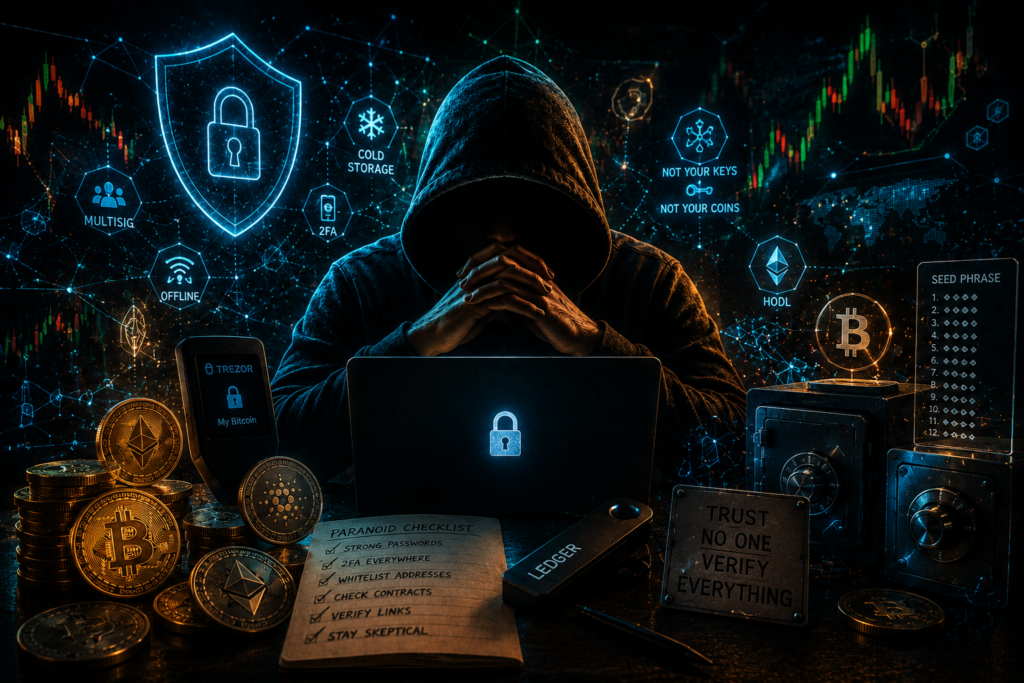
In traditional finance, a bank employee can legally pause a suspicious transaction for up to two weeks while they check whether an elderly customer is being scammed. In crypto, no equivalent authority exists. Nobody sits between you and a signature request, and once you sign, it’s final. That absence is not a minor gap. It’s the single biggest reason personal skepticism does more to protect crypto users than almost any other habit, because skepticism is the only thing currently standing where an institutional safeguard would normally be.
This is why the crypto users who lose the least tend to look, from the outside, a little excessive: they double-check URLs they’ve visited a hundred times, they treat unexpected messages as hostile by default, and they pause before signing things that feel even slightly off. That behavior isn’t anxiety. It’s doing manually what banking law now requires certain financial institutions to do automatically.
Key Facts
| Fact | Detail | Source |
|---|---|---|
| Senior Safe Act (2018) | Federal law giving trained staff at covered financial institutions legal immunity to report suspected elder financial exploitation and, in many states, to delay disbursement | U.S. SEC, NASAA, and FINRA joint fact sheet |
| FINRA Rule 2165 / NASAA Model Act | Allows broker-dealers and investment advisers to delay disbursing funds from a suspected exploitation victim’s account for up to 15 business days | NASAA, Senior Model Act summary |
| MetaMask/Blockaid transaction alerts, Ledger Connect Kit attack | During a December 2023 supply-chain attack affecting roughly 100 dapp frontends, every MetaMask user who had opted into Blockaid security alerts was fully protected, preventing an estimated $1.15 million in losses | MetaMask, official announcement |
| Scale of malicious dapp activity | Blockaid’s research found roughly 1 in 10 decentralized applications it scans shows signs of malicious behavior | MetaMask, official announcement |
| Prior alert experiment | An earlier, narrower opt-in alert for OpenSea transactions helped secure an estimated $500 million in assets before the wider rollout | MetaMask, official announcement |
TL;DR
- Traditional finance has built legal mechanisms, like the Senior Safe Act and FINRA Rule 2165, specifically because pausing a suspicious transaction measurably prevents fraud. Crypto has no equivalent institution empowered to pause anything on a user’s behalf.
- That means the individual’s own default skepticism functions as the substitute for a safeguard that doesn’t otherwise exist in crypto.
- Real data backs this up: during a major December 2023 supply-chain attack, users who had opted into wallet security alerts and heeded them were fully protected, while others were not.
- Security tools like transaction simulators help, but by design they still let a user click through a warning and sign anyway. The tool can flag risk. Only the person’s own hesitation stops the transaction.
- “Paranoid” habits, verifying URLs character by character, treating unsolicited contact as hostile, pausing before signing, are not overreactions. They are doing manually what an entire regulatory framework exists to do automatically in banking.
Why Traditional Finance Built Delay Into the Law
The Senior Safe Act, signed into law in May 2018 as part of a broader banking reform bill, exists because financial regulators recognized a specific pattern: scams targeting older adults often succeed because the victim is moved to act quickly, before anyone who might recognize the fraud has a chance to intervene. The law gives trained staff at banks, credit unions, broker-dealers, and investment advisers legal immunity to report suspected exploitation to the right authorities. Building on that, FINRA’s Rule 2165 and a NASAA model law adopted by many states go further, explicitly authorizing broker-dealers and investment advisers to delay a disbursement for up to 15 business days if they reasonably believe a transaction would result in financial exploitation.
The logic behind these laws is straightforward: fraud that relies on urgency loses much of its power once someone introduces a mandatory pause. A fifteen-day delay gives a family member, a bank employee, or law enforcement time to check whether a request is legitimate before money actually leaves.
Crypto has nothing resembling this. No exchange, wallet provider, or protocol has the legal authority, or in most cases even the technical ability, to pause a transaction a user has decided to sign. The entire design of the space prioritizes finality and user control, which is exactly why the burden of building in that same protective delay falls back on the individual.
What Happens When a User’s Own Skepticism Is the Only Safeguard
In December 2023, attackers compromised Ledger’s ConnectKit software library, a piece of code embedded in roughly 100 different decentralized application frontends, and used it to inject a wallet-draining script that could appear on any of those sites. This is exactly the kind of attack no amount of blockchain security prevents, since the manipulation happens in the interface layer before a transaction ever reaches the chain.
According to MetaMask’s own account of the incident, every user who had opted into its Blockaid-powered security alerts and encountered the malicious code was fully protected, an outcome the company estimates prevented roughly $1.15 million in losses among that group. Other users, who either hadn’t turned the feature on or clicked through a warning anyway, were not protected by the same margin.
That gap is the entire argument of this article in miniature. The tool existed. It worked. But by MetaMask’s own design, and by the design of every similar transaction-simulation tool, a security alert is a warning, not a lock. A user can still confirm the transaction after seeing it. The technology can flag danger. Only a person’s willingness to actually stop, read the warning, and back away converts that flag into protection.
Comparison: Institutional Friction vs. Crypto’s Missing Layer
| Traditional Finance | Crypto | |
|---|---|---|
| Who can pause a suspicious transaction | Trained staff at banks, broker-dealers, investment advisers, under specific legal authority | No one; the user alone decides whether to sign |
| Legal basis for delay | Senior Safe Act, FINRA Rule 2165, state-adopted NASAA model laws | None |
| Maximum delay available | Up to 15 business days under the NASAA model act | Zero; transactions are final upon signing |
| What replaces the delay | Institutional review and reporting to adult protective services or regulators | The individual user’s own hesitation, verification habits, and willingness to say no |
| What technology contributes | Fraud-detection software that flags transactions for staff review before they’re released | Transaction simulators and alerts that flag risk but still allow the user to proceed anyway |
What Productive Paranoia Actually Looks Like
The most protective habits aren’t complicated, but they run against the grain of how most software is designed to feel fast and frictionless.
- Treat any unexpected message asking you to act on your crypto, whether it claims to be support, a giveaway, or an urgent security alert, as hostile until proven otherwise, rather than neutral until proven harmful.
- Turn on transaction simulation and security alert features where your wallet offers them, and actually read the warning when one appears instead of dismissing it out of habit.
- Introduce your own delay on large or unfamiliar transactions. Waiting even a few hours before sending a large amount to a new address gives you time to notice something that felt wrong in the moment.
- Verify addresses and URLs character by character rather than trusting that something “looks right” at a glance, since convincing look-alikes are the entire basis of address poisoning and phishing.
- Separate high-value holdings from the wallet you use for everyday interactions with new websites or contracts, so a single compromised interaction can’t reach your full balance.
What Happens Next
Expect wallet-level security tools like transaction simulation to keep improving and expanding, since the Ledger Connect Kit case gave the industry concrete evidence that they work when used. But expect the underlying gap to persist: crypto has no near-term path toward anything resembling the Senior Safe Act’s institutional delay authority, both because of the field’s design philosophy around finality and because there’s no clear entity positioned to hold that authority the way a bank or broker-dealer does. Until that changes, if it ever does, the responsibility for introducing friction into a fast-moving, irreversible system will keep falling on individual users, which is exactly why the most careful ones tend to look the most suspicious of everything.
FAQs
Does crypto have any equivalent to a bank’s fraud delay authority? No. No exchange, wallet, or protocol currently has the legal authority to delay a transaction a user has decided to sign, unlike broker-dealers and banks under the Senior Safe Act and related rules.
Do wallet security alerts actually stop a scam transaction? They flag it, but they generally still allow the user to proceed after seeing the warning. In the December 2023 Ledger Connect Kit attack, users who heeded the alerts were protected; the alert alone wasn’t what stopped the loss, the user’s decision to act on it was.
Is being overly cautious about crypto transactions actually useful, or just anxiety? The data suggests it’s genuinely protective. Traditional finance built legal delay mechanisms specifically because pausing suspicious transactions reduces fraud, and crypto users effectively have to replicate that pause themselves since no institution can do it for them.
What’s the single most protective crypto safety habit? Introducing your own delay before large or unfamiliar transactions, combined with verifying every address and URL directly rather than trusting that something looks familiar.
Sources
- U.S. Securities and Exchange Commission, “SEC, NASAA, and FINRA Issue Senior Safe Act Fact Sheet”
- NASAA, “Model Act to Protect Vulnerable Adults from Financial Exploitation”
- MetaMask, “MetaMask Security Alerts by Blockaid: A Safer Transaction Experience”
- The Block, “MetaMask integrates Blockaid security alerts for wallet users across multiple chains”
This article is for educational purposes and does not constitute financial or legal advice. Cryptocurrency transactions carry risk of irreversible loss. If you believe you have been targeted by fraud, contact IC3.gov or the FTC directly.