


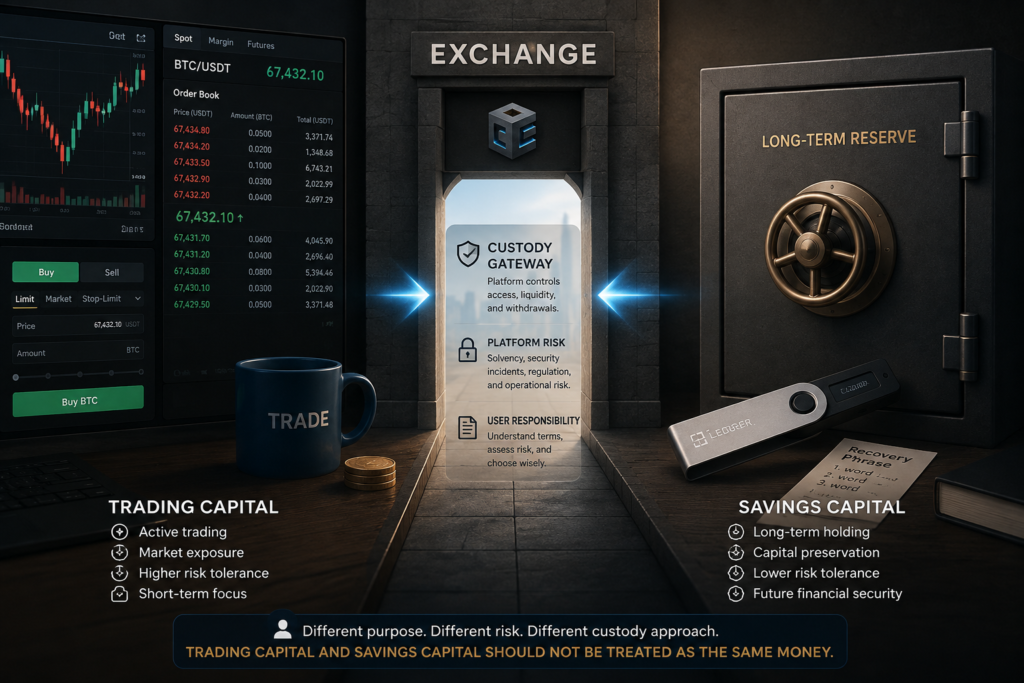
Crypto users often see an exchange balance and assume the number on the screen represents money they fully control. However, that assumption can break down when withdrawals stop, a platform fails, regulators intervene, or a custodian becomes insolvent. Understanding trading capital and savings capital therefore matters far more than simply deciding how much money to invest. Trading capital is money deliberately exposed to market and platform risk so you can trade. Savings capital is money you expect to preserve, access, and depend on later. Although both may appear inside the same exchange account, they do not carry the same purpose or acceptable level of risk.
The distinction becomes especially important in crypto because using an exchange usually means relying on a third party to control the private keys and provide access to your assets. The SEC’s investor education office warns that third-party custodians can expose users to loss of access if the custodian is hacked, shuts down, or enters bankruptcy.
Trading Capital and Savings Capital Serve Different Jobs
The simplest way to understand trading capital and savings capital is to ask what would happen if the money became unavailable tomorrow.
Trading capital is money assigned to an activity that already involves financial risk. A trader may use it to buy Bitcoin, rotate between assets, maintain a cash balance for opportunities, or manage short-term positions. Therefore, the owner should already expect volatility, losses, and execution risk.
Savings capital serves a different purpose. It may represent emergency money, future rent, tuition, a home deposit, retirement funds, business reserves, or capital needed for a predictable expense.
Consequently, trading capital and savings capital should not automatically share the same risk environment.
A person who loses access to trading funds may suffer an investment loss. By contrast, someone who loses access to savings could face a wider financial problem. The consequences may include missed bills, delayed plans, or an inability to respond to an emergency.
That difference changes how custody should be evaluated.
Why Trading Capital and Savings Capital Can Look Identical on an Exchange
Exchange interfaces create an unusual psychological effect. Everything appears neat.
You may see:
| Balance type | What the screen shows | What actually matters |
|---|---|---|
| Trading funds | Dollar or crypto value | Market risk, liquidity, platform access |
| Long-term holdings | Dollar or crypto value | Custody, solvency, withdrawal access |
| Stablecoin balance | Dollar-like value | Issuer risk, platform risk, liquidity |
| Cash balance | Fiat value | Legal structure, banking arrangements, applicable protections |
Because every balance appears inside the same dashboard, users can easily treat trading capital and savings capital as equivalent.
Yet the interface does not tell the whole custody story.
With third-party custody, the custodian normally manages the private keys that control access to crypto assets. Moreover, some custodians may commingle assets or use deposited assets for lending or other activities, depending on their terms and structure. The SEC specifically advises investors to ask how custodians store assets, whether assets are commingled, and whether they engage in practices such as rehypothecation.
Therefore, a balance can look immediately accessible while still depending on systems outside the user’s control.
Custody Changes the Meaning of Trading Capital and Savings Capital
Custody means the arrangement through which crypto assets are stored and accessed.
When users hold crypto through self-custody, they control the private keys. However, they also assume responsibility for protecting those keys and recovery phrases. Losing them can permanently remove access to the assets.
An exchange creates a different trade-off.
Instead of managing keys personally, users depend on the platform.
That convenience helps explain why exchanges remain useful for trading capital. Users can move between markets quickly, place orders, convert currencies, and access liquidity.
However, savings capital introduces a harder question.
Do you want money needed for future financial security to depend on the continued operation of one trading platform?
That question matters because trading capital and savings capital face different tolerance levels for platform failure.
For active trading funds, exchange access may be necessary. For long-term savings, constant exchange access may offer little additional benefit while still exposing the holder to custody risk.
Here’s a detailed explanation of crypto asset custody.
Your Exchange Balance Is Also a Claim on Platform Access
A useful way to think about trading capital and savings capital is to separate economic value from operational control.
Suppose an exchange account displays $20,000.
The number tells you what the account currently attributes to you. However, access also depends on the platform processing your request.
Under normal conditions, that distinction feels irrelevant. You click withdraw, the transaction completes, and the system works as expected.
During a failure, however, the difference becomes obvious.
A platform may pause withdrawals because of a security incident, liquidity shortage, bankruptcy proceeding, technical failure, legal order, or internal risk controls. The SEC has previously warned that customers depositing crypto with certain entities may lose legal ownership rights or find themselves unable to recover assets when they want them, depending on the legal arrangement involved.
Therefore, trading capital and savings capital should be evaluated by more than account value alone.
The real question is whether the holder can still control or retrieve the asset when circumstances become difficult.
FTX Showed Why Platform Access Cannot Be Assumed
FTX provides one of the clearest real-world examples of why users should understand trading capital and savings capital.
Customers deposited funds on what had become one of the world’s best-known crypto exchanges. Yet prosecutors later proved that billions of dollars of customer funds had been misappropriated. In March 2024, founder Sam Bankman-Fried received a 25-year prison sentence after his conviction on multiple fraud and conspiracy charges. The Justice Department said he had repeatedly represented that customer deposits were safe and separated from company assets while billions were actually routed to Alameda Research.
The lesson extends beyond FTX itself.
A recognizable brand, large trading volumes, professional interface, or widely used mobile app cannot eliminate custody risk.
For someone who had only short-term trading capital on the platform, the collapse was already devastating.
For anyone who had treated the same exchange as a savings account, the financial consequences could become much more serious.
That is precisely why trading capital and savings capital deserve separate treatment.
Celsius Added Another Important Lesson About Ownership
Legal structure matters as much as technology.
During the Celsius bankruptcy, a U.S. bankruptcy court issued a January 2023 opinion concerning ownership of assets in the company’s Earn program. The case demonstrated how contractual terms can become central when determining who owns deposited crypto during insolvency proceedings.
In other words, the phrase “my crypto” can become legally complicated when a third party holds the assets under contractual terms.
This creates another reason to separate trading capital and savings capital.
Before leaving substantial assets with any custodian, users should understand whether they remain owners of specific assets, hold a contractual claim, or enter another legal relationship entirely.
That information normally appears in account agreements and custody terms rather than on the portfolio dashboard.
Trading Capital and Savings Capital Also Face Different Solvency Risk
Custody answers the question: who controls access?
Solvency answers another question: can the company meet its obligations?
Those risks overlap, but they are not identical.
A secure platform can still encounter financial trouble. Likewise, a financially healthy company can still suffer a cybersecurity failure.
Consequently, users considering trading capital and savings capital should evaluate several layers at once:
- Who controls the private keys?
- Can withdrawals be suspended?
- Are customer assets segregated?
- Can the platform lend or reuse customer assets?
- What happens during bankruptcy?
- What insurance, if any, actually applies?
- Which regulator oversees the relevant activity?
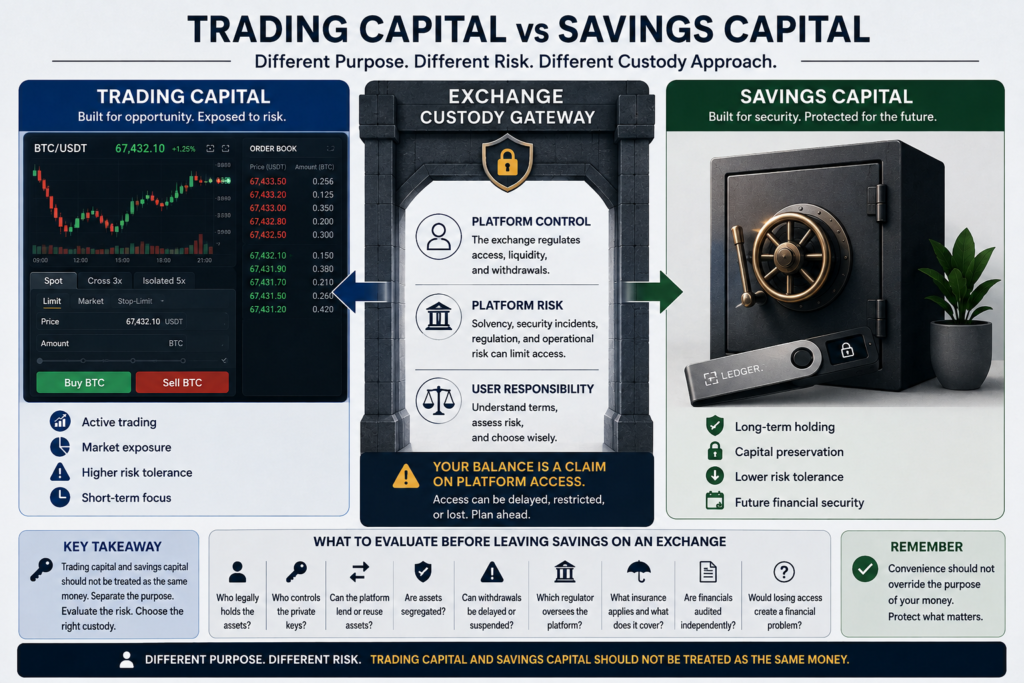
- Even proof-of-reserves reports do not answer every solvency question. The SEC has warned that proof-of-reserves reports are not equivalent to full financial-statement audits and may not provide enough information about liabilities or overall financial condition.
Therefore, a reserve snapshot alone should not determine where savings capital sits.
Why Bank Savings and Crypto Exchange Balances Are Not Equivalent
Another important difference between trading capital and savings capital appears when people compare exchange balances with ordinary bank deposits.
In the United States, qualifying deposit accounts at FDIC-insured banks receive federal deposit insurance up to applicable limits. The standard amount is $250,000 per depositor, per insured bank, for each ownership category. Crypto assets themselves do not receive FDIC deposit insurance.
Furthermore, FDIC insurance does not protect customers against the bankruptcy of a non-bank crypto exchange simply because that exchange works with an insured bank. The FDIC has explicitly warned that its insurance does not cover the default, insolvency, or bankruptcy of crypto custodians, exchanges, brokers, wallet providers, and other non-bank entities.
As a result, trading capital and savings capital require different assumptions about protection.
A dollar balance shown by a crypto platform should never automatically be treated as equivalent to an insured savings deposit.
Users need to verify the exact structure.
How Much Trading Capital Should Stay on an Exchange?
There is no universal amount.
However, the purpose of trading capital provides a useful starting point.
Money actively needed for orders, conversions, collateral, or near-term market activity may need to remain accessible on an exchange.
By contrast, money with no immediate trading purpose deserves a separate custody decision.
Therefore, separating trading capital and savings capital can work as a risk-management principle rather than a rigid formula.
For example, imagine a user has $30,000 in crypto-related assets.
They actively trade with $4,000. Another $6,000 represents long-term speculative holdings. Meanwhile, $20,000 has gradually accumulated as money they now consider personal savings.
Keeping the entire $30,000 in the same exchange account might feel convenient.
Yet convenience has quietly combined three different financial purposes into one custody risk.
Separating trading capital and savings capital forces the user to ask better questions about each portion.
Self-Custody Does Not Automatically Make Savings Capital Safe
Moving assets away from an exchange removes some platform risk.
However, it replaces that risk with personal operational responsibility.
The SEC notes that self-custody gives users complete control of their crypto assets, but it also makes them solely responsible for safeguarding private keys and seed phrases. Loss or theft of those credentials can permanently remove access.
Therefore, trading capital and savings capital should not become a simplistic “exchange bad, wallet good” discussion.
A user who cannot securely manage self-custody may create a different type of danger by moving everything off-platform.
Instead, the decision should consider competence, access needs, asset size, recovery planning, security practices, and the consequences of losing access.
Custody always moves responsibility somewhere.
The goal is to understand where it moves.
Read more about crypto safety and security.
A Practical Framework for Separating Trading Capital and Savings Capital
Users can make the distinction more useful by assigning every pool of money a job.
First, identify capital required for active trading.
Next, separate money that you may need within a defined period.
Then, identify long-term holdings that do not require daily liquidity.
Finally, evaluate each pool according to the consequences of failure.
This approach makes trading capital and savings capital easier to manage because the custody decision begins with financial purpose rather than convenience.
A simple test can help:
If this platform became inaccessible for six months, what would happen to my life?
If the answer involves missing rent, delaying education, losing an emergency buffer, or being unable to meet essential obligations, the money is probably functioning as savings capital rather than trading capital.
That distinction deserves attention before a crisis begins.
Trading Capital and Savings Capital Require Different Risk Expectations
Markets can recover after a price decline.
Platform access may not recover on the same schedule.
That difference is crucial.
Trading capital accepts market uncertainty as part of its purpose. Savings capital usually exists to reduce financial uncertainty elsewhere in life.
Therefore, placing both into exactly the same custody arrangement can create a mismatch between purpose and risk.
The deeper principle behind trading capital and savings capital is simple: money should face risks appropriate to the job you expect it to perform.
If money needs to remain available, preserving access matters alongside preserving value.
If money exists for speculation, greater volatility and platform exposure may be acceptable within limits.
Yet those decisions should remain deliberate.
Questions to Ask Before Leaving Savings on a Crypto Exchange
Before treating an exchange balance as savings, users should investigate the arrangement rather than relying on the interface.
Ask:
- Who legally holds the assets?
- Who controls the private keys?
- Can the platform lend or reuse customer assets?
- Does it segregate customer holdings?
- What happens if the company fails?
- Can withdrawals be delayed or suspended?
- Which regulator oversees the company?
- What insurance applies, and exactly what does it cover?
- Are financial statements independently audited?
- Would losing access create an immediate financial problem?
These questions turn trading capital and savings capital from abstract concepts into practical risk management.
Moreover, they encourage users to evaluate custody before they need liquidity.
Conclusion: Trading Capital and Savings Capital Should Not Be Treated as the Same Money
The main difference between trading capital and savings capital is purpose.
Trading capital exists to participate in markets. Therefore, it accepts volatility, execution risk, liquidity risk, and some degree of platform exposure.
Savings capital exists to preserve future financial flexibility. Consequently, reliable access matters just as much as the displayed balance.
Crypto exchanges remain useful because they offer liquidity, convenience, and market access. However, an exchange balance also depends on custody arrangements, solvency, regulation, technology, and platform controls.
Separating trading capital and savings capital does not eliminate risk. Instead, it helps users understand which risks they are taking and why.
The number on an exchange screen tells you what your account says you have.
Custody determines who can actually move it.
FAQs
What is the main difference between trading capital and savings capital?
Trading capital is money intentionally exposed to market risk for trading or investing activity. Savings capital is money intended to preserve financial security or meet future needs. Therefore, the acceptable custody and liquidity risks can differ significantly.
Can trading capital and savings capital stay on the same exchange?
They can, but doing so concentrates custody and platform risk. Users should consider what would happen if withdrawals stopped or the exchange failed before keeping both types of capital in one place.
Is money on a crypto exchange legally mine?
The answer depends on the platform, jurisdiction, product, and contractual terms. Some arrangements may give users direct ownership rights, while others can create different legal claims. Therefore, users should review custody and account agreements carefully.
Is self-custody better for savings capital?
Self-custody removes reliance on an exchange for private-key control. However, the user then becomes responsible for key security, backups, recovery, and transaction mistakes. Losing a private key or seed phrase can permanently remove access.
Are crypto exchange balances FDIC-insured?
Crypto assets themselves are not FDIC-insured. Furthermore, FDIC insurance does not protect customers from the failure of a non-bank crypto exchange simply because the company has a relationship with an insured bank.
Disclaimer
This article is for informational and educational purposes only. It does not provide financial, investment, legal, tax, or accounting advice. Cryptocurrency and digital asset markets involve risk, including possible loss of capital. Readers should conduct their own research before making any financial decision.