


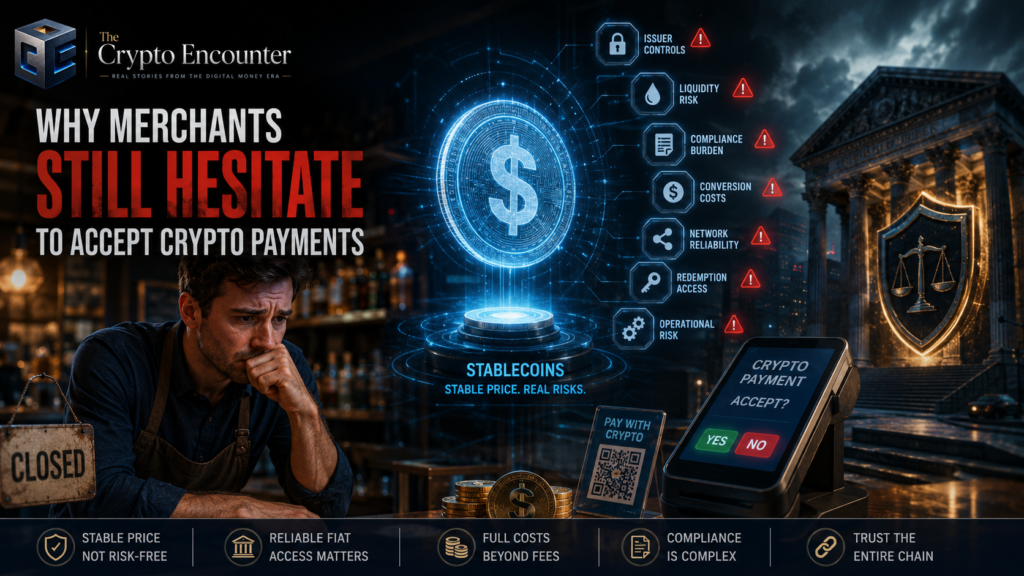
Crypto payments can offer merchants fast settlement, cross-border access, and an alternative to conventional payment rails. Stablecoins make that proposition practical because they aim to track fiat currencies rather than fluctuate like Bitcoin.
Yet merchants still hesitate because stable prices do not remove payment risk. The key questions are who issues the token, what supports it, and how redemption works. For broader crypto coverage, readers can also explore The Crypto Encounter.
The Merchant Risks Behind Crypto Payments
A merchant accepting crypto payments accepts more than a digital dollar. The business also depends on the token’s issuer, reserves, redemption process, blockchain, and conversion infrastructure.
The Financial Stability Board recommends clear redemption rights, transparent disclosures, governance, and risk controls for global stablecoin arrangements. Its recommendations also call for timely redemption and a legal claim against the issuer or reserve assets. Stablecoin payment risks appear when the route from receiving a token to accessing fiat becomes difficult.
Key Merchant Considerations When Accepting Crypto Payments
| Merchant Concern | What It Means for Crypto Payments |
| Stablecoin value | A stablecoin may target a fiat value, but this does not eliminate payment or redemption risks. |
| Redemption access | Merchants need reliable ways to convert stablecoins into usable fiat currency. |
| Issuer controls | Some arrangements may restrict transfers, freeze tokens, or apply compliance controls. |
| Liquidity | Limited liquidity can make conversion slower, harder, or more expensive. |
| Network reliability | Congestion or technical problems can delay otherwise valid transactions. |
| Compliance | Businesses may face screening, reporting, sanctions, and recordkeeping requirements. |
| Conversion costs | Fees, exchange spreads, and processor charges can reduce expected savings. |
| Operational continuity | Merchants need dependable access to funds after receiving stablecoins. |
Crypto Payments May Not Be as Free as They Look
Merchants can face a control issue that is easy to overlook. Some stablecoin arrangements can include issuer or administrator controls that affect how tokens are transferred or redeemed. As a result, crypto payments should not be treated like cash until businesses understand the rules governing the asset.
Businesses need to review blocklisting, redemption, and compliance policies before accepting stablecoins. Stablecoin payment risks can also come from blockchain infrastructure. Network congestion, technical failures, or problems affecting a supported chain can delay transfers or redemptions. A transaction can be recorded on-chain while access to usable funds remains dependent on other parts of the payment system.
Why Crypto Payments Add Compliance and Operational Work
Crypto payments can create additional compliance responsibilities. Businesses may need transaction monitoring, customer screening, tax records, sanctions controls, and procedures for suspicious activity.
Stablecoin payment risks become more visible when funds cross jurisdictions. A customer may send tokens from an overseas exchange or wallet while the merchant operates through a local bank. The transaction can settle on-chain while source-of-funds, reporting, sanctions, or conversion questions remain.
The Hidden Costs Behind “Cheap” Crypto Payments
Digital transactions may appear cheaper because they can bypass some intermediaries. However, merchants should consider the full payment route before assuming lower costs. A business using crypto payments can still face network fees, processor charges, exchange spreads, and compliance expenses.
Stablecoin payment risks therefore include liquidity and conversion friction. A token can remain near its target price while the merchant faces a costly or delayed path to bank money. The relevant question is whether the business can reliably turn received value into money it can use.
Why Stablecoin Payments Can Remain Difficult for Everyday Businesses
Before accepting digital payments, merchants should examine the issuer and reserve model, redemption rights, freeze and compliance policies, conversion costs, and the exact blockchain being used.

Stablecoin payment risks should be assessed against the business’s actual needs. A global digital service may value fast settlement more than a local shop using inexpensive bank transfers. The Bank for International Settlements explains that stablecoin designs differ according to reserve composition, redemption conditions, and regulatory arrangements. Its 2026 analysis also notes that money-like stablecoins would require strong redeemability and high-quality liquid reserves to support payment use. This distinction matters because merchants need reliability, not merely speed.
Regulation May Protect the System, But Not Every Payment
Regulation may make digital payments easier to evaluate by establishing requirements around reserves, redemption, disclosure, governance, and financial integrity. The BIS has emphasized the importance of reserve quality and redemption capacity when assessing stablecoin arrangements.
Regulation does not guarantee uninterrupted payments. Laws differ across jurisdictions, and compliance requirements can change. A merchant still needs to understand the specific issuer, processor, banking relationship, and jurisdiction involved.
Stablecoin payment risks are therefore legal and operational as well as technical. A regulated arrangement can still experience outages, delays, fraud, liquidity pressure, or restrictions on access.
A Stablecoin Peg Does Not Guarantee Payment Confidence
The concern is continuity. A payment is useful only when the seller can receive it, verify it, account for it, convert it when necessary, and use the proceeds.
That is why Stablecoin payment risks matter even when a token remains close to one dollar. Merchants are choosing between payment infrastructures with different costs and failure points.
For broader context on regulation and market risk, readers can explore How Crypto Regulation Is Becoming the Market’s Next Big Filter.
Conclusion
Crypto payments remain a cautious choice for many merchants because stable prices do not guarantee stable access to funds. Issuer controls, reserve quality, redemption, compliance, blockchain reliability, liquidity, and conversion all affect the payment experience.
Stablecoin payment risks should be evaluated before a business focuses on speed or convenience. Merchants should understand who controls the token, how it can be redeemed, what can cause restrictions, and how quickly proceeds can become usable cash.
Crypto payments may become more practical as infrastructure and regulation improve. Merchant adoption will depend less on hype and more on whether businesses can trust the complete payment chain.
FAQs
Are Stablecoins Risk-Free for Merchants?
No. They can reduce price volatility, but issuer, reserve, redemption, compliance, liquidity, and technical risks remain.
Can Stablecoin Payments Be Frozen?
Some stablecoin arrangements may include controls that restrict transfers or redemption under specified circumstances.
Do Digital Payments Always Cost Less?
No. Total costs can include network fees, processors, conversion spreads, compliance, and accounting.
Should Merchants Hold Stablecoins After Receiving Them?
That depends on liquidity needs, risk tolerance, conversion options, and operational requirements.
What Is the Biggest Merchant Concern?
Reliable access to usable funds. Fast blockchain settlement does not guarantee immediate fiat liquidity.
Disclaimer
This article is for educational purposes only and is not financial, legal, tax, accounting, or business advice. Crypto payments and stablecoins involve issuer, reserve, redemption, freeze, technical, fraud, compliance, liquidity, and regulatory risks. Merchants should independently verify applicable laws, provider terms, fees, redemption procedures, and operational requirements before accepting digital assets. Professional advice may be appropriate when payment decisions could materially affect a business, its customers, finances, or regulatory obligations. Conditions and protections can also vary between providers and jurisdictions.