


Crypto users often assume that moving assets into DeFi removes the risks associated with centralized custody. It can remove one intermediary, but it does not remove risk. Wrapped asset risks emerge when an asset is represented on another blockchain through smart contracts, bridges, custodians, liquidity pools, or other infrastructure. The result can be useful, but the user may inherit several new failure points.
The Crypto Encounter approach to crypto safety is simple: understand who controls an asset, what mechanism represents it, and what happens when that mechanism fails. This article explains the wrapped asset risks behind cross-chain liquidity, including smart-contract exploits, reserve failures, token approvals, liquidity shortages, and user mistakes.
Ethereum’s documentation also warns that bridges can introduce smart-contract, systemic financial, and counterparty risks.
What Are Wrapped Assets?
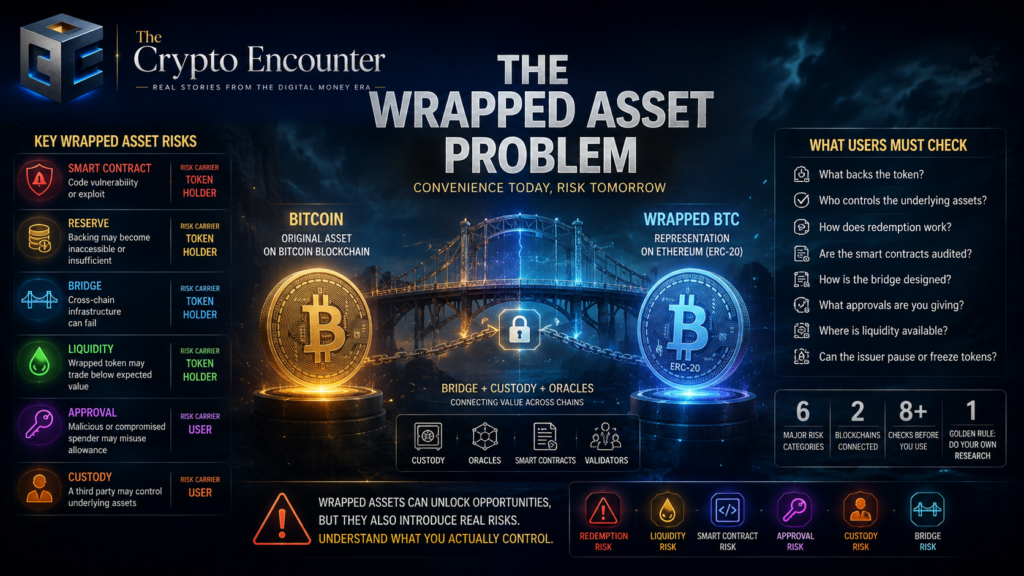
A wrapped asset represents an asset from one blockchain on another network. For example, BTC can be represented as an ERC-20 token on Ethereum while the original Bitcoin remains held elsewhere. This means owning the wrapped token does not necessarily provide direct control over the underlying asset.
As explained in Chainlink Research, the system depends on mechanisms that verify or communicate the backing. These dependencies create wrapped asset risks, including custody, verification, smart-contract, and cross-chain infrastructure risks.
Key Risks Behind Wrapped Assets
| Risk | What can go wrong | Who carries the risk? |
| Smart contract | Code vulnerability or exploit | Token holder |
| Reserve | Backing may become inaccessible or insufficient | Token holder |
| Bridge | Cross-chain infrastructure can fail | Token holder |
| Liquidity | Wrapped token may trade below its expected value | Token holder |
| Approval | A malicious or compromised spender may misuse allowance | User |
| Custody | A third party may control underlying assets | User |
Why Wrapped Asset Risks Are Different From Exchange Custody Risk
A centralized exchange concentrates custody, withdrawals, and account access under one company, while DeFi shifts reliance toward smart contracts, bridge validators, token issuers, liquidity providers, oracles, and user decisions.
This does not automatically eliminate risk. As Ethereum’s bridge documentation explains, bridges can introduce smart-contract and counterparty risks. A wrapped token may remain visible in a wallet even when its backing or redemption mechanism weakens.
If reserves become uncertain, liquidity disappears, or redemption is interrupted, the token may no longer maintain its expected value. These wrapped asset risks show why token representation does not always equal direct ownership.
How Wrapped Asset Risks Can Become User Losses
Consider a simple scenario.
A user holds BTC and converts it into a wrapped version to access a lending protocol. The transaction works. The token appears in the wallet. The user deposits it into a DeFi application and earns yield.
Then the bridge or wrapping system suffers an exploit.
The user may still see tokens in the wallet, but the market may begin pricing them below the underlying BTC because confidence in redemption has weakened. If liquidity providers withdraw, selling becomes harder. If the protocol pauses withdrawals, the user can face another layer of exposure.
This is the central lesson of wrapped asset risks: technical functionality does not guarantee economic equivalence.
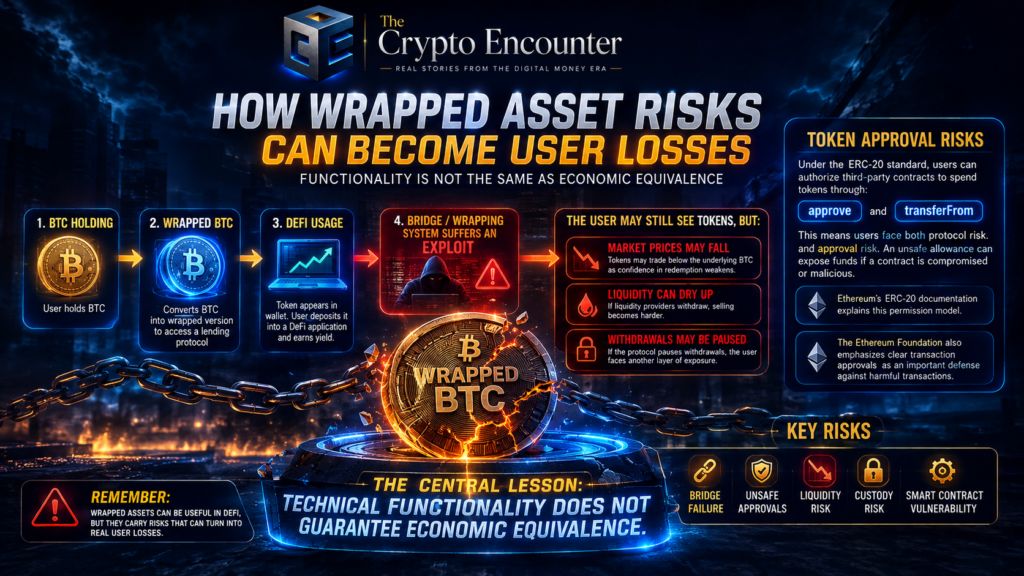
Token approvals add another layer of risk when using wrapped assets. Under the ERC-20 standard, users can authorize third-party contracts to spend tokens through approve and transferFrom, as explained in Ethereum’s ERC-20 documentation. That means users face both protocol risk and approval risk. An unsafe allowance can expose funds if a contract is compromised or malicious. The Ethereum Foundation also emphasizes clear transaction approvals, making informed confirmation an important defense against harmful transactions.
The Hidden Liquidity Problem
A wrapped token can maintain a close market price while liquidity is healthy. That does not mean the price relationship is guaranteed.
During market stress, traders may rush to exit simultaneously. Liquidity providers can withdraw capital. Arbitrage becomes more difficult. Redemption mechanisms can slow down.
The result can be a gap between the wrapped token’s market price and the underlying asset.
This is one of the most important wrapped asset risks because users often confuse “backed” with “immediately liquid.”
Backing answers one question: what is supposed to support the token?
Liquidity answers another: can you actually sell or redeem it when you need to?
Those are different questions.
What Users Should Check Before Wrapping Crypto
Before using a wrapped asset, users should examine:
- Backing: What exactly supports the token?
- Custody: Who controls the underlying assets?
- Redemption: Can holders redeem directly, and under what conditions?
- Smart contracts: Has the relevant code been independently audited?
- Bridge design: Does the system rely on validators, multisignatures, or centralized operators?
- Approvals: What spending permission does the transaction request?
- Liquidity: Where can the wrapped asset be traded or exited?
- Failure controls: Can the issuer pause, freeze, mint, or upgrade the token?
These checks help users assess different wrapped asset risks rather than assuming decentralization automatically means safety. Audits can reduce uncertainty but cannot eliminate vulnerabilities. For broader context, readers can explore What They Never Told You About the Security of Cryptocurrencies, which examines security risks crypto users may overlook.
Why Decentralization Does Not Eliminate Wrapped Asset Risks
The strongest misconception is that removing a company removes trust.
In reality, trust often moves.
A centralized exchange asks users to trust a business. A wrapped asset may ask users to trust code, custodians, validators, bridges, liquidity providers, oracles, and governance processes.
That can be a better fit for some users, but it creates a different risk map.
The user also carries more responsibility. A mistaken approval, incorrect contract interaction, or transfer to an incompatible address can become irreversible. Ethereum itself documents cases where ERC-20 tokens can become permanently stuck when sent incorrectly to contracts.
The deeper issue is therefore control. Users need to understand not just where their token sits, but what must continue working for that token to retain its expected value.
Conclusion
The wrapped asset risks behind DeFi are easy to overlook because the user experience can feel simple. A token appears in a wallet, a protocol accepts it, and a balance changes on-chain. Underneath that simplicity may sit custody arrangements, bridge infrastructure, smart contracts, approvals, liquidity assumptions, and redemption mechanisms.
Wrapped assets can make blockchain ecosystems more interoperable and useful. They do not make the underlying risks disappear.
The safest mental model is to treat every wrapped token as a system, not merely a coin. Ask what backs it, who controls that backing, how redemption works, what contracts you approve, and what happens if liquidity or infrastructure fails.
Wrapped asset risks are ultimately about understanding what you actually control. In DeFi, that distinction can matter more than the balance displayed on the screen.
FAQs
Are wrapped assets safe?
No asset is automatically safe because it is decentralized. Safety depends on the token design, custody model, smart contracts, bridge, liquidity, and user behavior.
Can a wrapped token lose its peg?
Yes. Weak liquidity, redemption problems, reserve concerns, or infrastructure failures can cause a wrapped token to trade below its expected underlying value.
What is the biggest wrapped asset risk?
There is no single universal risk. Smart-contract vulnerabilities, bridge failures, custody problems, liquidity shortages, and unsafe approvals can all create losses.
Does proof of reserves eliminate risk?
No. Proof of reserves can improve transparency around backing, but it does not automatically eliminate smart-contract, custody, liquidity, governance, or market risks.
Disclaimer
This article is for general educational and informational purposes only and does not constitute financial, investment, legal, or technical advice. Wrapped assets, bridges, smart contracts, liquidity pools, and token approvals carry risks, including exploits, custody failures, liquidity problems, and irreversible transactions. Readers should conduct independent research, review official protocol documentation, and understand potential risks before using any DeFi application or wrapped asset. The Crypto Encounter does not guarantee the security, performance, accuracy, or future value of any asset, protocol, or platform discussed.