


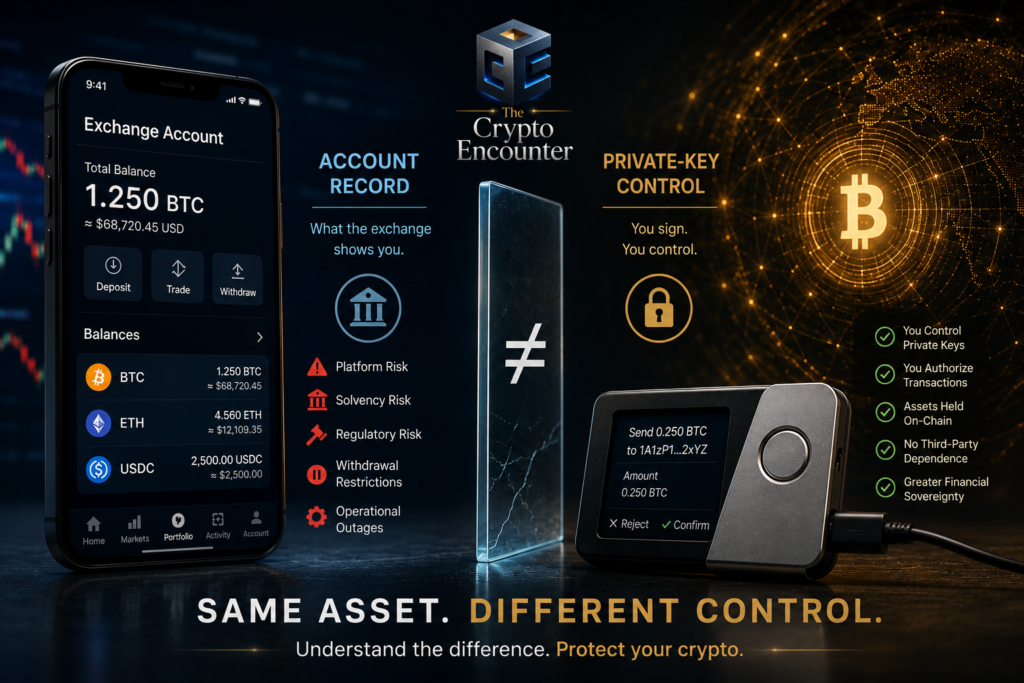
An exchange balance can make crypto ownership feel simple. You open an app, see a Bitcoin balance, and assume those coins sit in a personal digital account under your control. However, the screen shows what the exchange says it owes or holds for you. The platform usually controls the private keys, processes withdrawal requests, maintains the internal ledger, and decides when transactions can proceed.
Therefore, your exchange balance is not the same as holding crypto in a wallet that you independently control. You may have a legal or contractual claim to the assets. Yet your access still depends on the exchange’s custody system, solvency, security, compliance procedures, technical availability, and account rules.
That distinction matters most when something goes wrong.
Key Takeaways
- An exchange balance usually represents an entry in the platform’s internal records.
- The exchange normally controls the private keys needed to move the underlying crypto.
- Withdrawals can stop because of outages, security reviews, legal orders, liquidity problems, insolvency, or account restrictions.
- Crypto assets do not receive the same general deposit-insurance protection as money in an insured bank account.
- Self-custody gives users greater control, although it also transfers security and recovery responsibilities to them.
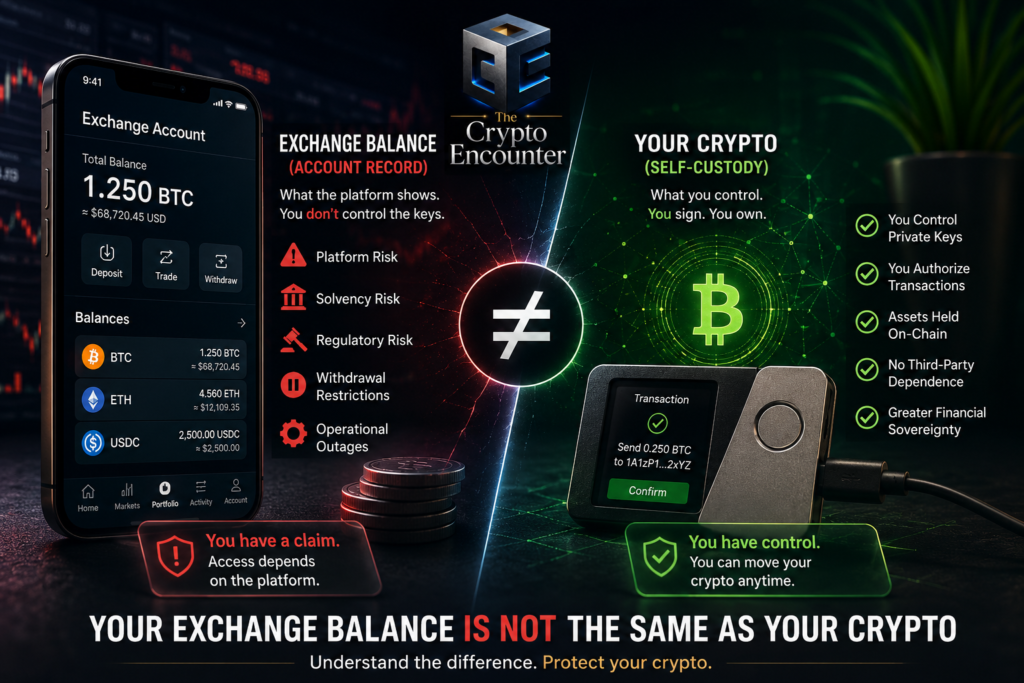
An exchange balance shows what a platform records for your account, while self-custody gives you direct control through your private keys.
What an Exchange Balance Actually Represents
When you buy Bitcoin through a centralized exchange, the platform may not create a separate blockchain address containing your exact coins. Instead, it can hold customer assets across shared wallets while recording each customer’s entitlement on an internal database.
As a result, your exchange balance is often an accounting entry.
Coinbase’s User Agreement explains that customer digital assets remain the customer’s property while Coinbase acts as the custodian and controls the private keys until assets are withdrawn.
For example, suppose you buy 0.1 BTC. The exchange updates your account to show 0.1 BTC. However, it may hold your entitlement within a larger wallet that contains Bitcoin for thousands of customers. Your name does not normally appear on the Bitcoin blockchain, and the blockchain may not show a separate transaction for your purchase.
Coinbase’s current U.S. user agreement illustrates this custodial model. It says customer digital assets remain customer property. Nevertheless, Coinbase retains control over the private keys while the assets remain on its platform. The agreement also says Coinbase may use shared blockchain addresses rather than creating a separate address for each user.
This model can make trading faster and cheaper. Internal transactions do not always require an immediate blockchain settlement. Still, the exchange balance depends on the platform’s records and operational integrity.
Why Your Exchange Balance Is Not the Same as Your Crypto
A crypto asset moves on its blockchain when someone signs a valid transaction using the relevant private key. Therefore, control of that private key determines who can technically authorize movement.
With a custodial exchange account, the exchange controls that key.
You can request a withdrawal. However, you do not personally sign the blockchain transaction. Instead, the platform reviews your request and, if approved, signs and broadcasts the transaction on your behalf.
Consequently, your exchange balance gives you a claim and an interface, but not direct cryptographic control.
That difference creates two separate forms of ownership:
| Form of control | What it means |
|---|---|
| Account entitlement | The exchange’s records show that it holds or owes a certain amount for your benefit. |
| Private-key control | You possess the credentials required to authorize an on-chain transaction without the exchange. |
A reputable exchange may legally recognize your ownership and maintain strong safeguards. Even so, your ability to use the exchange balance remains subject to the exchange’s systems, policies, and legal obligations.
Who Controls the Crypto Behind Your Exchange Balance?
A centralized exchange controls several important layers between you and the blockchain.
First, it controls the private keys. Second, it controls the account database. Third, it controls withdrawal processing. Finally, it decides how to respond to security incidents, blockchain disruptions, asset migrations, and regulatory demands.
Some exchanges state that customers retain legal title to assets held in custody. That protection matters. However, legal title and immediate operational control do not mean the same thing.
Coinbase, for instance, states that customers control the digital assets credited to their wallets. Yet its agreement also makes withdrawals subject to factors such as outages, downtime, blockchain requirements, processing time, and applicable policies. The exchange continues to control the associated private keys until the customer withdraws the assets.
Therefore, an exchange balance can represent an asset that belongs to you legally while remaining under another party’s technical control.
Five Ways Access to an Exchange Balance Can Fail
1. The Exchange Pauses Withdrawals
An exchange may pause withdrawals during maintenance, network congestion, wallet upgrades, suspected attacks, or unusual market conditions.
Sometimes, a short pause protects customers. Nevertheless, the result remains the same: you cannot move the exchange balance when you choose.
Additionally, an exchange may support trading while suspending withdrawals. In that situation, your app still shows the asset, and you may even buy or sell it internally. Yet you cannot settle it to an external wallet.
2. The Platform Faces a Liquidity Shortfall
An exchange may show customer liabilities correctly while lacking enough immediately available assets to meet every withdrawal request.
This problem can arise when a platform lends customer assets, posts them as collateral, stores funds with another company, or keeps too little liquidity available. A sudden wave of withdrawals can then expose the shortfall.
A healthy-looking exchange balance does not reveal whether the platform can satisfy all customers at once.
Proof-of-reserves reports may provide useful information about assets. However, reserves alone do not always show every liability, off-chain obligation, borrowing arrangement, or related-party exposure. Users should examine what a report covers, who verified it, when the snapshot occurred, and whether liabilities received equal scrutiny.
3. The Exchange Becomes Insolvent
Insolvency turns an account-access problem into a legal process.
The collapse of FTX showed how sharply an exchange balance can differ from accessible crypto. According to the U.S. Department of Justice, FTX founder Sam Bankman-Fried misappropriated billions of dollars in customer funds after telling customers that their deposits remained safe and separate. A federal judge later sentenced him to 25 years in prison. The U.S. Department of Justice’s FTX case provides the official details of the criminal proceedings and explains how customer assets were misused.
Exchange custody also plays an important role whenever large holders move assets between platforms. Our analysis of How Bhutan Raises a Huge Sovereign Treasury Question with $34.5M Bitcoin Move to Binance explores why custody decisions can attract market attention.
Customers could see numbers in their accounts before the collapse. However, those numbers did not ensure that equivalent assets remained available for withdrawal.
Bankruptcy can also delay recovery. Courts, administrators, creditors, and applicable laws determine how claims receive treatment. Therefore, even customers who eventually recover money may wait months or years and may not receive the same assets they originally deposited.
4. Regulators or Courts Restrict the Account
Exchanges must follow the laws that apply in their operating jurisdictions. Consequently, they may freeze an account after receiving a court order, sanctions instruction, garnishment notice, law-enforcement request, or regulatory directive.
Compliance systems can also flag transactions automatically. A platform may request identity documents, explanations of fund sources, or additional verification before restoring access.
Thus, the exchange balance may remain visible while transfers stay blocked.
Such restrictions do not automatically mean the exchange has failed. Instead, they show that access through a regulated intermediary depends on more than possession of a password.
5. The User Loses Account Access
Platform risk is only one side of the issue. Customers can also lose access through:
- Compromised email accounts
- Stolen passwords
- SIM-swapping attacks
- Failed identity verification
- Lost two-factor authentication devices
- Disputed account ownership
- Phishing scams
- Violations of platform terms
In each case, the exchange balance may still exist in the platform’s records. However, the user may struggle to prove the right to control it.
An Exchange Balance Is Not a Bank Deposit
Many users interpret a crypto app through the mental model of online banking. Both systems show a balance, transaction history, and withdrawal button. Still, their legal and insurance structures differ.
The Federal Deposit Insurance Corporation states that crypto assets are not FDIC-insured products. FDIC protection generally applies to eligible deposits at insured banks, not to the market value or loss of crypto assets.
An exchange may hold some customer cash at insured banking institutions. However, that arrangement does not automatically insure the customer’s Bitcoin, Ether, or other crypto. Moreover, pass-through insurance for cash can depend on how the funds sit, how records work, and whether all legal conditions have been met.
Therefore, users should never assume that an exchange balance carries the same protection as an insured checking or savings account.
Custody, Solvency, and Liquidity Are Different Risks
People often combine several exchange risks into one general question: “Is the platform safe?” A better assessment separates three issues.
| Risk | Main question | Possible consequence |
|---|---|---|
| Custody risk | Can the exchange protect the private keys and prevent unauthorized transfers? | Theft or loss of assets |
| Solvency risk | Does the exchange own enough assets to cover what it owes? | Customer claims exceed available assets |
| Liquidity risk | Can the exchange meet withdrawal demands when customers request them? | Delayed or suspended withdrawals |
| Operational risk | Do the platform’s systems and staff work reliably? | Outages, errors, or transaction delays |
| Legal risk | Can laws, courts, or regulators restrict access? | Account freezes or regional service changes |
A platform may perform well in one category and poorly in another. Strong cybersecurity, for example, cannot solve a hidden balance-sheet deficit. Likewise, complete reserves do not prevent an account freeze or identity dispute.
For that reason, evaluating an exchange balance requires more than asking whether the app uses cold storage.
Does Self-Custody Solve the Problem?
Self-custody removes the exchange from the authorization process. When you control a wallet’s private keys or recovery phrase, you can generally initiate transactions directly.
Accordingly, the asset no longer depends on an exchange balance or the platform’s internal ledger.
Still, self-custody introduces different risks. You must protect the recovery phrase, verify recipient addresses, avoid malicious wallet software, understand transaction fees, and maintain a recovery plan. If you lose the keys, no customer-support department can simply reset them.
The U.S. Securities and Exchange Commission’s investor guidance describes custody as the method used to hold and safeguard crypto assets. It also encourages retail investors to consider how different custody choices work before deciding how to hold assets.
Therefore, self-custody offers control, not automatic safety.
When Keeping an Exchange Balance May Make Sense
Centralized exchanges serve practical purposes. Active traders need fast execution. New users may prefer managed account recovery. Some customers also value fiat deposits, tax records, limit orders, and regulated access.
Consequently, keeping an exchange balance is not inherently irresponsible.
The more useful question is whether the amount and duration match the reason for using the exchange.
For example, a trader may keep a limited amount on a platform for planned transactions. Meanwhile, that person may store longer-term holdings in a separate wallet. This approach limits exposure without abandoning exchange services.
However, every user must assess personal capability. Moving funds to self-custody without understanding wallet security can replace platform risk with a serious risk of permanent personal error.
How to Reduce Exchange Balance Risk
No checklist can eliminate every risk. Nevertheless, several steps can reduce unnecessary exposure:
- Read the custody terms. Check whether the platform says customer assets remain customer property and whether it may lend, pledge, or reuse them.
- Test withdrawals early. Send a small amount to a controlled wallet before relying on the platform for larger transfers.
- Use strong account security. Prefer an authenticator app or security key over text-message authentication.
- Review proof-of-reserves carefully. Look for liabilities, independent verification, scope, frequency, and limitations.
- Avoid keeping unnecessary funds online. Match the exchange balance to your actual trading or payment needs.
- Save account records. Download transaction histories, deposit confirmations, and withdrawal records.
- Understand local protections. Custody and bankruptcy treatment vary by jurisdiction.
- Build self-custody skills gradually. Practice with a small amount before transferring significant value.
Most importantly, do not wait for a crisis before learning how withdrawals work.
Your Exchange Balance Is a Promise Plus a System
An exchange balance combines several layers. It includes the platform’s promise to recognize your entitlement, its accounting system, its custody arrangements, its available liquidity, its security controls, and the legal framework around the account.
Usually, those layers work quietly. Users deposit, trade, and withdraw without trouble. As a result, the distinction between account credit and direct crypto control can seem theoretical.
However, during a hack, insolvency, freeze, outage, or legal dispute, the distinction becomes immediate.
The number on the screen tells you what the exchange records. It does not, by itself, prove that you can move the same amount on-chain at any moment.
Frequently Asked Questions
Is an exchange balance real crypto?
An exchange balance can represent a valid custodial entitlement to real crypto. However, the exchange usually controls the private keys and processes withdrawals. Therefore, you do not have the same direct control that you would have in a self-custody wallet.
Do I legally own crypto held on an exchange?
The answer depends on the platform’s agreement and the law governing the account. Some exchanges state that customers retain legal title. Nevertheless, legal ownership does not guarantee uninterrupted access or immediate withdrawal.
Can an exchange use my crypto?
Policies differ. Some custodial agreements prohibit lending or pledging standard customer assets, while other products may expressly involve lending, staking, collateral, or rehypothecation. Review the terms for the exact account and product.
Is my exchange balance FDIC-insured?
Crypto assets generally do not receive FDIC deposit insurance. Certain cash balances may qualify for pass-through coverage under specific arrangements, but that protection does not insure the value of crypto assets.
Does proof of reserves guarantee withdrawals?
No. Proof of reserves can show certain assets at a particular time. However, users also need information about liabilities, borrowing, asset ownership, liquidity, and verification methods. A reserve snapshot cannot guarantee future access.
Should everyone move all crypto off exchanges?
No single custody choice fits everyone. Self-custody increases control but also places key security and recovery on the user. A risk-based approach may involve keeping transactional funds on an exchange while securing longer-term holdings separately.
Conclusion
Your exchange balance is useful, but it should not be confused with direct control over crypto. The platform manages the private keys, records your entitlement, approves withdrawals, and responds to legal or technical events. Therefore, access depends on more than the number displayed in your account.
Before holding significant value on any platform, examine its custody terms, withdrawal rules, financial transparency, security practices, and legal protections. At the same time, learn the responsibilities that come with self-custody.
Ultimately, understanding why your exchange balance is not the same as your crypto helps you choose custody deliberately rather than discovering the difference during a crisis.
Continue exploring our Bitcoin coverage for broader market context.