

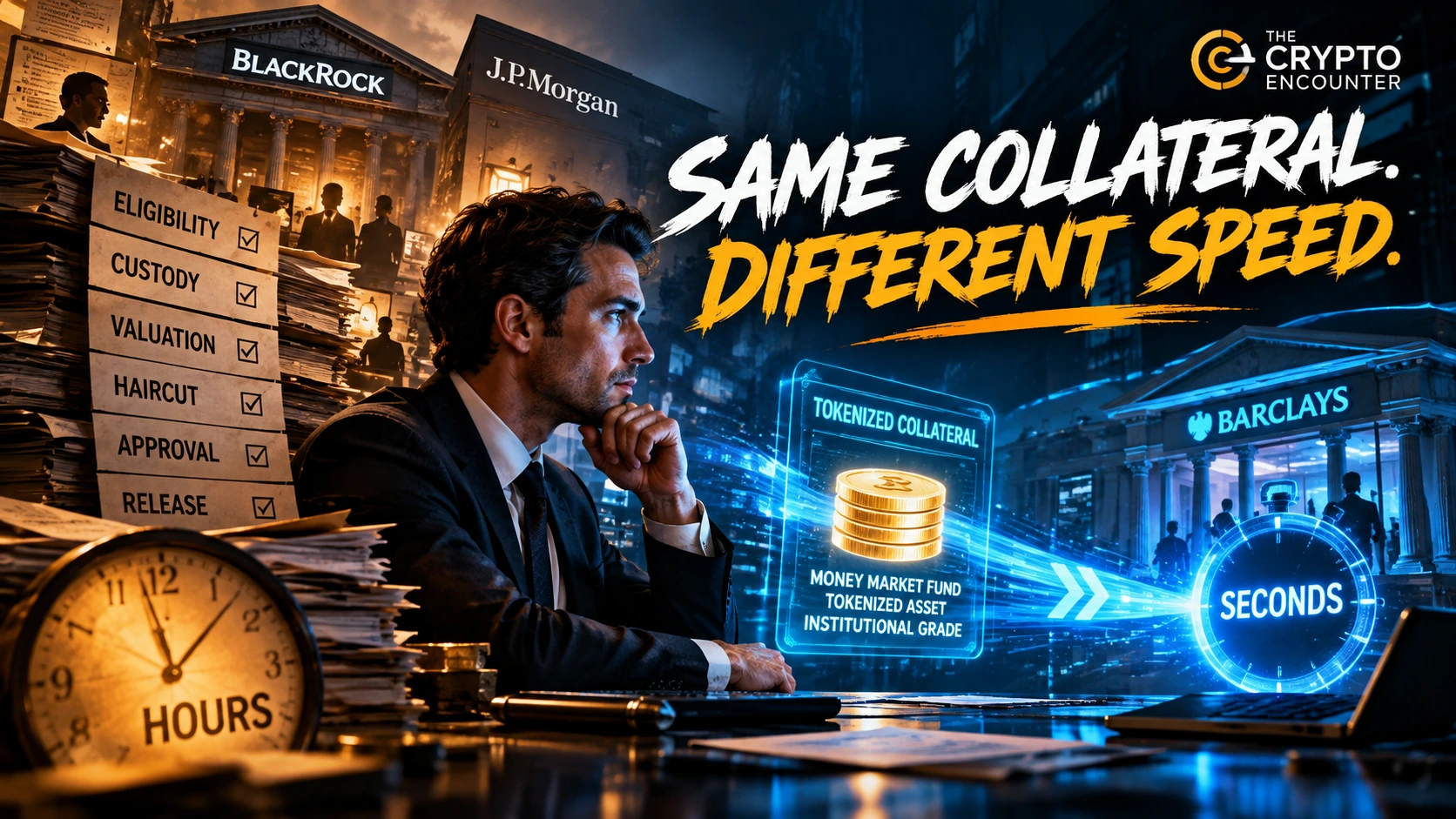
Dubai, United Arab Emirates: A collateral asset can now move across blockchain infrastructure in seconds. That does not mean the collateral process takes seconds.
The distinction sounds small. In institutional finance, it changes almost everything about how the tokenization story should be judged.
In October 2023, BlackRock used J.P. Morgan’s Tokenized Collateral Network to tokenize shares in one of its money market funds and transfer those interests to Barclays as collateral for an over-the-counter derivatives transaction. It was a live transaction involving major financial institutions, not a laboratory demonstration.
The technological achievement was significant. An asset that traditionally might have needed to be redeemed into cash before being mobilized against another obligation could instead remain invested and be transferred in tokenized form.
But a question raised by treasury and digital-assets professional Roman Murtazin in response to The Crypto Encounter’s earlier analysis of tokenized collateral mobility exposes the more important test.
Can we follow one collateral position through the entire chain:
- eligibility;
- custody and control;
- valuation and haircut;
- acceptance against the obligation;
- and eventual release or substitution?
And if we can, exactly where does tokenization save time?
The answer is more revealing than either the industry’s biggest claims or its harshest criticism.
A two-second settlement does not create a two-second collateral process.
Blockchain can dramatically compress some of the waiting between institutions. It cannot automatically eliminate the decisions those institutions must make before, during and after the asset moves.
What Did BlackRock, Barclays and J.P. Morgan Actually Do?
The October 2023 transaction remains one of the cleanest real-world examples of tokenized collateral moving beyond a proof of concept.
BlackRock used J.P. Morgan’s Tokenized Collateral Network, then part of its Onyx blockchain infrastructure, to tokenize shares in a money market fund. Those tokenized interests were transferred to Barclays to satisfy collateral requirements associated with an OTC derivatives transaction.
Contemporary reporting on the transaction described it as J.P. Morgan’s first live blockchain-based collateral settlement involving clients.
That matters because the token was not simply created and left sitting in a wallet as a technological demonstration.
It performed a financial job.
The money market fund position became collateral supporting another obligation.
This is precisely the shift The Crypto Encounter identified in its analysis of Wall Street’s growing real-world asset tokenization market: issuance is only the beginning. Tokenized assets become economically more interesting when they can participate in collateral, credit, settlement and liquidity workflows.
Where Did Tokenization Actually Save Time?
The clearest answer is collateral mobilization and settlement.
In a conventional workflow, an institution holding a money market fund position may need to redeem the fund interest, wait for the appropriate operational processes, receive cash and then move that cash into the account or infrastructure where it can satisfy a margin requirement.
The tokenized model can potentially remove several of those sequential movements.
Instead of converting an eligible investment into another asset simply because the collateral infrastructure cannot use what the institution already owns, the position itself can become mobile.
That is a genuine efficiency.
It can also reduce opportunity cost because an institution may be able to keep capital invested in a yield-bearing instrument rather than moving prematurely into idle cash.
But settlement is only one stage of collateral management.
To understand what tokenization has really changed, the transaction needs to be pulled apart.
Stage One: Who Decides Whether the Asset Is Eligible Collateral?
Tokenization does not answer the first question in the collateral process:
Will the receiving institution accept this asset?
A money market fund share does not become acceptable collateral merely because a blockchain can transfer it quickly.
The receiver still needs to consider the underlying asset, contractual documentation, liquidity, credit characteristics, concentration limits, jurisdiction, legal enforceability and its own risk policies.
This is not an incidental detail. It is one of the core regulatory issues surrounding tokenized collateral.
The U.S. Commodity Futures Trading Commission’s tokenized-collateral guidance explicitly addresses eligible tokenized assets, legal enforceability, segregation, custody and control, haircuts, valuation and operational risk.
The logic is straightforward.
If a Treasury security is acceptable collateral under a particular agreement, representing it digitally may improve how it is transferred.
If an illiquid or contractually prohibited asset is unacceptable collateral, putting it on a blockchain does not repair the underlying problem.
Tokenization can make an eligible asset move faster. It does not make an ineligible asset eligible.
Stage Two: Does Blockchain Solve Custody and Control?
This is where the technological case becomes stronger, but not absolute.
Traditional collateral management often involves assets sitting across custodians, accounts, legal entities and market infrastructures.
An institution can own high-quality collateral and still struggle to put it in the right place quickly enough to satisfy an obligation.
Tokenization can change the mechanics of control and movement.
A properly structured tokenized asset can provide a shared record of ownership or control, make transfer instructions more immediate and reduce reconciliation between separate ledgers.
That is especially important because ownership and control are not always the same thing.
The Crypto Encounter has examined that distinction at the retail level in The Difference Between Owning Crypto and Controlling Crypto. Institutional collateral turns the same question into a legal and operational problem measured in potentially billions of dollars.
The CFTC’s framework makes the remaining constraint clear. Tokenized collateral still requires legally enforceable custody and control arrangements.
The blockchain record may tell participants that a token moved.
The financial system must still know what rights moved with it.
Tokenization can change how fast control moves. It does not automatically change what control legally means.
Stage Three: Who Values the Collateral and Decides the Haircut?
This is one of the strongest examples of an institutional bottleneck that blockchain cannot simply erase.
Suppose an institution needs $10 million of collateral.
Posting $10 million of an asset does not necessarily satisfy that requirement.
The receiving institution may apply a haircut because the asset could lose value before it can be liquidated.
A highly liquid government security may receive relatively favorable treatment. A more volatile or illiquid asset may need a substantially larger haircut.
Someone still has to determine:
- the current value of the asset;
- the reliability of the price source;
- its liquidity;
- its credit and market risk;
- the appropriate haircut;
- concentration limits;
- and whether market conditions require those parameters to change.
The CFTC’s guidance is revealing here because it does not propose throwing traditional risk management away. It says tokenized collateral should be subject to risk-based haircuts linked to the underlying asset, with adjustments where settlement, credit, market or liquidity risks differ.
That tells us something important about institutional tokenization.
The blockchain can carry the asset.
It can potentially carry the valuation data.
A programmable system may even apply an agreed haircut automatically.
But the methodology behind the haircut remains a risk decision.
Technology can automate a policy once the policy exists. It does not decide what an institution’s risk appetite should be.
Stage Four: When Does the Tokenized Asset Actually Become Collateral?
This is where the BlackRock-Barclays transaction becomes particularly valuable as evidence.
The tokenized money market fund interests were not merely transferred between blockchain addresses. They were transferred to Barclays as collateral supporting an OTC derivatives trade.
The asset therefore crossed the boundary between digital representation and financial utility.
Once eligibility, documentation and the necessary institutional controls were satisfied, tokenization could compress the actual movement.
This is one reason tokenized money market funds are strategically important.
They can combine relatively stable value, yield and institutional familiarity with digital transferability.
That same relationship between collateral and usable liquidity is emerging elsewhere in digital finance. The Crypto Encounter’s examination of on-chain credit used to finance card settlement shows how the ability to mobilize capital without selling the underlying position can change the economics of financial products.
The institutional version is far larger.
If a fund, Treasury position or other eligible security can remain economically productive while simultaneously supporting a margin requirement, the asset becomes more useful without necessarily becoming riskier.
Stage Five: What Happens When the Collateral Needs to Be Released or Replaced?
This is where the public evidence becomes much thinner.
The Crypto Encounter found strong public documentation showing that BlackRock’s money market fund shares were tokenized and transferred to Barclays as collateral.
We did not find sufficiently detailed public documentation tracing that same collateral position through its complete subsequent release or substitution lifecycle, with timestamps for every institutional approval and operational handoff.
That distinction matters.
It would be tempting to take evidence of rapid transfer and extrapolate it across the entire collateral lifecycle.
We cannot responsibly do that.
Tokenized systems can clearly be designed to support substitution and release. A smart contract could, for example, release pledged collateral once an obligation falls below a threshold or once replacement collateral has been accepted.
But technical capability is not the same thing as public evidence that every stage of a specific live transaction occurred automatically.
This is one of the most important findings of this investigation.
Public evidence is strongest where the token moves. It becomes weaker when we ask exactly how every institutional decision surrounding that movement was made.
DTCC’s Experiments Show How Much Faster the Movement Layer Can Become
The evidence for settlement compression has strengthened considerably since the 2023 BlackRock-Barclays transaction.
In its Great Collateral Experiment, DTCC demonstrated live on-chain collateral movements, automated rule enforcement and settlement compressed from hours into seconds.
DTCC said the demonstration also provided shared visibility into collateral status and explored interoperability between tokenized assets, digitally native instruments, stablecoins, tokenized money market funds and Bitcoin.
By 2026, the discussion had moved closer to production infrastructure.
DTCC’s review of the Great Collateral Experiment argues that faster collateral mobility can reduce the time assets spend in transit or operational limbo, potentially lowering settlement uncertainty and improving capital efficiency.
DTCC has since moved toward production-scale tokenization infrastructure, including real production trades using DTC-tokenized assets in July 2026 ahead of a planned tokenization-service launch.
That is substantial progress.
But once again, the right question is not simply whether blockchain works.
It is which part of the financial process it makes better.
The Bottleneck Map: Where Does Tokenization Actually Help?
| Collateral Stage | Can Tokenization Accelerate It? | What Can Still Slow It Down? |
|---|---|---|
| Asset eligibility | Partly | Collateral agreements, regulation, counterparty policy, liquidity and risk limits |
| Custody and control | Materially | Legal enforceability, custody structure, segregation and jurisdiction |
| Valuation | Partly | Price sources, market liquidity, NAV timing and stress conditions |
| Haircut calculation | Execution can be automated | Risk methodology, regulation and counterparty requirements |
| Acceptance against obligation | Strongly after approval | Eligibility, documentation and authorization |
| Movement and settlement | Very strongly | Network access, interoperability and operational availability |
| Release and substitution | Potentially strongly | Approval conditions, obligation status, legal controls and legacy-system interfaces |
Why Settlement Speed Is Still Economically Important
Pointing out the remaining bottlenecks should not be confused with dismissing tokenization.
Moving collateral faster can have enormous economic value even when other parts of the process remain conventional.
Financial institutions hold liquidity buffers partly because they cannot assume that every asset they own will be available precisely where and when it is needed.
If collateral becomes more mobile, institutions may be able to use existing assets more efficiently.
Faster movement can also reduce the period during which counterparties are exposed to incomplete settlement.
It may make intraday financing more practical.
It can reduce the need to redeem yield-bearing assets into cash simply to satisfy an operational requirement.
And it can make collateral substitution less dependent on chains of messages among trading desks, custodians, settlement systems and operations teams.
DTCC’s 2026 research argues that near-real-time collateral mobility could help institutions reduce liquidity buffers and improve capital efficiency across global markets.
Those are not cosmetic improvements.
They attack genuine costs embedded in financial infrastructure.
But 24/7 Transferability Is Not the Same as 24/7 Liquidity
This distinction is essential.
A token may be technically transferable at 3 a.m.
That does not mean:
- there is a liquid market for the underlying asset at 3 a.m.;
- a fund administrator is calculating a new NAV;
- a redemption can be processed immediately;
- the underlying Treasury market is open;
- a human approval is available;
- or the receiving institution is willing to accept the collateral under current conditions.
The same distinction appears throughout digital finance.
Stablecoins, for example, can move on-chain continuously while the assets supporting them remain connected to banks, custodians, Treasury markets and money market funds. The Crypto Encounter’s investigation into who actually holds the dollars behind stablecoins shows why a fast token can still depend on slower institutional infrastructure.
Likewise, our analysis of whether stablecoins can replace traditional bank transfers found that faster settlement does not automatically reproduce every legal, operational and consumer-protection feature of bank money.
Tokenized collateral faces a comparable reality.
The digital rail can be continuous while parts of the financial system connected to it are not.
Interoperability Could Become the Next Bottleneck
There is another problem hiding behind faster settlement.
Financial institutions are unlikely to put every security, deposit, derivative, fund and collateral obligation on one blockchain.
Some systems will be permissioned.
Others will use public networks.
Some assets will remain inside conventional central securities depositories while tokens represent rights associated with them.
Different banks will use different infrastructures. Different jurisdictions will impose different rules.
That makes interoperability essential.
But interoperability introduces its own risks.
Crypto already provides an uncomfortable warning. The Crypto Encounter’s investigation into why blockchain bridges became such attractive targets for hackers showed what can happen when valuable assets depend on vulnerable mechanisms connecting separate networks.
Institutional tokenization cannot solve fragmentation by recreating bridge risk at financial-system scale.
The strongest future infrastructure may therefore be hybrid: tokenized assets moving across interoperable networks while regulated custodians, depositories and legal frameworks continue to anchor ownership and finality.
Legal Finality Matters More Than Blockchain Finality
A blockchain can confirm that Token A moved from Address X to Address Y.
That does not automatically answer what happens if one party becomes insolvent ten minutes later.
Institutional collateral requires answers to questions such as:
- Does possession of the token constitute legally enforceable control?
- Does the holder own the underlying asset or merely have a contractual claim?
- What happens in bankruptcy?
- Can another creditor challenge the security interest?
- Which jurisdiction governs the transaction?
- Can the collateral be liquidated immediately after default?
This is why regulatory treatment increasingly focuses not merely on blockchain technology but on legal enforceability, segregation, custody and control.
The technology may make settlement finality technically observable.
The legal system determines whether that finality survives a dispute.
Programmability May Ultimately Matter More Than Raw Speed
The most interesting long-term benefit may not be reducing a transfer from hours to seconds.
It may be reducing how many manual decisions and messages are needed before that transfer occurs.
Collateral agreements already contain rules.
An asset may need a minimum credit quality.
A counterparty may impose concentration limits.
Certain issuers may be excluded.
Different asset classes receive different haircuts.
A collateral pool may need to maintain a particular currency mix.
Substitution may be permitted only if the replacement asset satisfies specified conditions.
Today, those requirements can be distributed across contracts, risk systems, collateral-management software and operational teams.
Tokenized infrastructure can potentially make more of those conditions machine-readable.
A system could identify eligible collateral, obtain a valuation, apply the agreed haircut, verify ownership, reject an asset that breaches a concentration limit and initiate transfer once the conditions are satisfied.
That would attack latency before settlement, not merely settlement itself.
This is where tokenization could move from a faster pipe to a different operating model.
What Has Tokenization Actually Solved?
The evidence now supports several conclusions.
First, tokenization has demonstrated that regulated financial assets can be mobilized as collateral through blockchain infrastructure.
The BlackRock-Barclays transaction established that point in a live institutional setting.
Second, blockchain infrastructure can materially compress the transfer and settlement stage.
DTCC’s later experiments strengthened the evidence that collateral movements that traditionally take hours can be executed in seconds under properly designed digital infrastructure.
Third, tokenization can make yield-bearing assets more operationally useful.
An institution may not need to convert an eligible fund or security into cash merely because the collateral system cannot otherwise accommodate it.
Fourth, programmability creates a credible path toward automating parts of eligibility, valuation, haircut application and substitution.
But the evidence also tells us what tokenization has not solved.
It has not abolished collateral agreements.
It has not eliminated risk committees.
It has not removed valuation uncertainty.
It has not made every tokenized asset liquid.
It has not resolved every custody or bankruptcy question.
It has not made every financial institution interoperable.
And it has not turned every stage of the collateral lifecycle into an instantaneous process.
The Bigger 2026 Shift: From Proof of Concept to Financial Plumbing
The chronology matters.
In 2023, BlackRock, Barclays and J.P. Morgan demonstrated that a tokenized money market fund position could be used in a live collateral transaction.
Subsequent experiments expanded the discussion toward interoperability, programmable collateral and more complex asset environments.
By 2025, U.S. regulators were explicitly addressing tokenized collateral through frameworks covering eligibility, custody, control, valuation, haircuts and operational risk.
By 2026, DTCC was discussing production infrastructure, near-real-time collateral mobility and the capital-efficiency implications of tokenized markets.
In July 2026, DTCC also announced that DTC-held securities had been converted into tokens and used in real production trades ahead of the planned launch of its tokenization service.
The question is therefore changing.
It is no longer primarily:
Can Wall Street tokenize an asset?
That has been demonstrated repeatedly.
The harder question is:
Can the rest of the institutional machinery surrounding that asset become as responsive as the digital rail carrying it?
Why This Matters Beyond Wall Street
Collateral sounds like an obscure institutional-finance topic until its effects reach ordinary markets.
Collateral determines how much leverage financial institutions can support.
It affects liquidity.
It influences how quickly firms can respond to market stress.
It determines how much capital must sit idle as protection against operational delays.
It affects derivatives, repo markets, securities financing, clearing and increasingly digital-asset markets.
More efficient collateral does not guarantee safer finance. Greater efficiency can even encourage institutions to operate with smaller buffers if risk management becomes too optimistic.
That is why speed and resilience must be evaluated together.
The Crypto Encounter’s analysis of banks adding tokenization and new payment rails before legacy infrastructure disappears highlights the same broader challenge: financial modernization rarely replaces the old system overnight.
For years, old and new infrastructure coexist.
The costs, risks and bottlenecks often sit at the boundary between them.
The Crypto Encounter Take
Roman Murtazin’s question gets to the heart of how tokenization should now be evaluated.
Do not ask only whether the token moved faster.
Ask what had to happen before it was allowed to move, what happened while it moved, and what still had to happen afterward.
On that test, tokenized collateral is neither empty blockchain hype nor a finished financial revolution.
It is something more interesting.
It has already demonstrated a meaningful solution to one of institutional finance’s oldest problems: moving eligible collateral to where it is needed without unnecessarily dismantling the investment position first.
Settlement can become dramatically faster. Shared visibility can improve. Some operational rules can become programmable. Yield-bearing assets can become more mobile. Collateral can potentially operate beyond conventional settlement windows.
But the surrounding financial decisions remain stubbornly real.
Someone must decide what is eligible.
Someone must determine the haircut.
Someone must establish legally enforceable control.
Someone must value the asset during stress.
Someone must define when collateral can be released or substituted.
And regulators, counterparties and courts must recognize the rights that the technology claims to transfer.
Blockchain can remove the waiting between institutions. It cannot automatically remove the decisions inside them.
That may be the most useful way to understand where tokenization stands in 2026.
The race is no longer simply to put financial assets onchain.
It is to make the institutional system surrounding those assets capable of moving at something closer to the same speed.
Frequently Asked Questions
What is tokenized collateral?
Tokenized collateral is an asset represented or issued through distributed-ledger infrastructure that can be pledged to secure a financial obligation. Examples can include tokenized Treasury securities, money market fund shares, bonds, fund interests, stablecoins and other eligible assets.
Did BlackRock really use tokenized assets as collateral?
Yes. In October 2023, BlackRock used J.P. Morgan’s Tokenized Collateral Network to tokenize shares in a money market fund and transfer the tokenized interests to Barclays as collateral for an OTC derivatives transaction.
Can tokenized collateral really settle in seconds?
Digital-ledger infrastructure has demonstrated collateral settlement in seconds under controlled and live transaction environments. DTCC’s Great Collateral Experiment reported settlement timelines compressed from hours into seconds. However, that does not mean the complete collateral lifecycle, including eligibility, valuation, approval, release and legal processes, takes seconds.
Why can the full collateral process still take hours if blockchain settlement is instant?
Because settlement is only one stage. Institutions still need to determine whether the asset is eligible, establish custody and control, value it, apply the correct haircut, satisfy legal and regulatory requirements and authorize its use against the relevant obligation.
Does tokenization eliminate collateral haircuts?
No. Haircuts exist to protect the receiving institution against credit, market and liquidity risk. Tokenization can automate the application of a haircut, but it does not eliminate the underlying risk that makes the haircut necessary.
Can tokenized collateral move 24/7?
The blockchain infrastructure may technically operate around the clock, but continuous transferability does not guarantee continuous market liquidity, NAV calculation, redemption, institutional approval or availability of the underlying traditional market.
Does a blockchain transaction automatically transfer legal ownership?
Not necessarily. The legal effect depends on the structure of the token, custody arrangement, governing law and contractual rights. Financial institutions need legally enforceable ownership or control, not merely evidence that a token moved between blockchain addresses.
Why are money market funds attractive for tokenized collateral?
Money market funds can combine yield, relatively stable value and institutional familiarity. Tokenization can potentially allow an eligible fund position to remain invested while being mobilized as collateral, reducing the need to redeem into cash first.
What is the biggest remaining obstacle to tokenized collateral?
There is no single obstacle. Interoperability, legal finality, custody, valuation, collateral eligibility, risk policy, legacy-system integration and institutional adoption all remain important. The technology can move faster than the surrounding financial and legal infrastructure.
Has tokenization solved institutional collateral management?
No. It has demonstrated meaningful improvements in mobility, settlement speed, visibility and programmability. The larger collateral process still depends on risk management, contracts, custody, valuation, regulation and institutional decision-making.
Disclaimer: This article is for informational and educational purposes only. It does not constitute investment, legal, tax, trading, or financial advice. Digital assets, tokenized securities and collateral arrangements can involve significant financial, operational, legal and regulatory risks. Readers should conduct independent research and seek appropriate professional advice before making financial or investment decisions.