

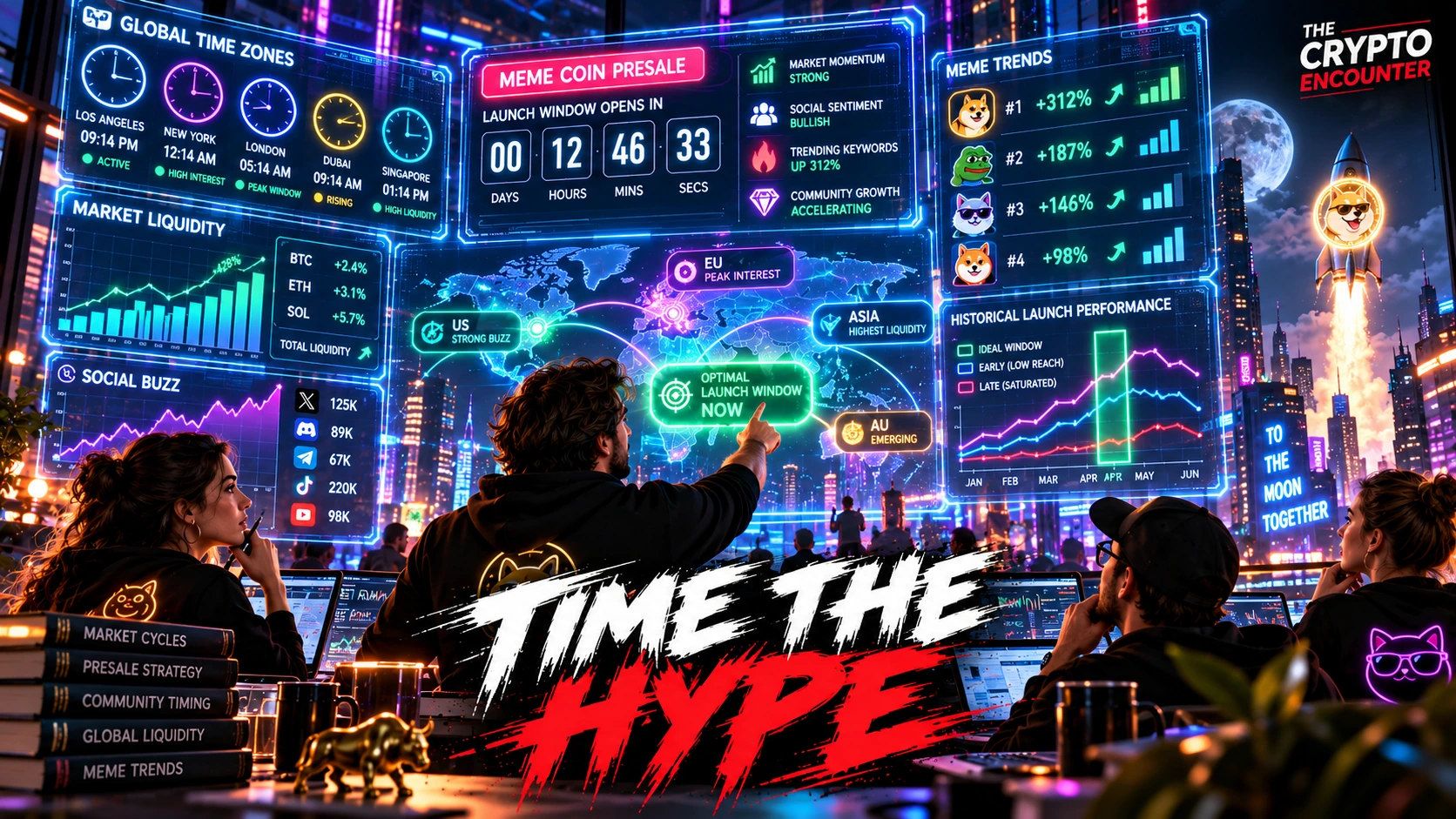
DUBAI, United Arab Emirates, October 2, 2026: A meme coin founder can spend months designing tokenomics, building a community, developing a website, preparing smart contracts and creating a launch campaign, yet one question still has the power to change almost everything:
When should the presale actually begin?
Crypto has no shortage of answers.
Launch during a bull market.
Wait for Bitcoin to rally.
Start on a Monday.
Avoid weekends.
Launch when Americans are awake.
Wait for meme coin season.
Start before the narrative gets crowded.
Launch immediately when something goes viral.
Some of these ideas contain pieces of useful logic. None provides a universal formula.
There is no single best date, weekday, hour or Bitcoin price at which every meme coin presale should begin.
There is, however, something more useful: a launch window.
That window appears when several conditions line up at the same time. Market participants have enough risk appetite to explore speculative assets. Capital is circulating through crypto. The meme or narrative is culturally relevant. The project’s audience is large enough to convert attention into participation. The technical, legal and operational systems are actually ready. The token economics can survive the transition from presale pricing to public-market price discovery.
Miss one of those conditions and an otherwise promising launch can struggle.
Wait too long and the cultural moment may disappear.
Launch too early and the community may be too small.
Launch into a market-wide liquidity shock and speculative capital can retreat.
Rush because a meme suddenly goes viral and the project may enter the market before its contracts, disclosures, treasury controls or claim systems are ready.
The best time to launch a meme coin presale is therefore not found on a calendar.
It is found at the intersection of market timing, attention timing, community timing, operational timing and token timing.
This guide explains how to identify that intersection.
Important: This article is educational and analytical. It does not recommend launching, purchasing or participating in any meme coin or token presale. Crypto assets can be highly speculative and may lose most or all of their value. Regulatory, offering, marketing and financial-services requirements vary by jurisdiction. Founders should obtain qualified legal, compliance, tax and technical advice appropriate to their project.
Is There Really a Best Time to Launch a Meme Coin Presale?
Not in the sense most people mean.
There is no reliable rule showing that every meme coin launched in January will outperform one launched in July, that Tuesday is inherently superior to Friday, or that opening a presale at 10 a.m. UTC produces better results than opening it at 6 p.m.
The useful question is not:
What is the best date?
It is:
What conditions should exist before the project asks the market for money?
That changes timing from superstition into operational analysis.
The Five Clocks Behind a Meme Coin Presale
A founder can think about presale timing as five clocks running simultaneously.
| Clock | What It Measures | What Happens If It Is Wrong |
|---|---|---|
| Market clock | Liquidity, risk appetite and crypto-wide momentum | Capital may not be available for speculative tokens |
| Narrative clock | Whether the meme or cultural idea is gaining, peaking or fading | The project may arrive after the internet has moved on |
| Community clock | Audience quality, engagement and conversion readiness | The presale opens to an empty room |
| Project clock | Legal, technical, security, treasury and operational readiness | A rushed launch creates preventable failures |
| Token clock | Presale duration, TGE, vesting, liquidity and public-market transition | Fundraising succeeds but launch economics fail |
The strongest launch window appears when all five clocks are reasonably aligned.
That rarely happens perfectly.
The founder’s job is to decide whether the remaining gaps are acceptable or dangerous.
Clock One: Is the Crypto Market Actually Ready for More Risk?
Meme coins sit near the speculative end of the crypto market.
That means demand can depend heavily on what is happening elsewhere.
If Bitcoin, Ethereum and the wider market are experiencing large losses, leverage is being unwound, exchange volumes are falling and traders are moving toward cash or stable assets, a new meme coin must compete against fear.
When market confidence improves, the opposite can happen.
Profits from larger crypto assets may migrate toward smaller assets. Traders become more willing to explore new narratives. Social-media activity rises. Risk tolerance expands.
This does not mean every meme coin should wait for Bitcoin to reach an all-time high.
It means founders should understand the environment into which they are selling.
The Crypto Encounter’s analysis of why Bitcoin still reacts to Federal Reserve policy and global liquidity explains why crypto prices do not operate independently from broader financial conditions.
What Does the 2026 Market Show About Timing?
Recent market history provides a useful example of why timing cannot be reduced to enthusiasm alone.
CoinGecko’s 2026 Q2 Crypto Industry Report found that total crypto market capitalization declined 12.6% during the quarter to approximately $2.1 trillion.
Average daily trading volume also fell 20.9% quarter over quarter to $93.1 billion, while spot volume across the top centralized exchanges declined significantly.
Stablecoin market capitalization fell 1.6%, which CoinGecko described as the first quarterly contraction since the third quarter of 2023.
These numbers do not prove that no token could succeed during that period.
They do show that the capital environment was materially different from a period characterized by expanding liquidity, rising market capitalization and increasing trading activity.
A founder launching into such conditions needs to understand that the project may be fighting a market-wide reduction in risk appetite rather than merely a weak advertising campaign.
Why the Federal Reserve Can Matter to a Meme Coin Presale
A meme coin may have nothing to do with American monetary policy technically.
Its buyers still participate in global financial markets.
On September 16, 2026, the Federal Reserve raised its target range for the federal funds rate by 25 basis points to 3.75% to 4.00%, citing elevated inflation.
The Federal Reserve’s September FOMC statement is relevant to crypto founders because monetary conditions can influence yields, dollar liquidity, leverage and investor appetite for speculative risk.
A founder does not need to become a macroeconomist.
The project should, however, know whether it is launching immediately before a major central-bank decision, inflation release, geopolitical event or other catalyst capable of overwhelming its own narrative.
Should a Meme Coin Presale Launch During a Bull Market?
A broadly rising crypto market can provide advantages.
- Investors may have unrealized or realized crypto profits.
- Risk appetite can be stronger.
- Search interest may be higher.
- Crypto media consumption may increase.
- Influencers and communities may be more active.
- Trading liquidity may be deeper.
- Users may be more willing to explore smaller assets.
There is an obvious downside.
Everyone else sees the same opportunity.
A strong speculative market can produce an enormous number of new tokens competing for the same capital and attention.
Being early to a strong cycle can therefore be valuable.
Being the 20,000th token launched after the market becomes euphoric may be much less useful.
Why Bull Markets Can Become Terrible Launch Environments
More demand does not automatically mean easier customer acquisition.
It can also mean more competition.
At the height of Solana’s meme coin boom in the fourth quarter of 2024, CoinGecko recorded an average of roughly 35,500 token launches per day across tracked meme coin launchpads. Daily launches reached approximately 73,700 in January 2025 following the launch of TRUMP.
Those figures appear in CoinGecko’s research into how launchpads transformed meme coin creation and distribution.
The important lesson is not the exact number.
It is what the number represents.
A speculative boom attracts buyers.
It also attracts thousands of competitors.
During extreme saturation, a new token can disappear from attention almost immediately.
Meme Coin Timing Is Really an Attention Problem
Meme coins have another clock that Bitcoin does not have in the same way.
Cultural relevance.
A meme can explode overnight.
It can also become embarrassing two weeks later.
A viral animal, television moment, public figure, phrase, artificial-intelligence character or online joke can produce enormous attention before disappearing just as quickly.
This makes meme coin timing fundamentally different from launching a conventional long-term technology company.
The project’s narrative has an attention half-life.
CoinGecko co-founder Bobby Ong described the sector succinctly during an earlier meme-coin downturn:
“Meme coins were always seasonal.”
His analysis of the meme coin cycle also showed how dramatically activity could fall after a speculative peak, with launch activity and trading volumes contracting rapidly when attention moved away.
Seasonality here should not be interpreted literally as spring, summer, fall and winter.
The season is attention.
How Do You Know Whether a Meme Narrative Is Early, Hot or Already Exhausted?
Think of narrative momentum as a curve.
| Phase | What You May Observe | Presale Implication |
|---|---|---|
| Emergence | Organic references begin appearing in small communities | Potentially early, but demand remains unproven |
| Acceleration | Searches, memes, posts and creators increase quickly | Potential launch window if the project is ready |
| Mainstream virality | The narrative appears across major social accounts and media | Large audience, but competition increases rapidly |
| Saturation | Dozens or hundreds of copycat tokens appear | Acquisition costs and differentiation problems rise |
| Fatigue | Engagement falls and jokes feel repetitive | Launching can mean chasing yesterday’s attention |
| Revival | Old narrative returns through a new event or cultural trigger | Possible new window, but needs fresh evidence |
The mistake is assuming that maximum attention automatically means maximum opportunity.
By the time everyone agrees that a meme is hot, the easiest part of the opportunity may already have passed.
What Should Founders Measure Instead of Guessing About Meme Attention?
A useful narrative dashboard can track:
- search-interest direction;
- organic social mentions;
- unique accounts discussing the theme;
- engagement per post;
- community growth rate;
- share of positive versus negative engagement;
- number of competing tokens;
- competitor launch frequency;
- media mentions;
- creator participation;
- website referral traffic;
- waitlist growth.
No single number proves demand.
The pattern matters.
A community adding 5,000 genuinely engaged people over several weeks can be more useful than an account gaining 100,000 low-quality followers in two days.
Do Not Confuse Viral Reach With Presale Readiness
A viral post can generate millions of impressions.
That does not mean millions of people want the token.
Attention should therefore be measured through a funnel.
| Stage | What It Tests |
|---|---|
| Reach | Do people see the idea? |
| Engagement | Do people react to it? |
| Interest | Do they visit the project? |
| Intent | Do they join, register or read deeper material? |
| Eligibility | Can they participate under applicable rules? |
| Conversion | Do eligible participants actually complete the presale process? |
A project that understands this funnel can time its presale around observable demand rather than social-media vanity metrics.
Clock Three: Is the Community Ready to Become a Market?
A Telegram channel is not automatically a community.
A Discord server is not automatically demand.
An X follower count is not automatically a buyer base.
The community clock is ready when people begin taking actions that demonstrate deeper commitment.
Possible indicators include:
- repeat participation in discussions;
- organic user-created content;
- consistent website visits;
- whitepaper or documentation engagement;
- waitlist registrations;
- questions about token mechanics rather than only price;
- participation across multiple geographic regions;
- independent discussion outside official channels;
- reasonable retention after promotional campaigns stop.
A founder should be particularly careful with follower growth that appears too easy.
AI-generated identities, bots and synthetic engagement can create the appearance of traction. The Crypto Encounter’s investigation into AI-generated crypto teams and synthetic identities demonstrates why digital appearance alone has become weak evidence of authenticity.
How Large Does the Community Need to Be Before a Presale?
There is no universal number.
A community of 10,000 genuinely engaged people can potentially be more commercially meaningful than 500,000 accounts acquired through giveaways, paid followers or bots.
The more useful measure is conversion capacity.
Suppose a project has:
- 25,000 active community members;
- 8,000 verified presale registrations;
- 5,000 eligible participants after applicable onboarding;
- an expected average contribution of $300.
A simple scenario model would imply approximately $1.5 million if every eligible participant converted.
They almost certainly will not.
If only 20% convert, the implied figure becomes $300,000.
If 40% convert, it becomes $600,000.
These are hypothetical calculations, not fundraising predictions.
The point is that founder planning should use conversion scenarios rather than follower counts.
A Presale Should Not Be the First Time You Discover Whether People Care
One of the worst launch strategies is:
Build quietly for six months.
Open the presale.
Then discover whether anyone wants it.
Audience testing belongs before fundraising.
The project can measure response to:
- the meme;
- brand identity;
- content;
- community proposition;
- product concept where applicable;
- token explanation;
- founder credibility;
- roadmap.
A weak response before the sale is information.
Founders should use it.
Clock Four: Is the Project Ready Even If the Market Is?
This is where many founders make their most expensive timing mistake.
The market suddenly turns bullish.
A meme goes viral.
Competitors start raising money.
The team concludes that the window is closing and launches before the project is ready.
That trades market-timing risk for operational risk.
The second can be much more destructive.
Do Not Launch Because the Meme Is Ready If the Contract Is Not
Before a presale begins accepting funds, the team should know:
- which legal entity conducts the offering;
- which jurisdictions can participate;
- what the token does;
- total supply;
- presale allocation;
- vesting;
- treasury controls;
- official receiving addresses;
- smart-contract privileges;
- claim process;
- refund conditions where applicable;
- security procedures;
- incident-response procedures.
A market window can return.
Funds lost through a critical exploit may not.
Security Readiness Is Part of Market Timing
Crypto founders sometimes treat cybersecurity as a technical workstream separate from launch strategy.
That is a mistake.
The project is not ready to launch if:
- one private key controls everything;
- the claim process has not been tested;
- the production contract differs materially from the audited version;
- the team has not secured domain administration;
- official social accounts use weak access controls;
- treasury and operational wallets are unnecessarily mixed;
- developers still have undocumented production privileges.
The Crypto Encounter’s DeFi wallet separation guide explains why compartmentalizing wallet exposure can prevent one risky interaction from exposing every asset under the project’s control.
The same principle belongs in a token-launch architecture.
Overconfidence Can Make a Founder Launch Too Early
Success during development can create false certainty.
The website works.
The testnet works.
The community is excited.
The audit returned no unresolved critical findings.
None of those proves that launch day will behave exactly as expected.
The Crypto Encounter’s guide to confidence and overconfidence in crypto makes a useful distinction: confidence should come from verification, while overconfidence often removes verification because the person assumes the answer is already known.
A good launch process deliberately keeps some doubt alive.
Clock Five: Is the Token Ready for What Happens After the Presale?
Opening a presale is only one timing decision.
Founders actually need to time at least four events:
- presale opening;
- presale stages or closing;
- token generation event;
- public trading or liquidity activation.
Those events do not have to occur close together.
This is where presale duration becomes important.
Can a Meme Coin Presale Run for Too Long?
Yes.
A long presale can raise more capital and give a project more time to build its community.
It can also create problems.
The narrative can cool.
Early buyers can become impatient.
Competitors can launch.
Market conditions can reverse.
The difference between early and late presale prices can become difficult to justify.
Marketing can become repetitive.
The project can begin to look permanently stuck in fundraising mode.
A meme token is particularly vulnerable because cultural attention can have a shorter life than a conventional startup development cycle.
Can a Presale Be Too Short?
Also yes.
A very short presale may not allow sufficient time for:
- community education;
- participant verification;
- geographic expansion;
- press coverage;
- technical support;
- partnership activation;
- fraud detection;
- onboarding issues to be resolved.
A rapid launch can also create artificial pressure that encourages users to make decisions before they understand the token.
The correct duration depends on the actual sales model rather than an arbitrary industry template.
The Presale and TGE Need to Be Timed Together
A project can choose an excellent presale opening date and still create a poor launch by mishandling TGE.
Imagine a presale ends during strong market conditions.
The project then waits four months before tokens become claimable.
By TGE, the market may have changed completely.
Early participants may also have spent months waiting for liquidity.
Alternatively, a project may rush from presale closure to TGE without enough time to reconcile allocations, test claiming and seed appropriate liquidity.
Timing therefore requires backward planning from public-market readiness.
Liquidity Must Be Ready Before TGE, Not After It
A token can have enormous social interest and still experience disastrous public trading if its market is too shallow.
The Crypto Encounter’s analysis of DEX slippage and price impact explains why the amount of liquidity available can matter as much as the displayed token price.
The larger the expected circulating supply and opening trade sizes, the more important market-depth modeling becomes.
A founder who knows the planned TGE date but does not know how much sell pressure the initial liquidity can absorb has not finished launch timing.
Should a Project Wait for “Meme Coin Season”?
Not necessarily.
A meme coin season can offer stronger attention and liquidity.
It can also produce extraordinary competition.
A project should examine at least three conditions:
1. Is interest expanding?
More people entering the category can enlarge the addressable audience.
2. Is capital expanding?
Attention without money does not fund a presale.
3. Is competition expanding faster than demand?
If thousands of tokens are fighting for every new buyer, the apparent boom can become a very difficult environment for an undifferentiated project.
A smaller but accelerating narrative can sometimes provide a better window than the absolute peak of mania.
The Ideal Meme Coin Launch Window Often Begins Before Everyone Calls It a Season
The best commercial opportunity can emerge when several indicators are improving but have not yet reached extremes.
For example:
- crypto trading volumes are recovering;
- stablecoin liquidity is improving;
- Bitcoin volatility has become constructive rather than chaotic;
- meme-related interest is rising;
- competitor creation is increasing but not yet overwhelming;
- community conversion is improving;
- the project’s own infrastructure is already launch-ready.
This is not a formula.
It is a pattern worth watching.
Why Waiting for Perfect Conditions Can Also Be a Mistake
No founder will receive a notification saying:
Congratulations. The perfect meme coin window begins tomorrow.
Markets are visible only in hindsight with complete clarity.
Waiting for every signal to become obviously bullish often means waiting until the opportunity is already crowded.
The goal should therefore be sufficient alignment, not certainty.
Should You Launch Immediately After Bitcoin Rallies?
Not automatically.
A Bitcoin rally can improve crypto sentiment, but the composition of that rally matters.
Bitcoin dominance may be increasing because investors are moving away from smaller assets.
Institutional capital may be entering Bitcoin without flowing into speculative tokens.
Altcoin liquidity may remain weak.
Retail search activity may remain subdued.
In that environment, Bitcoin can be strong while a meme coin presale remains difficult.
The relevant question is whether risk appetite is broadening beyond Bitcoin.
What About Launching After an Altcoin Rally?
This can provide another signal because it suggests traders are moving further along the risk curve.
Again, the movement needs context.
A narrow rally in three large tokens is different from broad participation across smaller assets.
Useful indicators can include:
- breadth of gains;
- DEX volume;
- small-cap volume;
- stablecoin activity;
- new-wallet activity;
- social engagement;
- meme-sector market share.
Do Weekdays Matter?
Operationally, yes.
Economically, not in a universal way.
There is no defensible rule that every meme presale should begin on a particular weekday.
However, a founder may prefer a window in which:
- the core engineering team is working;
- compliance personnel are available;
- community moderators are fully staffed;
- banking or payment partners are reachable;
- launchpad support is available;
- exchange contacts are reachable;
- security monitoring is active.
Launching at 3 a.m. on a weekend because it feels dramatic can be an unnecessary operational risk if the people needed to resolve problems are unavailable.
Is There a Best Time of Day for a Meme Coin Presale?
There is no universal hour either.
The appropriate time depends on the project’s actual audience.
A global community may include significant groups across:
- North America;
- Europe;
- the Middle East;
- South Asia;
- Southeast Asia;
- East Asia.
One launch hour cannot give everyone prime-time access.
Rather than using generic crypto folklore, analyze first-party data:
- website traffic by hour;
- Discord or Telegram activity;
- email open times;
- social engagement;
- registration geography;
- customer-support demand.
The strongest operational launch time is often the period when the largest relevant audience and the full project team overlap.
Why Geographic Timing Matters More Than UTC Alone
A launch can technically be global while commercially depending on a few markets.
Suppose 60% of qualified presale registrations come from Asia.
A schedule designed entirely around U.S. social-media hours may waste the project’s strongest audience.
The reverse is also true.
Founders should know where legitimate interest actually comes from before scheduling major presale stages, AMAs and announcements.
Geographic analysis should also remain consistent with participation restrictions. A project should not deliberately target a jurisdiction from which it says purchasers are prohibited.
Never Let Marketing Timing Override Legal Readiness
A project sometimes discovers an attractive market window before its legal structure is complete.
That is not a reason to launch anyway.
A founder should know which entity is conducting the presale, where participants can legally be accepted, which disclosures apply and whether the business performs other regulated activities.
The meme may be time-sensitive.
The legal exposure can last much longer.
The Same Marketing Message Can Matter to Regulatory Analysis
Token classification does not depend only on the token’s name.
How the project raises money and what promoters promise can also matter under applicable legal frameworks.
This makes rushed marketing especially dangerous.
A team chasing a narrow attention window may begin promising:
- specific returns;
- future price appreciation;
- guaranteed listings;
- guaranteed liquidity;
- future management actions intended to increase value.
The urgency of a cultural moment does not make unsupported financial claims safer.
When Should a Founder Definitely Delay the Presale?
A strong market cannot compensate for certain readiness failures.
Delay should receive serious consideration when:
- the legal issuer remains unclear;
- token supply does not reconcile;
- vesting terms are still changing;
- the production smart contract has unresolved critical vulnerabilities;
- treasury authority is not properly secured;
- the KYC or eligibility system required by the project does not work;
- fundraising claims cannot be measured accurately;
- presale terms contradict the website;
- the claim system has not been tested;
- the planned TGE liquidity cannot tolerate plausible selling;
- key team members are unavailable during launch;
- a major security incident remains unresolved.
Launching under those conditions is not aggressive timing.
It is unfinished preparation.
A Weak Market Can Sometimes Be Useful Before the Presale
Bearish conditions are not entirely useless to founders.
They can provide time to build without the pressure of a rapidly closing speculative window.
Teams can use quieter markets to:
- develop the product;
- establish the entity;
- complete legal analysis;
- build the community;
- test tokenomics;
- audit contracts;
- prepare content;
- establish treasury systems;
- build partnerships;
- test demand.
The goal does not have to be launching during the downturn.
It can be becoming launch-ready before conditions improve.
That Creates the Most Valuable Form of Optionality
A project whose infrastructure is complete can choose when to launch.
A project that begins preparing only after the market becomes bullish cannot.
This is one of the most important strategic differences between preparation and prediction.
You do not need to predict exactly when the meme market will return if the organization is ready to act when evidence begins changing.
The Presale Readiness Dashboard
A founder can convert launch timing into a repeatable decision system.
| Signal | Red | Yellow | Green |
|---|---|---|---|
| Broad crypto liquidity | Contracting sharply | Stabilizing | Expanding |
| Trading volume | Persistent decline | Mixed | Broad recovery |
| Meme attention | Falling | Stable or emerging | Accelerating |
| Competitive saturation | Extreme | Elevated | Manageable |
| Community quality | Mostly passive or artificial | Growing | Highly engaged |
| Presale intent | Unproven | Early evidence | Strong verified funnel |
| Legal readiness | Unresolved | Minor work remaining | Cleared for planned structure |
| Smart contracts | Critical issues | Testing or remediation | Production-ready |
| Treasury/security | Single points of failure | Controls being finalized | Operationally secured |
| TGE liquidity | Not modeled | Preliminary | Stress-tested |
The framework is intentionally qualitative.
It should stimulate judgment rather than create fake mathematical precision.
Do Not Average the Score
This is crucial.
Nine green indicators do not cancel one critical red indicator.
A project can have:
- perfect market conditions;
- massive social reach;
- strong community demand;
- excellent marketing;
and still be unready because the smart contract has a critical vulnerability.
Some launch conditions are additive.
Others are gates.
What Should Be Hard Go/No-Go Gates?
At minimum, founders should consider treating these as hard gates:
- legal authority to conduct the planned sale;
- correct token supply;
- production contract readiness;
- critical security remediation;
- treasury control;
- accurate sale terms;
- correct participant eligibility system where applicable;
- ability to account for funds;
- working distribution or claim architecture.
Market sentiment should not override a failed hard gate.
What Should Be Soft Timing Signals?
Other factors help optimize timing rather than determine whether the sale is safe to launch at all.
These include:
- Bitcoin momentum;
- altcoin breadth;
- meme-sector attention;
- search interest;
- competitor activity;
- social engagement;
- news cycles;
- creator availability;
- community growth.
These signals can improve or worsen the opportunity.
They do not repair broken infrastructure.
How Far Ahead Should a Meme Coin Presale Be Planned?
There is no universal duration because project complexity differs enormously.
A useful strategy separates preparation from activation.
Preparation phase
Build the components that should not depend on market timing:
- entity;
- governance;
- legal framework;
- smart contracts;
- tokenomics;
- website;
- security;
- treasury;
- analytics;
- community infrastructure;
- documentation.
Activation phase
Once launch readiness exists, monitor:
- market liquidity;
- sector momentum;
- meme attention;
- competitive saturation;
- community conversion;
- major macro events.
This architecture prevents the project from trying to build everything during a short-lived cultural moment.
Should You Delay Because the Fed Is Meeting?
Not necessarily.
But the event deserves awareness.
A scheduled FOMC decision can introduce significant volatility into Bitcoin, equities, the dollar and yields.
A project planning its biggest presale announcement within minutes of such an event is accepting additional uncertainty.
The same reasoning applies to:
- major inflation reports;
- large regulatory decisions;
- major elections;
- serious geopolitical events;
- major crypto court decisions;
- large exchange disruptions.
The event may help the market.
It may hurt it.
The timing risk comes from allowing an external event to dominate your own launch.
Avoid Launching Into a Crisis You Do Not Control
If a major exchange has just stopped withdrawals, a large protocol has been exploited or markets are experiencing an extraordinary liquidation event, delaying a discretionary presale may be rational.
A crisis changes attention.
It changes trust.
It changes liquidity.
It can also change the practical ability of participants to move funds.
The Crypto Encounter’s analysis of why regulated exchanges can still face operational, liquidity and custody risks illustrates why crypto infrastructure itself can become part of launch timing.
Exchange Availability Can Affect Presale Conversion
Participants may hold the assets they intend to use on centralized platforms.
If deposits or withdrawals are unavailable, their displayed balance may not be immediately deployable capital.
As The Crypto Encounter explains in Your Exchange Balance Is Not the Same as Your Crypto, access to exchange-held assets depends on the platform’s custody, withdrawal and operational systems.
Founders should therefore avoid assuming that theoretical crypto wealth equals immediately available presale liquidity.
How Should a Project Time Its Marketing Before the Presale?
The marketing campaign should build in stages rather than suddenly appearing on sale day.
Phase 1: Recognition
Introduce the meme, idea or cultural identity.
Phase 2: Community
Give people a reason to participate before asking for money.
Phase 3: Evidence
Publish the team, tokenomics, documentation, security information and relevant project structure.
Phase 4: Education
Explain how the presale works, who can participate and what risks exist.
Phase 5: Activation
Open the sale only when operational systems are ready.
A project that begins with “BUY NOW” before establishing credibility makes timing harder because every future message has to overcome the impression that fundraising came before substance.
FOMO Should Not Be the Project’s Primary Timing System
Founders can experience FOMO too.
They see another meme coin raise millions.
They see a competing token trend.
They see a launchpad suddenly dominate social feeds.
They become afraid that waiting another month will destroy the opportunity.
That emotional pressure can weaken the same judgment founders expect from buyers.
The Crypto Encounter’s crypto safety checklist emphasizes verification under pressure. The principle scales beyond individuals: the larger the financial consequence of a rushed decision, the stronger the verification process should become.
The Wrong Time to Launch May Be When Everyone on the Team Says “Now or Never”
“Now or never” deserves scrutiny.
If the meme will be completely irrelevant within seven days, ask whether the project has enough long-term identity to survive after the joke fades.
If it does not, the problem may be larger than timing.
A token presale creates obligations that can survive much longer than the viral moment that inspired it.
What Happens If You Miss the Meme?
Sometimes the correct decision is to miss it.
This sounds painful to founders who have already invested money in branding and development.
But sunk costs do not make a fading narrative young again.
The project can:
- reassess the concept;
- delay;
- reposition where legally and ethically appropriate;
- build a stronger underlying product;
- wait for renewed cultural relevance;
- abandon the launch if the economics no longer make sense.
Not launching can be a legitimate entrepreneurial decision.
Timing the TGE May Matter More Than Timing the First Presale Stage
The presale opening attracts attention.
TGE exposes the project to the market.
At TGE:
- presale allocations become economically meaningful;
- vesting begins to matter;
- liquidity becomes observable;
- bots may arrive;
- open-market price discovery begins;
- holders can become sellers;
- the project’s valuation meets an independent market.
That is why our guide to liquidity and DEX price impact belongs in the launch-planning conversation, not merely in post-launch troubleshooting.
TGE Should Have Its Own Go/No-Go Decision
Closing the presale should not make TGE automatic.
Before public-market activation, recheck:
- distribution;
- vesting;
- claim readiness;
- contract addresses;
- liquidity;
- exchange readiness;
- website capacity;
- security monitoring;
- community instructions;
- incident response.
A presale can be successful while the project remains unready for TGE.
Liquidity Providers Also Need to Be Ready for Launch Timing
Initial liquidity is not free capital sitting safely beside the market.
Liquidity providers take economic exposure.
The Crypto Encounter’s explanation of impermanent loss in DeFi liquidity pools shows how pool composition changes as relative prices move.
This means TGE liquidity planning needs to consider both the trader’s experience and the treasury’s exposure.
A Four-Week Presale Activation Framework
This is not a promise that every project should launch within four weeks. It is a decision framework for a project that is already technically, legally and operationally ready.
Week 4 Before Presale
- Confirm market conditions are not deteriorating sharply.
- Measure narrative momentum.
- Measure community quality.
- Review competitive launches.
- Freeze core tokenomics.
- Complete major legal and security gates.
Week 3 Before Presale
- Increase educational content.
- Open or validate eligible registration funnel.
- Measure conversion intent.
- Run infrastructure load tests.
- Recheck treasury controls.
Week 2 Before Presale
- Review macro calendar.
- Review major crypto-market events.
- Confirm marketing claims.
- Train moderators and support.
- Rehearse incident response.
Final Week
- Perform final go/no-go review.
- Verify contracts and addresses.
- Confirm support staffing.
- Confirm monitoring.
- Publish official participation instructions.
- Prepare fraud and phishing warnings.
The 48-Hour Go/No-Go Test
Forty-eight hours before the planned presale opening, ask:
- Has anything materially changed in the market?
- Has the meme narrative accelerated or collapsed?
- Has a major competitor absorbed attention?
- Are the legal assumptions still valid?
- Is the production infrastructure stable?
- Are all official wallet addresses confirmed?
- Can the treasury operate safely?
- Can support handle expected traffic?
- Are all marketing claims still accurate?
- Can the project explain what happens after the presale?
If the answer to a critical operational question is no, delay can be the stronger decision.
The Best Presale Timing Formula Is Not a Formula
A founder can summarize the framework like this:
Launch readiness = sufficient market opportunity + rising or durable attention + proven community intent + completed operational gates + credible post-presale execution.
The equation is conceptual.
It is not mathematical.
Its purpose is to stop founders from confusing one positive signal with complete readiness.
Frequently Asked Questions About Meme Coin Presale Timing
What is the best time to launch a meme coin presale?
There is no universal date or hour. A stronger launch window appears when crypto liquidity and risk appetite are supportive, the meme narrative still has momentum, the community shows genuine participation intent and the project’s legal, technical, security and treasury systems are ready.
Should a meme coin presale launch during a bull market?
A rising market can improve risk appetite and crypto participation, but bull markets also attract large numbers of competing tokens. A project should evaluate liquidity, attention and competitive saturation rather than assuming that rising Bitcoin prices automatically create a good presale environment.
Should I wait for meme coin season?
Not necessarily. By the time a meme coin season is obvious, token creation and competition may already be extremely high. An emerging period of improving meme interest, liquidity and community engagement can sometimes provide better conditions than the peak of speculative mania.
Is there a best weekday to launch a crypto presale?
There is no reliable universal weekday. Operational considerations matter more. Projects should favor a period when technical, security, compliance, treasury and community personnel are available to respond to problems.
What is the best time of day to launch a meme coin presale?
The answer depends on the project’s audience geography and team availability. First-party analytics such as website traffic, registrations and community activity are more useful than generic assumptions about crypto trading hours.
Should a project launch immediately when its meme goes viral?
Only if the project is already launch-ready. Virality does not compensate for unfinished contracts, uncertain tokenomics, weak security, unclear legal structure or inadequate treasury controls. A missed cultural opportunity can be disappointing, but rushing an unsafe financial product can create much larger consequences.
Can a meme coin presale last too long?
Yes. A lengthy presale can allow the underlying cultural narrative to weaken, create fatigue among early participants and expose the project to changing market conditions. The appropriate duration depends on the fundraising structure, community and post-presale launch plan.
How far apart should the presale and TGE be?
There is no universal interval. The project needs enough time to reconcile allocations, finalize contracts, prepare claims and establish liquidity without leaving participants waiting unnecessarily while market conditions change.
Should a project avoid launching around an FOMC meeting?
Not automatically, but major monetary-policy events can create substantial market volatility. A project should understand the macro calendar and decide whether it wants its largest fundraising announcement competing with an event capable of dominating global risk markets.
Should founders delay a presale if Bitcoin is falling?
A Bitcoin decline alone does not determine whether a presale should proceed. Founders should examine the reason for the decline, wider market liquidity, altcoin participation, community demand and project readiness. A disorderly market-wide selloff presents different conditions from an ordinary Bitcoin pullback.
What is more important, market timing or project readiness?
Project readiness should function as a gate. Favorable market timing can improve an opportunity, but it should not override unresolved critical legal, security, technical, treasury or distribution problems.
How can founders tell whether presale demand is real?
Look beyond follower counts. Useful signals include qualified registrations, repeat engagement, documentation consumption, organic content, geographic diversity, waitlist retention and actual conversion behavior. Bots and paid traffic can inflate surface-level metrics without creating a durable buyer base.
Can launching too early hurt a meme coin?
Yes. An underdeveloped community can leave the presale without sufficient demand, while unfinished technical or operational systems can create security, distribution and reputational problems. Early entry into a narrative is useful only when the organization is capable of operating.
Can launching too late hurt a meme coin?
Yes. Internet culture can move quickly. A project may enter after search interest, social activity and community excitement have peaked, while copycat competition has already expanded. This is why narrative timing needs to be monitored alongside project readiness.
The Bottom Line: The Best Time Is a Window, Not a Date
There is no magical hour when a meme coin presale becomes destined to succeed.
Markets do not work that way.
Internet culture certainly does not.
The strongest launch window appears when several things become true at approximately the same time.
Crypto capital is willing to take risk.
The meme still has cultural energy.
The market is not so saturated that the project disappears instantly.
The community has moved beyond passive followers into measurable intent.
The legal structure is clear.
The smart contracts work.
The treasury is secured.
The tokenomics are settled.
The presale can be accounted for.
TGE has been planned.
Liquidity has been modeled.
The team is available if something goes wrong.
That is what “good timing” looks like.
Sometimes those conditions will appear during a roaring bull market.
Sometimes they will emerge during the early stages of a recovery.
Sometimes the market will be ready before the project.
Sometimes the project will be ready months before the market.
And sometimes the correct decision will be not to launch at all.
The founder who spends all day trying to predict the perfect candle can miss the bigger responsibility.
Presale timing is not about predicting exactly when people will become irrationally enthusiastic.
It is about being sufficiently prepared when genuine opportunity appears.
The calendar can tell you when the presale begins.
Only the market, the audience and the project’s own readiness can tell you whether that date makes sense.
This article is provided for informational and educational purposes only. It does not constitute financial, investment, legal, trading, tax or regulatory advice. The Crypto Encounter does not recommend purchasing, selling, launching or participating in any particular meme coin or token presale. Crypto assets and early-stage token projects can involve extreme volatility, regulatory uncertainty, technical failures, fraud and total loss of capital.