

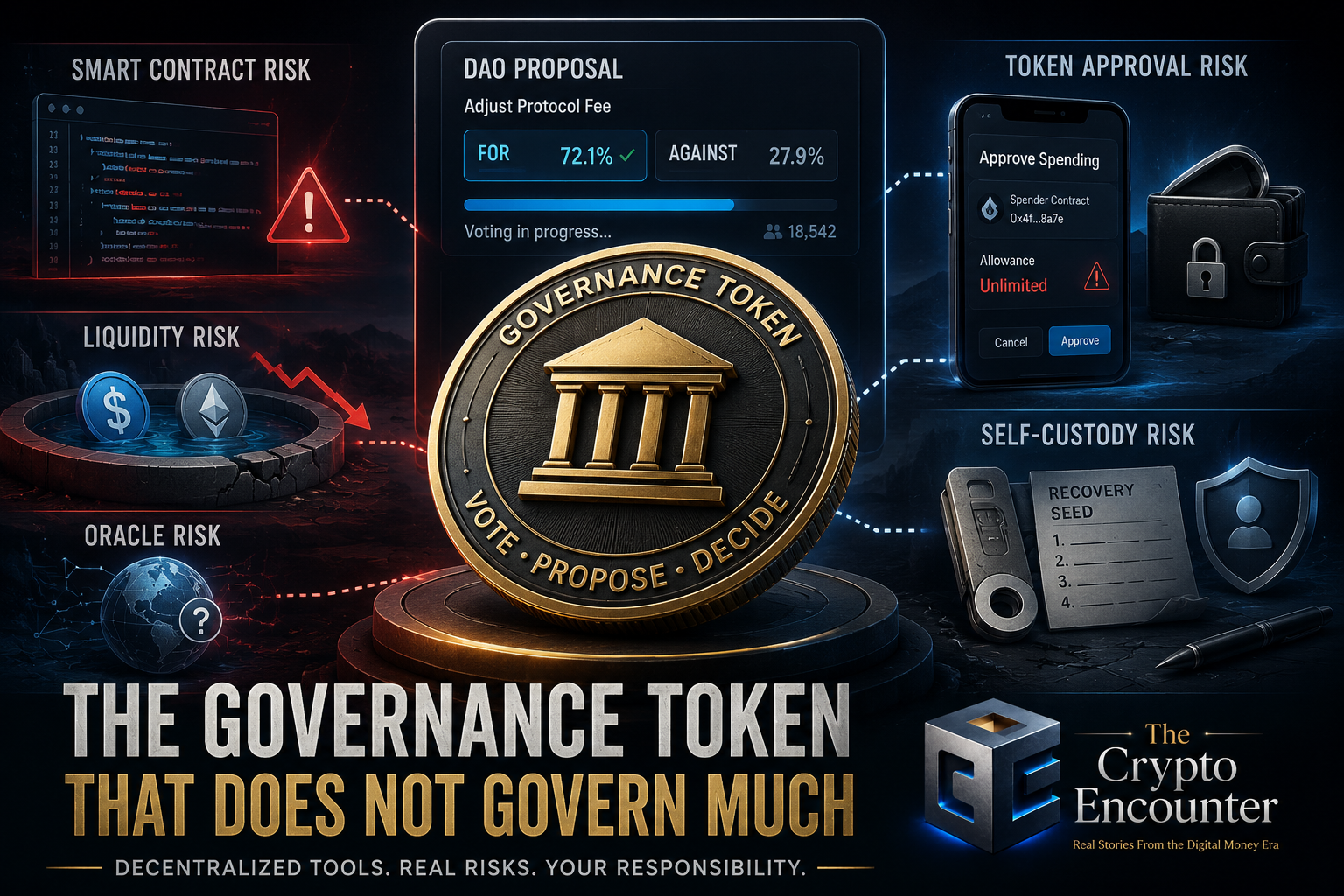
A governance token sounds powerful. The name suggests ownership, voting rights, and meaningful control over a decentralized financial system. However, holding a governance token does not necessarily mean you control the website you use, the smart contracts holding funds, the liquidity available for an exit, or every decision surrounding a protocol.
That distinction matters because DeFi moves responsibility away from traditional financial intermediaries and toward code, token holders, liquidity providers, wallet users, and sometimes separate development companies. Consequently, a governance token may govern one narrow layer while leaving several of the risks that can actually cost users money outside its reach.
For ordinary users, the important question is therefore not simply, “Does this protocol have governance?” It is: What does its governance token actually control?
Key Facts
| Question | What users should understand |
|---|---|
| What is a governance token? | A crypto token that may give holders or delegated voters rights over specified protocol decisions. |
| Does every governance token provide the same powers? | No. Governance scope differs substantially between protocols. |
| Does a governance token control every product connected to a protocol? | Not necessarily. A protocol, website interface, wallet, foundation, company, and third-party service can have different control structures. |
| Can governance eliminate smart contract risk? | No. Voting can sometimes authorize upgrades or responses, but it cannot guarantee that code will never fail. |
| Does self-custody remove platform risk? | It removes some custodial risk, but users still face smart contract, approval, liquidity, oracle, transaction, and security risks. |
| Why does this matter? | A token can provide real voting rights while offering much less practical control than its name appears to imply. |
What a Governance Token Actually Means
A governance token generally gives its holder some ability to participate in decisions associated with a crypto protocol. Depending on the system, those decisions can involve fees, treasury spending, upgrades, risk parameters, incentives, or new markets.
However, the phrase itself is not a technical guarantee.
One governance token may control critical protocol parameters. Another may influence only a limited set of decisions. Furthermore, voting power may require delegation before a holder can participate.
Compound offers a clear example of substantial onchain governance. Its documentation states that COMP holders and delegates can propose, vote on, and implement protocol changes. Compound governance can control administrative smart contract functions and change important protocol parameters.
Uniswap also gives its governance token genuine powers. According to current Uniswap developer documentation, UNI governance can spend treasury funds, set and activate protocol fees, and authorize additional UNI issuance within specified limits.
Yet that still does not mean a UNI holder controls everything carrying the Uniswap name.
That difference exposes the central problem.
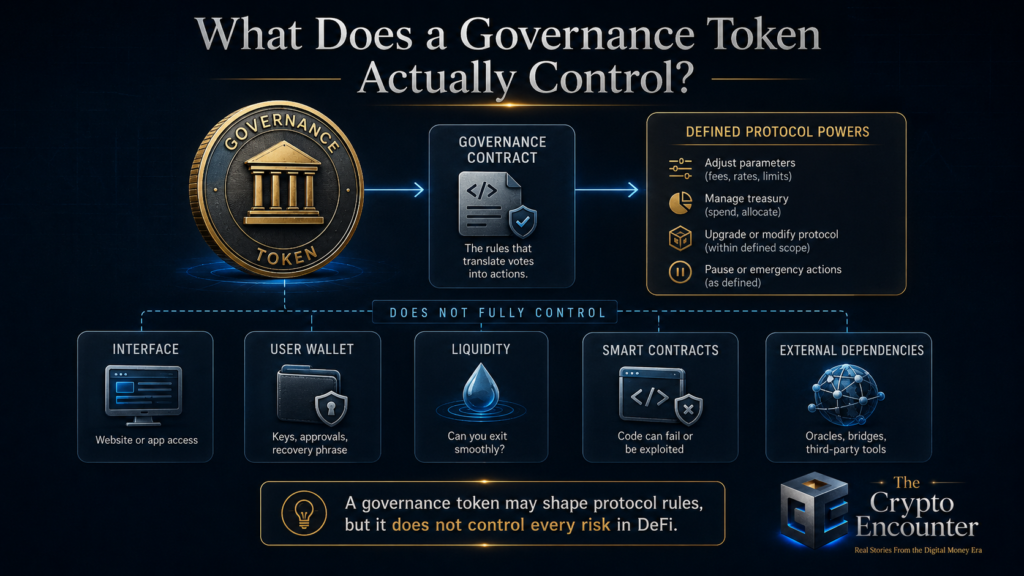
A Governance Token Can Govern the Protocol Without Governing the Product You See
Users often experience DeFi through a website or mobile interface. Therefore, it is easy to treat the interface, underlying protocol, governance system, wallet, development company, and liquidity pools as one platform.
They may not be one thing at all.
Uniswap Labs provides a particularly useful real-world example. Its current terms explicitly distinguish the Uniswap Labs interface from the underlying Uniswap Protocol. The interface provides one way to access the protocol, while Uniswap Labs says it does not operate the protocol or control its liquidity pools and trade execution.
Meanwhile, UNI governance has defined authority over specific protocol functions.
So, a governance token can influence protocol fees while not functioning like corporate shares that give holders managerial control over a company building an interface around that protocol.
This distinction is easy to miss.
Imagine a decentralized exchange with four layers:
- Smart contracts execute swaps.
- Independent liquidity providers supply assets.
- A company develops a popular website for accessing those contracts.
- A governance token lets voters modify selected protocol parameters.
A user may see one brand on the screen. Nevertheless, control can sit in several different places.
As a result, buying the governance token does not automatically give that user authority over all four layers.
Why the Governance Token Label Can Create the Wrong Impression
Traditional corporate governance gives investors a familiar mental model. Shareholders own interests in companies, boards oversee management, and executives operate businesses.
A governance token works differently.
The token’s authority comes from the rules of its particular governance system. Consequently, users must inspect those rules instead of assuming that the word “governance” carries a standard package of rights.
This is particularly important in DeFi because decentralization exists on a spectrum.
The Bank for International Settlements has previously warned that DeFi can contain significant concentrations of decision-making power despite its decentralized design. Its research notes that governance token holdings can become concentrated among developers, early investors, or large holders.
Therefore, two questions matter.
First, what can the governance token vote on?
Second, who realistically has enough voting power to influence the result?
A wallet containing a small number of tokens may technically have voting rights. In practice, however, its influence can remain tiny compared with large delegates or concentrated holders.
The right to vote and meaningful control are not always the same thing.
A Governance Token Does Not Remove Smart Contract Risk
This is where governance becomes especially relevant to ordinary users.
Suppose someone deposits $5,000 of stablecoins into a DeFi strategy because the displayed yield looks attractive. The protocol also has a governance token, an active DAO, public voting, and transparent smart contracts.
Those features may improve transparency. Still, none guarantees that the user’s $5,000 is safe.
Smart contracts execute programmed instructions. If the code contains an exploitable flaw, an attacker may act before governance can organize a discussion, proposal, vote, and response.
Moreover, DeFi systems often interact with other contracts, price oracles, tokens, bridges, and liquidity sources. Each dependency can introduce another point of failure.
The CFTC’s Technology Advisory Committee report identified operational vulnerabilities, smart contract and security risks, liquidity mismatches, oracle exploitation, concentration, leverage, and dependence on key service providers among the risks that policymakers should consider in DeFi.
Therefore, the existence of a governance token should never serve as a substitute for examining the system itself.
Governance can change rules.
It cannot make software incapable of failing.
The Governance Token Cannot Guarantee Liquidity Either
Liquidity creates another risk that token voting cannot simply erase.
A decentralized exchange needs enough assets on both sides of a market for users to trade efficiently. Likewise, lending systems and yield strategies rely on available liquidity when users want to withdraw, borrow, repay, or unwind positions.
During calm markets, that mechanism may work smoothly.
During stress, conditions can change quickly.
That wider relationship between liquidity and crypto markets also appears in The Crypto Encounter’s analysis of how liquidity conditions affect crypto markets.
The BIS has identified liquidity mismatches, leverage, interconnectedness, and operational fragilities as important DeFi vulnerabilities.
Consider another practical example.
A user deposits assets into a high-yield strategy. Then, a market shock sends many users toward the exit at once. Available liquidity falls. Slippage rises. An underlying asset loses value. Meanwhile, automated liquidations begin.
The governance token might allow holders to adjust future parameters. However, the token does not manufacture immediate liquidity for somebody trying to exit during the crisis.
Consequently, users should separate governance rights from liquidity protection.
They solve different problems.
Self-Custody Removes One Risk but Transfers Several Others to the User
Decentralized finance attracts users partly because it can remove the need to place assets directly in the custody of a centralized exchange.
That can be valuable.
Still, self-custody changes the risk model rather than eliminating risk.
With a non-custodial wallet, users control their private keys. They also approve transactions, connect applications, authorize smart contracts, manage recovery information, and decide which contracts can interact with their assets.
With a non-custodial wallet, users control their private keys. They also approve transactions, connect applications, authorize smart contracts, manage recovery information, and decide which contracts can interact with their assets. Readers who want the wider security context can also examine the security risks crypto users often underestimate.
Therefore, responsibility moves closer to the individual.
MetaMask’s documentation explains that token approvals can authorize a smart contract to access a specified amount of a user’s tokens. Some applications request very large or effectively unlimited allowances. MetaMask also warns users that managing these permissions forms part of the responsibility that comes with a non-custodial wallet.
That creates a risk that the governance token cannot solve for you.
If you approve a malicious contract, governance may never become involved.
If you send assets to the wrong address, a DAO vote cannot normally reverse the blockchain transaction.
If you expose your recovery phrase, the governance token does not restore your wallet.
If an old token approval remains active and later becomes dangerous, your voting rights do not automatically revoke it.
Self-custody gives users more control. In return, it demands more attention.
Token Approvals Show Where Control Really Moves
Token approvals are among the clearest examples of the shift from institutional responsibility to individual responsibility.
Imagine visiting a decentralized application and clicking “Approve.”
The request may look like a routine step before a swap. Technically, however, you may be granting a smart contract permission to spend a token from your wallet.
A legitimate protocol may request a broad allowance for convenience. Nevertheless, broad permissions increase the consequences if the approved contract or related system becomes compromised.
Consensys advises users to examine approval amounts and understand which contracts they authorize. Its MetaMask materials also describe token approvals as a known attack vector used in crypto scams.
Again, the governance token operates elsewhere in the system.
Token governance may determine a fee.
Your wallet approval determines who can access your tokens.
Those are completely different forms of control.
Governance Can Be Real and Still Be Narrow
None of this means governance tokens are fake or useless.
That conclusion would go too far.
Compound governance demonstrates that token holders can exercise significant authority over protocol administration and upgrades. Likewise, UNI governance controls meaningful economic and treasury functions within the Uniswap Protocol.
The more accurate lesson is narrower.
A governance token governs whatever its contracts, legal structures, and governance rules allow it to govern.
Nothing about the token’s name guarantees authority beyond those boundaries.
That means users should avoid asking whether a protocol “has governance.”
Instead, ask what the governance token can change, what it cannot change, how proposals reach a vote, who holds or receives delegated voting power, how quickly emergency action can occur, and which parts of the user experience sit outside token governance.
Those questions reveal much more than the label.
The Governance Token Does Not Replace Due Diligence
Before using a DeFi protocol, a user can examine several separate layers of risk.
| Risk | Question to ask |
| Governance risk | What can the governance token actually change? |
| Voting concentration | Who holds or controls meaningful voting power? |
| Smart contract risk | What happens if the code fails or gets exploited? |
| Approval risk | What spending permissions am I granting? |
| Liquidity risk | Can I exit under stressed conditions without severe losses? |
| Oracle risk | Does the protocol depend on external price information? |
| Interface risk | Who controls the website or application I am using? |
| Custody risk | Who controls the private keys? |
| Dependency risk | Which bridges, stablecoins, contracts, or external protocols does the system rely on? |
| Recovery risk | What happens if I make a mistake or lose access to my wallet? |
This framework helps explain why a governance token should sit inside a wider risk assessment.
Governance matters.
However, governance represents only one layer.
Why High Yield Can Distract Users From Governance Risk
High yields create another psychological problem.
A large percentage displayed on a dashboard naturally pulls attention toward potential returns. Yet the number does not summarize the risks required to generate that return.
Yield can depend on borrowing demand, token incentives, trading fees, leverage, liquidity provision, or strategies involving several interconnected protocols.
Therefore, a user evaluating a yield opportunity should ask where the return comes from before focusing on the governance token attached to the ecosystem.
The BIS has found that the search for yield plays a significant role in DeFi participation, particularly among retail users in lending markets.
That incentive can become dangerous when a governance token creates an additional sense that users collectively control the system.
Control over selected parameters does not protect principal.
Voting rights do not guarantee liquidity.
Community discussions do not eliminate contract bugs.
And decentralization does not turn a risky strategy into a safe one.
What a Governance Token Should Tell You Before You Buy or Use a Protocol
A governance token becomes more informative when users look beyond its ticker.
Start with its documented powers.
Which contracts can governance modify? Can voters change fees, collateral rules, treasury spending, incentives, upgrades, or asset listings?
Next, examine the voting process.
Does the governance token need delegation? Is there a proposal threshold? What level of participation does a proposal need? How long does voting take? Does a timelock delay execution?
Then, identify the limits.
Does governance control the underlying protocol but not the main interface? Can a separate company change its own product? Are independent liquidity providers responsible for supplying markets? Do outside oracle or bridge systems introduce additional dependencies?
Finally, examine your own responsibilities.
A governance token cannot secure your recovery phrase, inspect every approval, choose safe contracts, or manage your position during a liquidity crisis.
The user still carries those responsibilities.
The Bigger DeFi Trade-Off: Less Custody, More Personal Responsibility
DeFi’s strongest idea is also the source of many of its hardest risks.
Users can interact with financial software without handing every decision to a traditional intermediary. Smart contracts can execute transactions transparently on public networks. Self-custody can reduce dependence on a centralized custodian.
However, removing an intermediary also removes some of the support structures that users expect from traditional platforms.
There may be no customer-service employee who can reverse an accidental transfer.
No branch manager can reset a private key.
No governance token can guarantee that liquidity remains deep during panic.
No DAO vote can promise that every contract contains flawless code.
As a result, decentralization redistributes responsibility.
Some control moves to code. Some moves to token voters. Some stays with developers or service providers. Some sits with liquidity providers. A significant amount moves directly to the user.
Understanding that distribution matters more than simply seeing the word “decentralized.”
Conclusion: Judge the Governance Token by Its Actual Powers
A governance token can provide meaningful voting rights. It can help communities manage treasuries, change protocol parameters, activate fees, approve upgrades, and shape a decentralized protocol.
However, a governance token should never be confused with universal control.
The token may not govern the interface you use. It cannot guarantee deep liquidity. It cannot remove smart contract vulnerabilities. It does not protect a careless wallet approval. Moreover, it cannot eliminate the responsibilities that arrive with self-custody.
That is the central trade-off behind DeFi.
Decentralized systems can reduce dependence on corporate custody. At the same time, they replace part of that dependency with code risk, liquidity risk, governance limitations, token approvals, and personal responsibility.
Therefore, before trusting any governance token, ask one simple question:
What, exactly, does this token have the power to govern?
The answer tells you far more than the label.
FAQs
What is a governance token?
A governance token is a crypto token that can give holders or delegates voting rights over specified decisions within a protocol. Those rights may cover fees, treasury spending, upgrades, incentives, risk parameters, or other functions. However, powers vary by project.
Does holding a governance token mean I control the protocol?
Not by yourself. A governance token usually gives voting power according to defined rules. Your influence depends on your voting weight, delegation structure, proposal requirements, participation levels, and the exact authority assigned to governance.
Can a governance token protect users from a DeFi hack?
No. A governance token may allow voters to approve certain responses or upgrades, but it cannot guarantee bug-free code or prevent every exploit. Smart contract and security risks remain separate from governance rights.
Why can a governance token have limited power?
A DeFi ecosystem may contain several independent layers. Smart contracts, interfaces, companies, foundations, liquidity providers, wallets, oracles, and third-party services can operate under different control structures. Token governance may cover only some of them.
Is self-custody safer than keeping crypto on a centralized exchange?
Self-custody removes reliance on an exchange to hold your private keys. However, it creates different responsibilities. Users must protect recovery information, verify transactions, manage smart contract approvals, avoid malicious applications, and understand that blockchain transactions can be difficult or impossible to reverse.
What should I check before buying a governance token?
Read the protocol’s governance documentation. Identify exactly what the governance token controls, how voting and delegation work, who holds meaningful voting power, how proposals execute, and which important parts of the ecosystem remain outside governance.
Disclaimer
This article is for informational and educational purposes only. It does not provide financial, investment, legal, tax, or accounting advice. Cryptocurrency and digital asset markets involve risk, including possible loss of capital. Readers should conduct their own research before making any financial decision.