

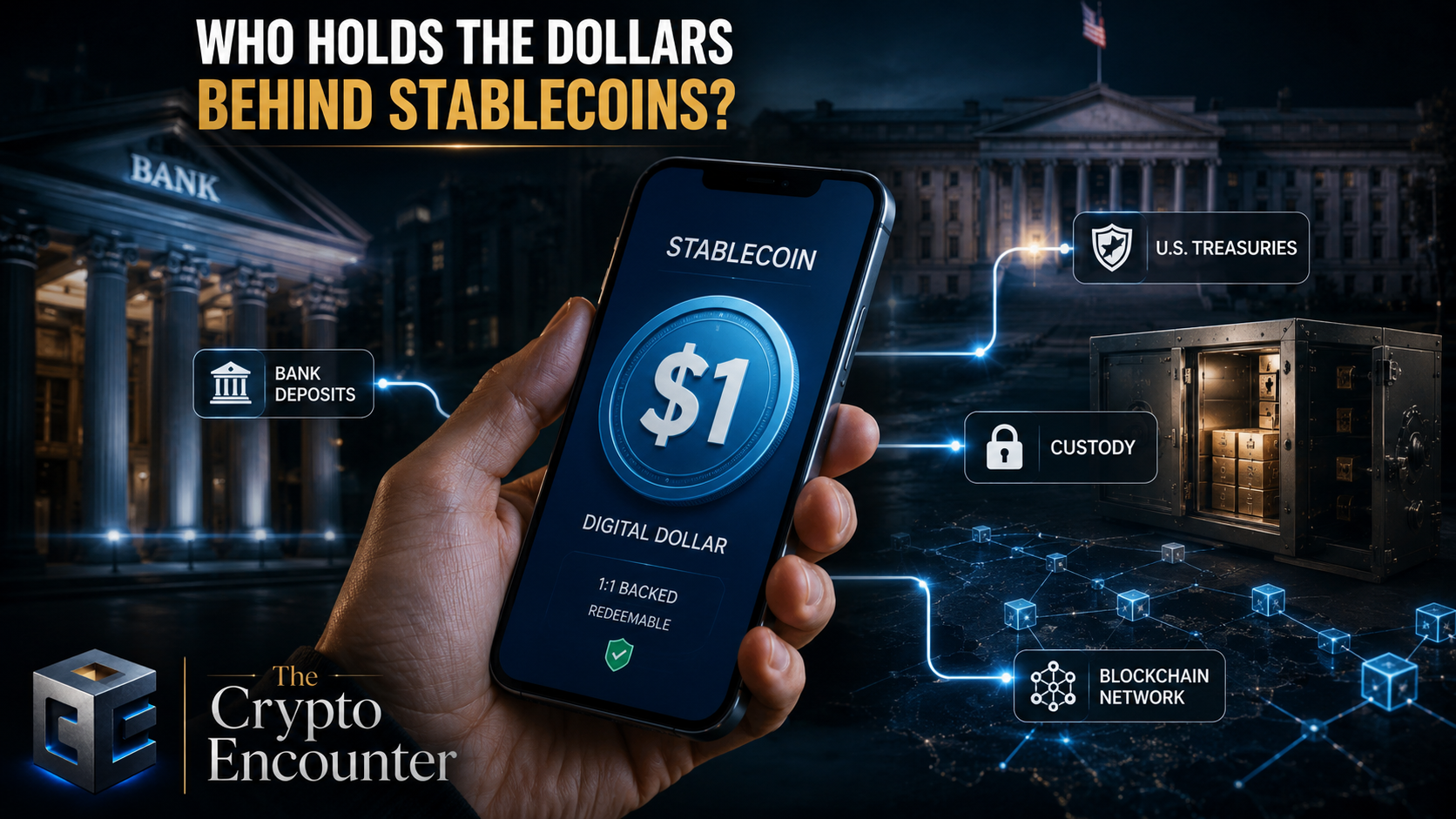
Stablecoins can cross a blockchain in seconds. However, the money supporting them usually sits inside a much older financial system. That gap matters.
The dollars behind stablecoins may exist as bank deposits, short-term U.S. Treasury securities, government money market funds, or other highly liquid assets. Therefore, holding a dollar-linked token does not necessarily mean a physical dollar sits in a vault with your name on it.
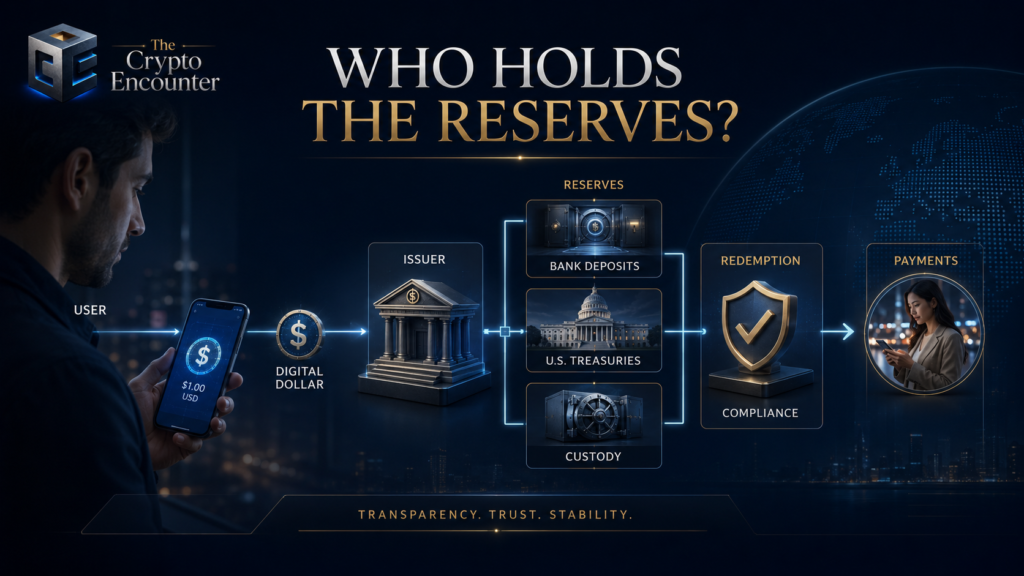
Instead, users depend on an issuer, banks, custodians, reserve managers, redemption systems, and compliance rules. Consequently, anyone using stablecoins for savings, payments, or remittances should understand who actually controls the money behind the token.
The central question is simple: when your wallet says $1, who owes you that dollar, where is the supporting money, and what could stop you from getting it?
What Actually Backs Stablecoins?
The simplest version works like this.
A customer gives a stablecoin issuer $1. The issuer creates one token. Then, the issuer places the received value into its reserve system. Later, an eligible holder can return the token and request dollars back, subject to the issuer’s redemption policies, compliance checks, fees, and applicable law.
However, reputable fiat-backed stablecoins do not necessarily keep every reserve dollar as cash in a checking account.
Under the U.S. GENIUS Act, permitted payment stablecoin issuers must maintain reserves of at least 1:1 and may use specified assets such as U.S. currency, qualifying bank deposits, short-dated Treasury securities, certain Treasury-backed repurchase agreements, and qualifying government money market funds.
New York’s existing stablecoin framework follows a similar principle. The New York Department of Financial Services requires covered dollar-backed stablecoins to maintain sufficient reserves and limits those reserves to specified liquid assets. It also requires issuers to segregate reserve assets from their own corporate property.
Therefore, saying stablecoins are “backed by dollars” can hide an important detail. The backing may actually consist of several types of dollar-denominated assets held by several financial institutions.
Who Really Holds the Money Behind Stablecoins?
Usually, no single company physically holds everything.
Several layers can separate a stablecoin holder from the underlying reserves.
The stablecoin issuer sits at the first layer. It creates tokens, manages redemptions, works with banking partners, and structures the reserve within its regulatory and contractual requirements.
Banks can form the second layer. They may hold part of the cash reserves.
Then, custodians may safeguard Treasury securities or reserve-fund assets. Meanwhile, an asset manager may manage those investments without actually issuing the stablecoin.
USDC provides a useful real-world example.
Circle states that the majority of USDC reserves are held through the Circle Reserve Fund, an SEC-registered government money market fund managed by BlackRock. That fund can hold cash, short-dated U.S. Treasuries, and overnight Treasury repurchase agreements. Circle also says the remaining reserve is primarily held as cash at major financial institutions.
Furthermore, Circle says BNY Mellon provides custody for much of the Circle Reserve Fund portfolio, while BlackRock manages it. Deloitte provides monthly third-party assurance over USDC reserves.
Circle’s USDC reserve disclosures show that reserves can include bank deposits, short-term U.S. Treasuries, and overnight Treasury repurchase agreements.
So, when someone asks who holds the dollars behind stablecoins, naming the issuer gives only part of the answer.
A more useful set of questions is:
Who issues the stablecoin?
Which assets back it?
Which banks hold its cash?
Which institutions custody its securities?
Who manages any reserve fund?
Who can redeem directly?
What legal rules govern those reserves?
Those questions reveal far more about the safety of stablecoins than their $1 price alone.
Stablecoins Are Not the Same as Bank Deposits
A bank account and a stablecoin wallet may both show “$1,000.” Legally and financially, however, they can represent very different relationships.
When you hold fiat-backed stablecoins, you generally hold digital tokens together with whatever redemption rights arise from the issuer’s terms and applicable law.
You do not normally own a specific dollar bill, Treasury bill, or bank deposit inside the issuer’s reserve.
Instead, the reserve supports the stablecoin system as a whole.
That difference becomes especially important when consumers buy stablecoins through exchanges, wallets, or payment apps. A holder may own the token without maintaining any direct customer relationship with the company that issued it.
For example, Circle’s current USDC terms state that direct redemption through Circle requires the holder to qualify for and establish an eligible Circle Mint account. A holder who cannot establish that relationship does not automatically gain direct redemption access through Circle simply because the holder owns USDC.
As a result, reserve backing and personal access to those reserves are two different issues.
Why Redemption Matters More Than a $1 Price
Most people first judge stablecoins by one number: the market price.
If a coin trades near $1, everything may appear normal.
Yet the more important mechanism is redemption.
When eligible market participants can buy a stablecoin below $1 and redeem it with the issuer at or near $1, they have an economic incentive to close that price gap. Likewise, when a coin trades above $1, new issuance and selling activity can help bring the market price downward.
Therefore, redemption helps connect stablecoins circulating on blockchains with the traditional dollars and assets sitting behind them.
Still, “redeemable for $1” does not necessarily mean that every consumer can send one stablecoin to its issuer and immediately receive one dollar.
Direct redemption can involve identity verification, geographic restrictions, minimum amounts, account requirements, fees, bank processing, and compliance reviews.
Tether offers an especially clear example. Its current fee schedule lists a minimum direct acquisition or redemption amount of $100,000. It also lists a redemption fee equal to the greater of $1,000 or 0.1%.
Moreover, Tether’s current terms require direct users to pass verification requirements. Those terms also state that Tether tokens are not legal tender, do not constitute government-backed money, and do not carry FDIC or SIPC protection.
Consequently, an everyday user with $500 of stablecoins may never interact with the issuer’s redemption system.
Instead, that person might sell the tokens on an exchange, spend them through a payment service, or transfer them to another user.
That distinction matters greatly for households using stablecoins as practical digital dollars.
What Happens If a Bank Holding Stablecoin Reserves Fails?
Even strong reserve assets can create another question: where are they held?
The banking turmoil of March 2023 offered a useful stress test.
Circle disclosed that $3.3 billion of USDC reserve cash had been held at Silicon Valley Bank when the bank failed. During the uncertainty, USDC traded below its normal $1 level on secondary markets. Circle later said that the reserve risk had been removed after U.S. authorities intervened and banking access was restored.
The episode showed something important about stablecoins.
A reserve can contain enough assets on paper while access to part of those assets becomes temporarily uncertain.
Therefore, users should care about more than the total reserve number.
They should also consider:
concentration across banks;
liquidity of reserve investments;
quality of custodians;
speed of asset liquidation;
banking access during weekends or crises; and
the issuer’s ability to process large redemption volumes.
This is why the location of stablecoin reserves matters almost as much as their value.
New York regulators have taken that issue seriously. In June 2026, the Department of Financial Services proposed updated rules that would, among other measures, establish limits on reserve concentration at individual custodians. The proposal builds on New York’s existing framework for backing, redemption, custody, and independent reserve verification.
Can Stablecoin Companies Freeze Your Money?
Yes, some centralized stablecoins include technical controls that can restrict particular blockchain addresses.
That does not necessarily mean the reserve itself has disappeared.
Reserve backing and freedom to transfer are separate issues.
Circle’s USDC terms state that the company can block certain addresses that it associates with prohibited or illegal activity. The terms also explain that Circle may freeze USDC or related assets when a valid government authority requires it to do so.
Tether’s terms similarly allow the company to freeze tokens, blacklist addresses, suspend access, or take other actions under specified legal, security, and compliance circumstances.
This means centralized stablecoins contain an important tradeoff.
Issuer controls can help companies respond to sanctions, fraud, theft, money laundering, and court orders. However, those same controls mean users should not treat centralized stablecoins as equivalent to physical cash.
A $100 bill cannot normally be remotely disabled after it enters your wallet.
Some digital dollars can.
Why Compliance Risk Matters for Everyday Payments
Compliance may sound like a concern only for exchanges or financial institutions. In practice, it can affect ordinary users too.
Suppose someone receives stablecoins from another wallet. The blockchain transfer succeeds immediately.
Later, however, an exchange may ask where the funds came from. An issuer could also restrict an address if authorities connect it to sanctioned activity, theft, fraud, or another prohibited use.
In other words, a technically successful blockchain payment does not guarantee unrestricted future use.
This matters particularly for remittances.
A worker could send stablecoins to a relative abroad within minutes. Yet the recipient still needs a compliant exchange, payment provider, merchant network, or other off-ramp to turn those tokens into useful local money.
Therefore, successful payment involves more than blockchain settlement.
It also requires access to financial institutions on both sides.
How U.S. Regulation Is Changing Stablecoins
This wider shift in stablecoin regulation is already becoming part of the market’s broader trust and infrastructure test.
The United States enacted the GENIUS Act on July 18, 2025, establishing a federal legal framework for payment stablecoins. The law does not simply say that a token must remain worth $1. It creates requirements around issuers, reserves, redemption, disclosure, compliance, and supervision.
Among its major provisions, permitted issuers must maintain at least 1:1 qualifying reserves. Under the GENIUS Act, permitted issuers must maintain qualifying reserves, disclose their redemption policies, and publish information about their reserve composition.
They must also disclose redemption policies and publish reserve information regularly. In addition, registered public accounting firms must examine required monthly reserve reports.
The law also restricts most rehypothecation of required reserves. In plain English, an issuer generally cannot take the assets backing customers’ stablecoins and repeatedly pledge or reuse them for unrelated financial activity. Limited exceptions apply under the statute.
Furthermore, the GENIUS Act addresses insolvency. Holders of payment stablecoins receive priority with respect to required reserve assets if a permitted issuer enters insolvency proceedings.
However, implementation remains important.
The statute became law in July 2025, but it provides for a later effective date. As of August 18, 2026, federal agencies were still working through implementation. For example, the FDIC had proposed rules covering reserve assets, redemption, capital, custody, and risk management. Meanwhile, an interagency customer-identification proposal remained open for comment through August 21, 2026.
So, stronger regulation can reduce certain risks surrounding stablecoins. Nevertheless, regulation cannot make every operational, banking, compliance, or market risk disappear.
Stablecoins Are Not FDIC-Insured Dollars
One misconception deserves special attention.
Holding stablecoins is not the same as holding insured deposits in your personal bank account.
The GENIUS Act specifically states that payment stablecoins are not backed by the full faith and credit of the United States, guaranteed by the federal government, or themselves subject to federal deposit insurance.
Reserve cash may still sit inside FDIC-insured banks. However, that does not automatically turn each stablecoin into an insured bank account belonging to the token holder.
In April 2026, the FDIC proposed rules stating that deposits held as reserves behind payment stablecoins would not receive pass-through deposit insurance for stablecoin holders. That proposal forms part of the continuing GENIUS Act implementation process.
Therefore, users should never assume that the words “backed by cash held at banks” mean the same thing as “my stablecoin balance has FDIC insurance.”
They do not.
Why Stablecoins Can Still Make Sense for Remittances
None of these risks erase the practical appeal of stablecoins.
Traditional international transfers can involve multiple institutions, foreign-exchange steps, business-hour restrictions, and intermediary processing.
By contrast, blockchain networks can transfer digital tokens across borders without waiting for every stage of a conventional correspondent-banking chain.
The growing role of crypto payments and remittances is already visible in markets where fintech companies are building faster cross-border payment rails.”
The Crypto Encounter currently lists this article inside its Stablecoins section, so it is a strong contextual internal link for your remittance angle.
However, stablecoins do not remove the traditional financial system completely.
Someone still holds the reserve assets.
Banks still connect issuers to ordinary money.
Custodians still protect securities.
Compliance teams still review suspicious activity.
Exchanges and payment providers still help recipients convert tokens into local currency.
Therefore, the practical question for a family sending money abroad should go beyond:
“Is this stablecoin worth $1?”
A better question is:
“Can the person receiving it reliably turn that token into money they can actually spend?”
That question captures the real consumer risk.
Five Questions to Ask Before Trusting Stablecoins
Question Why It Matters
Who issues the stablecoin? The issuer controls minting, redemption, reserve management, and major compliance decisions.
What assets back it? Cash, Treasury securities, crypto collateral, loans, and other assets carry very different risks.
Where are the reserves held? Banks, custodians, and investment funds each create separate operational and concentration risks.
Can ordinary users redeem directly? Identity checks, location, minimum amounts, fees, and account rules can limit direct access.
Can the issuer freeze addresses? Some centralized stablecoins allow issuers to restrict transfers for legal or compliance reasons.
A sixth question is also useful: how transparent is the issuer?
Circle currently publishes detailed USDC reserve information and says it provides weekly reserve disclosure plus monthly third-party assurance.
Tether publishes reserve reports quarterly and says BDO Italia provides independent assurance reports covering those reserve disclosures. Its latest reserve page available when this article was checked listed March 31, 2026 as the most recent reporting date.
The reporting models differ. Therefore, users should examine what information each issuer publishes rather than treating all stablecoins as interchangeable.
What Stablecoin Users Should Remember
Stablecoins can make digital payments fast, portable, and useful across borders.
However, the blockchain represents only one layer of the system.
Behind major fiat-backed stablecoins sit issuers, banks, custodians, Treasury markets, asset managers, accountants, regulators, exchanges, and payment providers.
Each layer solves a problem. Each layer can also introduce risk.
For that reason, a stable $1 price should never serve as the only measure of safety.
Reserve quality matters.
Custody matters.
Redemption access matters.
Bank concentration matters.
Compliance controls matter.
Legal rights matter.
Transparency matters.
Most importantly, users should understand who ultimately owes them money and what must happen before a digital token becomes a spendable dollar again.
FAQs
Who holds the money backing stablecoins?
It depends on the issuer. Stablecoins may use reserves held across banks, custodians, government money market funds, and short-term U.S. Treasury assets. The issuer normally coordinates the reserve structure, while other financial institutions may custody or manage the underlying assets.
Are stablecoins backed entirely by cash?
Not necessarily. Many fiat-backed stablecoins use highly liquid dollar-denominated assets such as short-term Treasuries, Treasury-backed repurchase agreements, bank deposits, and government money market funds rather than keeping every dollar as cash.
Can I always redeem stablecoins for one dollar?
No. Direct redemption can depend on the issuer’s rules. Verification, jurisdiction, account eligibility, minimum transaction sizes, fees, legal restrictions, and compliance reviews may apply. Some consumers therefore sell their stablecoins through exchanges instead.
Can stablecoin issuers freeze tokens?
Some centralized issuers can restrict addresses or freeze tokens under their contractual terms or when required by law. Circle and Tether both disclose address-freezing or blocking powers in their current legal terms.
Are stablecoins covered by FDIC insurance?
Payment stablecoins themselves should not be treated as FDIC-insured bank deposits. The GENIUS Act expressly states that payment stablecoins are not subject to federal deposit insurance.
Are stablecoins useful for international payments?
They can be useful because blockchain settlement can move digital dollar value across borders quickly. However, recipients still depend on wallets, exchanges, payment providers, compliance systems, and local off-ramps when converting tokens into spendable local currency.
Conclusion
The biggest misconception about stablecoins is that each token simply represents one untouched dollar waiting inside a bank.
The real structure is more complicated.
Stablecoins can depend on issuers, banks, Treasury securities, custodians, money market funds, asset managers, redemption agreements, and compliance systems. Meanwhile, the person holding the token may have no direct relationship with several of those institutions.
That does not make stablecoins inherently unsafe. However, it does mean users should judge them by more than price stability.
Before relying on stablecoins for savings, household payments, or remittances, look at reserve composition, custody, redemption access, issuer transparency, freeze powers, and regulatory oversight.
A token may move like digital cash. The dollars behind it still depend on real institutions, real contracts, and real financial infrastructure.