

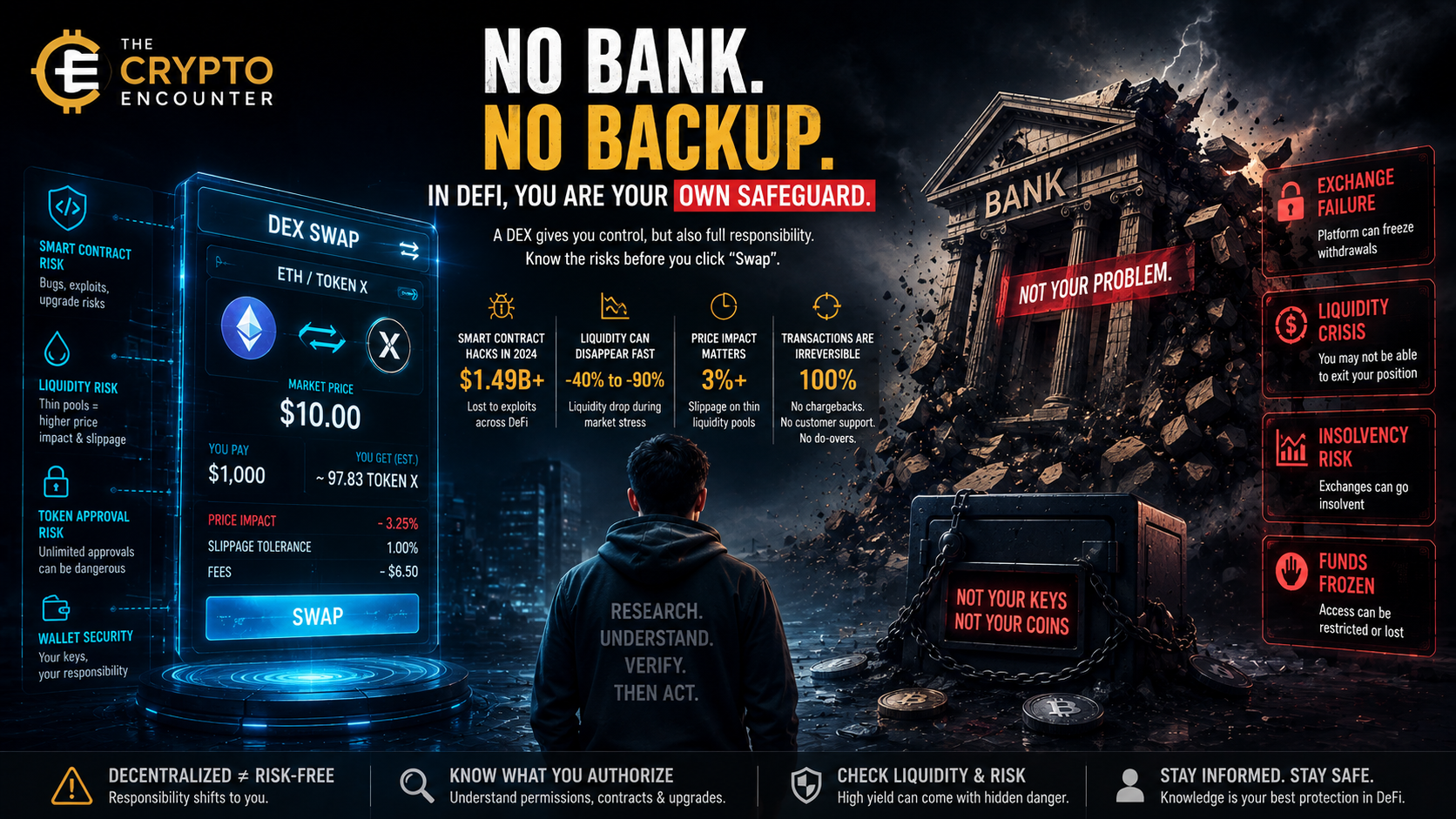
Crypto can feel simple on a DEX, but the moment you click “swap,” you may be taking responsibility that a bank normally handles for you. A DEX can let users trade without handing their assets to a traditional bank or centralized exchange, reducing reliance on corporate custody. But decentralized exchange risks can be far more complex beneath the simple “connect wallet, swap, done” experience.
These DEX risks can include self-custody crypto responsibilities, DEX smart contract risk, token approval risks, and liquidity risk. As readers explore the broader crypto security and risk coverage from The Crypto Encounter, they can better understand how responsibility shifts to smart contracts, liquidity pools, blockchain infrastructure, wallet security, and the users themselves.
The interface may look familiar, but no bank employee is waiting to reverse a costly mistake. Understanding these DeFi risks helps users see what they are authorizing, where their assets are going, why DeFi yield risk can be overlooked, and what can happen when code, liquidity, or user decisions fail.
What a DEX Actually Changes
| Bank-style assumption | What can happen on a DEX |
| “Someone is holding my money for me.” | You may retain control through your wallet while smart contracts facilitate transactions. |
| “A failed transaction can be fixed by customer support.” | Blockchain transactions can be difficult or impossible to reverse. |
| “The platform protects my balance.” | Your assets may be exposed to smart-contract, wallet, approval, liquidity, and market risks. |
| “The displayed price is what I will receive.” | Slippage, liquidity, price impact, and transaction costs can change the result. |
| “I can trust the interface.” | A compromised or fraudulent interface can direct users toward harmful transactions. |
| “High yield means better returns.” | Higher yields can come with higher protocol, liquidity, token, and market risks. |
Decentralized Exchange Risks: A DEX Replaces One Trust Model With Another
A traditional bank operates through a centralized financial relationship, managing accounts, access, and internal systems within a legal and regulatory framework. A DEX works differently. Smart contracts automate transactions while users interact with blockchain-based software through their wallets.
This shift creates decentralized exchange risks that users must understand. Instead of relying on a corporate intermediary, users may depend on smart-contract code, wallet security, token contracts, protocol governance, blockchain infrastructure, and available liquidity.
These factors can create DEX smart contract risk, self-custody crypto responsibilities, and liquidity risk. That is why “decentralized” should not be treated as another word for “protected.” A DEX can reduce centralized custody while introducing other forms of exposure that may be unfamiliar to ordinary users.
Smart-Contract Risk Can Become Your Problem
Smart contracts are software. They can automate financial logic, but software can contain vulnerabilities, unexpected behaviors, or design flaws.
Ethereum’s official security guidance warns that smart contracts can control substantial amounts of value and that attackers can exploit vulnerabilities. Because deployed contract code is generally difficult to modify and stolen assets can be difficult or impossible to recover, a software failure can become a financial loss. Ethereum’s smart-contract security guidance
Consider a user who deposits assets into a DeFi protocol because it advertises an attractive yield. The user may focus on whether the yield is sustainable. But another question is just as important:
What happens if the contract itself fails?
A smart-contract audit can reduce uncertainty, but it is not an insurance policy or guarantee of safety. Ethereum cautions that audits cannot identify every possible bug or design flaw. Protocols may also have upgrade mechanisms, administrative permissions, external dependencies, or governance systems that influence how they operate.
For users, the key questions extend beyond whether a protocol has been audited. They should consider what the audit covered, what has changed since the review, who controls upgrades, and what could happen if the system fails.
Your Wallet Gives You Control, and Responsibility
Self-custody is one of DeFi’s defining characteristics. Instead of asking a company to hold assets on your behalf, you generally control the wallet that signs transactions. That can reduce dependence on a centralized custodian, but it also means the user has greater responsibility for the security of the wallet and the transactions it authorizes.
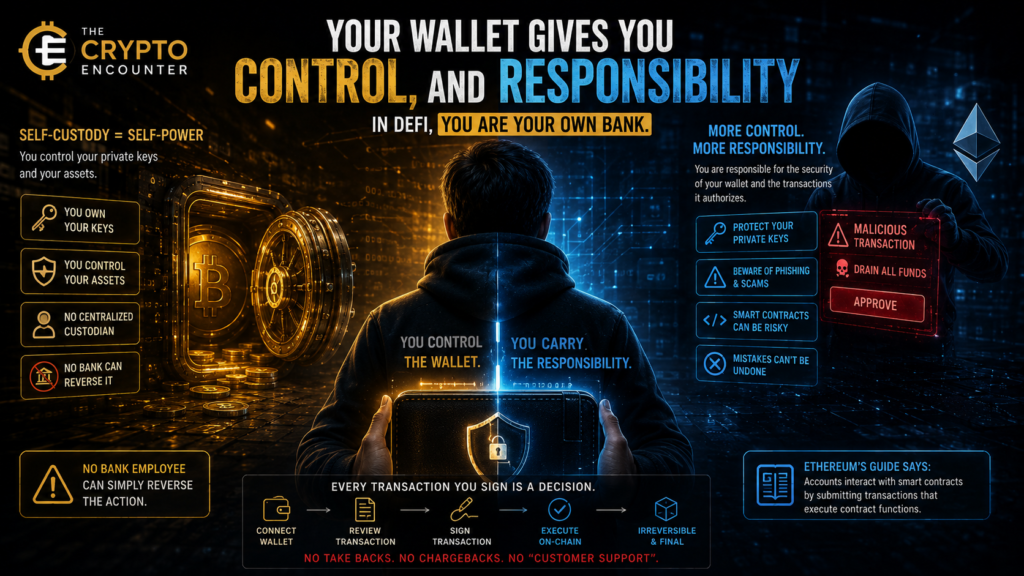
As Ethereum’s guide to interacting with smart contracts explains, accounts interact with smart contracts by submitting transactions that execute contract functions. If someone gains control of a private key, or if a user signs a malicious transaction, there may be no bank employee who can simply reverse the action.
That changes what “control” means: you control the wallet, but you also carry more responsibility for what that wallet authorizes.
Token Approvals: An Overlooked Part of Decentralized Exchange Risks
A DEX transaction may require a token approval before the actual swap can take place. In plain English, an approval can allow a smart contract to spend a user’s tokens under specified conditions. That permission can be more important than the swap itself, yet many users pay little attention to the approval screen.
Ethereum’s ERC-20 token documentation explains that token contracts can include approval functions that allow another account or contract to move tokens on a user’s behalf. Imagine that a user wants to swap $100 worth of tokens but approves a contract to spend a much larger amount.
The immediate trade may be small, while the permission granted can be considerably broader. That is why users should not treat every “Approve,” “Sign,” or “Confirm” prompt as a routine step.
The important question is: What exactly am I authorizing this contract to do? Users should also periodically review permissions and remove approvals they no longer need, particularly after interacting with unfamiliar applications.
The DEX Price Illusion: What Happens When Liquidity Runs Dry
A DEX can display a market price without guaranteeing that a large trade will execute near that price. Liquidity determines how much trading activity a pool can absorb without significant price movement. A deep pool may limit price impact, while a shallow pool can cause substantial slippage.
For example, a $1,000 purchase in a thin pool could move the token’s price and reduce the amount received. During market stress, liquidity can deteriorate further as users rush to exit, making trades even more difficult and costly.
For more context on how liquidity conditions can affect crypto markets, see The Crypto Encounter’s analysis of Bitcoin and global liquidity. Liquidity providers face a different risk known as impermanent loss. When the relative prices of assets in a liquidity pool change, the value of providing liquidity can differ from simply holding the assets.
Trading fees and other returns may offset some of that difference, but they do not eliminate the underlying exposure. That means a high advertised yield should never automatically be interpreted as high safety. A yield can compensate users for taking risks that are easy to overlook.
The Interface Can Look Centralized Even When the System Isn’t
There is a psychological trap in DeFi: the website can look like a financial institution.
Users may see balances, charts, prices, buttons, and confirmation screens. But the interface is not necessarily the entity controlling the underlying assets.
That distinction matters because users can encounter phishing websites, malicious applications, or compromised interfaces. Ethereum’s security resources specifically warn users about scams and malicious interactions and emphasize caution around wallet permissions and approvals. Ethereum’s guidance on scams and wallet security
A familiar-looking interface therefore does not provide the same reassurance as a regulated financial institution with defined operational responsibilities.
Before connecting a wallet, users should verify that they are using the correct application and official domain, understand which contract they are interacting with, and review the transaction details before signing.
The Bottom Line
A DEX is not a bank because it operates on a fundamentally different trust model. Instead of placing the entire financial relationship inside a centralized institution, DeFi distributes responsibility across code, blockchain infrastructure, liquidity providers, governance systems, wallets, and users.
Decentralized exchange risks therefore involve more than market volatility. They can include DEX smart contract risk, token approval risks, liquidity risk, wallet security issues, and irreversible transactions. Removing a custodian does not remove risk. Before pursuing convenience or yield, users should understand what they are authorizing, where their assets are going, and how DeFi yield risk can affect their funds if a protocol fails. In DeFi, the absence of a bank does not mean the absence of risk. It changes where that risk lives.
FAQs
Is a DEX safer than a bank?
Not categorically. A DEX and a bank expose users to different risks. A DEX can reduce dependence on centralized custody while increasing exposure to smart-contract, wallet, approval, liquidity, and transaction risks.
Does a DEX hold my crypto?
It depends on the specific protocol and transaction. In many self-custody DEX interactions, users control their wallets while smart contracts facilitate swaps. Other DeFi products may require assets to be deposited into contracts or liquidity pools.
Can a DEX reverse a failed transaction?
Users should not assume that an on-chain transaction can be reversed. Ethereum’s documentation explains that smart-contract interactions are irreversible by default, making transaction accuracy especially important.
Does a smart-contract audit guarantee safety?
No. An audit can identify certain vulnerabilities, but it does not guarantee that a protocol is secure. Ethereum’s security documentation explicitly notes that audits cannot catch every bug and should not be considered a complete guarantee of safety.
Why can DeFi offer high yields?
Yield can come from trading fees, lending activity, incentives, token emissions, or other mechanisms. A high yield can reflect higher protocol, liquidity, token, or market risk. It should never be treated as a guarantee of profit or safety.
Disclaimer
This article is for educational and informational purposes only and should not be considered financial, investment, legal, or tax advice. Decentralized exchanges involve significant risks, including smart-contract vulnerabilities, liquidity shortages, price volatility, token approval issues, wallet security threats, and potentially irreversible transactions. High yields do not guarantee profits or safety. Readers should conduct their own research, understand the protocols and risks involved, and consider seeking qualified professional advice before making financial decisions involving DeFi or digital assets.