

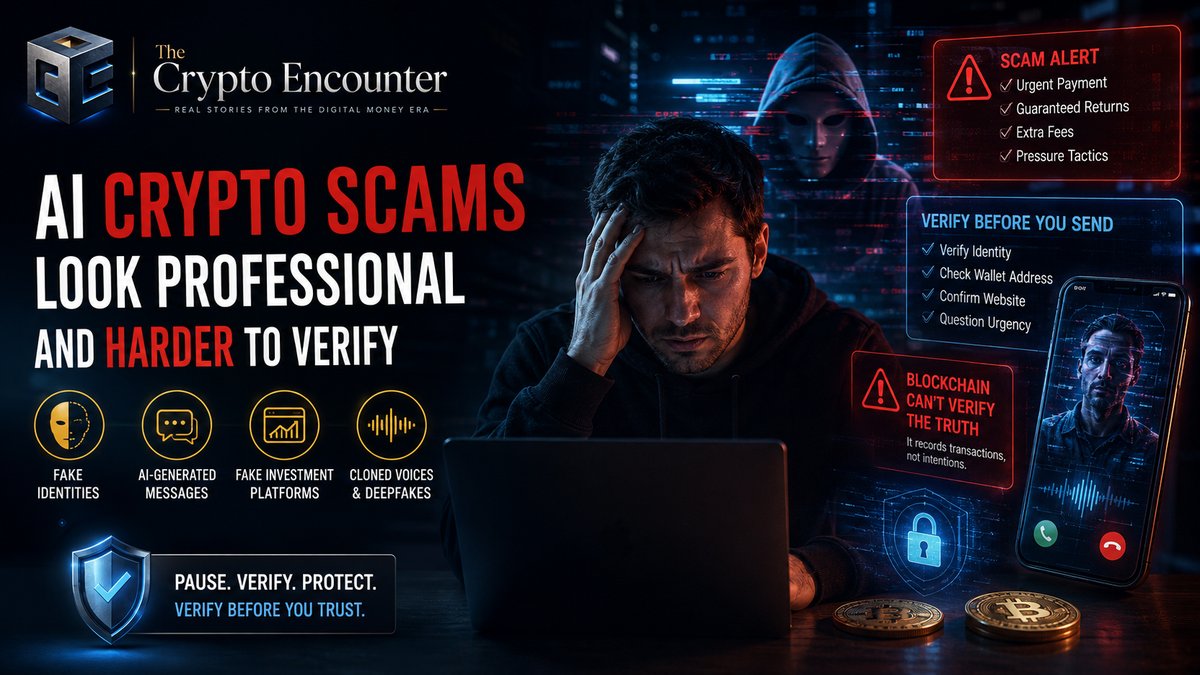
Crypto users are facing a trust problem that blockchain alone cannot solve. AI crypto scams can resemble legitimate investment platforms, support messages, research reports, and personal conversations. AI can produce convincing text, images, voices, websites, and profiles at scale, making fraudulent operations appear increasingly credible.
For readers of The Crypto Encounter, understanding these tactics is essential. This article explains how AI-powered crypto scams create false credibility, why polished content should not be treated as proof of legitimacy, and how ordinary users can verify identities, platforms, messages, and payment requests before sending cryptocurrency.
The Scam Advantage Has Moved To Credibility
A scam does not need to break a blockchain. It needs to persuade someone to send funds, reveal credentials, connect a wallet, or approve a transaction. AI strengthens that persuasion layer by making fraudulent communication appear more credible.
AI crypto scams can generate natural-sounding messages, translations, profile images, and conversations. The FBI warns that criminals use generative AI to create fictitious profiles, fraudulent cryptocurrency investment websites, and high-volume messages. Readers can review the FBI’s guidance on generative AI and financial fraud for additional context.
How AI Crypto Scams Personalize Trust
Traditional fraud reused messages. AI can make each interaction personal.
With AI-powered crypto scams, criminals can use public information to tailor pitches, generate follow-up replies, and create urgent payment instructions. One target may receive a trading opportunity while another sees a token pitch.
This makes crypto scam risks increasingly dependent on independent verification.
Deepfakes Can Manufacture Familiar Faces And Voices
People trust familiar voices and faces. Synthetic media exploits that instinct.
The Federal Trade Commission warns about voice-cloning fraud and advises consumers to contact the supposed person through a known channel instead of trusting the voice alone. FTC guidance on harmful voice cloning.

For AI crypto scams, a fake video might promote a token sale, a cloned voice might instruct someone to move funds, or a synthetic support agent might demand a withdrawal fee. A face, voice, or video is a claim requiring verification, especially when crypto scam risks are involved.
Why Fake Crypto Platforms Can Look Real
Fake investment websites can imitate legitimate financial products. They may display balances, profit charts, transaction histories, and support windows. None proves assets exist.
AI can make an operation feel coherent. Yet AI crypto scams often use a simple mechanism: real money enters an environment controlled by the attacker. When a victim tries to withdraw, the scam can demand taxes, verification charges, liquidity fees, or another deposit.
The blockchain can confirm the transfer, even in AI-powered crypto scams. It cannot validate the business behind it or remove crypto scam risks. That distinction matters for ordinary users.
Pressure Can Reveal What Technology Hides
People often focus on logos and domains when assessing crypto scam risks. Behavior matters.
Urgency, guaranteed returns, secrecy, unexpected fees, and requests to move funds immediately deserve extra scrutiny. A sophisticated scam may contain perfect grammar.
Open official websites yourself, contact companies through known channels, and confirm wallet addresses before sending funds. If someone demands immediate action, pause.
Blockchain Can Verify Transfers, Not Truth
Blockchain networks confirm transactions and preserve records. They do not decide whether a payment was wise, voluntary, or based on a truthful business claim.
That distinction is central to AI crypto scams. If manipulation convinces a user to send cryptocurrency to a scammer, the network can record the transaction perfectly. It does not reverse the transfer because the story was fraudulent.
A Better Verification Routine
Before sending crypto, separate the claim from the evidence. Identify who is making the request and independently verify the destination.
For AI-powered crypto scams, verification is more useful than detecting synthetic media. Contact the organization through a channel the sender does not control and verify the wallet address separately. This reduces crypto scam risks.
AI Crypto Scams Verification: What Users Should Check
Use a simple pause-and-verify routine:
| Verification Area | What To Check | Why It Matters |
| Identity | Verify the person independently | Prevents impersonation |
| Website | Use the official domain | Avoids fake platforms |
| Wallet Address | Confirm the full address | Prevents wrong transfers |
| Payment Request | Question urgency or extra fees | Exposes pressure tactics |
| Credentials | Never share private keys | Protects wallet control |
| Returns | Reject guaranteed-profit claims | Identifies unrealistic promises |
| Media | Treat videos and voices cautiously | AI can imitate people |
| Registration | Check relevant authorities | Supports legitimacy checks |
| Transaction | Review before signing | Reduces irreversible mistakes |
| Communication | Use trusted channels | Avoids attacker-controlled contacts |
These steps cannot eliminate AI crypto scams, but they reduce crypto scam risks.
The Human Trust Layer Now Matters More
AI has not made blockchains inherently unsafe. It has made the human layer around crypto easier to imitate. That means AI-powered crypto scams can increasingly rely on realistic identities, automated conversations, fabricated evidence, and timed pressure.
The response is to require independent evidence. Readers can also explore Crypto Can Be Secure Without Being Safe: Let’s Dissect Crypto Safety for a broader look at user protection.
Conclusion
AI crypto scams succeed when a believable story moves faster than verification. AI can improve language, images, voices, websites, and personalization, but it cannot turn a fraudulent claim into legitimate ownership.
For readers facing crypto scam risks, the strongest defense is deliberate verification. Confirm identities, inspect destinations, question urgency, and never treat polished presentation as proof. Technology will keep changing. The need to pause before an irreversible transaction will not, especially as crypto scam risks evolve.
FAQs
Can AI Create A Realistic Crypto Scam Website?
Yes. AI can produce website copy, images, translations, and support content. A polished interface proves little.
Can A Voice Or Video Prove A Crypto Request Is Real?
No. Synthetic media can imitate real people. Verify important requests independently.
Are AI-Powered Crypto Scams Harder To Detect?
They can be. AI can reduce obvious errors and personalize communication.
What Should I Do Before Sending Crypto?
Verify the recipient, organization, website, wallet address, and reason for payment independently.
Can Blockchain Reverse A Scam Transaction?
Usually, no. A blockchain records a valid transaction without determining whether the sender was deceived.
Disclaimer
This article is for educational and informational purposes only and is not investment, legal, tax, or cybersecurity advice. Cryptocurrency transactions can be irreversible, and scams may cause permanent losses. Readers should independently verify identities, platforms, wallet addresses, claims, and regulatory information before acting. Never share private keys or recovery phrases. If fraud is suspected, preserve evidence and contact the platform, financial institution, regulator, or law-enforcement agency. The Crypto Encounter does not guarantee the accuracy or future relevance of this information.