

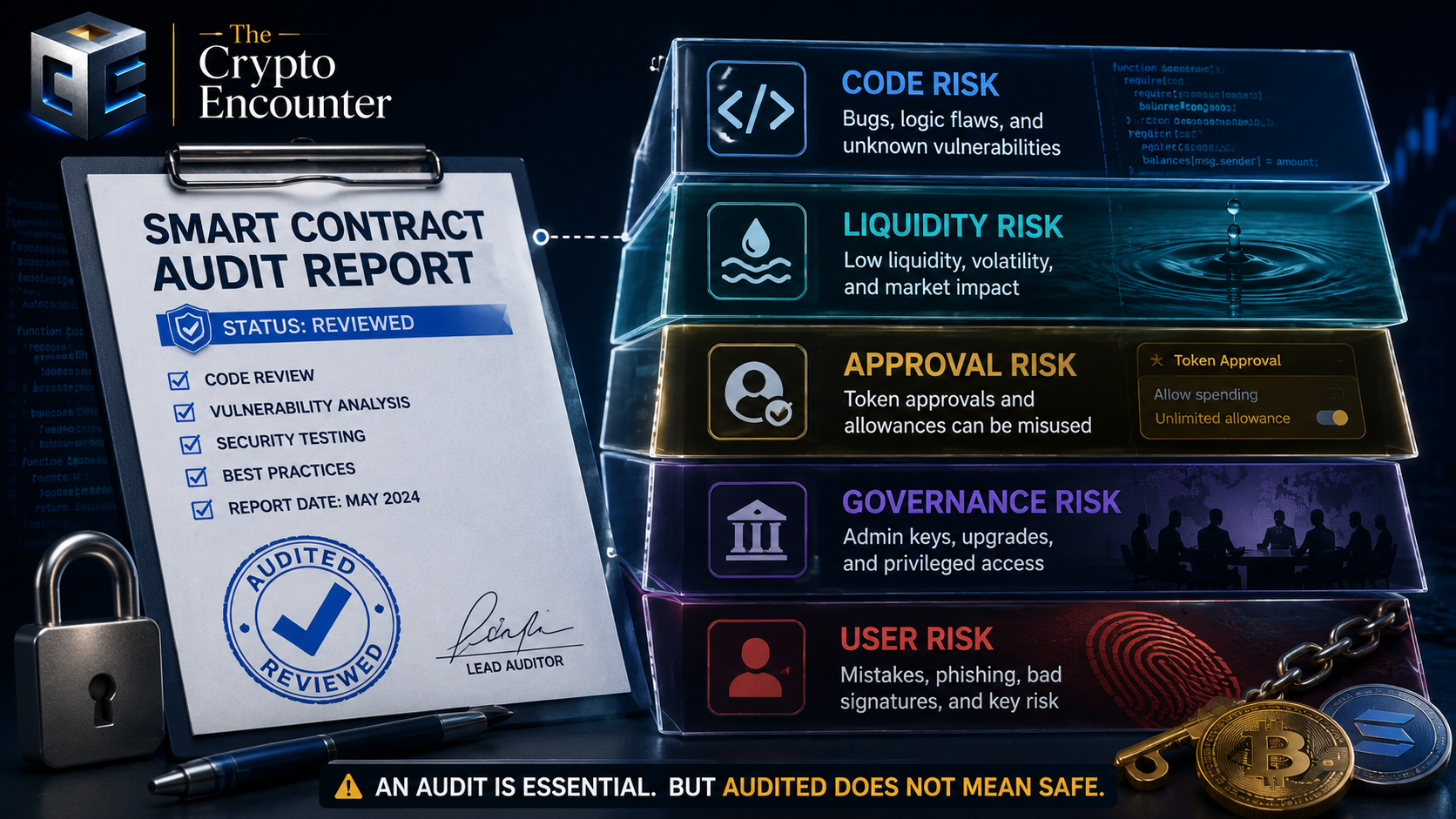
A security audit can make a decentralized finance protocol safer. However, audited does not mean safe. An audit reviews specific code, at a specific point in time, using a defined testing scope. It cannot guarantee that every bug, economic weakness, dangerous permission, liquidity problem, or future upgrade will remain harmless. Ethereum’s smart contract security guidance also warns developers against treating audits as a complete security solution because an audit may still miss bugs.
That distinction matters for ordinary users. DeFi can remove the need to hand assets to a traditional corporate custodian. Yet the risk does not disappear. Instead, users may face smart contract failures, token approvals, volatile liquidity, privileged admin controls, malicious interfaces, and mistakes they must manage themselves.
Therefore, audited does not mean safe should be understood as a practical rule, not an argument against audits. Audits reduce one category of uncertainty. They do not remove the wider risk surrounding a decentralized financial product.
Key Takeaways
| Question | What Users Should Understand |
|---|---|
| Does an audit prove a DeFi protocol is safe? | No. Audited does not mean safe. An audit can identify vulnerabilities but cannot guarantee that none remain. |
| What does an audit actually examine? | Usually a defined version and scope of smart contract code during a particular review period. |
| Can audited code still lose money? | Yes. Bugs, economic design flaws, upgrades, liquidity changes, compromised admin controls, approvals, or user mistakes can still create losses. |
| Does self-custody eliminate platform risk? | It removes some custody risks, but users still interact with contracts, interfaces, tokens, liquidity pools, and permissions. |
| Does connecting a wallet let a dApp spend tokens? | Not by itself. Token approvals grant that spending permission. |
| What should users check? | Audit scope, unresolved findings, contract changes, admin powers, approvals, liquidity, dependencies, and personal exposure. |
Why Audited Does Not Mean Safe in DeFi
A smart contract audit is essentially a specialist review of software that may control digital assets. Auditors look for vulnerabilities, flawed assumptions, dangerous permissions, and other weaknesses. That process has real value.
Still, audited does not mean safe because an audit provides evidence about risk rather than a certificate of future safety.
Ethereum recommends independent reviews and smart contract audits as part of a broader security process. At the same time, its security documentation explicitly says audits cannot catch every bug. Ethereum also recommends testing, code analysis, secure development processes, access controls, monitoring, and disaster-recovery planning.
Moreover, smart contracts often control valuable assets while operating on public blockchains. Once vulnerable code reaches users, correcting the problem can become difficult. An attacker may exploit the weakness before developers can respond. Ethereum therefore describes diverse testing methods as important because no single technique covers every possible failure mode.
In other words, the audit is one layer of defense.
It is not the entire defense.
Audited does not mean safe after the code changes
Timing creates another important limitation.
Imagine an auditor reviews version 1.0 of a protocol. Developers later introduce a new function, alter an existing module, change an oracle, update a proxy implementation, or modify permissions.
The original report does not automatically prove that the changed system remains secure.
Even when developers send an update for additional review, audited does not mean safe. New code can interact with old code in unexpected ways. Moreover, one apparently small change may alter the economic behavior of the entire protocol.
OWASP highlights this wider problem through its work on business-logic vulnerabilities. A contract can execute its programmed rules correctly while those rules still allow an exploitable economic outcome. In such cases, the individual lines of code may appear reasonable, yet the system-level behavior remains unsafe.
That distinction matters because DeFi behaves like programmable finance, not ordinary static software.
The Euler Exploit Shows Why Audited Does Not Mean Safe
The March 2023 Euler Finance exploit offers a particularly useful example.
Euler reported that an attacker exploited its V1 lending protocol for roughly $197 million in assets. According to Euler’s later account, the protocol had undergone multiple audits, maintained a large bug bounty, and used other security measures before the incident. Nevertheless, a vulnerability remained.
The issue involved a function called donateToReserves. Euler said the function had been reviewed, but it lacked a health check that should have prevented the exploitable sequence of actions. The attacker used that weakness to manipulate a position and exploit the liquidation system.
Fortunately, the Euler Foundation later announced that all recoverable funds had been returned following negotiations.
The incident does not show that audits are useless. Quite the opposite. It shows why audited does not mean safe even when a serious team spends money and effort on security.
Security reviews reduce risk. They cannot mathematically promise that every relevant interaction has been anticipated.
More importantly, users rarely lose money because a website simply lacks an “audit” badge. Losses can emerge from the interaction between code, market conditions, incentives, collateral, permissions, governance, and human decisions.
Audited Does Not Mean Safe When Admins Still Hold Powerful Controls
“Decentralized” can also describe systems with very different levels of control.
Some smart contracts include privileged functions. For example, an administrator, multisignature wallet, governance system, or security council may have the ability to pause contracts, modify parameters, move certain funds, or upgrade implementation logic.
Those powers may serve legitimate security purposes. However, they also create additional trust assumptions.
OWASP warns that critical functions controlled by a single entity can create a single point of failure. If the relevant private key becomes compromised, an attacker may gain access to privileged actions.
Upgradeable contracts add another layer. OWASP explains that insecure proxy administration or upgrade mechanisms can allow attackers to replace implementation logic or seize sensitive privileges.
Consequently, audited does not mean safe when users have not checked what powerful parties can still change after deployment.
A protocol may have excellent code today while retaining the technical ability to behave differently tomorrow.
Token Approvals Create Risk Outside the Audit Report
DeFi users also need to understand token approvals.
Connecting a wallet to a decentralized application does not automatically allow that application to transfer tokens. Instead, users generally sign an additional blockchain transaction called an approval or allowance.
That approval lets a smart contract access a specified token. MetaMask explains that these permissions support common DeFi actions such as swaps, lending deposits, liquidity provision, and NFT activity.
However, an approval may remain active after the original transaction ends.
Therefore, audited does not mean safe for everything inside your wallet. A protocol audit may examine a contract, but the user still controls which permissions remain attached to the wallet.
These responsibilities form part of the wider security risks across the crypto ecosystem, where wallet management, permissions, infrastructure, and user behavior can create separate points of failure.
MetaMask warns that unlimited token allowances can create substantial exposure if a vulnerable or malicious contract gains the ability to use them. It also distinguishes revoking an approval from merely disconnecting a wallet from a website. Disconnecting the interface does not necessarily cancel the underlying on-chain allowance.
For example, suppose Maria swaps $100 worth of Token A through a DEX. During the transaction, she approves unlimited access to Token A.
Months later, Maria has $4,000 worth of that token in the same wallet.
If the approved contract later becomes exploitable, the important exposure may no longer be the original $100 trade. The old allowance could matter much more.
So, audited does not mean safe unless users also understand what permissions they personally granted.
Audited Does Not Mean Safe From Liquidity Risk
Another misconception appears when users assume security equals profitability.
A perfectly functioning smart contract can still produce a financial loss.
For instance, liquidity providers on decentralized exchanges may face impermanent loss when the relative prices of assets inside a pool change. Uniswap also identifies market volatility, out-of-range positions, smart contract vulnerabilities, and risks associated with untrusted tokens as potential concerns for liquidity providers.
An audit cannot make a volatile asset stable.
Likewise, it cannot guarantee deep market liquidity.
It cannot prevent another token in a pool from collapsing.
Nor can it guarantee that transaction fees will compensate a liquidity provider for adverse price movements.
Accordingly, audited does not mean safe from ordinary market mechanics. Security risk and financial risk overlap, but they remain different concepts.
This distinction becomes especially important when a DeFi platform advertises an attractive annual percentage yield. A high yield may result from trading fees, token incentives, borrowing demand, or other mechanisms. However, the displayed percentage alone says little about smart contract risk, token-price risk, liquidity conditions, or the sustainability of those rewards.
These questions become even more important as DeFi credit and collateral systems expand and protocols compete to attract lending activity and liquidity.
Self-Custody Replaces One Risk With Several Responsibilities
Self-custody gives users direct control over cryptographic keys and assets. That control can remove important risks associated with depositing assets with a centralized intermediary.
However, greater control also shifts more responsibility to the user.
There may be no customer-service team capable of reversing a mistaken transfer. A malicious signature may execute exactly as authorized. A leaked seed phrase can give an attacker control over the wallet. An old token approval may remain active. Meanwhile, interacting with the wrong contract address can expose funds even if another legitimate version of the protocol passed several audits.
Therefore, audited does not mean safe once human decisions enter the transaction path.
This creates a useful distinction:
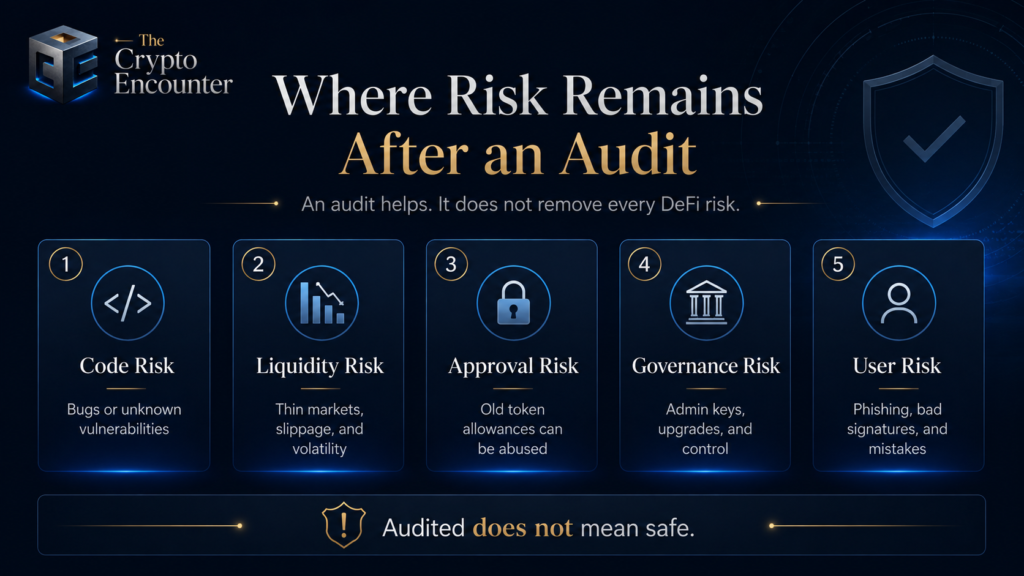
Custody risk: Who can control or withhold your assets?
Contract risk: Can the code behave unexpectedly or be exploited?
Permission risk: What have you authorized smart contracts to do?
Liquidity risk: Can assets be traded or withdrawn under stressed conditions without severe losses?
Market risk: Can the underlying assets lose value?
Governance risk: Who can alter important protocol parameters or code?
User risk: Can signing, key-management, address, or transaction mistakes cause irreversible losses?
Removing one category does not remove the others.
Why Audited Does Not Mean Safe Is More Useful Than an “Audit Badge”
For users, the better question is not simply, “Has this protocol been audited?”
Instead, ask what the audit actually tells you.
First, check who performed it. Then check the date. Next, identify which contracts and versions the auditor reviewed. Also look for unresolved findings and determine whether the protocol later changed its code.
After that, investigate permissions and governance.
OWASP’s security framework covers issues such as access control, authorization, contract architecture, upgradeability, business logic, input validation, and governance precisely because smart contract security involves several interacting layers.
A useful mental model is therefore:
Audit = evidence of security work.
Audit ≠ guarantee of safety.
Once that distinction becomes clear, audited does not mean safe becomes a much more practical way to evaluate DeFi.
Audited Does Not Mean Safe: A Practical User Checklist
Before depositing meaningful funds into a DeFi protocol or DEX, users can ask:
| Check | Why It Matters |
| Is there an audit? | An independent review can reveal vulnerabilities before attackers find them. |
| What exactly was audited? | The report may cover only certain contracts, modules, integrations, or versions. |
| When did the audit happen? | Later code changes may alter the security assumptions. |
| Were serious findings fixed? | An audit report can contain unresolved or partially addressed issues. |
| Can contracts be upgraded? | Future implementation changes can affect previously reviewed behavior. |
| Who controls admin privileges? | Admin keys, multisigs, governance, and security councils can hold significant power. |
| What approvals am I signing? | Token allowances can remain active beyond a single transaction. |
| Is the liquidity deep enough? | Thin liquidity can increase slippage and exit difficulty during stress. |
| Where does the yield come from? | Understanding the source helps reveal market, token, leverage, and incentive risks. |
| What happens if something fails? | Emergency pauses, bug bounties, monitoring, insurance arrangements, and response plans can affect outcomes. |
| How much can I afford to expose? | Even careful due diligence cannot reduce DeFi risk to zero. |
Most importantly, audited does not mean safe should prompt deeper questions rather than automatic distrust.
A reputable audit remains a positive signal. Multiple independent audits may provide additional scrutiny. Formal verification can offer stronger guarantees about specified properties in some circumstances. Ethereum describes formal verification as a way to prove whether predefined properties of contract logic hold. However, those guarantees still relate to the specification being tested.
No single label substitutes for understanding the system.
What Ordinary DeFi Users Should Remember
DeFi changes where trust and responsibility sit.
A centralized exchange may ask users to trust a company with custody. By contrast, a decentralized protocol may let users retain control of their wallet while asking them to trust smart contract logic, governance mechanisms, oracle systems, liquidity conditions, interfaces, and their own transaction decisions.
Neither model automatically eliminates risk.
Instead, the risk moves.
That is why audited does not mean safe is such an important principle. An audit can strengthen a protocol and expose weaknesses before deployment. Still, an audit cannot promise that markets will remain liquid, administrators will never lose keys, every economic edge case has been modeled, approvals will stay harmless, upgrades will remain secure, or users will never sign dangerous transactions.
Conclusion: Audited Does Not Mean Safe, but Audits Still Matter
Audited does not mean safe because DeFi security extends far beyond a code review. Smart contract vulnerabilities matter, but so do liquidity conditions, token approvals, governance powers, protocol upgrades, market behavior, wallet security, and individual decisions.
Still, users should not interpret that conclusion as a reason to ignore audits. Independent reviews remain an important security layer. Ethereum itself recommends them while warning that they cannot catch every bug.
The better approach is to treat an audit as one piece of evidence.
Check its scope. Check its date. Understand the permissions. Review the protocol’s control structure. Consider the liquidity and assets involved. Finally, limit exposure according to risks you actually understand.
In DeFi, audited does not mean safe. It means someone looked for problems. What remains unseen can still matter.
FAQs
Why does audited does not mean safe apply to smart contracts?
Audited does not mean safe because auditors can miss bugs, economic design problems, unusual interactions, or vulnerabilities introduced after the review. Ethereum recommends audits as one security layer but specifically warns against treating them as a complete solution.
Can an audited DeFi protocol still be hacked?
Yes. Euler Finance provides a documented example. Its V1 protocol had undergone extensive security work before a vulnerability contributed to a roughly $197 million exploit in March 2023. The recoverable assets were later returned.
What should I look for in a smart contract audit?
Check the auditor, publication date, code version, audit scope, severity of findings, unresolved issues, and whether developers changed the relevant contracts afterward. Therefore, audited does not mean safe simply because a project displays an audit logo.
Are DEXs safer than centralized exchanges?
They carry different risks. A DEX can reduce dependence on corporate custody because users can trade through self-controlled wallets. However, users may then face smart contract, approval, liquidity, governance, interface, and self-custody risks. “Decentralized” should not be interpreted as “risk-free.”
Can disconnecting my wallet remove token approvals?
Not necessarily. MetaMask explains that disconnecting a wallet from a dApp differs from revoking an on-chain token approval. Users must revoke allowances separately if they no longer want a contract to retain permission to move approved tokens.
Does a high DeFi yield mean the protocol is unsafe?
Not automatically. However, high advertised yields require context. Users should understand where the return comes from, what assets generate it, whether incentives depend on volatile tokens, and what contract, liquidity, leverage, or market risks accompany it. Audited does not mean safe from those financial risks.
Disclaimer
This article is for informational and educational purposes only. It does not provide financial, investment, legal, tax, or accounting advice. Cryptocurrency and digital asset markets involve risk, including possible loss of capital. Readers should conduct their own research before making any financial decision.