

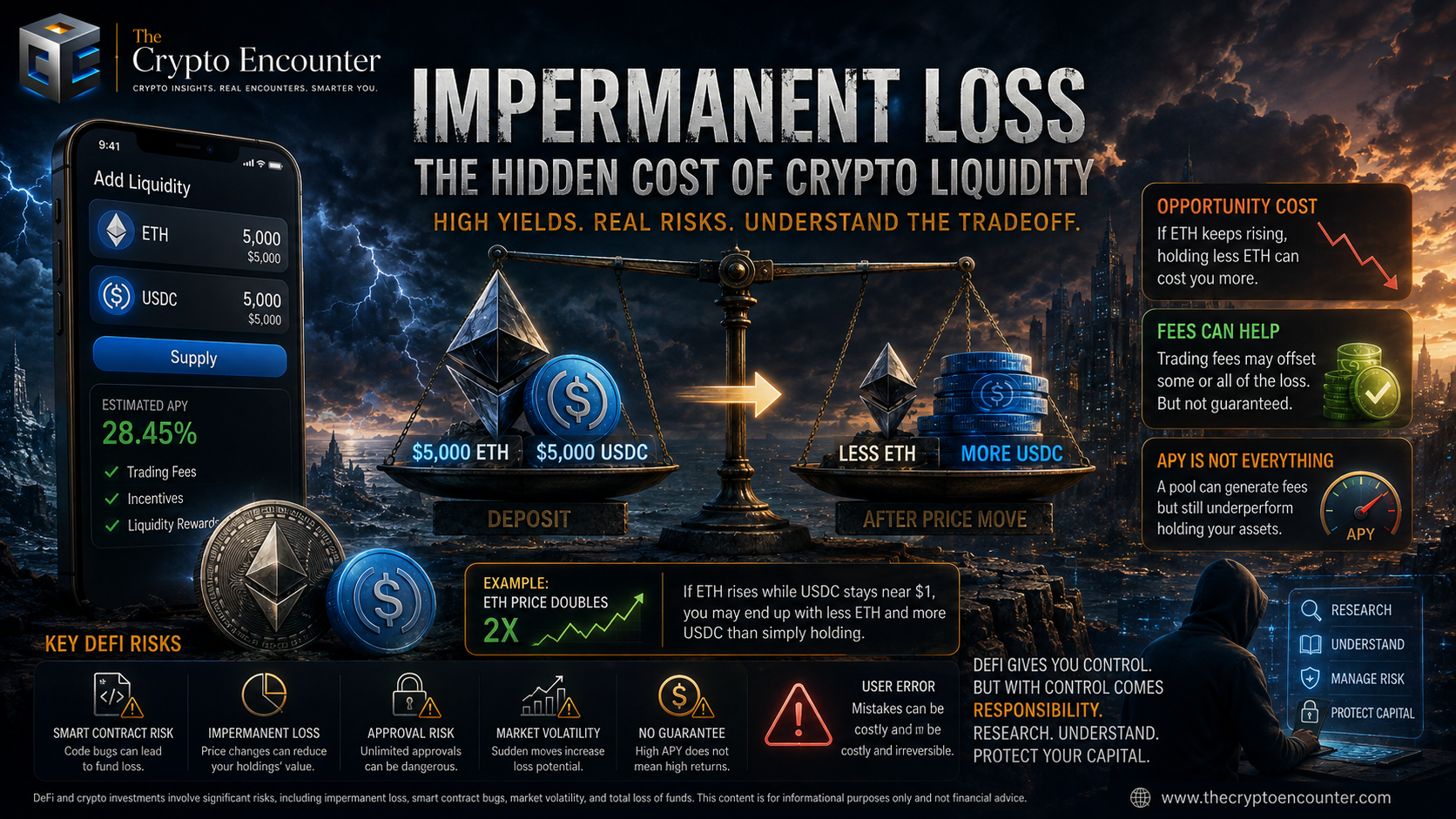
Crypto users are often told that decentralized finance removes the need to trust a company with their assets. That can be true, but it does not remove risk. As explained by The Crypto Encounter, decentralized tools can shift responsibility toward users, smart contracts, and protocol design. These risks become especially important when users provide liquidity, as impermanent loss can add another layer of exposure when token prices move relative to each other.
When you become a liquidity provider, you exchange some custody risk for exposure to automated market-making rules, token-price movements, smart contracts, approvals, and your own transaction decisions. Impermanent loss is one of the clearest examples of that tradeoff.
When two assets in a liquidity pool move significantly relative to one another, the value of a liquidity position can become lower than if the same assets had simply been held separately. The difference is called impermanent because it can shrink if prices return to their earlier relationship. But if you withdraw while the divergence remains, the economic loss becomes real.
DeFi protocols, wallets, smart contracts, and related crypto products involve meaningful risks, and users remain responsible for their own decisions.
What Impermanent Loss Actually Means
A liquidity pool typically holds two assets so traders can swap between them. Liquidity providers deposit both assets, while an automated market-making mechanism adjusts the pool’s balances as trades occur.
Imagine depositing equal values of ETH and USDC. ETH then rises sharply against USDC. Arbitrage traders have an incentive to buy the relatively cheaper ETH from the pool until its price reflects the wider market. As this happens, the pool holds less ETH and more USDC.
If you had simply held the original ETH and USDC, you might have ended up with a higher total value. That difference is the basic idea behind impermanent loss.
Uniswap’s documentation explains that liquidity providers have greater exposure to relative price changes when paired assets are less correlated. The important distinction is that impermanent loss is not simply a token falling in dollar value. It is primarily about the changing relationship between the assets in the pool.
Why Impermanent Loss Can Feel Permanent
The word “impermanent” can make the risk sound harmless. It is not.
Suppose ETH doubles while USDC remains near $1. The pool’s automated pricing mechanism encourages traders to remove ETH and add USDC until the pool reflects the new market relationship. A liquidity provider who exits after that move may have fewer ETH than they would have had by simply holding their original assets. As Uniswap’s official documentation explains, changes in relative asset prices can create impermanent-loss exposure for liquidity providers.
At that point, the difference relative to holding has been realized.
Trading fees may offset some or all of the difference, but fee income depends on trading activity, fee structure, pool design, liquidity conditions, and how long the position remains active. A high advertised yield does not automatically mean a liquidity provider has been adequately compensated.
This is why DeFi risks cannot be judged by APY alone. A pool can generate fees while the underlying position performs worse than simply holding the assets.
Impermanent Loss Is Only One Layer of DEX Risk
Liquidity providers also face DEX risks unrelated to relative token prices. One major concern is smart contract risk. A decentralized application relies on code rather than a conventional custodian. Ethereum’s official security guidance warns that smart contracts can contain vulnerabilities and that stolen assets may be extremely difficult to recover. It also explains that audits should not be treated as guarantees of safety.
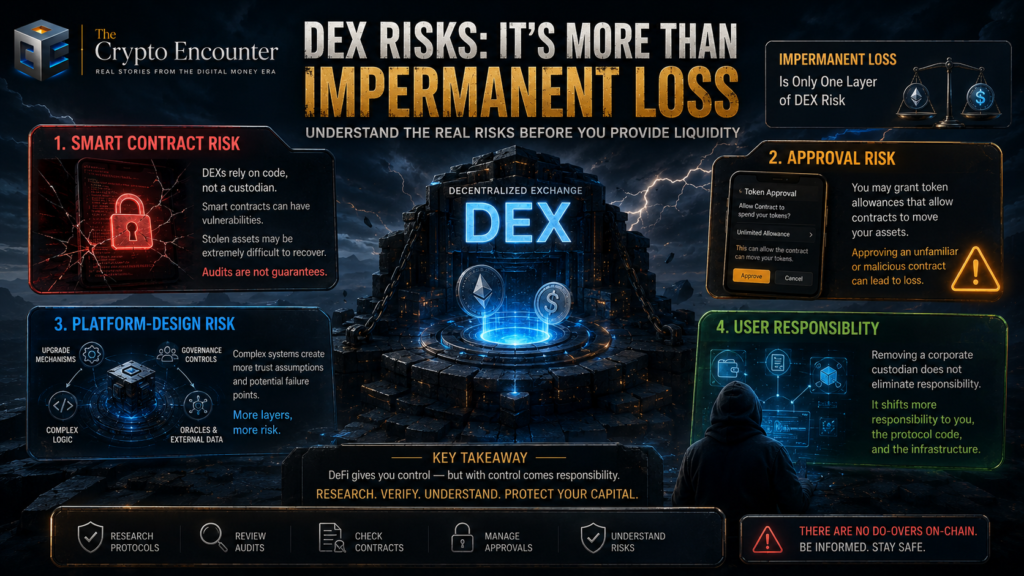
Approval risk is another concern. Users may grant token allowances that permit contracts to move specified assets. Approving an unfamiliar or malicious contract can create another path to loss.
Platform-design risk matters too. Protocols can depend on complex contract logic, upgrade mechanisms, governance controls, or external oracles. These components can introduce additional trust assumptions and technical failure points.
Removing a corporate custodian does not eliminate responsibility. It shifts more responsibility toward the user, protocol code, and surrounding infrastructure.
A Liquidity Provider Is Taking a Position
When you become a liquidity provider, you are not simply placing assets into a savings account and collecting interest. You are participating in a market-making mechanism, so the composition of your holdings can change. For a broader understanding of how liquidity and market conditions can affect crypto, see The Crypto Encounter’s analysis of global liquidity and crypto markets.
Consider a simplified example: you deposit $5,000 of ETH and $5,000 of USDC. ETH later rises substantially. Automated trading and arbitrage can leave you with less ETH and more USDC than you initially deposited.
If ETH keeps rising, the opportunity cost of holding less ETH can increase. If ETH later returns toward its original relationship with USDC, the difference may shrink. That is why the loss is called impermanent. There is no guarantee that prices will return.
Crypto liquidity should therefore not be viewed as money sitting idle. Liquidity is actively exposed to market mechanics.
How to Think About the Risk Before Providing Liquidity
Before entering a pool, consider:
- Price correlation: Assets that usually move together may have different exposure from a volatile token paired with a stablecoin.
- Fee income: Consider whether realistic fees could compensate for potential relative-price movement.
- Contract design: Review the protocol, architecture, audits, upgrade controls, and known incidents.
- Token quality: A pool can operate as designed while an underlying token loses substantial value.
- Approvals: Understand which contracts can move your tokens and remove unnecessary allowances when appropriate.
- Exit conditions: Consider what happens if you need to withdraw during a sharp market move.
These steps do not eliminate smart contract risk or market risk. They make the risks easier to understand before capital is committed.
Why Decentralization Changes Responsibility
The appeal of decentralized finance is direct access to protocols without relying on a traditional institution to hold and manage everything. But direct control also creates direct consequences. A centralized platform may offer customer support, internal controls, account recovery, and institutional custody.
A decentralized application may instead require a wallet signature, token approval, and interaction with immutable or upgrade-able code. As Ethereum’s official smart contract documentation explains, smart contracts are programs deployed on a blockchain that execute according to programmed logic.
Because some blockchain interactions can be irreversible, users need to understand what they are signing before approving a transaction. Self-custody can provide greater control, but mistakes can also become expensive.
Conclusion
Impermanent loss has a very permanent feeling because “impermanent” describes a mechanism, not a promise that a user’s money will return to its starting position.
DeFi can reduce dependence on centralized custody, but it creates a different risk structure. Users may carry more responsibility for smart contracts, approvals, liquidity positions, token selection, and exit decisions.
A decentralized system can remove an intermediary without removing risk. Impermanent loss, DeFi risks, and DEX risks show that automated markets still have real economic consequences.
The sensible starting point is not chasing the highest yield. It is understanding what a protocol does with your assets, how your position changes when prices move, and what risks remain when nobody is standing between you and the transaction.
FAQs
Is impermanent loss the same as losing money?
Not exactly. It measures performance relative to holding the assets separately and can become a realized loss when the provider withdraws.
Can trading fees eliminate impermanent loss?
They can offset some or potentially all of the difference in certain circumstances, but fee income does not guarantee profitability.
Are stablecoin pools safer?
They may have lower relative-price exposure when assets remain closely correlated, but they can still involve smart-contract, depeg, approval, liquidity, and protocol risks.
Why does impermanent loss happen?
Trading and arbitrage change a pool’s asset balances as the relative market prices of its tokens change.
Disclaimer
This article is for educational purposes only. It does not constitute financial, investment, legal, or tax advice. DeFi, decentralized exchanges, liquidity pools, and smart contracts involve significant risks, including impermanent loss, volatility, technical failures, token depegging, and potential loss of funds. Readers should conduct independent research and carefully consider their circumstances before participating in crypto or DeFi activities. Risks can vary significantly, and past performance does not guarantee future results or protect against losses.