

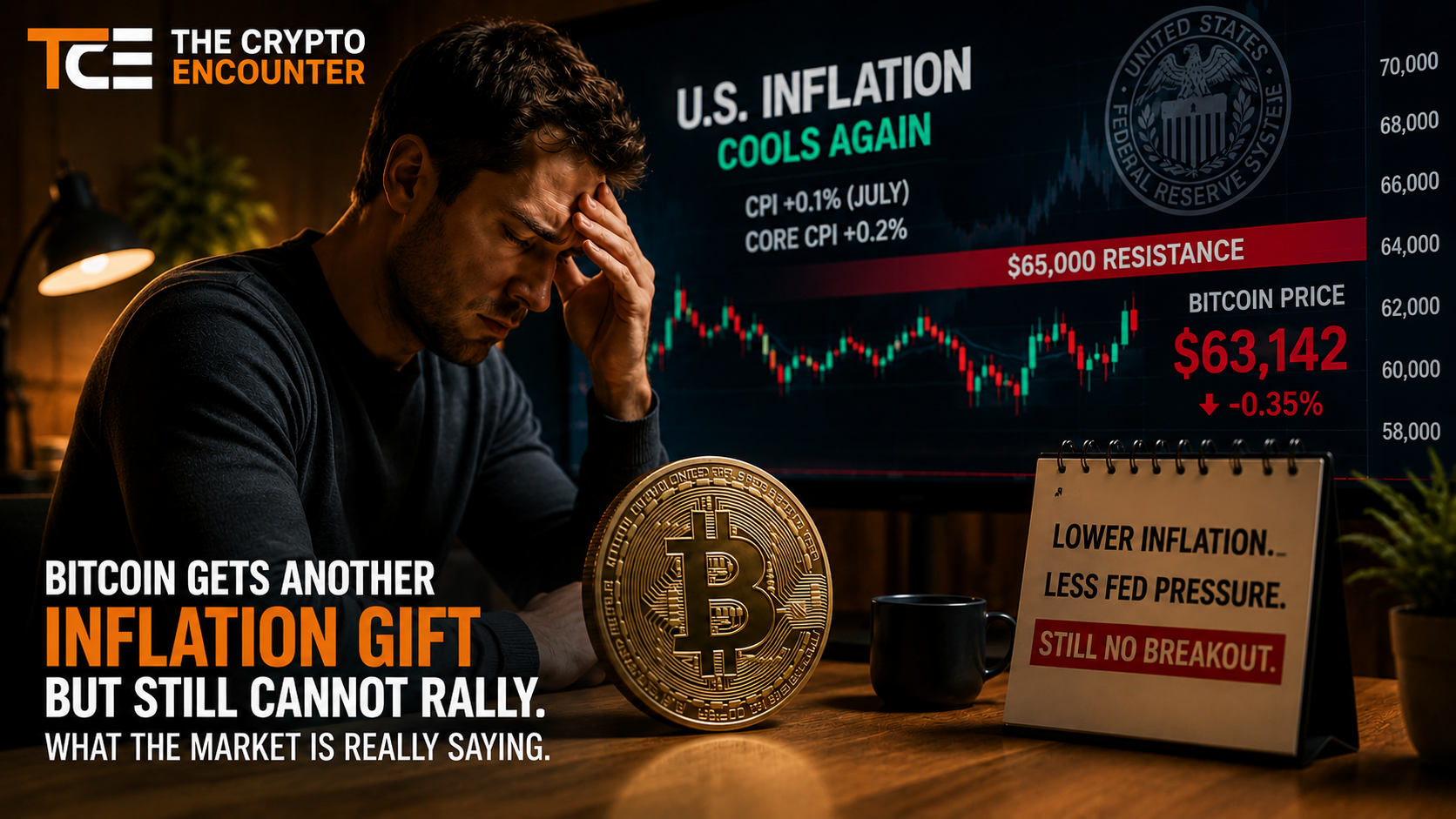
Bitcoin has now received two U.S. inflation signals that should have made the path higher easier. The market still refuses to respond with conviction.
July consumer inflation softened. Producer-price pressures also cooled. Expectations for another immediate Federal Reserve rate increase eased. Yet Bitcoin remains trapped around the same $63,000 to $65,000 region that has frustrated bulls for much of August.
That disconnect is becoming more important than the inflation data itself.
The market is beginning to show that lower inflation alone is no longer enough to generate a sustainable Bitcoin rally. The macro obstacle is easing, but the demand problem remains.
That distinction matters because Bitcoin does not rise simply because economic conditions improve. It rises when buyers are willing to absorb available supply at progressively higher prices.
Right now, the market appears to be discovering the limits of inflation relief.
Why Is Bitcoin Barely Reacting to Softer U.S. Inflation?
The latest inflation data offered Bitcoin a relatively favorable macro backdrop.
According to the U.S. Bureau of Labor Statistics, the Consumer Price Index rose just 0.1% in July 2026 on a seasonally adjusted basis.
Headline inflation increased 3.4% over the previous 12 months, down from 3.5% in June.
Core CPI, which excludes food and energy, rose 0.2% for the month and 2.5% year over year, compared with a 2.6% annual increase in June.
The data reduced some of the immediate fear that inflation was accelerating strongly enough to force the Federal Reserve into another rapid tightening move.
That should have been supportive for Bitcoin.
The response was surprisingly muted.
Bitcoin remained close to the low-$63,000 region instead of producing the kind of decisive risk-on move that crypto markets have often delivered after favorable inflation surprises.
The lack of follow-through raises a more difficult question for bulls: if softer inflation is no longer enough, what catalyst does Bitcoin need?
The Fed Is Still Part of the Bitcoin Story
The Federal Reserve remains one of the most important macro variables affecting Bitcoin.
At its July 29 meeting, the Federal Open Market Committee kept the federal funds target range unchanged at 3.50% to 3.75%.
The decision was unusual because three policymakers dissented and favored an immediate quarter-point increase.
The Federal Reserve’s official July 29 statement confirmed the 9-3 vote.
The vote showed that inflation concerns remain alive inside the central bank even though the official target rate did not change.
For Bitcoin, that matters because higher interest rates affect liquidity, bond yields, borrowing costs and investor appetite for risk.
Bitcoin’s supply policy remains independent of central banks, but its market price is still heavily influenced by the conditions central banks create.
That relationship is explored in greater detail in The Crypto Encounter’s analysis of why Bitcoin continues to move with the Federal Reserve.
This Is Becoming a Bitcoin Demand Problem
For much of 2026, weak Bitcoin price action could be blamed on familiar macro pressures.
Inflation remained stubborn.
Treasury yields stayed elevated.
Oil shocks revived concerns about another inflation wave.
The Federal Reserve remained cautious.
Those explanations were legitimate.
The problem is that several of those pressures have now eased at the margin, while Bitcoin still cannot generate a sustained breakout.
That shifts attention toward the demand side of the market.
Bitcoin does not need merely good economic news.
It needs buyers.
A softer CPI reading may improve investor sentiment, but sentiment only matters when it translates into real capital entering the market.
So far, that conversion appears weak.
The $62K to $65K Cost-Basis Zone Is Absorbing Good News
Bitcoin’s current price structure offers one explanation for the weak reaction.
That concentration represents roughly 8.93% of circulating Bitcoin supply, according to the Bitfinex analysis used in that report.
The largest concentration reportedly sits near $63,800.
This is not a literal exchange sell wall.
It means a large number of holders acquired Bitcoin near the same levels where BTC is currently trading.
That creates a behavioral pressure point.
When Bitcoin rises toward $65,000, some holders move from losses back toward break-even or small profits.
Some of those investors may use the opportunity to exit.
Fresh buyers must absorb that supply before Bitcoin can establish itself at higher prices.
This helps explain why favorable inflation headlines can generate only limited upside.
The good news arrives.
The cost-basis supply absorbs it.
Bitcoin Has Already Shown It Can Touch $65K
Bitcoin’s problem is no longer reaching $65,000.
It is staying there.
Bitcoin traded above $65,000 during multiple sessions in early August but repeatedly failed to establish sustained daily closes above the level.
That makes another intraday push through $65,000 less meaningful than it would have been earlier in the cycle.
The market now needs evidence of acceptance.
That means buyers must continue absorbing supply after resistance is crossed instead of disappearing once the first wave of sellers arrives.
This is why Bitcoin’s muted inflation reaction matters.
The market received a catalyst capable of generating demand.
That demand was still insufficient to produce a decisive breakout.
July’s Inflation Rally Looked Very Different
The contrast with the previous month is particularly revealing.
After softer June inflation data were released in July, crypto markets reacted much more aggressively.
That move showed how quickly digital assets can respond when inflation changes expectations around monetary policy.
August looks different.
Another relatively favorable inflation reading has produced far less enthusiasm.
There are several possible explanations.
- The market may already have priced in much of the inflation improvement.
- Bitcoin may be facing stronger holder supply near current prices.
- Spot-market participation may be too weak to sustain the breakout.
- Higher Treasury yields may still be competing for capital.
- Investors may remain concerned about geopolitical and energy risks.
- Institutional demand may not be strong enough to overcome existing selling pressure.
The important point is that inflation alone is no longer controlling the Bitcoin narrative.
Lower Inflation Does Not Mean Easy Financial Conditions
One of the most common mistakes in crypto macro analysis is treating lower inflation as equivalent to easy money.
They are not the same thing.
The Federal Reserve’s target rate remains at 3.50% to 3.75%.
Treasury yields remain high enough to offer investors meaningful returns in relatively lower-risk assets.
That matters for Bitcoin because Bitcoin does not provide a contractual yield.
When Treasury securities offer attractive returns, investors have less incentive to move aggressively into highly volatile assets simply because inflation has eased slightly.
This is one reason Bitcoin’s earlier move above $66,000 was tied closely to U.S. debt, Treasury borrowing and broader liquidity conditions.
The inflation story cannot be separated from the bond market.
If long-term yields remain elevated, financial conditions can stay restrictive even when CPI is moving in the right direction.
The Treasury Market May Matter More Than CPI From Here
Bitcoin investors increasingly need to watch Treasury yields alongside inflation.
Consumer prices tell investors what has already happened to inflation.
Bond yields reflect what investors think may happen next.
The Treasury market is evaluating several risks at once:
- future U.S. borrowing requirements;
- large fiscal deficits;
- energy-market instability;
- persistent inflation risk;
- Federal Reserve policy; and
- demand for long-duration government debt.
If investors demand higher yields to absorb new Treasury supply, Bitcoin may continue facing competition for capital even if inflation gradually cools.
That is why the market can receive a positive CPI print without generating a meaningful BTC rally.
Oil Is Still a Serious Inflation Risk
The softer July inflation numbers are backward-looking.
Energy prices remain one of the biggest variables capable of changing the outlook quickly.
Earlier in the summer, Bitcoin fell below $64,000 as rising oil prices and weakness in technology stocks damaged risk appetite.
The episode showed how geopolitical shocks can affect Bitcoin through several channels at once.
Higher oil prices can raise inflation expectations.
Higher inflation expectations can lift Treasury yields.
Higher yields can increase the probability of tighter Federal Reserve policy.
All three can reduce demand for speculative assets.
This means one softer CPI report cannot eliminate Bitcoin’s macro risk.
If oil rises sharply again, the inflation narrative can turn quickly.
Geopolitical Risk Can Overpower Inflation Relief
Bitcoin investors have already seen this conflict play out.
During the previous inflation-driven rebound, geopolitical tension rapidly overwhelmed the positive macro signal.
Bitcoin gave back part of its earlier inflation relief as U.S.-Iran tensions intensified.
That episode demonstrated why inflation data should never be analyzed in isolation.
Crypto trades inside the global financial system.
If geopolitical risk damages risk appetite, raises oil prices or strengthens demand for defensive assets, Bitcoin can struggle even when domestic inflation data improves.
Bitcoin Is Not Behaving Like a Market Ready to Chase Good News
The key difference between a strong market and a weak one often appears in how price reacts to favorable information.
A strong market tends to amplify good news.
A fragile market can struggle to respond even when the news appears constructive.
Bitcoin currently looks closer to the second condition.
The inflation data is giving bulls arguments.
The price is not validating them.
That does not automatically mean Bitcoin is preparing for a major decline.
It does mean investors should be careful about assuming that every softer inflation reading will translate into higher BTC prices.
The Market Still Has a Memory of Earlier Fed Uncertainty
Bitcoin’s current hesitation also fits a broader pattern that has persisted throughout 2026.
Investors repeatedly try to anticipate Federal Reserve policy before policymakers provide a clear direction.
That question remains relevant.
Is Bitcoin building a genuine accumulation base?
Or are repeated rebounds simply giving existing holders better opportunities to reduce exposure?
The answer is unlikely to come from one inflation print.
It will come from the interaction between spot demand, holder behavior, institutional flows, Treasury yields and monetary policy.
Why Bitcoin Is Lagging the Broader Risk-On Narrative
Another important clue comes from Bitcoin’s relative behavior.
When inflation pressure eases, equities and other risk assets can benefit because investors expect less restrictive monetary policy.
Bitcoin frequently participates in that same trade.
When Bitcoin responds less strongly than equities to the same macro catalyst, it suggests crypto-specific constraints are becoming more important.
Those constraints may include:
- weak spot-market liquidity;
- selling from holders close to break-even;
- uncertain institutional flows;
- defensive derivatives positioning;
- repeated failed breakouts; and
- reduced conviction among short-term traders.
The issue is not that inflation suddenly stopped mattering.
It is that inflation now has to compete with Bitcoin’s internal market structure.
What Would Make Softer Inflation Bullish for Bitcoin Again?
Lower inflation can still become a powerful Bitcoin catalyst.
The market would probably need several conditions to improve together.
1. Stronger Spot Demand
Bitcoin needs real buying pressure rather than another brief move above resistance.
Sustained spot volume would indicate that investors are committing capital rather than relying primarily on short-term derivatives positioning.
2. Lower Treasury Yields
If bond yields fall alongside inflation, the opportunity cost of holding Bitcoin becomes less restrictive.
That would strengthen the macro transmission mechanism from lower inflation to higher crypto demand.
3. A More Clearly Dovish Fed
The Fed does not need to cut rates immediately.
A clear shift away from further tightening could still improve confidence.
4. Sustained Bitcoin Closes Above $65,000
A genuine breakout requires more than another intraday spike.
Bitcoin needs to hold above the resistance region and demonstrate that buyers can absorb break-even supply.
5. Stronger Institutional Flows
Improved ETF and institutional demand could provide the capital required to convert favorable macro conditions into actual Bitcoin purchases.
What Could Make Inflation a Bitcoin Problem Again?
The bullish inflation narrative can still reverse.
Several developments would increase the risk of renewed pressure:
- a sharp rise in energy prices;
- stronger core inflation;
- accelerating wage growth;
- higher inflation expectations;
- another rise in Treasury yields;
- hawkish Federal Reserve commentary; and
- geopolitical disruption affecting commodities or global trade.
Any combination of those factors could revive expectations for additional tightening.
Bitcoin would then face renewed macro pressure while still struggling with resistance near $65,000.
$63K Is Becoming Bitcoin’s Real-Time Test of Demand
For all the attention given to CPI, rates and the Federal Reserve, Bitcoin keeps returning to roughly the same price zone.
That makes the current range increasingly informative.
Every positive macro development that fails to push Bitcoin decisively above $65,000 says something about demand.
Every decline that fails to break the lower part of the range says something about support.
The market is effectively conducting a continuous test around $63,000.
Bulls can point to cooler inflation and reduced immediate tightening pressure.
Bears can point to repeated resistance failures and the weak reaction to favorable news.
Neither side has achieved control.
The Biggest Signal May Be What Bitcoin Did Not Do
Markets naturally focus on dramatic moves.
Sometimes the absence of a move is more revealing.
Bitcoin received a softer CPI report.
It did not rally decisively.
Pressure for immediate Federal Reserve tightening eased.
Bitcoin still struggled around the same range.
That sequence suggests the market has moved into a different phase.
The inflation obstacle is becoming less restrictive.
The demand obstacle is becoming more visible.
This does not guarantee a bearish outcome.
It means the next Bitcoin breakout will probably require more than another favorable macro headline.
What Bitcoin Investors Should Watch Next
- Future inflation reports: one softer month does not establish a permanent trend.
- Federal Reserve guidance: policymakers will determine whether inflation improvement is strong enough to justify staying on hold.
- Treasury yields: falling yields would make the inflation story more supportive for Bitcoin.
- The $63,000-$63,800 region: this remains an important ownership and support zone.
- $65,000 resistance: sustained closes matter more than brief intraday breaks.
- Spot-market volume: stronger participation could validate the next rally.
- Institutional demand: ETF and large-investor flows may determine whether favorable macro conditions translate into actual BTC purchases.
- Oil prices: energy remains one of the clearest risks to the disinflation narrative.
The Final Take
July’s inflation data gave Bitcoin something bulls have wanted for months: less immediate pressure from U.S. inflation.
It did not deliver the breakout.
That changes the market conversation.
Bitcoin is no longer waiting only for inflation to improve.
It is waiting for buyers willing to absorb the supply already sitting near current prices.
This is why the muted reaction matters.
Macro conditions determine how attractive risk-taking becomes.
They do not decide where capital ultimately flows.
Until stronger demand appears, every favorable inflation report should be judged through a simple question:
Did the news create new Bitcoin buying, or did it simply give existing holders another opportunity to sell into strength?
So far, the second explanation remains difficult to dismiss.
Frequently Asked Questions
Why did Bitcoin barely rise after softer U.S. inflation?
Softer inflation reduced some pressure for further Federal Reserve tightening, but Bitcoin is also facing weak marginal demand, resistance near $65,000, a large holder cost-basis concentration and competition from high Treasury yields. Better inflation data improves the environment but does not automatically generate Bitcoin purchases.
Is lower inflation bullish for Bitcoin?
Lower inflation can support Bitcoin because it may reduce the need for tighter monetary policy, lower bond yields and improve investor appetite for risk. However, Bitcoin also depends on liquidity, institutional demand, holder behavior and broader market conditions.
Why does the Federal Reserve affect Bitcoin?
The Federal Reserve does not control Bitcoin’s network or issuance. Its policies influence interest rates, Treasury yields, dollar liquidity and investor risk appetite. Those factors affect how much capital investors are willing to allocate to Bitcoin.
Why is $65,000 important for Bitcoin?
Bitcoin has repeatedly traded above $65,000 without establishing sustained daily closes there. A large amount of BTC also carries a cost basis between $62,000 and $65,000, meaning some holders may sell as they return to break-even or profit.
Why does $63,800 matter?
Market analysis cited by The Crypto Encounter identifies the area near $63,800 as a particularly dense ownership concentration within the broader $62,000-$65,000 cost-basis zone. That makes it important for determining whether recent buyers remain close to break-even or move back into losses.
Could inflation start rising again?
Yes. Energy prices, geopolitical disruptions, stronger consumer demand, wages and persistent service-sector inflation could reverse part of the recent improvement. One month of softer inflation does not guarantee a lasting decline.
What would make softer inflation more bullish for Bitcoin?
A combination of continued disinflation, lower Treasury yields, less hawkish Federal Reserve guidance, stronger institutional flows, higher spot volume and sustained Bitcoin closes above $65,000 would create a more convincing bullish setup.
Could Bitcoin still fall toward $60,000?
Yes. A move toward $60,000 becomes more plausible if Bitcoin loses the $63,000-$63,800 region, weak demand persists and macro conditions deteriorate. No technical level guarantees a future price outcome.
What should investors watch after the July inflation data?
Investors should monitor upcoming inflation readings, Federal Reserve commentary, Treasury yields, oil prices, institutional Bitcoin flows, spot trading volume and Bitcoin’s ability to hold above $65,000.
Disclaimer
This article is for informational and educational purposes only and does not constitute financial, investment, trading, legal or tax advice. Bitcoin and other cryptocurrencies are highly volatile and may result in substantial losses. Inflation data, Federal Reserve policy expectations, technical levels and historical market relationships do not guarantee future price movements. Readers should conduct independent research and consult qualified professionals before making financial decisions.