


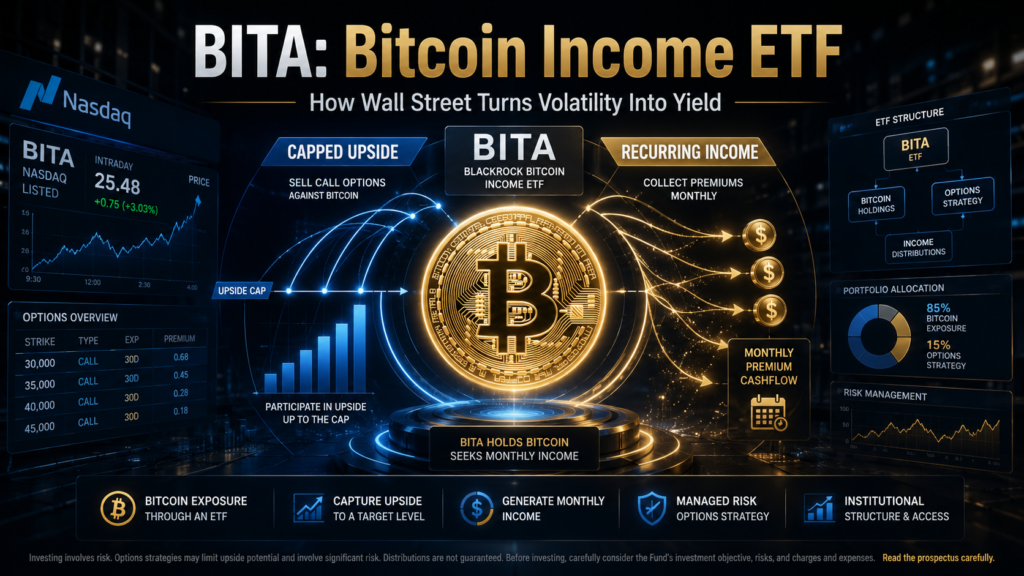
BlackRock’s new iShares Bitcoin Premium Income ETF, trading under the ticker BITA, marks a major shift in how Wall Street is packaging Bitcoin exposure. Instead of offering investors pure participation in Bitcoin’s price movement, BITA combines Bitcoin-linked exposure with an options strategy designed to generate monthly income.
The trade-off is clear. Investors may receive attractive distributions when Bitcoin volatility supports strong option premiums, but they give up part of the upside if Bitcoin rallies sharply. For financial advisors, institutions, and income-focused investors, BITA could make Bitcoin easier to fit into portfolio models. For long-term Bitcoin bulls, however, the structure may feel like a diluted version of direct exposure.
BlackRock Moves Beyond Spot Bitcoin Exposure
BlackRock’s launch of the iShares Bitcoin Premium Income ETF is not simply another crypto ETF listing. It signals the next stage of Bitcoin’s institutional product cycle.
ALSO READ: What They Never Told You About the Security of Cryptocurrencies
The first stage focused on access. Spot Bitcoin ETFs allowed investors to gain exposure to Bitcoin through regulated brokerage accounts without dealing with wallets, private keys, exchanges, or custody risk. BlackRock’s iShares Bitcoin Trust ETF, known as IBIT, quickly became the dominant product in that category.
BITA represents a different objective. It does not only ask whether investors want Bitcoin exposure. It asks whether investors want Bitcoin exposure with monthly income.
That distinction matters because many traditional investors, especially those advised by wealth managers, do not evaluate assets only by price appreciation. They often think in terms of income, volatility, allocation fit, tax treatment, and portfolio behavior. Bitcoin has historically struggled in that conversation because it does not pay dividends, interest, coupons, or staking rewards.
BITA attempts to solve that gap by turning Bitcoin’s volatility into a source of option premium.
How BITA Works
BITA is designed to provide Bitcoin-linked upside while generating monthly distributions through an options overlay.
According to the product structure described by BlackRock, the fund holds a mix of actual Bitcoin exposure and shares of BlackRock’s IBIT. It then sells call options against part of the portfolio, with the options strategy applied to up to 35% of its holdings.
A call option gives the buyer the right to purchase an asset at a set price within a defined period. The seller receives an upfront payment, known as a premium. In BITA’s case, those premiums support the fund’s monthly payout objective.
This structure resembles a covered-call strategy. The fund owns the underlying exposure, then sells calls against a portion of it. If Bitcoin trades sideways, rises moderately, or remains volatile without breaking too far above the option strike prices, the fund can benefit from collected premiums. If Bitcoin surges aggressively, the sold calls can cap part of the upside.
That is the central bargain.
BITA offers income potential in exchange for reduced participation in Bitcoin’s strongest rallies.
Why Bitcoin Volatility Makes This Product Possible
Bitcoin’s volatility often scares conservative investors, but it also makes options more valuable. In options markets, higher expected volatility generally means higher premiums. For a covered-call product, that can create a larger income opportunity.
BlackRock’s head of digital assets, Robert Mitchnick, reportedly described the current payoff profile as roughly 70% upside retention with a mid-to-high-teens yield under current market conditions. That is the kind of structure likely to interest investors who previously viewed Bitcoin as too speculative because it produced no cash flow.
The product does not magically remove Bitcoin risk. It repackages that risk.
BITA still depends on Bitcoin-linked exposure. If Bitcoin falls sharply, option premiums may soften the impact but cannot fully protect investors from losses. The fund’s income stream is also not guaranteed. Monthly distributions depend on market conditions, option premiums, portfolio positioning, fund expenses, and execution.
This is why investors should avoid treating BITA’s projected yield as a fixed-income substitute. It is not a bond. It is a Bitcoin-linked ETF using an options strategy.
Why Financial Advisors May Pay Attention to Bitcoin-linked ETF
BITA may appeal to financial advisors for one practical reason: it creates a more familiar investment conversation around Bitcoin.

Many advisors have clients who are curious about Bitcoin but uncomfortable with pure price exposure. A covered-call-style ETF gives advisors a framework they already understand. They can discuss income, upside cap, volatility harvesting, tax treatment, and allocation sizing. That makes Bitcoin easier to place inside a broader portfolio discussion.
This could be especially relevant for pensions, insurers, family offices, and income-focused investors that have historically avoided Bitcoin because it lacked yield.
The product also gives BlackRock a way to expand beyond IBIT without waiting for a new crypto asset class to gain similar institutional demand. BlackRock already has a leading spot Bitcoin product. BITA lets it segment the Bitcoin market further: pure exposure for growth-oriented investors, premium-income exposure for investors seeking monthly distributions.
That is a classic Wall Street move. Once access is established, product design becomes more targeted.
The Key Trade-Off: Income Today, Less Upside Tomorrow
The most important question for investors is simple: what are they giving up?
A covered-call strategy usually performs best when the underlying asset moves sideways, rises slowly, or remains volatile within a range. It tends to lag during explosive bull markets because part of the upside has been sold away through call options.
That means BITA may suit investors who want moderated Bitcoin exposure and monthly income more than investors who want maximum upside from a major Bitcoin cycle rally.
For example, if Bitcoin enters a strong upward trend, a pure spot Bitcoin ETF may outperform BITA because it does not cap gains through sold calls. If Bitcoin moves sideways while volatility stays elevated, BITA may look more attractive because it can harvest premiums while pure spot exposure produces no income.
This makes BITA less of a direct competitor to IBIT and more of a portfolio-specific alternative.
IBIT is for investors who want clearer Bitcoin beta.
BITA is for investors willing to exchange some upside for monthly income potential.
Why This Launch Matters for the Bitcoin ETF Market
BlackRock’s entry into Bitcoin premium-income ETFs validates a broader trend: crypto ETFs are moving from simple access products toward structured outcome products.
Goldman Sachs filed for a similar Bitcoin income ETF in April, while NEOS already offers the NEOS Bitcoin High Income ETF. This shows that major financial firms see demand for Bitcoin-linked income strategies, especially as investors look for alternatives to traditional yield sources.
The timing is important. Crypto markets have been volatile, and Bitcoin has faced pressure from macro uncertainty, risk-off sentiment, and shifting institutional flows. In that environment, a product that converts volatility into monthly distributions may feel more practical than a pure price-chasing vehicle.
Still, competition will likely grow fast. Once large issuers prove demand, more asset managers may enter with variations: different option coverage levels, different yield targets, different fee structures, and different tax profiles.
That could turn Bitcoin income ETFs into a meaningful subcategory of the digital asset ETF market.
What Investors Should Watch Next
Investors should not judge BITA only by its headline yield. They should monitor several deeper factors.
1. Distribution Consistency
Monthly payouts will matter, but consistency matters more than one impressive annualized yield figure. Investors should watch how distributions behave during low-volatility periods.
2. Upside Capture
The fund’s long-term appeal will depend on how much Bitcoin upside it retains. If Bitcoin rallies and BITA trails too far behind spot ETFs, growth-oriented investors may lose interest.
3. Downside Behavior
Option premiums can reduce some volatility, but they do not provide full downside protection. The fund’s performance during Bitcoin drawdowns will reveal whether income meaningfully offsets losses.
4. Advisor Adoption
If financial advisors begin allocating BITA to client portfolios, the product could become more than a niche ETF. It could become a bridge between Bitcoin exposure and income-focused portfolio construction.
5. Competition From Goldman and Others
Goldman’s filing suggests that more institutional products are coming. Competition may pressure fees, improve product design, and expand investor choice.
The Bigger Picture: Bitcoin Is Becoming Financial Infrastructure
The launch of BITA reflects a deeper institutional shift. Bitcoin is no longer being packaged only as a speculative digital asset. It is being turned into raw material for financial products.
Spot ETFs converted Bitcoin into accessible brokerage-account exposure. Options-based ETFs now convert Bitcoin volatility into income potential. Future products may package Bitcoin into buffer strategies, structured outcomes, retirement models, or institutional allocation tools.
This evolution does not change Bitcoin’s core nature. Bitcoin remains volatile, cyclical, and sensitive to liquidity, macro conditions, regulation, and investor sentiment. But it does change how traditional finance interacts with it.
Wall Street is no longer asking whether Bitcoin belongs in markets. It is asking how many different products can be built around it.
Final Analysis
BlackRock’s BITA ETF is important because it shows how the Bitcoin ETF market is maturing. The product is not designed for investors who want full exposure to every Bitcoin rally. It is built for investors who want a more structured way to participate in Bitcoin while receiving monthly income potential.
That makes BITA both useful and limited.
Its strength is its ability to make Bitcoin more accessible to income-focused investors, financial advisors, and institutions that need a clearer portfolio rationale. Its weakness is the same trade-off that defines all covered-call strategies: the income comes at the cost of capped upside.
For investors, the decision should start with objective, not yield.
Those seeking maximum long-term Bitcoin appreciation may prefer direct Bitcoin exposure or a spot Bitcoin ETF. Those seeking partial Bitcoin participation with monthly distributions may find BITA more aligned with their needs.
The product does not make Bitcoin conservative. It makes Bitcoin more programmable inside traditional portfolio structures.
That may be the real story. BlackRock is not only selling another Bitcoin ETF. It is helping turn Bitcoin volatility into a Wall Street income product.
FAQs
What is BlackRock’s BITA ETF?
BITA is the iShares Bitcoin Premium Income ETF. It provides Bitcoin-linked exposure while using an options strategy to generate monthly premium income.
How does BITA generate income?
BITA sells call options against part of its Bitcoin-linked holdings. The fund collects option premiums, which support monthly distributions.
Does BITA offer full Bitcoin upside?
No. BITA offers partial Bitcoin upside because its call-option strategy can cap gains if Bitcoin rises sharply.
Is BITA the same as IBIT?
No. IBIT is BlackRock’s spot Bitcoin ETF designed to reflect Bitcoin’s price performance. BITA combines Bitcoin-linked exposure with an income-generating options strategy.
Is BITA suitable for all investors?
No. BITA carries Bitcoin-related market risk and options-strategy risk. It may suit investors seeking income-oriented Bitcoin exposure, but investors should review the fund’s prospectus, risk disclosures, fees, and tax treatment before making any decision.
Disclaimer: This article is for informational and educational purposes only. It does not provide financial, investment, legal, or tax advice. Cryptocurrency and ETF investments involve risk, including possible loss of principal.