

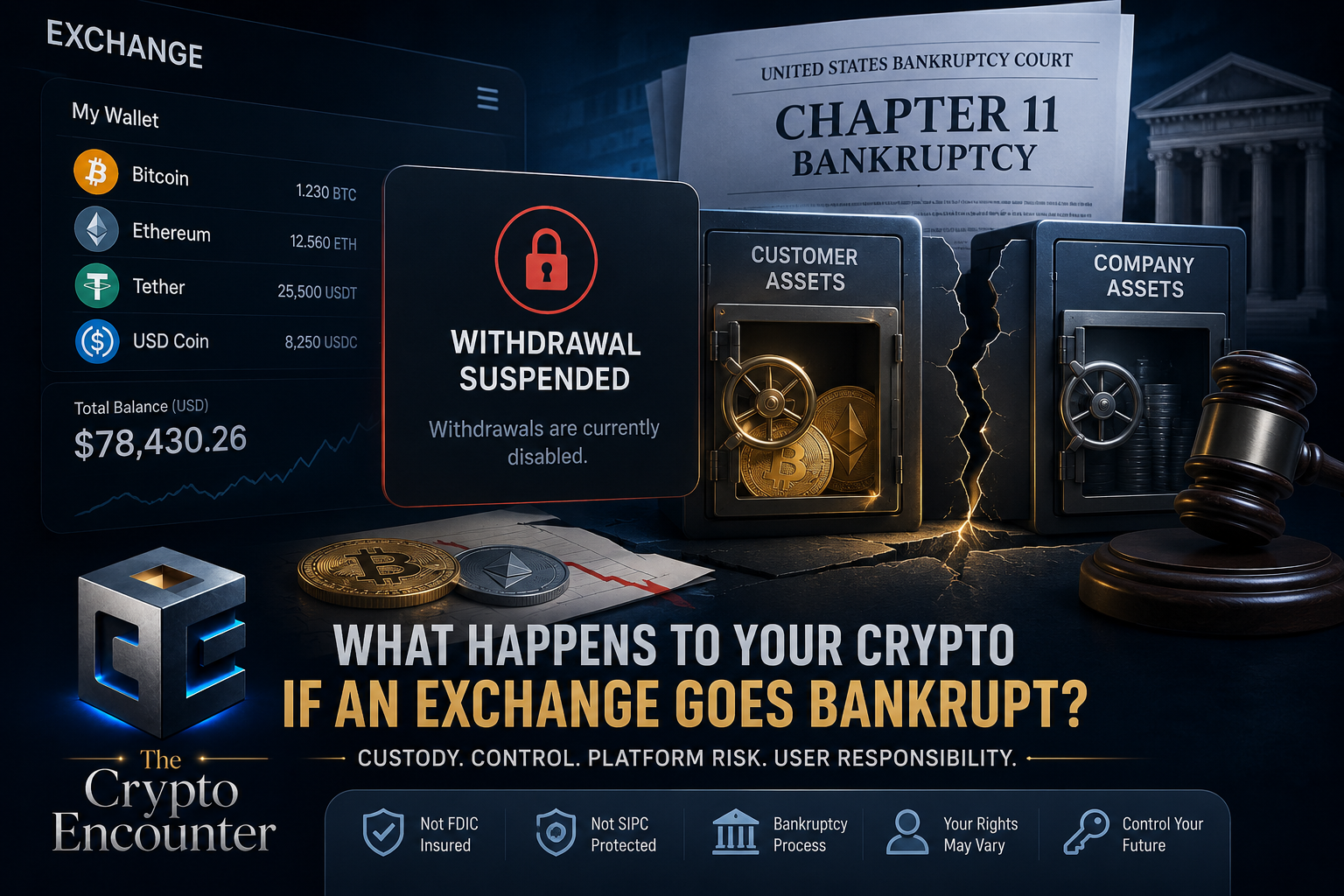
A crypto exchange bankruptcy can turn a balance that looked immediately accessible into a legal claim that may take months or years to resolve. You may still see Bitcoin, Ether, stablecoins, or other assets listed in your account. However, that screen does not by itself prove that the same coins remain available for withdrawal or legally sit outside the exchange’s bankruptcy estate.
What happens next depends on custody arrangements, the exchange’s terms, asset segregation, applicable law, available reserves, and the bankruptcy process. In some cases, customers may recover most of their value. In others, they may receive cash instead of crypto, recover only part of a claim, or face substantial losses.
That is the central risk behind a crypto exchange bankruptcy: using an exchange gives you convenient access to crypto, but the platform controls the custody system that stands between you and your assets.
The SEC’s Office of Investor Education and Assistance explains that under third-party crypto custody, an exchange or other custodian controls access to the private keys. If that custodian shuts down or goes bankrupt, customers may lose access to their assets.
Key Facts About Crypto Exchange Bankruptcy
| Question | What It Means for Users |
|---|---|
| Does an exchange balance prove legal ownership? | No. Account records matter, but contracts, custody structure, applicable law, and asset segregation can determine your legal rights. |
| Can withdrawals stop before bankruptcy? | Yes. Financial distress can lead platforms to suspend withdrawals before or around an insolvency filing. |
| Do customers always receive the same crypto back? | No. A bankruptcy plan may value claims in fiat and distribute cash or other consideration. |
| Is crypto covered by FDIC insurance? | Crypto assets themselves are not FDIC-insured. |
| Does SIPC automatically protect exchange crypto? | No. SIPC protection does not generally cover crypto that does not qualify as a protected security under SIPA. |
| Does regulation matter? | Yes. Some jurisdictions impose stronger segregation and custody rules than others. |
| Can self-custody remove exchange insolvency risk? | It can reduce third-party exchange custody risk, but it transfers key-management and security responsibility to the user. |
FDIC guidance states that deposit insurance covers qualifying deposits at insured banks, not crypto assets. SIPC also says it does not protect digital or crypto assets that fall outside its statutory definition of protected securities.
What Happens First in a Crypto Exchange Bankruptcy?
Usually, the most immediate concern is access.
An exchange facing a liquidity crisis may restrict or suspend withdrawals. Once a U.S. company enters Chapter 11 bankruptcy, an automatic stay generally suspends many collection actions involving pre-bankruptcy debts while the court-supervised process moves forward. The bankruptcy system then determines claims, estate property, creditor rights, and a possible repayment or liquidation plan.
Therefore, a crypto exchange bankruptcy changes the relationship between the customer and the platform.
Before the failure, you might click “withdraw” and expect a blockchain transaction.
After the filing, you may instead need to prove what the company owes you.
That shift matters because bankruptcy operates through legal claims and property rights, not through the exchange interface that customers used before the collapse.
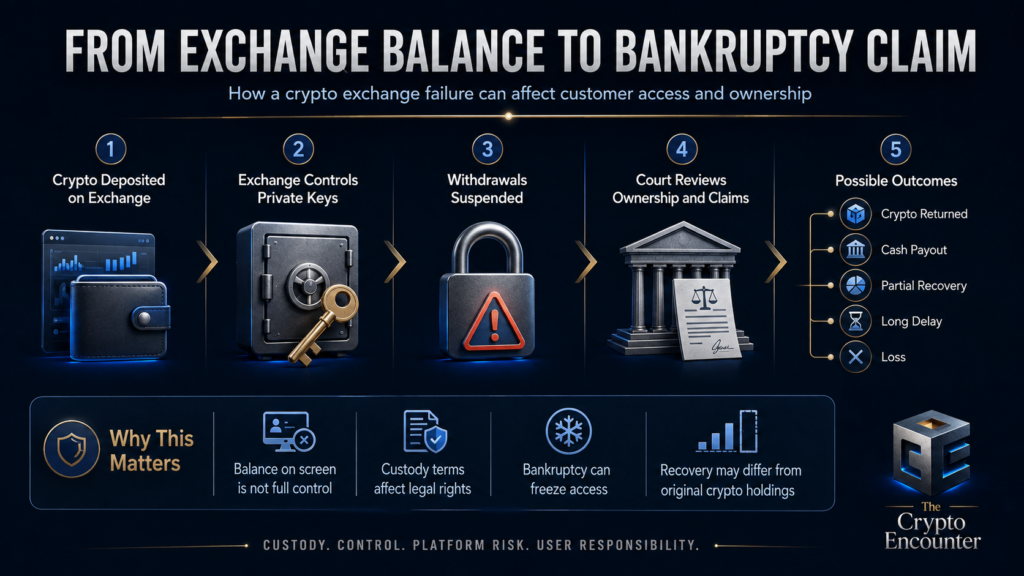
Your Account Balance Is Not the Same as a Private Key
Crypto custody works differently from a conventional wallet that you directly control.
With self-custody, you control the private keys. With third-party custody, the exchange or custodian controls access to those keys on your behalf. Consequently, the legal and operational structure behind the account becomes critical during a crypto exchange bankruptcy.
A dashboard might say:
1 BTC
Yet several separate questions remain:
Who controls the keys? Where does the exchange hold the Bitcoin? Is the asset segregated from company property? Can the company lend or otherwise use customer assets? What do the customer agreement and local law say?
Those questions rarely matter during normal withdrawals. During insolvency, however, they can determine whether a customer seeks the return of property or stands in line as a creditor.
Who Actually Owns the Crypto During a Crypto Exchange Bankruptcy?
There is no universal answer.
Instead, courts and administrators may examine the account agreement, custody arrangement, governing law, asset segregation, and the specific product the customer used.
The Celsius bankruptcy provides a particularly important example, although Celsius operated primarily as a crypto lender rather than a conventional spot exchange. In January 2023, the U.S. Bankruptcy Court for the Southern District of New York concluded that assets in Celsius Earn accounts became Celsius property under the applicable Terms of Use. As a result, the remaining Earn assets became property of the bankruptcy estates.
That ruling shows why contract language matters during a crypto exchange bankruptcy or similar crypto insolvency.
A user can feel that deposited coins still “belong” to them economically. Legally, however, the agreement may create a different relationship.
This distinction becomes even more important when a platform offers lending, yield, staking, margin, or other products that allow the company to use customer assets.
Crypto Exchange Bankruptcy Can Turn Coins Into Dollar Claims
Many users assume that if an exchange fails while holding one Bitcoin, the bankruptcy process will eventually return one Bitcoin.
That assumption can fail.
The FTX proceedings show why.
FTX’s customer claims portal records customer balances as of November 11, 2022, the date of the bankruptcy filing. Later, the bankruptcy court approved a Digital Assets Conversion Table for estimating digital-asset claims for voting and distribution purposes.
Therefore, the economic result of a crypto exchange bankruptcy may differ sharply from simply receiving the original coins.
Consider a simplified example.
Suppose a customer had 1 BTC on an exchange when bankruptcy began. If the bankruptcy process fixes the customer’s claim using a dollar valuation from that period, and Bitcoin later rises substantially, receiving the allowed dollar claim does not necessarily recreate the economic position the customer would have had by continuing to hold 1 BTC.
FTX became a real-world illustration of that problem. Its approved restructuring plan focused on customer claims measured around the November 2022 bankruptcy period. Some customers objected because crypto prices later recovered substantially. Reuters reported that FTX could repay customers at least 118% of the November 2022 value of their claims, yet that figure did not mean customers necessarily received 118% of the later market value of the crypto they originally held.
This is one of the least intuitive consequences of crypto exchange bankruptcy.
A high percentage recovery on a bankruptcy claim and a full recovery of the original crypto position are not necessarily the same thing.
FTX Shows How Long a Crypto Exchange Bankruptcy Can Keep Affecting Users
FTX filed for bankruptcy in November 2022. Years later, customers still had to follow claims procedures, identity checks, tax requirements, distribution onboarding, and payment schedules.
FTX’s latest official guidance says the next distribution was anticipated for July 31, 2026, for holders of allowed claims who had met the required conditions by the relevant record date.
That timeline highlights another feature of crypto exchange bankruptcy: recovery can become an administrative process, not simply a financial calculation.
Users may need to:
- Confirm their scheduled balance.
- File or verify a proof of claim.
- Complete identity verification.
- Meet tax-document requirements.
- Select or onboard with an approved distribution provider.
- Watch court deadlines.
- Protect themselves from phishing attempts that target creditors.
FTX’s support pages continue to warn users to rely on approved communications and listed official addresses, which matters because bankruptcy creditors can become attractive targets for impersonation scams.
What Could You Receive After a Crypto Exchange Bankruptcy?
A crypto exchange bankruptcy can produce several outcomes.
The result depends on what assets remain, what administrators recover, how claims rank, and whether customer assets remain legally separate from company property.
1. The Same Crypto Back
This may become more plausible when customer assets remain clearly identified, legally segregated, and available.
However, customers should never assume this outcome.
2. Cash Instead of Crypto
A bankruptcy plan may convert crypto holdings into fiat-valued claims.
FTX demonstrates how a court-approved conversion mechanism can establish values for digital-asset claims.
Therefore, crypto exchange bankruptcy can expose customers to opportunity-cost risk even when they eventually recover substantial dollar value.
3. A Partial Recovery
If the exchange owes customers more than it can recover, creditors may receive only a percentage of their allowed claims.
Legal expenses, missing assets, fraud, bad loans, operational costs, market losses, and competing creditor claims can all affect what remains for distribution.
4. A Long Delay
Even a strong eventual recovery does not equal continuous access.
A customer who cannot use assets for several years faces a liquidity cost that a simple recovery percentage does not capture.
5. Severe or Total Loss
In the worst cases, too few recoverable assets may remain to satisfy customer claims.
The SEC therefore warns investors that when a crypto custodian fails, shuts down, or enters bankruptcy, customers may lose access to their crypto.
Are Customers Unsecured Creditors in a Crypto Exchange Bankruptcy?
Sometimes. However, that status depends on the facts.
An unsecured creditor generally has a claim against a company without specific collateral backing the debt.
If customer crypto legally becomes part of an exchange’s estate, the customer may have to pursue repayment through the creditor process instead of simply taking identified coins out of custody.
The legal picture remains developing in the United States.
For example, Coinbase’s 2025 Form 10-K says the company structures custody arrangements so that it believes UCC Article 8 should keep custodied assets outside claims by Coinbase’s general creditors. However, Coinbase also states that courts have not yet tested this treatment for custodied crypto assets in an insolvency case.
That disclosure captures the uncertainty surrounding crypto exchange bankruptcy in the United States.
Contract design can strengthen customer rights. Nevertheless, new legal structures do not become completely certain until courts test them against actual disputes.
Regulation Can Change Crypto Exchange Bankruptcy Risk
Jurisdiction matters enormously.
The European Union’s Markets in Crypto-Assets Regulation, or MiCA, provides a useful contrast.
Article 70 requires crypto-asset service providers that hold client crypto to make arrangements that protect clients’ ownership rights, particularly during insolvency. Article 75 goes further for custody providers. It requires client crypto to remain segregated from the provider’s own holdings and states that custodied crypto must be legally segregated from the provider’s estate so its creditors cannot pursue those assets in insolvency.
That framework can reduce one major crypto exchange bankruptcy risk.
However, regulation cannot remove every danger.
Customers may still face operational disruption, cyber incidents, recordkeeping disputes, sub-custodian problems, legal delays, or difficulties accessing assets.
Moreover, protections differ between jurisdictions. Therefore, “regulated exchange” should never function as the end of a user’s due diligence.
The better question is: regulated to do what, under which entity, and under which custody rules?
FDIC and SIPC Do Not Create Blanket Protection for Crypto Exchange Bankruptcy
Many users recognize the FDIC and SIPC names from traditional finance. However, those protections do not automatically transfer to crypto balances.
The FDIC states that crypto assets are not FDIC-insured. Deposit insurance protects qualifying bank deposits when an insured bank fails. It does not insure Bitcoin, Ether, or other crypto assets simply because a crypto company has a banking relationship.
Likewise, SIPC protection has statutory limits. SIPC states that it does not protect crypto assets that do not qualify as protected securities under SIPA.
Consequently, users should not assume a crypto exchange bankruptcy works like the failure of an insured bank or a traditional brokerage.
Different legal frameworks apply.
Proof of Reserves Does Not Eliminate Crypto Exchange Bankruptcy Risk
Proof of reserves can provide useful information. Still, it answers only part of the solvency question.
Reserves show assets that a platform can demonstrate or identify.
Solvency also depends on liabilities.
For example, an exchange may prove that it controls substantial crypto reserves while still carrying obligations that exceed those assets. In addition, proof-of-reserves systems may not automatically explain corporate debt, off-balance-sheet liabilities, pledged collateral, intercompany exposure, or customer priority rights.
Therefore, a proof-of-reserves page should never become a substitute for understanding crypto exchange bankruptcy risk.
Users should ask a wider set of questions about custody, liabilities, governance, legal segregation, and withdrawal rights.
How to Reduce Your Exposure to Crypto Exchange Bankruptcy
No custody method removes every risk. However, users can make the trade-offs clearer.
Before leaving substantial assets on an exchange, read the custody terms. Identify the legal entity serving your account. Check the governing jurisdiction. Determine whether customer assets remain legally segregated. Look for language covering lending, pledging, rehypothecation, or other uses of customer crypto.
Next, investigate how withdrawals work.
A platform that supports straightforward on-chain withdrawals gives users more flexibility than one that keeps certain assets trapped inside its ecosystem.
Also, understand any insurance claim precisely. Ask what the policy covers, who owns it, which losses qualify, what exclusions apply, and whether it protects against insolvency. Do not equate cybersecurity insurance with protection from crypto exchange bankruptcy.
Finally, consider whether all your long-term holdings need to remain on an exchange.
Self-custody can reduce exposure to exchange insolvency because the user directly controls the private keys. However, self-custody introduces its own risks. Lost seed phrases, phishing, malicious approvals, compromised devices, and stolen credentials can all lead to losses. Our guide to crypto’s password problem explains why security responsibility extends far beyond simply choosing a strong login password.
What Should You Do If an Exchange Looks Financially Unstable?
If an exchange still operates normally but credible financial concerns emerge, first verify the information through official announcements and reliable reporting.
Next, review your exposure.
Download transaction histories, statements, tax records, and account balances while you still have access. Confirm which legal entity holds the account. Also, review withdrawal policies and the customer agreement.
If a crypto exchange bankruptcy has already started, use official court or administrator channels rather than social media links.
Then track claim deadlines closely.
FTX’s process demonstrates why deadlines matter. Its original customer proof-of-claim deadline was September 29, 2023, and late claims may face disputes unless the bankruptcy court allows them.
Most importantly, treat every unexpected message about a bankruptcy payout with suspicion. Creditor databases and public proceedings can create opportunities for phishing campaigns.
Crypto Exchange Bankruptcy Reveals the Difference Between Access and Control
Centralized exchanges solve real problems.
They make buying, selling, converting, and transferring crypto easier. They provide fiat access, liquidity, trading tools, and account recovery options that many users value.
Yet convenience creates dependence.
A user who keeps crypto on an exchange depends on that exchange’s custody infrastructure, solvency, cybersecurity, governance, legal structure, and withdrawal controls.
That is why crypto exchange bankruptcy should not be understood only as a company running out of money.
It is also a custody event.
It tests whether the assets customers see on-screen remain available, segregated, legally protected, and operationally retrievable when the company itself fails.
That is the deeper issue.
Ultimately, moving assets away from an exchange changes the type of risk rather than eliminating risk completely. Understanding the difference between crypto security and safety can help users separate blockchain-level protection from the human, custody, device, and platform risks that still remain.
Conclusion: What Happens to Your Crypto If an Exchange Goes Bankrupt?
A crypto exchange bankruptcy does not have one universal outcome.
Your crypto could remain segregated and eventually return to you. Alternatively, your holdings could become part of a bankruptcy claim, receive a dollar valuation, face a partial recovery, or remain inaccessible for years.
FTX showed that even a substantial recovery can differ from receiving the original crypto position back. Celsius showed how account terms can affect legal ownership. Meanwhile, MiCA shows how regulation can require stronger segregation of customer assets.
Therefore, the important question is not simply whether an exchange appears safe today.
Ask what happens if it stops being safe tomorrow.
Understanding custody, legal ownership, segregation, insurance limits, withdrawal rights, and jurisdiction gives users a much clearer view of crypto exchange bankruptcy risk before a crisis begins.
Frequently Asked Questions
What happens to my coins during a crypto exchange bankruptcy?
A crypto exchange bankruptcy may freeze access while administrators determine which assets belong to customers and which belong to the bankruptcy estate. Depending on the legal structure, you might receive crypto, cash, a percentage of your claim, or potentially much less.
Do I legally own crypto shown in my exchange account?
Possibly, but the account balance alone does not settle the question. Custody terms, asset segregation, applicable law, and the product you used can affect your rights during a crypto exchange bankruptcy.
Will I get the same Bitcoin or Ether back?
Not necessarily. A crypto exchange bankruptcy may convert digital-asset balances into fiat-valued claims. FTX used a court-approved Digital Assets Conversion Table for claim estimation and distributions.
Is crypto on an exchange FDIC insured?
Crypto assets themselves are not FDIC-insured. FDIC insurance applies to qualifying deposits held at insured banks and protects against failure of the insured bank, not against the loss of crypto assets in a crypto exchange bankruptcy.
Does self-custody prevent exchange bankruptcy losses?
Self-custody can remove direct exposure to crypto exchange bankruptcy for assets that you successfully move into a wallet you control. However, it creates private-key, backup, phishing, and transaction risks that the user must manage.
How can I tell whether an exchange protects customer assets?
Check the customer agreement, custody policy, governing legal entity, applicable jurisdiction, asset-segregation rules, withdrawal rights, sub-custodian arrangements, and restrictions on using customer assets. Regulatory requirements can materially affect crypto exchange bankruptcy outcomes.
Disclaimer
This article is for informational and educational purposes only. It does not provide financial, investment, legal, tax, or accounting advice. Cryptocurrency and digital asset markets involve risk, including possible loss of capital. Bankruptcy and custody laws vary by jurisdiction. Readers should conduct their own research and consult qualified professionals where necessary.