

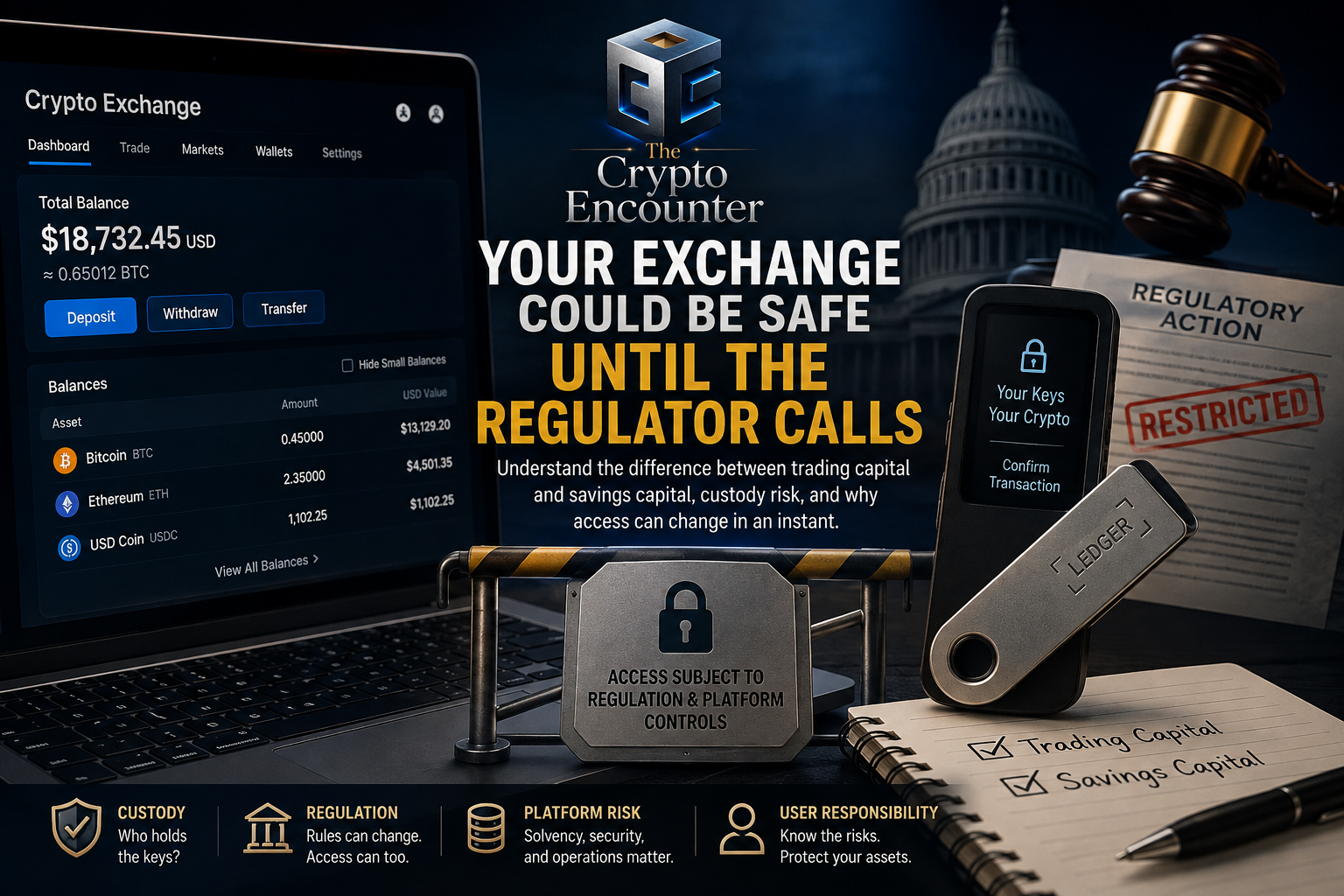
A crypto exchange can look perfectly normal right up to the moment access changes. The app still loads. Your balance still appears. Trades may even execute. Yet the real test comes when you try to withdraw and discover that a compliance hold, platform failure, solvency problem, cyber incident, or regulatory action stands between you and your assets. That is why a crypto exchange balance should not automatically feel like cash in a bank account or coins in a wallet you control. If the crypto exchange controls the private keys and the withdrawal system, it controls the practical route to your funds. For ordinary users, the key lesson is simple: trading capital and savings capital do different jobs, so they should not always carry the same custody risk.
Key Takeaways
- Trading capital is money you actively need on a crypto exchange for buying, selling, converting, or hedging.
- Savings capital is money you intend to preserve rather than deploy constantly.
- A crypto exchange balance can remain visible even when withdrawals become restricted.
- Custody, solvency, regulation, compliance controls, and platform infrastructure all affect access.
- Self-custody reduces dependence on a crypto exchange, but it creates personal responsibility for keys and recovery.
What Crypto Exchange Risk Really Means
Crypto exchange risk is the chance that something other than market price prevents you from using, withdrawing, or recovering assets held through a trading platform.
That distinction matters. Bitcoin can rise while a user still cannot withdraw it. A stablecoin can hold its value while an account remains frozen. Likewise, a crypto exchange can stay online while one customer loses access because of identity checks, sanctions screening, fraud controls, or a legal order.
Custody sits at the center of the problem. The SEC’s investor education office explains that third-party custodians, including exchanges, control access to private keys. It also warns that users may lose access if a custodian is hacked, shuts down, or enters bankruptcy.
Therefore, the useful question is not simply, “Is this crypto exchange popular?” A better question is, “What could stop me from moving my assets when I need them?”
Trading Capital and Savings Capital Should Serve Different Jobs
Trading capital is money placed on a crypto exchange because it needs to be there. A trader may need funds ready for limit orders, conversions, portfolio changes, or short-term opportunities. In that case, keeping some assets on the platform can be practical.
Savings capital serves another purpose. It represents value you intend to preserve over time. If those funds remain on a crypto exchange for months only because the interface feels convenient, you accept platform dependency without receiving much trading benefit in return.
Consider a simple example. Maya keeps $2,000 worth of crypto on a crypto exchange because she trades several times each week. She also holds another $18,000 that she plans to leave untouched for three years. If the full $20,000 stays on the same platform, all of it depends on the same custodian, withdrawal system, legal entity, and operational controls.
Separating those pools does not remove market risk. However, it can reduce the amount exposed to one crypto exchange failure.
In practical terms, trading capital asks, “How much must remain available for my strategy?” Savings capital asks, “How much value should depend on this company at all?”
Why a Crypto Exchange Balance Is Not the Same as Direct Control
A crypto exchange interface creates a strong sense of ownership. You log in, see 0.25 BTC, and naturally think, “That is my bitcoin.”
Operationally, however, the crypto exchange may control the keys and the withdrawal process. The SEC’s guidance on crypto asset custody explains that third-party custodians, including crypto exchanges, manage access to users’ private keys and can introduce risks if the custodian fails, shuts down, or suffers a security breach. The SEC has warned that investors who deposit assets with certain crypto intermediaries may lose direct legal ownership or face uncertainty about recovery during financial distress. It has also cautioned users against assuming they can always withdraw whenever they want.
That is the hidden gap between a balance and control. The screen shows an amount, while the crypto exchange decides whether a withdrawal request reaches the blockchain.
For a broader look at how security assumptions break down across wallets, payments, exchanges, and personal savings, read our guide to the security of cryptocurrencies.
Self-custody works differently. When you control the private key, you control the credential needed to authorize a transfer. Still, that freedom creates another risk. If you lose the seed phrase, expose it to a scammer, or mishandle the wallet, no crypto exchange support desk may be able to restore access.
So the real decision is not “risk versus no risk.” It is one risk structure versus another.
How Regulation Can Change Crypto Exchange Access
Regulation can improve standards and consumer protection. At the same time, regulatory or law-enforcement action can change what an exchange may offer, where it may operate, or whether it can keep serving customers.
A real-world example came in 2025, when the U.S. Department of Justice and international partners disrupted the Garantex cryptocurrency exchange, including the seizure of domains and servers used to operate the platform.
In March 2025, U.S. authorities worked with Germany and Finland to disrupt Garantex. The U.S. Department of Justice said court-authorized action seized domains and servers connected to the exchange. Whatever customers believed about the platform beforehand, government action changed the practical ability to use its infrastructure.
That case was severe. However, the broader point matters for every crypto exchange user. A platform depends on licenses, registrations, banking relationships, payment rails, legal entities, and jurisdiction-specific rules.
That broader shift is explored in our analysis of how crypto regulation is becoming the market’s next big filter, where regulatory status increasingly affects which firms can operate, expand, and serve users.
The U.K. Financial Conduct Authority, for example, has continued expanding its crypto framework. Its current roadmap says a broader authorization regime will apply to firms operating specified crypto activities from October 25, 2027.
Still, regulation itself is not the enemy. The deeper issue is dependency. If another entity controls your access, changes affecting that entity can affect you too.
Insolvency Can Matter More Than the Coin Price
Crypto users often monitor price first. Yet an exchange introduces company risk as well.
FTX showed why that matters. The U.S. Department of Justice said Samuel Bankman-Fried misappropriated billions of dollars in customer funds deposited with FTX. A federal court later sentenced him to 25 years in prison. Customers therefore faced more than falling crypto prices. They faced failure inside the institution that held their money.
In other words, the crypto exchange itself became the risk.
This is also why proof-of-reserves claims deserve careful interpretation. The SEC has warned that proof-of-reserves exercises may not provide protections comparable with a full financial-statement audit because the scope, liabilities, assurance level, and methodology can vary.
Consequently, users should ask more than, “Does the exchange show assets?” They should also ask, “What are its liabilities, how are customer assets treated, and what happens if the company fails?”
A Crypto Exchange Can Restrict You Without Collapsing
An exchange does not need to become insolvent before access becomes difficult. Compliance systems can pause a withdrawal. Security controls can flag a login. A bank partner can stop supporting a payment method. A network can face congestion. A jurisdiction can become restricted. Planned maintenance can become an outage.
Each event may have a legitimate reason. Nevertheless, the customer experiences the same immediate result: the assets cannot move as expected.
That makes a crypto exchange partly an operational dependency. Users should understand withdrawal limits, verification requirements, supported networks, account-recovery rules, geographic restrictions, and the platform’s terms before storing meaningful value there.
For example, someone who needs money for next month’s rent should think differently from a trader who can tolerate a temporary delay. The more important the timing of access, the less sensible it is to assume one exchange will always be available.
A Practical Way to Separate Trading Capital From Savings Capital
There is no universal percentage that every user should keep on an exchange. A day trader, occasional buyer, long-term holder, and business treasury all have different needs.
However, a useful framework starts with purpose.
First, identify the amount you genuinely need for near-term trading. Next, estimate how much you could tolerate being temporarily inaccessible if the crypto exchange paused withdrawals. Then, review whether your longer-term holdings depend too heavily on one custodian.
That process turns custody from an abstract warning into a capital-allocation decision.
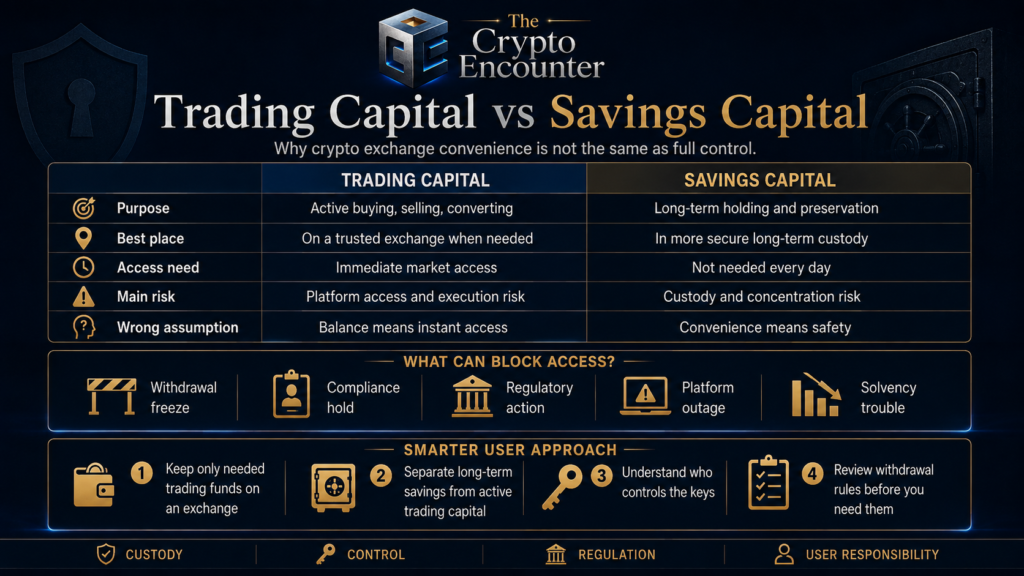
| Capital type | Main purpose | Access need | Main risk to manage |
|---|---|---|---|
| Trading capital | Active buying, selling, conversion | High | Exchange access and market volatility |
| Savings capital | Long-term holding | Lower day to day | Custody, key security, concentration |
| Emergency cash | Bills and urgent expenses | Immediate | Liquidity and capital preservation |
Emergency money deserves special attention. Crypto prices can move sharply, while exchange access can fail at the same time. Therefore, money needed for essential short-term expenses should not depend on selling through one platform at exactly the right moment.
Reducing Crypto Exchange Dependency Without Creating New Problems
Moving assets away from an exchange can reduce counterparty exposure, but self-custody is not automatically safer for every person.
The SEC advises users to protect seed phrases, use strong passwords, enable multi-factor authentication, and research custodians carefully.
Good risk management starts with capability. Someone who does not understand wallet backups should learn with a small amount before moving substantial savings. Likewise, anyone who keeps trading capital on a crypto exchange should secure the account properly and understand withdrawal protections.
Diversification can also apply to custody. Depending entirely on one exchange creates a single point of failure. Depending entirely on one poorly stored seed phrase creates another.
Therefore, stronger custody planning means designing around failure rather than pretending failure is impossible.
Questions to Ask Before Leaving Savings on a Crypto Exchange
Before treating an exchange account like a savings account, ask what happens under stress.
Can you withdraw to a wallet you control? Who holds the private keys? Which legal entity serves you? What happens to customer assets if that entity becomes insolvent? Does your jurisdiction provide statutory protection? Are customer assets segregated? What withdrawal limits can apply? Does the crypto exchange use outside custodians?
Those questions reveal more than brand recognition.
The answers can also change. Companies revise terms, regulators introduce rules, and services leave jurisdictions. As a result, a crypto exchange that fits your needs today may not fit them indefinitely.
What Crypto Exchange Users Should Understand About Protection
Traditional financial protections do not automatically follow money into an exchange.
The SEC notes that bank deposits can receive FDIC protection within applicable limits and that eligible securities held through registered broker-dealers can receive SIPC protection. However, most crypto assets do not receive those same protections simply because they sit in an online account.
Similarly, the CFTC warns that virtual-currency platforms may lack customer safeguards and that users should research how and where they store crypto.
Therefore, a familiar interface should never substitute for understanding the legal and custody structure behind a crypto exchange.
Conclusion: Treat a Crypto Exchange as Infrastructure, Not a Vault by Default
A crypto exchange is useful infrastructure. It can provide liquidity, market access, conversions, and a convenient bridge between fiat and digital assets. Yet convenience does not erase custody risk.
Trading capital belongs where it can trade. Savings capital deserves a separate decision based on access, legal protection, security, and personal capability.
A crypto exchange may operate normally today and face a withdrawal freeze, solvency crisis, cyber incident, service restriction, or regulatory intervention tomorrow. Therefore, the practical question is not whether one platform feels safe. It is whether your financial plan still works when that crypto exchange does not.
The safest mindset is clarity rather than complacency. Know what the crypto exchange controls, know what you control, and decide consciously how much of your savings should depend on someone else keeping the door open.
FAQs
What is crypto exchange risk?
Crypto exchange risk is the possibility that platform failure, insolvency, regulatory action, cyber incidents, compliance controls, or operational problems prevent you from accessing or recovering assets held through an exchange.
Is crypto safer in a personal wallet than on an exchange?
A personal wallet can remove some third-party custody risk if you control the keys. However, it creates personal security responsibilities. Losing a seed phrase or exposing a private key can permanently compromise access. The SEC recommends strong security practices for both self-custody and third-party custody.
Why should trading capital and savings capital be separated?
Trading capital needs regular market access. Savings capital may not. Separating the two can limit how much long-term value remains exposed to one crypto exchange and its operational, legal, and solvency risks.
Can a regulator freeze a crypto exchange?
Authorities can restrict firms, seize infrastructure, block certain services, or pursue enforcement when the law permits. The exact powers depend on the jurisdiction and circumstances. The Garantex disruption shows how law-enforcement action can directly affect platform infrastructure.
Does proof of reserves make a crypto exchange safe?
No. Proof of reserves can provide information about selected assets, but the SEC warns that it may not reveal the complete liability picture or provide assurance comparable with a financial-statement audit.
What should I check before using a crypto exchange for long-term storage?
Review custody arrangements, legal entity, regulatory status, withdrawal rules, insolvency terms, security controls, asset segregation, third-party custodians, and any statutory or insurance protection that actually applies.