

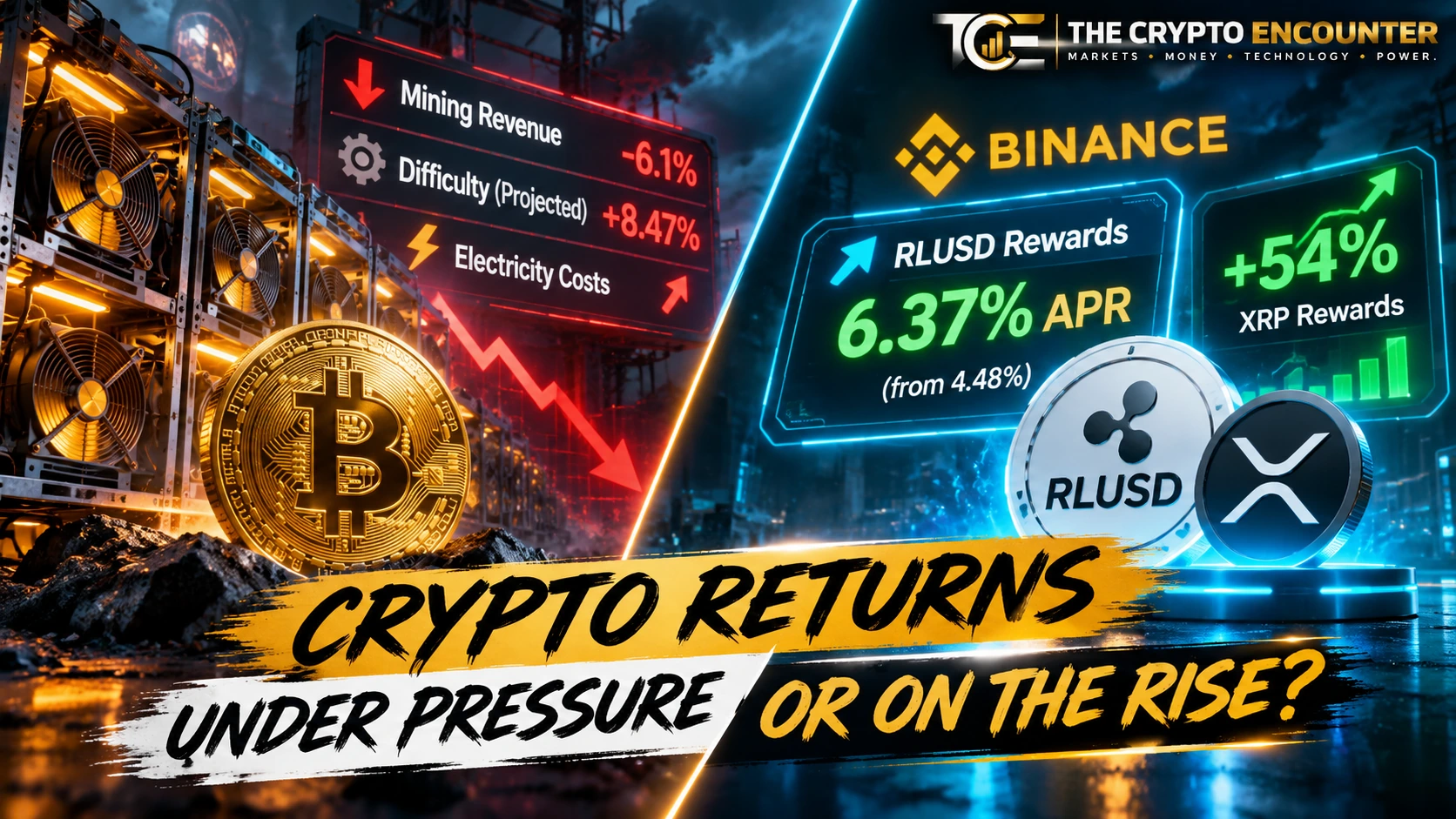
Bitcoin miners are facing another squeeze on their operating margins just as Binance increases rewards for customers holding Ripple’s RLUSD stablecoin. The two developments appear unrelated, but together they reveal how differently cryptocurrency businesses generate revenue and how quickly those economics can change.
Bitcoin’s expected mining revenue per unit of computing power has fallen, while a projected increase in network difficulty threatens to reduce miners’ earnings further. Binance, meanwhile, has raised its annualized RLUSD base reward rate from 4.48% to 6.37%, with the estimated XRP payout on an unchanged qualifying balance increasing approximately 54%.
These contrasting crypto returns reflect two fundamentally different mechanisms. Bitcoin mining revenue depends on network competition, block rewards, transaction fees and Bitcoin’s market price. Binance’s RLUSD rewards depend on an exchange-administered incentive program whose rates, eligibility rules and promotional funding can change.
The distinction matters because neither a declining mining revenue figure nor a rising stablecoin reward rate, viewed in isolation, tells the complete story about profitability, risk or sustainability.
Crypto Returns Are Moving in Opposite Directions
Bitcoin miners and RLUSD holders operate in different parts of the cryptocurrency economy, but both depend on converting a resource into financial returns.
For miners, that resource is computing power supported by electricity, specialized equipment and operating infrastructure. For qualifying RLUSD holders on Binance, it is a stablecoin balance maintained under the exchange’s reward conditions.
The latest figures show how differently the two models respond to changing conditions.
| Metric | Bitcoin Mining | Binance RLUSD Rewards |
|---|---|---|
| Reported change | Gross hashprice declined between November 16 and 20 | Base annualized reward rate increased from 4.48% to 6.37% |
| Reference figure | $28.58 per PH/s per day in the November 20 reading cited by CryptoSlate | 6.37% annualized base APR for the latest seven-day period |
| Next development | Difficulty adjustment projected around November 27 | New 600,000 XRP campaign runs through December 18 |
| Primary economic exposure | Electricity costs, machine efficiency, Bitcoin price and network competition | Exchange terms, reward funding, eligibility, custody and XRP conversion |
These are not comparable investment returns. Hashprice measures expected gross mining revenue from computing power before operating costs. Binance’s annualized percentage rate describes a reward calculation applied to qualifying stablecoin balances, not a guaranteed bank-deposit interest rate.
Bitcoin Mining Revenue Falls as Difficulty Threatens Another Increase
Bitcoin mining profitability has deteriorated as the dollar value of expected rewards declines.
CryptoSlate reported that Luxor-linked hashprice readings fell from $30.45 per petahash per second per day on November 16 to $28.58 on November 20, a decline of approximately 6.1%.
Hashprice measures the expected revenue generated by a fixed amount of mining computing power. One petahash per second, or PH/s, equals 1,000 terahashes per second.
The indicator incorporates Bitcoin’s market price, network difficulty, the block subsidy and transaction fees. A miner can therefore receive a similar quantity of Bitcoin while earning fewer U.S. dollars if Bitcoin’s price declines.
That is particularly important for operators whose electricity bills, hosting charges and equipment financing obligations are denominated in fiat currency.
The Luxor-linked Bitcoin Hashprice Index published by Simple Mining provides additional context. Its November 20 historical snapshot lists $27.31 per PH/s per day, below the earlier $28.58 reading used in CryptoSlate’s calculations.
The two readings reflect different observation points and should not be presented as identical measurements. Both nevertheless indicate substantial pressure on mining revenue.
The relationship between Bitcoin’s dollar price and mining economics is also relevant to broader market conditions. As The Crypto Encounter explained in its analysis of why Bitcoin remains sensitive to Federal Reserve policy and global liquidity, the network’s fixed issuance rules do not insulate its market price from macroeconomic developments.
Why Bitcoin Difficulty Matters More Than a Temporary Revenue Recovery
Bitcoin adjusts its mining difficulty approximately every 2,016 blocks to maintain an average block interval of roughly ten minutes.
When blocks are produced faster than the target, the network generally increases difficulty. When they arrive more slowly, difficulty generally decreases.
On November 14, Bitcoin’s difficulty fell 9.13%, from approximately 148.36 trillion to 134.82 trillion.
The reduction temporarily improved the amount of Bitcoin that a fixed quantity of computing power could expect to earn, assuming other variables remained unchanged.
However, faster subsequent block production pointed toward another increase.
CryptoSlate reported a projected 8.47% increase to approximately 146.24 trillion, based on a November 20 snapshot. A later snapshot on the MineOrNot Bitcoin difficulty tracker showed a projected increase of approximately 8.00%.
These figures are estimates, not completed network adjustments. The final result depends on the pace of block production during the remaining adjustment period.
If difficulty rises while Bitcoin’s price and transaction-fee conditions remain unchanged, the same amount of mining computing power will earn fewer bitcoins on average.
That creates a second source of pressure for operators already facing weaker dollar-denominated revenue.
Electricity Prices Could Determine Which Bitcoin Miners Remain Viable
The profitability consequences become clearer when mining revenue is compared with electricity consumption.
Using the $28.58 hashprice benchmark and assuming a projected 8.47% difficulty increase, expected gross revenue would decline to approximately $26.35 per PH/s per day if Bitcoin’s price, block subsidy and average fees remained constant.
That represents an additional reduction of approximately 7.8% from the starting benchmark.
Different machines experience the same revenue pressure but have very different electricity costs.
| Mining Machine Efficiency | Electricity Break-Even Before Increase | After Projected 8.47% Increase |
|---|---|---|
| 30 joules per terahash | 3.97 cents/kWh | 3.66 cents/kWh |
| 13.5 joules per terahash | 8.82 cents/kWh | 8.13 cents/kWh |
These figures are electricity-only calculations based on the November 20 benchmark used in the original report. They exclude pool fees, equipment depreciation, maintenance, financing, hosting overhead and other operating expenses.
At a hypothetical electricity rate of 3.8 cents per kilowatt-hour, a machine consuming 30 joules per terahash would cover its electricity cost before the projected adjustment but fall below that threshold afterward.
A more efficient machine consuming 13.5 joules per terahash would retain considerably more room to cover electricity at the same rate.
This is why mining profitability cannot be evaluated using Bitcoin’s price alone.
Two companies mining the same asset can have dramatically different economics because of electricity contracts, machine efficiency, operating scale, cooling requirements and financing arrangements.
For broader context, The Crypto Encounter’s coverage of Bitcoin’s relationship with employment data, Treasury yields and institutional flows explains how market conditions can influence the dollar value of the rewards miners receive.
Binance Raises RLUSD Rewards to 6.37% as XRP Payouts Increase
While miners confront declining gross revenue, Binance has increased the annualized base reward rate available through its RLUSD incentive program.
Ripple USD, or RLUSD, is a dollar-linked stablecoin issued within Ripple’s financial ecosystem. It is distinct from XRP, the native asset of the XRP Ledger.
Under Binance’s program, eligible RLUSD balances generate rewards distributed in XRP.
The exchange’s published distribution data show that the base annualized reward rate increased from 4.48% for the period ending November 13 to 6.37% for the period ending November 20.
That is an increase of 1.89 percentage points, equivalent to approximately 42.2% relative to the previous base rate.
However, the estimated XRP payout increased by approximately 54%, exceeding the percentage increase in the underlying annualized rate.
The explanation lies in the XRP conversion price used to calculate the distribution.
Why the XRP Reward Increased More Than the RLUSD Rate
Binance’s calculations use the qualifying RLUSD balance, the applicable annualized rate and a seven-day reward period to determine the dollar-denominated reward before converting it into XRP.
The exchange’s XRP conversion reference declined from $1.0413 in the November 13 distribution to $0.9603 in the November 20 distribution.
A lower conversion price means that a given dollar-denominated reward corresponds to more XRP tokens.
For a hypothetical customer maintaining a constant qualifying balance of 10,000 RLUSD, the calculations produce the following results.
| Distribution Period | Base APR | XRP Conversion Reference | Estimated Weekly XRP Reward |
|---|---|---|---|
| October 30 | 4.84% | $1.2379 | 7.49 XRP |
| November 6 | 5.29% | $1.2072 | 8.40 XRP |
| November 13 | 4.48% | $1.0413 | 8.25 XRP |
| November 20 | 6.37% | $0.9603 | 12.72 XRP |
The estimated increase from 8.25 XRP to 12.72 XRP is approximately 54.2%.
These figures assume a constant qualifying balance, exclude promotional multipliers and do not measure the total XRP distributed to all customers.
The distinction between a stablecoin balance and an XRP-denominated reward is important. A customer may hold an asset designed to track the dollar while receiving rewards in a cryptocurrency whose market price can fluctuate.
For a broader understanding of the underlying asset, The Crypto Encounter has examined Ripple’s efforts to integrate RLUSD into African cross-border payment infrastructure.
Binance Launches Another 600,000 XRP Rewards Campaign
Alongside the increased base rate, Binance announced another promotional campaign offering a total pool of 600,000 XRP to eligible RLUSD holders.
The campaign began November 20 and is scheduled to run through December 18.
According to the official Binance RLUSD rewards announcement, eligible balances may be held across specified Spot, Funding, Flexible Earn and Margin accounts, subject to the campaign’s conditions and regional availability.
The reward calculation uses the lowest balance recorded during hourly snapshots each day and averages those daily minimums across the relevant seven-day period.
This methodology means that maintaining a high balance for most of a day does not necessarily compensate for a brief period when the qualifying balance falls substantially.
The renewed campaign also includes additional reward multipliers for certain eligible balances.
Qualifying RLUSD in Flexible Earn can receive a 1.1-times multiplier, while eligible balance increases above a previous baseline can receive a 1.2-times multiplier. Portions meeting both conditions may qualify for a 1.3-times multiplier under the published rules.
These promotional features do not establish a permanent annualized return.
Actual rewards depend on qualifying balances, campaign terms, applicable multipliers and the exchange’s distribution calculations.
Binance has not publicly established in the cited announcement whether the entire rewards pool is funded through XRP purchased in the open market, existing inventory or another funding arrangement.
Consequently, the campaign should not automatically be interpreted as evidence of new market purchases of XRP.
What the Higher RLUSD Reward Rate Actually Means
A 6.37% annualized reward rate can appear attractive when compared with a declining mining revenue benchmark. However, the figures measure different things and carry different risks.
The Binance rate is an annualized representation of rewards for a particular calculation period. It does not mean the exchange has committed to paying that rate for an entire year.
Similarly, the 54% increase in estimated XRP rewards does not mean the RLUSD holder’s total account value increased by 54%.
The higher token payout reflects a combination of the increased reward rate and the lower XRP conversion reference.
Several risks remain relevant.
RLUSD holders depend on the stablecoin issuer’s reserve and redemption arrangements. Customers holding assets on Binance also face exchange custody, operational and account-access risks. The XRP rewards introduce separate market-price exposure.
As The Crypto Encounter explained in its investigation into who controls the reserves behind stablecoins, dollar backing does not automatically make a digital token equivalent to an insured bank deposit.
The distinction is also relevant to the debate over stablecoin rewards and banking regulation.
Our reporting on the CLARITY Act and the dispute over stablecoin rewards examines why policymakers distinguish issuer-paid interest, exchange incentives and transaction-related rewards.
Those legal and economic differences matter when evaluating how sustainable a promotional return may be.
Why Bitcoin Mining and RLUSD Rewards Tell a Larger Market Story
The most useful connection between these developments is not that one cryptocurrency activity is outperforming another.
It is that the economics of earning money within the cryptocurrency industry depend on who controls the reward mechanism and which costs are borne by the participant.
Bitcoin’s network determines mining rewards through transparent protocol rules and competition among miners.
Individual operators cannot negotiate a higher block subsidy because their electricity bills have increased. They must respond through efficiency, operating costs, equipment deployment and exposure to Bitcoin’s market price.
Binance, by contrast, can adjust promotional reward rates and campaign structures within its applicable terms.
The exchange may use those incentives to attract or retain qualifying stablecoin balances, but the public data do not establish whether the campaign will produce lasting increases in RLUSD deposits or how much incremental trading activity it will generate.
That difference creates an important asymmetry.
Mining revenue is exposed directly to network competition and market prices, while exchange-administered rewards can temporarily become more generous because of commercial decisions.
Neither structure guarantees a sustainable economic outcome.
The broader financial consequences of stablecoin adoption are examined in The Crypto Encounter’s analysis of how stablecoins could affect bank funding costs and financial intermediation.
What Could Change the Outlook for Bitcoin Miners and RLUSD Holders?
Several measurable developments will determine whether the present conditions persist.
Bitcoin’s Next Difficulty Adjustment
The final adjustment will establish whether the projected increase materializes and how much expected Bitcoin output changes for a fixed quantity of computing power.
A smaller increase would provide more relief than the current projections suggest. A larger increase would intensify the pressure if other variables remain constant.
Bitcoin’s Dollar Price and Transaction Fees
A higher Bitcoin price or stronger transaction-fee revenue could offset some of the negative effect of rising difficulty. Further price weakness could deepen the squeeze.
Mining Equipment and Electricity Costs
Operators with more efficient machines and lower electricity costs are better positioned to absorb declining hashprice than businesses operating older equipment with expensive power contracts.
Binance’s Next RLUSD Distribution
The next reward publication will show whether the elevated annualized rate persists and how the XRP conversion reference affects actual token distributions.
Qualifying RLUSD Balances and Campaign Funding
Changes in eligible balances before, during and after the promotional campaign would provide evidence of whether higher rewards attract durable stablecoin holdings.
More information about the source of XRP rewards would also help distinguish promotional distributions from possible open-market demand.
The Real Lesson Behind Diverging Crypto Returns
Bitcoin miners and RLUSD holders are experiencing very different economic conditions, but both developments reinforce the importance of understanding what sits behind a headline return.
For miners, a declining hashprice and higher difficulty can narrow the gap between gross revenue and electricity costs. For RLUSD holders, a higher advertised reward rate may increase XRP distributions without guaranteeing the same rate or market value in subsequent periods.
The critical distinction is between revenue generated by a competitive network and rewards administered through a financial platform.
Crypto returns cannot be understood through percentages alone. The underlying mechanism, cost structure, payout currency, contractual terms and exposure to market changes determine what those figures actually mean.
The next Bitcoin difficulty adjustment and Binance’s forthcoming reward distributions will provide additional evidence about whether these contrasting conditions are temporary or part of a more persistent change in cryptocurrency economics.
Frequently Asked Questions
Why are Bitcoin mining revenues declining?
Mining revenue per unit of computing power has declined in dollar terms. Bitcoin’s market price, transaction fees, block rewards and network difficulty all influence the amount miners can earn.
What happens when Bitcoin mining difficulty increases?
A fixed amount of computing power generally earns fewer bitcoins over the same period when difficulty rises, assuming other network conditions remain comparable.
Is Binance guaranteeing 6.37% annual returns on RLUSD?
No. The 6.37% figure is an annualized base reward rate for a specified seven-day period, not a guaranteed return for an entire year. Campaign conditions and future rates may change.
Why did estimated XRP rewards increase approximately 54%?
The base RLUSD reward rate increased, while Binance used a lower XRP conversion reference. Together, those changes produced more XRP for the same hypothetical qualifying balance.
Are RLUSD rewards equivalent to bank interest?
No. RLUSD is a stablecoin, and the Binance campaign is an exchange-administered reward arrangement. It involves different legal, custody, market and operational considerations from an insured bank deposit.
Does Binance’s XRP rewards campaign guarantee higher XRP demand?
No. The campaign establishes a distribution incentive, but the available information does not establish how the rewards are funded or whether recipients will retain, sell or withdraw their XRP.
Editorial methodology: Mining calculations are based on the specified November 20 hashprice benchmark and a hypothetical 8.47% difficulty increase. The Binance reward illustration assumes a constant 10,000 RLUSD qualifying balance without promotional multipliers or compounding. Figures are historical observations, published program terms or explicitly identified scenarios, not guaranteed future outcomes.
Disclaimer: This article is for informational and analytical purposes only. It does not constitute financial, investment, legal or trading advice. Cryptocurrency mining, stablecoin products, exchange custody and digital-asset rewards involve financial and operational risks.
Edited by Jawad Hussain