


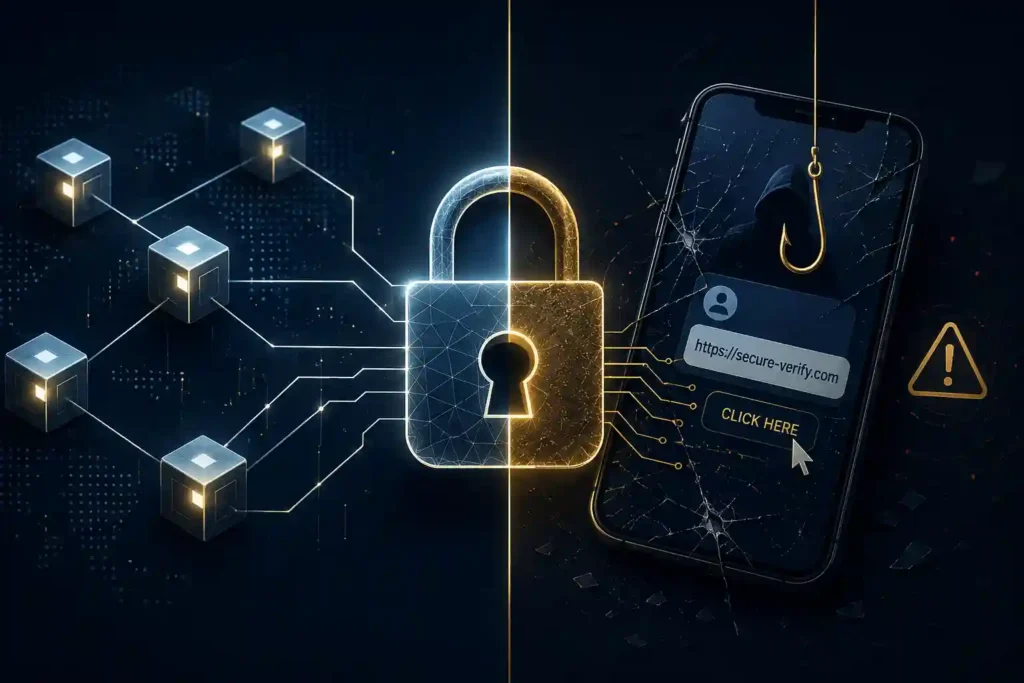
Crypto security vs safety is not the same question, even though most people treat them as one. Bitcoin’s blockchain has never been hacked at the protocol level. Ethereum’s core consensus has never been broken. Yet in 2025 alone, criminals stole roughly $17 billion from crypto users through scams and fraud, according to Chainalysis.
That gap between protocol strength and user loss is not a contradiction. It is the story of modern crypto crime. That gap sits at the center of crypto security vs safety, and the two are not the same thing. The math behind blockchain security works. The humans holding the keys are the weak point, and criminals now build entire operations around that fact.
Why This Story Matters: Crypto Security vs Safety
Most crypto coverage treats security as a single topic: either a chain got hacked, or it didn’t. That framing collapses crypto security vs safety into one idea when they behave very differently, and it misses where the real damage happens. The FBI’s Internet Crime Complaint Center reported more than 181,000 cryptocurrency fraud complaints in 2025, totaling over $11 billion in reported losses in the United States alone. Almost none of that money disappeared because a blockchain failed. It moved because someone signed a malicious transaction, typed a seed phrase into a fake site, or trusted a caller pretending to be exchange support.
For everyday holders, this distinction changes what “staying safe” actually means. Reading about protocol audits and consensus mechanisms will not stop a wallet-drainer link from emptying an account. Understanding how scams reach people and where personal habits create openings matters more than most investors realize. Our recent piece on crypto’s password problem covers a related angle: weak account hygiene remains one of the most common entry points for attackers.
What Happened: The Crypto Security vs Safety Divide
Crypto security operates on two separate layers, and conflating them is where public confusion about crypto security vs safety starts.
The first layer is protocol security. This covers the cryptography, consensus rules, and network design that keep a blockchain’s ledger accurate and resistant to tampering. Bitcoin and Ethereum have earned trust here through years of adversarial testing, economic incentives for honest validation, and enormous computing or staking power securing the network. When people say “crypto is secure,” they usually mean this layer, and for major chains, the claim generally holds.
The second layer is user safety. This covers wallets, private keys, browser extensions, mobile apps, customer support channels, and the judgment calls a person makes every time they approve a transaction or click a link. This layer has no equivalent to blockchain consensus. It depends entirely on individual behavior, device hygiene, and the ability to spot deception. Security researchers and blockchain forensics firms consistently find that this is where nearly all user-facing losses occur, which is the clearest evidence yet of how crypto security vs safety plays out in practice.
TRM Labs’ 2026 crypto crime report found that infrastructure attacks, meaning compromised private keys, seed phrases, wallet infrastructure, and privileged access, drove roughly $2.2 billion in losses across 45 incidents in 2025, accounting for about three-quarters of all hack-related theft that year. The pattern was social engineering and access compromise, not cryptographic failure.
Even the largest single theft in crypto history, the February 2025 Bybit breach that TRM Labs attributes to North Korean operatives, succeeded through compromised signing infrastructure rather than a broken blockchain.
Key Details
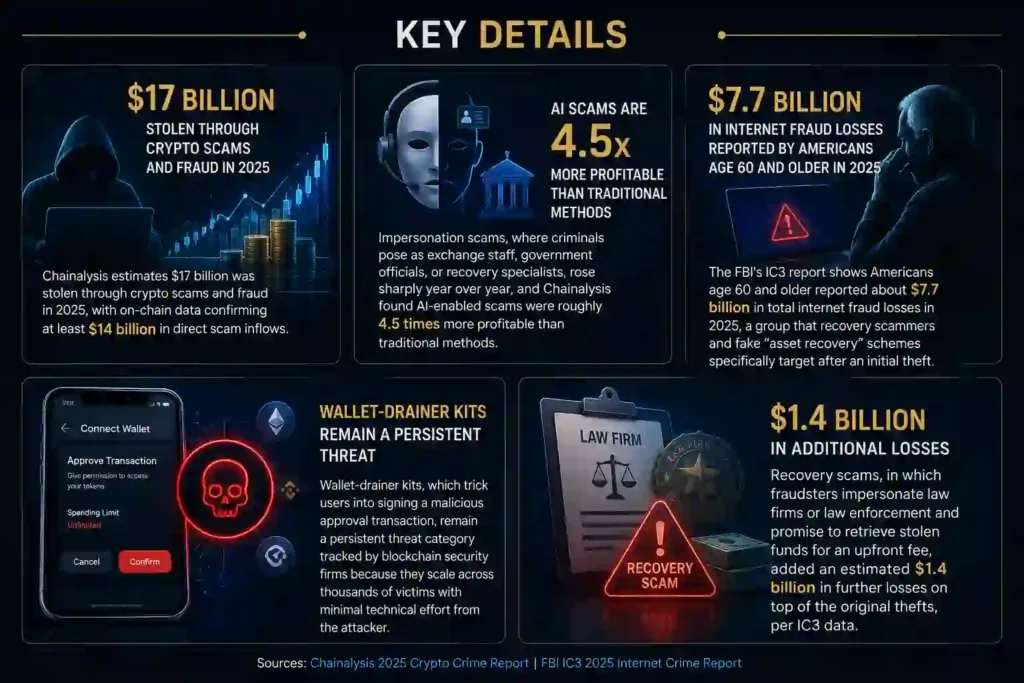
- Chainalysis estimates $17 billion was stolen through crypto scams and fraud in 2025, with on-chain data confirming at least $14 billion in direct scam inflows.
- Impersonation scams, where criminals pose as exchange staff, government officials, or recovery specialists, rose sharply year over year, and Chainalysis found AI-enabled scams were roughly 4.5 times more profitable than traditional methods.
- The FBI’s IC3 report shows Americans age 60 and older reported about $7.7 billion in total internet fraud losses in 2025, a group that recovery scammers and fake “asset recovery” schemes specifically target after an initial theft.
- Wallet-drainer kits, which trick users into signing a malicious approval transaction, remain a persistent threat category tracked by blockchain security firms because they scale across thousands of victims with minimal technical effort from the attacker.
- Recovery scams, in which fraudsters impersonate law firms or law enforcement and promise to retrieve stolen funds for an upfront fee, added an estimated $1.4 billion in further losses on top of the original thefts, per IC3 data.
Market or Industry Context: Living With Crypto Security vs Safety
The crypto industry has spent a decade making the case that decentralized systems are trustworthy because they remove reliance on a single point of failure. That argument is largely accurate at the protocol level. What it does not address is that removing a central authority also removes a central safety net.
There is no bank fraud department to reverse an unauthorized transfer once a user signs it. There is no customer service line that can undo a transaction sent to the wrong address or approved for a malicious contract.
This is part of why the industry increasingly separates “self-custody,” where a user holds their own private keys, from custodial arrangements on centralized exchanges. Each model shifts the crypto security vs safety balance differently. Self-custody removes counterparty risk from an exchange but places full responsibility for key security on the individual.
Centralized platforms handle key management but concentrate large sums in a single target, which is exactly what made the Bybit breach so costly. Readers weighing where to hold assets may find it useful to review our guide on the difference between owning crypto and controlling crypto, which walks through what custody actually means in practice.
Exchanges are not banks in the traditional regulatory sense either, a distinction covered in our Learning Corner explainer on why crypto exchanges are not banks. Deposit insurance, chargeback protections, and the consumer safeguards people associate with traditional finance generally do not apply the same way in crypto markets, which raises the stakes when something goes wrong.
Criminal tactics have also industrialized alongside the market’s growth. Chainalysis researchers describe scam operations increasingly relying on AI-generated impersonation content, automated phishing infrastructure, and scripted social engineering designed to build trust quickly before pressuring a victim into acting.
Coindesk’s coverage of the 2026 Chainalysis report noted that impersonation and AI-driven scams are gradually overtaking direct cyberattacks as the leading cause of individual losses, a shift that reflects how much harder deception has become to detect than a technical exploit.
Risks, Limits, or Unanswered Questions in Crypto Security vs Safety
Several open questions matter for anyone trying to assess their own exposure.
Reporting gaps understate the real scale. Law enforcement figures rely on victims filing complaints, and many people never report losses out of embarrassment or because they assume nothing can be done. Actual losses are almost certainly higher than official tallies suggest.
AI tools are lowering the skill floor for attackers. Deepfake voice and video, automated translation, and convincing scripted chat have made scams accessible to less sophisticated criminal groups, which likely means volume keeps rising even if individual scam payouts vary.
Recovery is rare. Once funds move to an attacker-controlled wallet and pass through a mixer or cross-chain bridge, recovering assets is difficult and often impossible, regardless of how much of the transaction trail blockchain analytics firms can reconstruct.
No single fix exists. Crypto security vs safety is not a problem one product solves. Exchange-based custody removes key-management burden but concentrates funds as an attractive target. Every setup involves trade-offs, and no configuration eliminates the need for careful judgment at the point of transaction.
Regulatory response remains uneven. Consumer protection frameworks for crypto vary widely by jurisdiction and are still developing, meaning victims often have limited legal recourse compared with traditional financial fraud. Readers can track how these frameworks are evolving in our ongoing crypto regulation coverage.
What to Watch Next
A few developments are worth monitoring going into the rest of 2026:
- Whether exchanges expand mandatory transaction warnings and delay windows for large or first-time withdrawals, a step several platforms adopted after high-profile impersonation losses.
- How wallet providers respond to drainer kits through improved transaction simulation, which shows users in plain language what a signature actually authorizes before they approve it.
- Whether law enforcement agencies expand programs like the FBI’s proactive victim-notification initiative, which the bureau credits with reducing potential losses by hundreds of millions of dollars since it launched.
- Continued growth in AI-generated impersonation scams, which researchers expect to keep expanding as generative tools become more accessible and harder to distinguish from genuine communication.
Readers who want a broader foundation before diving deeper into security topics can start with our Learning Corner, including the related piece on why your crypto is only as safe as your worst habit.
FAQs
Is Bitcoin actually secure, or is that just marketing language?
Bitcoin’s underlying protocol has a strong security track record. Its consensus mechanism has not been broken, and the network has operated without a successful attack on its core ledger since launch. Security at this level is separate from the safety of individual wallets, exchange accounts, or the devices people use to access crypto.
What is the difference between a hack and a scam in crypto?
A hack typically involves a technical exploit, such as a vulnerability in a smart contract or compromised infrastructure. A scam relies on deception, convincing a person to voluntarily send funds, approve a transaction, or share private keys. Recent data shows scams now cause more individual losses than technical hacks.
Are hardware wallets enough to stay safe?
Hardware wallets protect private keys from many forms of malware and remote theft, but they do not prevent a user from approving a malicious transaction if they are tricked into doing so. Safety depends on both the tool and the habits of the person using it.
Why are older adults targeted more often in crypto scams?
Federal fraud data shows older adults report the highest dollar losses in internet fraud overall, including crypto-related fraud. Scammers often specifically target this group with investment pitches, romance scams, and fake recovery services that build trust over extended periods before requesting funds.
Can stolen crypto ever be recovered?
Recovery is possible in some cases, particularly when law enforcement moves quickly and funds have not yet passed through a mixing service or been converted across multiple chains. In many cases, however, recovery is difficult or impossible, which is why prevention matters more in crypto than in traditional banking.
What should someone do if they suspect a crypto scam in progress?
Stop the transaction if possible, avoid clicking links or downloading software sent by the other party, and verify any support contact directly through an exchange’s official website rather than a number or link provided by the person contacting you. Reporting to the FBI’s IC3 or a local consumer protection agency helps investigators track patterns even when individual recovery isn’t guaranteed.
What does “crypto security vs safety” actually mean?
Security refers to the strength of a blockchain’s protocol, meaning its cryptography and consensus rules. Safety refers to whether a person’s wallet, device, and habits protect them from scams and theft. A network can be secure while an individual user remains unsafe, which is why the two terms should never be used interchangeably.
Disclaimer
This article is for informational and educational purposes only. It does not provide financial, investment, legal, tax, or accounting advice. Cryptocurrency and digital asset markets involve risk, including possible loss of capital. Readers should conduct their own research before making any financial decision.