



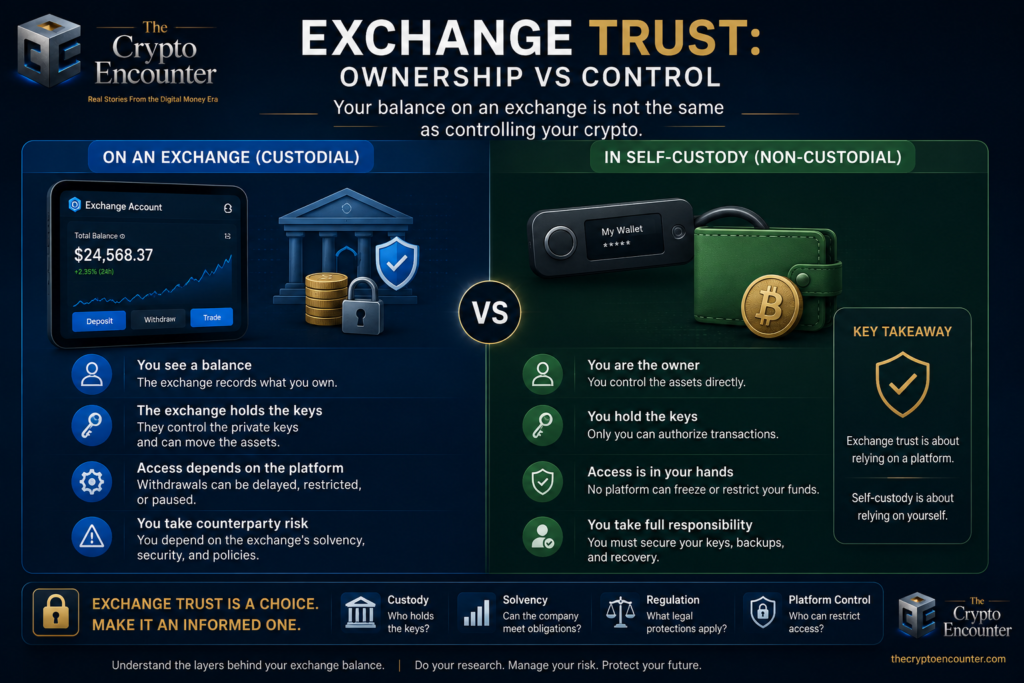
A crypto exchange can make ownership feel simple. You deposit money, buy an asset, and see a balance on a screen. Yet that balance does not always mean you control the underlying crypto directly. In a custodial account, the platform normally controls the private keys and sets the rules around withdrawals, account reviews, compliance checks, and system access. That is why exchange trust matters. Users are trusting far more than an app. They are trusting custody arrangements, solvency, legal protections, internal controls, cybersecurity, and the platform’s ability to honor withdrawals.
The central issue is simple. An exchange can show you an asset balance while still controlling the machinery that lets you access it. Understanding exchange trust means separating ownership, control, and access.
What Exchange Trust Actually Means
Exchange trust is the confidence that a trading platform will safeguard customer assets, keep accurate records, maintain enough resources to meet obligations, process legitimate withdrawals, follow applicable law, and operate systems that work when customers need them.
That sounds straightforward. However, crypto adds an unusual twist. In self-custody, the user controls the private keys. On a custodial exchange, the exchange typically controls the infrastructure that safeguards those keys and records the customer’s balance inside its system. The SEC has repeatedly treated custody as a central investor-protection issue because whoever safeguards crypto assets carries responsibilities around loss, theft, access, and competing claims.
The SEC has emphasized that a trustworthy custodian should protect customer assets from loss, destruction, theft, and competing claims if the custodian fails, which is why the SEC’s guidance on crypto custody is relevant to understanding exchange trust.
Therefore, exchange trust becomes part of the product. The platform sells convenience, liquidity, account recovery, trading tools, customer support, and easier access. In return, the user accepts a layer of counterparty risk.
That trade can be reasonable. Still, users should understand it rather than assume it.
Why Exchange Trust Starts With Ownership Versus Control
When users open an exchange app, the number on the screen feels like possession. Legally and technically, however, the picture can be more complicated.
A custodial platform may recognize the customer as the owner or beneficial holder of assets while still controlling the transaction infrastructure. For example, [Coinbase’s U.S. User Agreement] sets out the contractual relationship governing customer digital assets and the conditions that apply when users transfer or withdraw them. Coinbase’s current U.S. user agreement, for example, states that supported digital assets in its Digital Asset Wallet remain the customer’s property and are held for customers. However, the same agreement says withdrawals remain subject to outages, downtime, protocol requirements, and applicable agreements or policies.
That distinction sits at the center of exchange trust.
Ownership answers one question: whose asset is this? Control answers another: who can authorize its movement? Access asks a third: can the customer move it right now?
Those answers can differ.
As a result, exchange trust should never rest only on the balance displayed inside an account. Users also need to understand the legal and operational structure beneath that balance.
This distinction becomes clearer when comparing an account balance with direct blockchain control. Our guide to why an exchange balance is not the same as your crypto explains how custody, liquidity, solvency, and legal risks can affect access independently.
Convenience Makes Exchange Trust Easy to Forget
Centralized exchanges solve real problems. They let users buy and sell crypto, access trading markets, maintain account records, recover account access under platform procedures, and avoid personally managing every blockchain transaction.
Because the experience feels familiar, exchange trust can disappear into the interface.
The platform handles much of the complexity in the background. Meanwhile, the customer sees a clean account page, a trade button, and a withdrawal option.
If everything works, that arrangement feels almost invisible. However, a withdrawal freeze, account review, outage, cyberattack, or insolvency can expose the custody layer immediately.
At that moment, exchange trust stops being an abstract concept. It becomes a practical question about whether the customer can actually use the assets displayed on the screen.
Exchange Trust Depends on Solvency, Not Just Security
Many users judge an exchange by security features. Two-factor authentication, cold storage practices, device verification, and withdrawal controls all matter. Yet strong account security does not prove that a company is solvent.
Solvency concerns whether a business can meet its financial obligations. Therefore, exchange trust has a financial dimension that a login screen cannot reveal.
FTX remains a powerful example. The U.S. Department of Justice said evidence established that Sam Bankman-Fried misappropriated billions of dollars in customer funds deposited with FTX. A federal judge sentenced him to 25 years in prison in March 2024 after his fraud convictions.
The case exposed a crucial weakness in exchange trust. A customer’s account interface can show a balance even when serious problems exist inside the company responsible for honoring that balance.
The lesson reaches beyond FTX.
A secure blockchain does not guarantee a solvent intermediary. Likewise, an exchange can fail without the underlying blockchain failing at all.
Therefore, users should treat exchange trust as a financial question as well as a cybersecurity question.
Regulation Can Support Exchange Trust Without Guaranteeing Access
Regulation can improve accountability. Depending on the jurisdiction, legal entity, and product, rules may address custody, segregation, governance, disclosures, reporting, or customer protection.
However, exchange trust should not rest on the single word “regulated.”
FINRA warns that unregistered crypto assets, crypto intermediaries, and crypto exchanges may not provide important investor protections associated with registered securities markets. It also notes that whether particular crypto activity falls within federal securities law depends on the asset and activity involved.
Meanwhile, the SEC has continued clarifying the treatment and custody of crypto assets by regulated financial firms. Its December 2025 staff statement, for example, specifically addressed custody of crypto asset securities by broker-dealers.
Therefore, users need more specific questions.
Which legal entity serves the account? Which regulator oversees that entity? Does the relevant permission cover custody, trading, derivatives, or another service? How do the terms treat customer assets? What rules govern withdrawals?
A regulatory license can strengthen exchange trust. It cannot guarantee that a platform will never suffer an outage, cyberattack, liquidity problem, fraud event, or compliance restriction.
Regulatory status also affects whether a platform can continue serving users in a particular jurisdiction. Our deeper analysis of crypto exchange risk explains how compliance controls, regulatory intervention, custody, and platform infrastructure can affect access even when an exchange has not collapsed.
Platform Rules Are Part of Exchange Trust
Every custodial exchange keeps some control over its systems. That control can protect users. However, it can also limit immediate access.
Kraken’s current global terms state that it may suspend withdrawals or redemptions when it determines suspension is necessary or appropriate for compliance with legal, regulatory, or administrative obligations or guidance.
Coinbase’s U.S. agreement likewise makes withdrawals subject to outages, downtime, protocol requirements, blockchain processing time, and applicable policies.
Such restrictions can serve legitimate purposes. Exchanges need fraud controls, sanctions compliance, security reviews, identity checks, and other risk-management systems.
Still, exchange trust includes trusting those platform decisions.
A customer with assets inside a centralized exchange generally depends on the exchange to process an external withdrawal. Consequently, the customer’s practical access depends on more than blockchain code.
This is why exchange trust also represents a governance question. Users depend on company policies, systems, employees, legal obligations, and operational controls.
Four Layers Determine Whether Exchange Trust Is Justified
A useful way to evaluate exchange trust is to separate it into four layers.
| Layer | Plain-English question | What can go wrong? |
|---|---|---|
| Custody | Who controls the private keys and safeguards the assets? | Theft, weak key management, unclear asset treatment |
| Solvency | Can the company meet customer obligations? | Liquidity problems, losses, misuse of funds, insolvency |
| Regulation | What legal protections actually apply? | Oversight gaps, jurisdiction differences, unclear customer rights |
| Platform control | Who can restrict access or withdrawals? | Compliance holds, account freezes, outages, policy restrictions |
These layers overlap. However, they do not replace one another.
A platform can have sophisticated cybersecurity and weak financial controls. Another exchange can remain solvent while temporarily restricting an account for compliance reasons. A regulated company can still experience an outage.
Likewise, self-custody reduces platform dependency but transfers security and recovery responsibilities to the user.
Therefore, exchange trust is never one single promise.
What Users Receive in Return for Exchange Trust
Giving an exchange some control is not automatically a poor decision.
Users receive real benefits. Exchanges provide access to trading markets, order matching, account-management tools, fiat connections, customer support, and simpler interfaces. These services reduce the technical burden that direct blockchain use can place on ordinary users.
In that sense, exchange trust works like a product feature.
The customer gives up some direct control. In return, the platform handles complexity.
However, the amount of exchange trust a user accepts should match the role the exchange plays.
A small balance used for occasional trades creates one level of exposure. A life-changing long-term holding creates another.
Therefore, the same exchange can create very different consequences for two users even when both receive identical platform services.
Insurance Can Strengthen Exchange Trust, but Coverage Has Limits
Insurance can also shape perceptions of exchange trust.
Coinbase states that it carries crime insurance protecting a portion of digital assets held across its storage systems against certain theft-related losses, including some cybersecurity breaches. However, Coinbase also says that the policy does not cover losses caused by unauthorized access to a user’s personal account resulting from compromised credentials.
That distinction matters.
Insurance can cover defined events. Policies may also contain limits, exclusions, conditions, and deductibles.
Most importantly, private crime insurance should not automatically be interpreted as a universal guarantee for every customer balance or every type of loss.
Therefore, exchange trust should come from understanding the protection rather than simply seeing the word “insured.”
That word should begin the investigation, not end it.
Proof of Reserves Can Inform Exchange Trust Without Proving Everything
Reserve disclosures can provide information about assets held by an exchange. However, exchange trust should not depend on a reserve dashboard alone.
The SEC’s chief accountant warned in 2023 that some crypto companies had promoted limited third-party assurance work in ways that could make it sound equivalent to a financial-statement audit. The SEC emphasized that such non-audit work may be much narrower and may provide substantially less assurance.
That distinction matters because reserves represent only one side of a financial picture.
A useful assessment of exchange trust also considers liabilities, corporate obligations, custody arrangements, related-party exposure, governance, withdrawal commitments, and other financial risks.
Consequently, a reserve snapshot can add evidence. It cannot automatically establish complete solvency.
Users should seek broader evidence where it exists, including audited financial statements, regulatory filings, custody disclosures, reserve information, governance controls, and a credible history of processing customer withdrawals.
No single metric can carry all of exchange trust.
How Exchange Trust Changes When Withdrawals Stop
A withdrawal problem exposes the difference between an account balance and usable control.
Different events can interrupt access. A platform may detect suspicious activity. A security review may begin. A technical system can fail. A legal obligation can require restrictions. A liquidity problem can also affect operations.
Meanwhile, the blockchain itself may continue functioning.
This is why exchange trust matters even when the underlying cryptocurrency remains technically secure.
The problem can exist at the intermediary layer rather than the protocol layer.
That distinction is essential.
A functioning Bitcoin network, for example, does not by itself give a customer access to bitcoin held through an exchange that cannot process the customer’s withdrawal.
Consequently, exchange trust connects the blockchain asset to the user’s real-world ability to access it.
Self-Custody Reduces Exchange Trust but Creates Different Responsibility
Moving assets into self-custody can reduce exposure to exchange insolvency and platform withdrawal controls. However, self-custody does not remove risk.
Instead, it moves responsibility.
The user becomes responsible for private keys, recovery phrases, backups, phishing resistance, device security, address verification, and transaction accuracy.
The Crypto Encounter’s existing security coverage makes the same distinction: self-custody gives users direct control, but responsibility for backups, recovery, security, and transaction accuracy also moves to the owner.
Therefore, the choice is not simply exchange trust or no trust.
It is a decision about where responsibility sits.
Exchange trust concentrates significant operational responsibility in an institution. Self-custody concentrates much of that responsibility in the individual.
For some users, a mixed approach may make more sense than treating either method as universally superior. The appropriate decision depends on the user’s activity, security capabilities, risk tolerance, jurisdiction, and needs.
How to Evaluate Exchange Trust Before Depositing Funds
A serious exchange review should go beyond fees, token listings, and app design.
First, identify the legal entity serving your jurisdiction. Then, read its custody terms. Check whether the platform says customer assets remain customer property. Review the applicable terms for any product that may permit lending, staking, collateralization, or other use of assets.
Next, examine withdrawal rules. Look for circumstances that allow delays, restrictions, compliance reviews, or account freezes.
Then assess the evidence behind exchange trust. Regulatory status matters. So do financial disclosures, reserve reporting, independent audits where available, security practices, incident history, asset-segregation policies, and the company’s response to previous disruptions.
Finally, decide what job the exchange should perform.
An exchange can be useful for buying, selling, or transferring crypto without automatically becoming the permanent storage location for every asset a person owns.
That approach turns exchange trust into an intentional decision rather than a default assumption.
Exchange Trust Is Strongest When Users Understand Its Limits
Trust becomes more dangerous when nobody defines it.
A person who assumes an exchange balance equals direct blockchain control may misunderstand the relationship. By contrast, someone who understands custody can make a more informed decision.
That is why exchange trust should invite questions.
Who holds the keys? Who legally owns the assets? What happens if the platform fails? Under what circumstances can withdrawals stop? Which regulator applies? What insurance exists? Does the company publish credible financial information? What do the user terms actually promise?
Clear answers cannot remove risk.
However, they can make risk visible.
That is ultimately what informed exchange trust should achieve.
Conclusion: Exchange Trust Is a Product Because Control Has Value
Exchange trust becomes a product whenever a platform asks users to give up some direct control in exchange for convenience, liquidity, support, account-management tools, and easier access to markets.
The arrangement can work smoothly for long periods. Still, the number on an exchange screen should never hide the structure underneath it.
Custody determines who controls the keys. Solvency influences whether financial obligations can be met. Regulation shapes legal protections. Platform rules affect when access may change. User security matters as well.
Therefore, good exchange trust does not mean blind confidence.
It means understanding exactly what you are trusting, what you receive in return, and what could happen if access fails.
FAQs
What Is Exchange Trust in Crypto?
Exchange trust is the confidence that a crypto platform will safeguard customer assets, maintain accurate records, remain capable of meeting its obligations, follow applicable rules, and process legitimate withdrawals.
Does an Exchange Balance Mean I Control the Crypto?
Not necessarily. A custodial exchange may recognize your ownership or entitlement while still controlling the custody and transaction infrastructure. That is why exchange trust involves both legal ownership and practical access.
Can a Regulated Exchange Freeze Withdrawals?
Yes. Regulation does not mean withdrawals can never face restrictions. Current exchange agreements may allow withdrawal delays or suspensions because of compliance requirements, security controls, technical problems, or other defined circumstances.
Does Proof of Reserves Prove an Exchange Is Solvent?
Not by itself. Reserve information can provide useful evidence, but limited assurance exercises should not automatically be treated as equivalent to comprehensive financial-statement audits. A fuller assessment also needs to consider liabilities and other obligations.
Is Self-Custody Safer Than Exchange Custody?
It removes some exchange trust risks, particularly dependence on exchange solvency and withdrawal controls. However, it creates direct responsibility for keys, backups, phishing protection, device security, and transaction accuracy. The risk changes rather than disappears.