

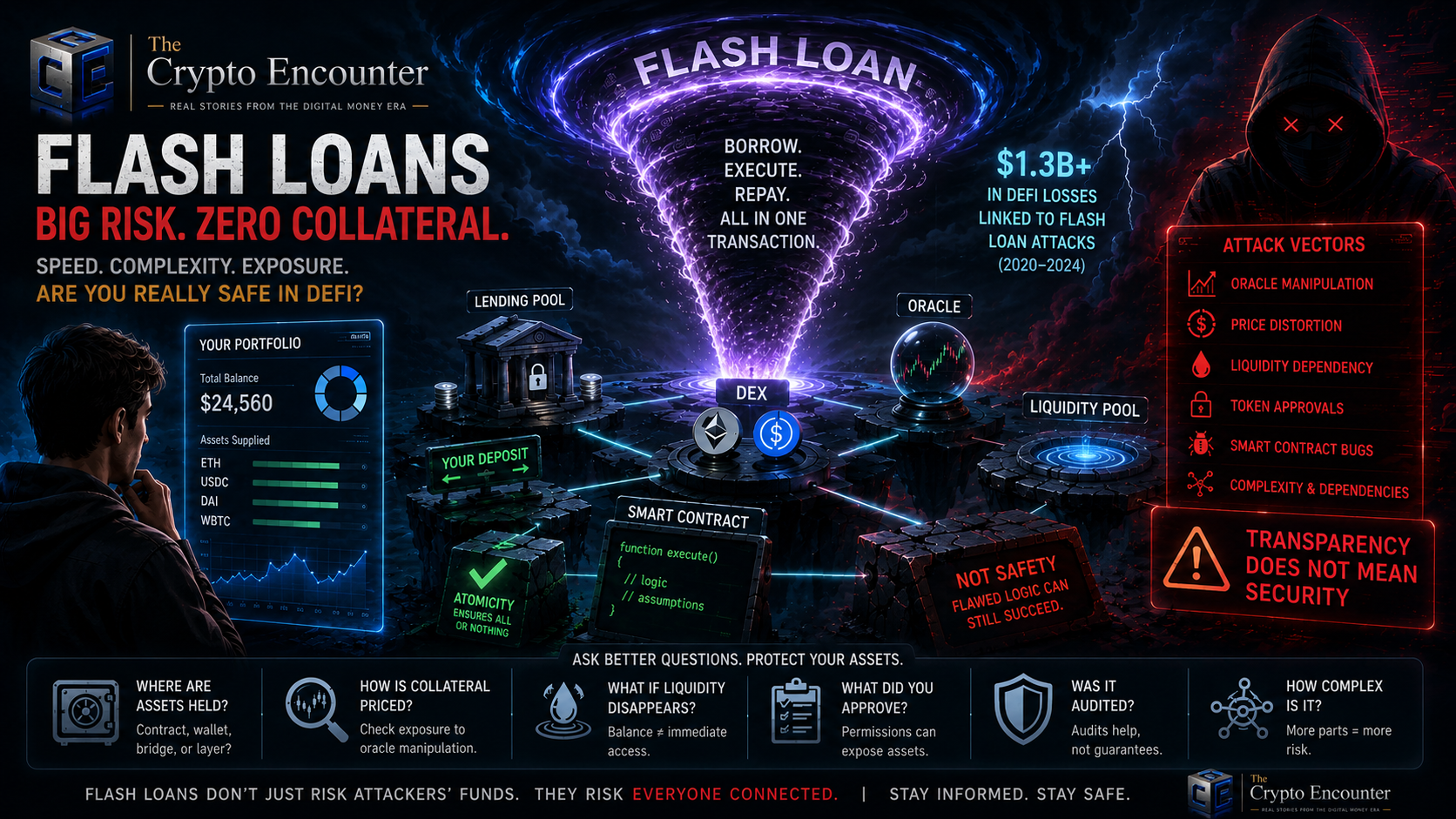
What makes flash loans dangerous for ordinary crypto users? They can give attackers access to huge amounts of temporary capital, allowing them to exploit weaknesses in smart contracts, pricing systems, or liquidity controls within a single transaction.
Flash loans allow smart contracts to access large amounts of capital without traditional collateral, provided that the borrowed assets and the required fee are returned in the same transaction. If repayment fails, the transaction can revert. For more practical insights into DeFi risks and crypto security, readers can explore The Crypto Encounter, where broader risks surrounding decentralized finance and digital assets are examined.
At first glance, that may seem relatively contained. The greater concern emerges when temporary liquidity interacts with poorly designed smart contracts, fragile pricing systems, or weak controls. Flash loans themselves are not inherently malicious.
They are legitimate DeFi infrastructure used for arbitrage, refinancing, collateral swaps, and other financial strategies. However, the same mechanism can give an attacker significant financial firepower without requiring substantial starting capital. Understanding this distinction matters because decentralized finance removes the central custodian, shifting more responsibility toward smart contracts, protocols, liquidity pools, and users themselves.
What Flash Loans Actually Do
A flash loan is essentially a loan that exists for the duration of one blockchain transaction. Under the ERC-3156 standard, a lender transfers assets to a borrower contract, the borrower executes its planned operations, and the principal plus fee must be returned before the transaction completes. If that condition is not satisfied, the transaction reverts.
The concept is easier to understand with a simple example.
Imagine an asset trading for $1.00 on one decentralized exchange and $1.05 elsewhere. A trader could temporarily borrow $10 million, buy the cheaper asset, sell it at the higher price, repay the loan, and keep the difference after fees and transaction costs.
The trader did not need $10 million sitting in a bank account. The protocol supplied temporary liquidity, while the blockchain enforced repayment.
That is one reason flash loans can make sophisticated financial strategies accessible without conventional collateral. Ethereum.org describes them as a form of decentralized lending in which borrowing and repayment occur within the same transaction.
The same feature, however, can magnify smart contract risk.
If a DeFi application incorrectly calculates collateral, trusts a manipulable price, or exposes a vulnerable function, an attacker can potentially use temporary liquidity to make the weakness economically worthwhile.
How Flash Loans Turn Small Weaknesses Into Large Attacks
The critical distinction is that flash loans do not necessarily create a vulnerability; they can provide the capital needed to exploit one that already exists.
For example, an attacker could borrow tokens, trade heavily against a thin liquidity pool, distort its spot price, and then use that manipulated price as collateral information in a lending protocol.
If the protocol trusts that price, the attacker may borrow more than the collateral is genuinely worth, repay the temporary loan, and leave the protocol undercollateralized. As Chainlink explains in its flash-loan security guidance, relying on a single DEX spot price can create an oracle manipulation vulnerability.
This shows why DeFi security depends on more than private-key protection: protocols must also account for pricing, liquidity, contract interactions, and economically motivated attackers.
Why Flash Loans Are Dangerous Even When You Never Take One
A user may never take a flash loan and still be exposed to an attack involving one because the target can be a protocol holding other users’ assets. A lending market may appear focused on yield, yet its security also depends on smart-contract logic, price oracles, liquidity assumptions, token approvals, and liquidation mechanisms. A successful exploit can affect users who had no role in the transaction.
The custody model matters too. Aave’s official documentation explains that its protocol uses publicly accessible, self-executing smart contracts accessed through self-custodial wallets. DeFi reduces reliance on traditional intermediaries, but it does not eliminate platform risk. Self-custody risk remains because controlling your wallet does not mean controlling every contract you interact with.
The Hidden Weak Point May Be the Price Feed
- Price assumptions create hidden risk: Many sophisticated DeFi attacks exploit inaccurate or temporarily distorted price information rather than directly attacking the underlying assets.
- DEX prices can be manipulated: A large trade can temporarily move the price on a decentralized exchange, making an asset appear more or less valuable than it really is.
- Oracle manipulation matters: If another protocol relies on that distorted price, an attacker may exploit the difference and create a protocol-level vulnerability.
- Broader data can help: Aggregated price feeds that draw data from multiple markets can reduce reliance on a single DEX’s spot price and make manipulation more difficult.
- Yield is not a security measure: A high APY cannot compensate for weak risk controls or a vulnerable price oracle.
What Users Should Check Before Trusting a DeFi Protocol
Before interacting with any DeFi protocol, users should examine where their assets are held, how collateral is priced, and what happens if liquidity suddenly disappears. Oracle manipulation can become a concern when protocols rely on narrow or easily distorted market data.
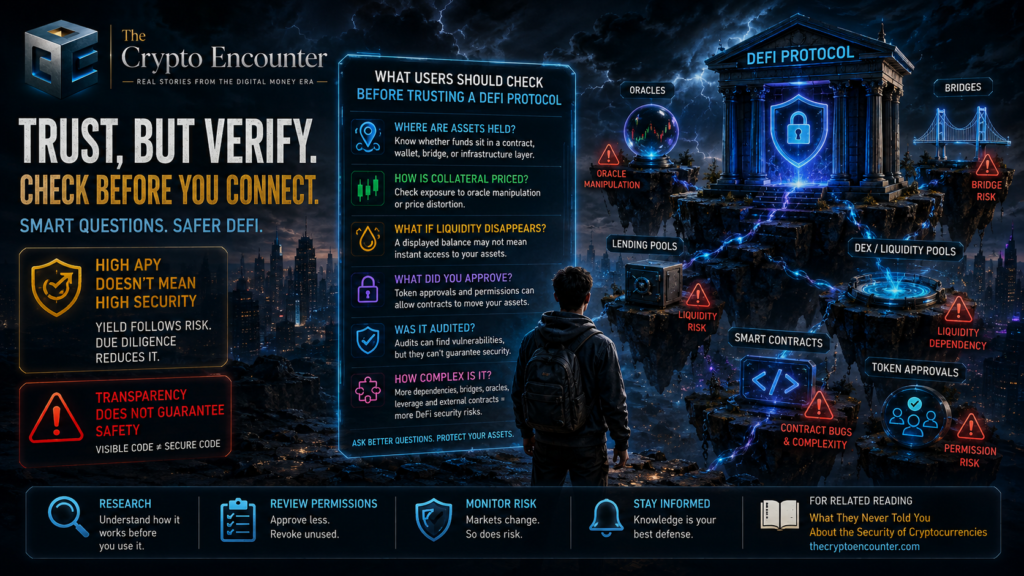
Users should also review token approvals because wallet ownership does not make every permission harmless. An audit can reveal vulnerabilities, but it cannot guarantee complete security.
Protocol complexity matters too, since bridges, oracles, leverage, and external contracts create additional dependencies. These checks are central to practical DeFi security. For related reading, explore What They Never Told You About the Security of Cryptocurrencies, which examines broader security risks facing crypto users.
Flash Loans: Key Risks at a Glance
| Risk | Why It Matters |
| Smart Contract Risk | Flawed code can expose user funds. |
| Oracle Manipulation | Distorted prices can enable exploits. |
| Liquidity Risk | Withdrawals may not always be immediate. |
| Token Approvals | Permissions can expose approved assets. |
| Protocol Complexity | More dependencies can mean more risk. |
Conclusion
Flash loans demonstrate how quickly temporary liquidity can expose weaknesses across interconnected DeFi systems. The technology has legitimate uses. However, it can amplify smart contract risk, oracle manipulation, liquidity weaknesses, and other DeFi security concerns.
Users should understand that self-custody does not eliminate protocol risk, especially when interacting with complex contracts, bridges, or lending markets. Strong DeFi security requires looking beyond attractive yields and considering how assets are held, prices are determined, permissions are granted, and liquidity is maintained.
Flash loans are therefore less a standalone threat than a reminder that decentralized finance transfers greater responsibility to users, developers, and protocol design.
FAQs
Are flash loans illegal?
The mechanism itself is not inherently illegal. Flash loans are a technical DeFi lending primitive with legitimate applications such as arbitrage and liquidity management. Whether a particular transaction violates law depends on its conduct, jurisdiction, and circumstances.
Can a flash loan itself steal my crypto?
Not automatically. The main danger comes from how temporary liquidity is used. An attacker may combine it with a vulnerable smart contract, flawed pricing mechanism, or other weakness.
Can flash loans be used for legitimate purposes?
Yes. They can support arbitrage, refinancing, collateral swaps, and other complex transactions without conventional collateral, provided the transaction satisfies the lender’s repayment conditions.
What is the biggest lesson for DeFi users?
Do not judge a protocol only by its yield, branding, or user interface. Understand the contracts, liquidity, pricing sources, permissions, and dependencies behind the product.
Disclaimer
This article is for general educational and informational purposes only. It is not financial, investment, legal, or security advice. Flash loans, smart contract risk, oracle manipulation, DeFi security, and self-custody risk involve significant and changing risks. No protocol, technology, or security practice can guarantee safety or prevent losses. Readers should conduct their own research and understand the risks before using decentralized finance or digital assets. Consider qualified professional advice when making financial decisions.