



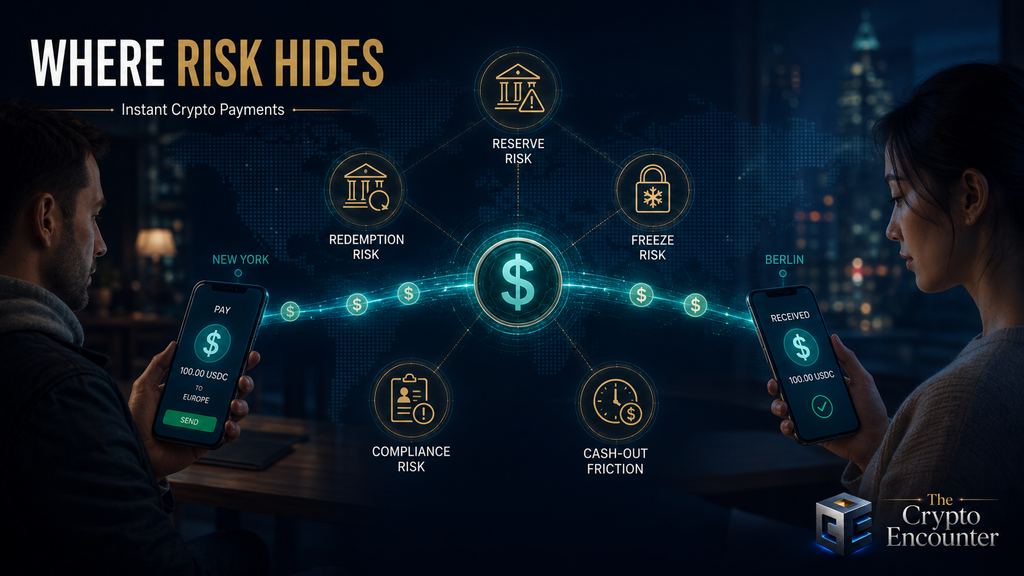
Instant crypto payments can feel almost frictionless. A sender can move a dollar-linked stablecoin across borders in minutes. A merchant can receive value without waiting days for settlement. A family can avoid some costs tied to traditional remittances. Yet instant crypto payments do not remove financial risk. Instead, they move much of that risk behind the payment screen.
The key tension is simple. A stablecoin may trade near $1 and still depend on an issuer, reserve assets, redemption rules, compliance systems, wallet providers, and blockchain infrastructure. Therefore, instant crypto payments can be fast at the transaction layer while creating slower problems when a user needs to reverse a mistake, convert tokens into bank money, challenge a freeze, or recover funds after fraud.
For everyday users, the hidden cost is not always a visible fee. Sometimes it is weaker payment protection, dependence on private issuers, or limited redemption access.
What Are Instant Crypto Payments?
Instant crypto payments are digital-asset transfers that settle quickly over a blockchain or crypto payment network. In everyday use, stablecoins are often the most practical option because they aim to maintain a stable value, usually one U.S. dollar per token.
A stablecoin is a digital token designed to track another asset. An issuer creates the token and holds reserve assets intended to support redemption. Reserves may include cash, bank deposits, short-term government securities, or other permitted liquid assets.
That structure makes instant crypto payments different from paying with a volatile asset such as Bitcoin. Users expect a dollar stablecoin to remain worth about $1 before and after a transfer. However, “stable” describes the target price. It does not guarantee that every holder can always convert one token into one dollar instantly.
In fact, BIS researchers examined 68 stablecoins and found that none maintained its peg at all times. They also concluded that stablecoin holders cannot assume full, on-demand redemption under every condition.
Why Instant Crypto Payments Appeal to Everyday Users
The attraction is real. Traditional cross-border transfers can involve several intermediaries, foreign-exchange spreads, banking-hour limits, and local payout fees. The World Bank’s Remittance Prices Worldwide service reported a global average remittance cost of 6.36% in its Q3 2025 highlight.
Meanwhile, the International Monetary Fund says stablecoins may reduce the cost and increase the speed of cross-border payments and remittances. It also notes that blockchains can simplify some of the long processing chains used in correspondent banking.
As a result, instant crypto payments can appeal to migrant workers, freelancers, online merchants, small firms, and families receiving money from abroad.
Still, a fast transfer is not automatically a cheap end-to-end payment. A user may pay to buy the stablecoin, move it on-chain, swap it, and cash it out. Exchange spreads, network fees, wallet charges, and withdrawal costs can make instant crypto payments more expensive than the blockchain fee alone suggests.
Consequently, the first hidden cost is easy to miss: blockchain speed and total payment cost are not the same thing.
Fast Settlement Does Not Mean Fast Access to Cash
One hidden cost of instant crypto payments is the gap between settlement and redemption.
Settlement means the blockchain has recorded the transfer. Redemption means the holder converts the stablecoin back into the currency or asset it represents.
Those events are different.
For example, a worker might send $300 in stablecoins to a relative abroad. The tokens could reach the recipient’s wallet within minutes. However, the recipient may still need a local exchange, bank account, compliant payment provider, or peer-to-peer market to turn those tokens into spendable local currency.
Therefore, instant crypto payments can settle quickly while cash-out remains slow, costly, or unavailable.
This distinction matters even more during market stress. The Bank for International Settlements has warned that stablecoin issuers can face liquidity pressure when users demand large redemptions and reserve assets must be sold quickly. Its 2026 research describes a mismatch between immediately redeemable stablecoins and reserve portfolios that can include assets that take more effort to liquidate.
In other words, instant crypto payments depend on the financial assets behind the token, not simply the speed of the blockchain carrying it.
Why Reserves Matter to Instant Crypto Payments
A reserve is the pool of assets intended to support a stablecoin’s value and redemptions. If an issuer promises one token for one dollar, users need confidence that enough liquid assets exist to honor that promise.
In the United States, the GENIUS Act established a federal framework for payment stablecoins. It established a federal framework for payment stablecoins. Permitted issuers must maintain qualifying reserves on at least a one-to-one basis. They must also publish reserve information, disclose redemption procedures, and provide clear information about certain purchasing and redemption fees.
Those requirements strengthen the foundation for instant crypto payments. However, reserve backing does not turn a stablecoin into an insured bank deposit.
It also does not eliminate wallet mistakes, intermediary failures, sanctions controls, operational outages, or temporary market discounts.
Moreover, reserve quality matters alongside reserve quantity. Cash and short-term government securities generally provide more immediate liquidity than assets that are harder to sell during stress.
The Federal Reserve has likewise emphasized the importance of reserve composition. Its April 2026 analysis found that stablecoins with safer and more liquid reserve structures showed lower run risk, although broader payment adoption could create new links between crypto markets and traditional finance.
Redemption Risk Can Surface at the Worst Time
Redemption risk means a holder cannot convert a stablecoin into its promised reference value as easily, quickly, or directly as expected.
This matters because many users of instant crypto payments never deal with the issuer itself. Instead, they buy and sell stablecoins through exchanges, wallets, brokers, or payment apps.
This distinction becomes even more important when users rely on custodial platforms, because your exchange balance is not the same as your crypto.
Circle’s USDC terms show why the distinction matters. Circle says direct redemption requires an eligible Circle Mint account. A person who simply holds USDC outside that system cannot automatically redeem directly with Circle unless the holder qualifies for and opens the required account.
Consequently, instant crypto payments can rely on more intermediaries than the wallet screen suggests.
Suppose an exchange suspends withdrawals. Alternatively, a local off-ramp might lose banking access. In either case, the stablecoin may continue to exist on-chain while the user’s route back to ordinary money becomes harder.
That difference between holding a token and possessing an immediate redemption channel is one of the least visible risks in everyday stablecoin use.
Freeze Powers Change the Meaning of Digital Cash
Many people imagine instant crypto payments as digital cash moving directly between two users. That comparison is incomplete for centrally issued stablecoins.
Some issuers can block blockchain addresses or freeze tokens under their terms or when law enforcement requires action. Circle states that it may block certain addresses linked to prohibited activity and may freeze associated USDC under specified circumstances.
U.S. law now reinforces this capability. The GENIUS Act requires permitted issuers to possess the technological ability to comply with lawful orders that may require stablecoins to be seized, frozen, burned, or prevented from moving.
These controls can support sanctions enforcement and financial-crime prevention. Nevertheless, they also create issuer-level control that physical cash does not have.
For an ordinary user, the issue is practical. A transfer can succeed on-chain and later face review at an exchange or wallet provider.
Therefore, instant crypto payments can be final at the blockchain layer while access to the money remains subject to compliance controls.
Compliance Can Add Friction After a Fast Transfer
The next hidden cost of instant crypto payments involves identity checks and financial-crime controls.
Know-your-customer rules require regulated firms to verify customers. Anti-money-laundering programs require financial firms to monitor specified risks. Sanctions rules can also restrict dealings with designated people, entities, or jurisdictions.
These safeguards serve legitimate public-policy goals. However, they can add time and documentation to instant crypto payments.
Imagine a freelancer receiving $2,000 in a dollar stablecoin. The transfer reaches the wallet quickly. Later, the exchange used for cash-out requests additional identity documents or source-of-funds information.
The blockchain step took minutes. Access to bank money takes longer.
The same access problem can appear at the exchange level, where crypto exchange access can change under regulatory pressure, compliance reviews, or platform restrictions.
Furthermore, compliance requirements continue to develop. In June 2026, U.S. regulators proposed customer-identification requirements for Board-supervised payment stablecoin issuers similar to those applied to supervised banks.
Accordingly, the real speed of instant crypto payments depends on the full chain: purchase, transfer, compliance review, conversion, and withdrawal.
Irreversible Transfers Shift More Responsibility to Users
Speed can also remove a useful delay.
Many blockchain transfers become irreversible once confirmed. Circle’s USDC terms state that transfers to third-party addresses are irreversible and place responsibility on users for losses caused by sending funds to an incorrect address.
That creates an important difference between instant crypto payments and many conventional consumer-payment systems.
Under U.S. electronic-fund-transfer rules, consumers can receive statutory protections for certain unauthorized transfers involving covered accounts. For qualifying cases, federal rules can limit consumer liability when the consumer reports the unauthorized activity within specified periods.
Banks and card networks may also offer dispute or reversal processes depending on the payment type and applicable rules.
A blockchain transfer does not provide a universal chargeback right.
Therefore, if a user sends stablecoins to the wrong address or authorizes a payment to a scammer, recovery can be difficult. An issuer may possess freeze capabilities, but that capability does not create a guaranteed refund.
For instant crypto payments, finality is both an efficiency feature and a consumer-protection trade-off.
Instant Crypto Payments vs Traditional Electronic Payments
| Feature | Stablecoin payment | Traditional bank or card payment |
|---|---|---|
| Transfer speed | Often minutes or seconds on-chain | Near-instant to several business days |
| Value | Usually designed to track fiat currency | Already denominated in fiat currency |
| Reversal | Often difficult or impossible on-chain | Dispute or reversal rights may exist |
| Cash-out | May require an exchange or off-ramp | Usually already inside the banking system |
| Freeze risk | Issuer or intermediary may freeze in some cases | Banks can also restrict accounts under law |
| Consumer protection | Varies by structure and jurisdiction | May include statutory or network protections |
| Redemption dependency | Issuer and off-ramp access matter | Normally unnecessary for domestic fiat funds |
The comparison shows why instant crypto payments should not be judged by speed alone.
A stronger test asks three questions: What happens before the payment? What happens after it? Finally, what happens when something goes wrong?
Remittances Show the Benefit and the Trade-Off
Remittances remain one of the strongest potential use cases for instant crypto payments.
A worker can send a dollar-linked token directly to a family member without waiting for a long correspondent-banking chain. In places where conventional remittance costs remain high, that can matter.
Nigeria provides a practical example. In June 2026, the IMF reported that stablecoins had become a meaningful cross-border channel there. It said households and small businesses were using smartphones, wallets, and dollar-pegged tokens to reduce payment friction. At the same time, the IMF highlighted monetary, regulatory, and currency-substitution concerns.
Yet several household-level costs may remain.
The sender may pay to acquire the stablecoin. Next, the network may charge a transaction fee. The recipient may lose money through an exchange spread. Finally, converting the token into local currency may require another service provider.
Thus, instant crypto payments can solve one layer of the remittance problem without solving every layer.
The important comparison is not simply stablecoin versus bank transfer. It is the full amount that leaves the sender’s account versus the amount the recipient can actually spend.
Cheap Instant Crypto Payments Can Still Have an Indirect Price
Another cost rarely appears on the payment screen.
Stablecoin issuers may earn interest on reserve assets such as short-term U.S. Treasury securities. Ordinary holders may not receive that income.
Circle’s USDC terms, for example, state that holders are not entitled to interest or other returns earned on reserve assets.
Economically, the arrangement is straightforward. Users receive a token designed to preserve a dollar value and move easily. Meanwhile, the issuer may earn income from the assets backing those tokens.
That does not make instant crypto payments inherently unfair. Issuers also face technology, regulatory, staffing, custody, and compliance costs.
Still, it shows why apparently cheap instant crypto payments can have an indirect business model.
In effect, low transaction friction may coexist with reserve income that flows to the issuer rather than the holder.
How to Evaluate Instant Crypto Payments Before Using Them
Before relying on instant crypto payments for wages, savings, remittances, or business revenue, check more than the token’s market price.
First, identify the issuer and review the reserve assets. Next, read the redemption policy. Find out whether ordinary wallet holders can redeem directly or must use an exchange.
Then, review freeze, blocklist, and compliance terms.
After that, calculate the full cost. Include purchase fees, network charges, exchange spreads, conversion costs, withdrawal fees, and local banking charges.
Finally, ask what happens if the payment goes wrong. Is there customer support? Can the provider review fraud? Can an intermediary freeze funds before they move again? Does any dispute process apply?
These questions turn instant crypto payments from a speed comparison into a payment-risk assessment.
For larger or recurring transfers, users should also consider whether they are comfortable depending on one issuer, wallet, exchange, blockchain, or local off-ramp.
What Regulation Can Fix About Instant Crypto Payments
Regulation can reduce several risks.
The U.S. GENIUS Act requires permitted issuers to maintain qualifying reserves, publish reserve composition, disclose redemption procedures, and provide fee disclosures. It also subjects permitted issuers to a clearer regulatory and anti-money-laundering framework.
However, regulation cannot eliminate every hidden cost of instant crypto payments.
A regulated stablecoin can still go to the wrong address. A private key can still be lost. An exchange can still suffer an outage. A recipient can still face local off-ramp problems.
Moreover, legal protections vary across borders.
The IMF has warned that stablecoins can improve cross-border payments while simultaneously creating fragmentation, capital-flow, financial-integrity, and currency-substitution risks.
Consequently, instant crypto payments may cross borders more easily than the legal protections attached to them.
That gap matters because stablecoins are global instruments operating through national legal systems.
Conclusion: Instant Crypto Payments Are Fast, but Risk Still Travels With Them
Instant crypto payments can make everyday transfers faster, more accessible, and potentially cheaper, especially across borders. Stablecoins also reduce the price volatility that makes many other crypto assets difficult to use for ordinary payments.
Still, speed can hide important trade-offs. Issuer risk, reserve quality, redemption access, freezes, compliance reviews, irreversible transfers, cash-out costs, and uneven consumer protections shape the real experience of instant crypto payments.
For households and businesses, the best question is not simply, “How fast did the token arrive?” A better question is, “Can I safely use, redeem, recover, and account for this money after it arrives?”
That is the hidden cost of instant crypto payments: the transfer may be instant, but trust, protection, and access still depend on the financial system around it.
FAQs
Are instant crypto payments actually instant?
The blockchain transfer can settle within seconds or minutes. However, converting a stablecoin into local bank money may take longer because exchanges, compliance reviews, banking rails, and withdrawal systems operate separately.
Are stablecoin payments safer than Bitcoin payments?
Stablecoins reduce price volatility because they aim to track assets such as the U.S. dollar. However, they introduce other risks, including issuer dependence, reserves, redemption rules, freezes, and compliance controls.
Can a stablecoin issuer freeze my money?
Some centrally issued stablecoins include technical freeze or blocklist functions. Issuers may use them under their terms or to comply with lawful orders. The exact powers depend on the stablecoin and jurisdiction.
Can I reverse a stablecoin payment sent to the wrong wallet?
Usually not at the blockchain level. Many transfers become irreversible after confirmation. Recovery may depend on the recipient, exchange, issuer, or law enforcement, and none of those routes guarantees recovery.
Are instant crypto payments cheaper for remittances?
They can be. However, users should compare the complete cost, including stablecoin purchase fees, blockchain fees, exchange spreads, off-ramp costs, and local currency conversion.
Are stablecoins the same as money in a bank account?
No. A stablecoin may track the value of bank money, but the legal structure, redemption process, consumer protections, issuer dependence, and access arrangements can differ significantly.