

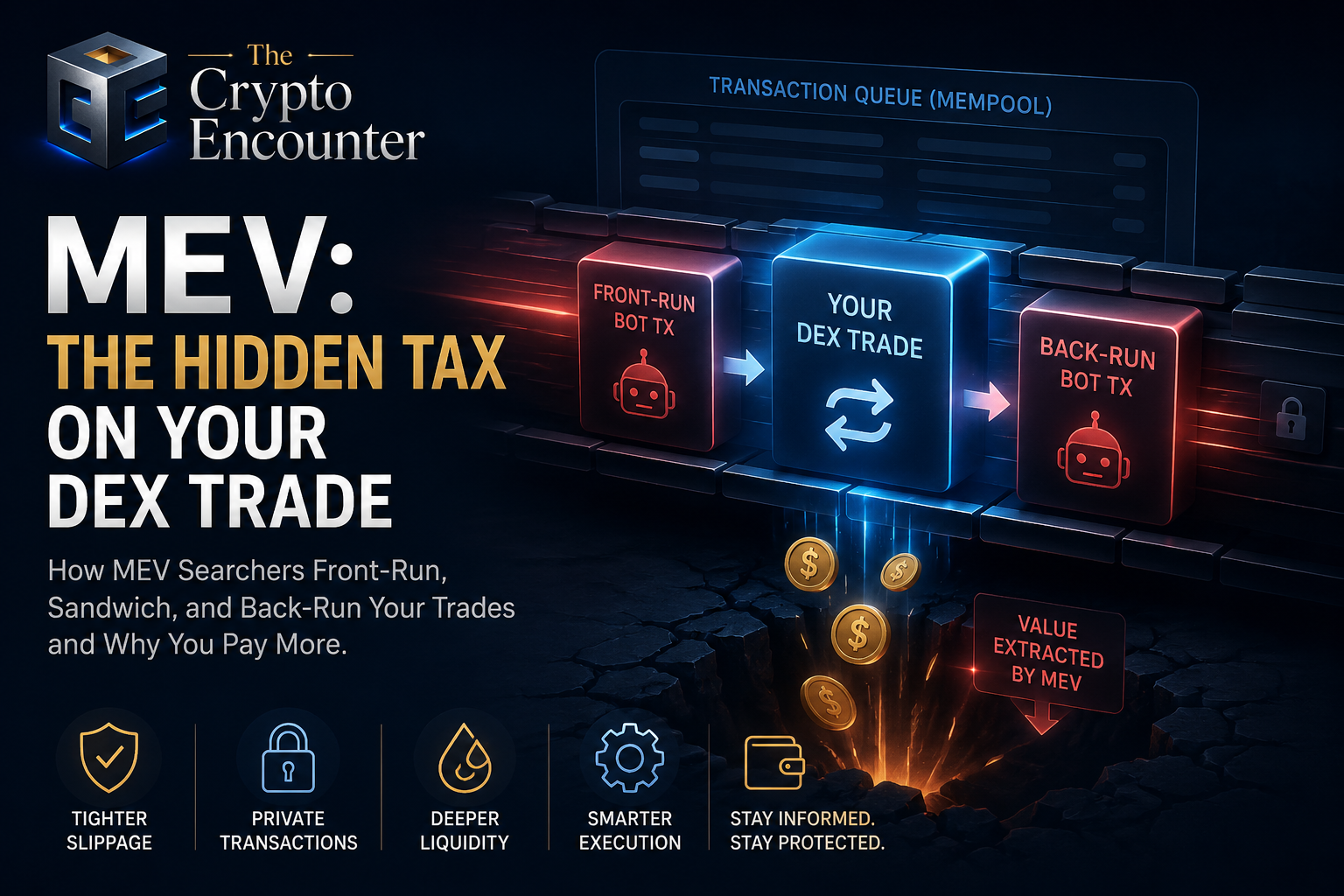
A decentralized exchange can let you trade directly from your wallet, without handing custody of your crypto to a centralized company. However, self-custody does not mean every trade receives fair execution. MEV can allow sophisticated actors to extract value from transactions before they settle. As a result, an ordinary DEX user may receive fewer tokens than expected even though the smart contract works exactly as designed.
MEV, short for maximal extractable value, comes from the ability to profit by controlling or exploiting transaction ordering inside blockchain blocks. Therefore, understanding MEV matters for anyone using decentralized exchanges. The risk highlights a broader DeFi tension: removing corporate custody gives users more control, but it also shifts more responsibility for execution, liquidity, approvals, and transaction protection onto the user.
Key Facts About MEV
| Question | Plain-English Answer |
|---|---|
| What is MEV? | Value extracted by strategically including, excluding, or ordering blockchain transactions. |
| Who searches for it? | Automated actors commonly called MEV searchers. |
| Why can DEX users lose value? | Pending swaps can reveal profitable opportunities before settlement. |
| What is a sandwich attack? | A searcher trades before and after a user’s swap to profit from the price movement. |
| Is every form of MEV harmful? | No. Arbitrage and liquidations can help markets and protocols function, although some strategies directly worsen user execution. |
| Can users remove the risk completely? | No single method eliminates every form of MEV, but private transaction routing, tighter slippage controls, deeper liquidity, and protected execution can reduce exposure. |
Ethereum defines maximal extractable value as value captured beyond standard block rewards and gas fees by including, excluding, or changing the order of transactions in a block. Searchers often identify these opportunities, while block builders and validators participate in the transaction-ordering process that makes extraction possible.
Why MEV Can Feel Like a Hidden Tax on a DEX Trade
Calling MEV a “hidden tax” is a metaphor. No government collects it, and no protocol automatically labels it as a fee. Still, the comparison helps explain the user experience.
Imagine that a DEX interface shows an expected return of 100 tokens for your swap. You submit the transaction with enough slippage tolerance to accept slightly worse execution. Before the transaction settles, another actor detects it and trades first. Your swap then executes at a less favorable price.
Suppose you receive 98.5 tokens instead of the original 100-token estimate. The 1.5-token difference does not automatically equal the attacker’s profit because liquidity fees, normal price movement, gas, and market conditions can also affect execution. However, a sandwich strategy can deliberately capture part of the economic value created by your willingness to accept a worse price.
Consequently, the DEX may have charged its stated fee correctly while your effective trading cost was still higher. That gap is why MEV can remain invisible to users who only look at the protocol fee.
Ethereum’s documentation specifically notes that sandwich trading can increase slippage and produce worse execution for affected users. Uniswap Labs likewise explains that a sandwiched user can receive fewer tokens because an attacker places one transaction before the user’s trade and another after it.
How MEV Works Before Your DEX Trade Settles
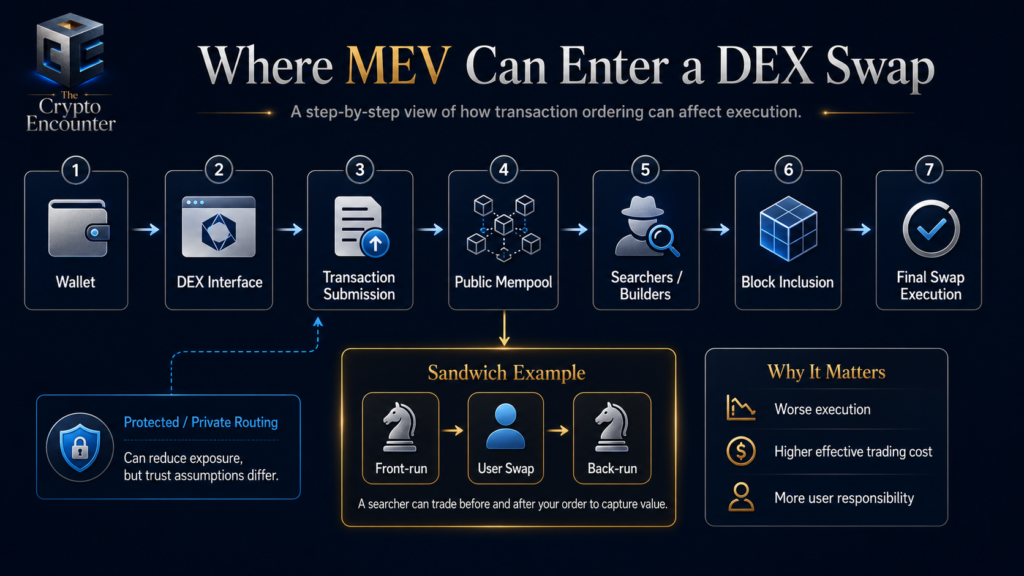
To understand MEV, first consider what happens between pressing “Swap” and seeing the completed transaction.
On Ethereum, transactions may enter a public mempool before block inclusion. A mempool is essentially a waiting area for pending transactions. Because the data can be visible before settlement, automated searchers can inspect the transaction and calculate whether its size, slippage tolerance, or interaction with available liquidity creates a profitable opportunity.
The searcher does not need to steal your private key. Instead, it can use information that your transaction has already exposed.
That distinction matters. MEV is often an execution problem rather than a traditional account compromise.
MEV Searchers
MEV searchers use automated systems to identify profitable transaction-ordering opportunities.
Searchers may identify price differences between exchanges, liquidation opportunities in lending protocols, or trades that could support a profitable sandwich. They can then submit transactions or bundles designed to capture that value. Ethereum notes that competitive MEV opportunities can lead searchers to pay significant priority fees because transaction ordering determines who captures the opportunity.
Front-Running
Front-running happens when another transaction gets positioned before a target transaction to benefit from information contained in that pending trade.
For example, a bot may detect that a large purchase will push a token’s price higher. It can attempt to buy first, before the user’s purchase changes the pool price.
Back-Running
Back-running places a transaction directly after another transaction.
Not every back-run harms the original trader. For example, an arbitrageur may trade after a large swap to restore a price difference between markets. In fact, Ethereum notes that DEX arbitrage can help keep prices aligned across decentralized markets.
That distinction is essential because MEV describes a broader economic phenomenon. It does not automatically mean theft or malicious activity.
Sandwich Attacks Turn MEV Into a Direct User Cost
Sandwich attacks create one of the clearest examples of harmful MEV.
The sequence is simple.
A user submits a swap. A searcher detects it. The searcher buys the same asset first, moving the pool price against the user. Next, the user’s transaction executes at the worse price. Finally, the searcher sells after the user’s transaction and attempts to capture the price movement.
The victim’s trade sits between the searcher’s two transactions, which explains the term “sandwich.” Uniswap’s description of the attack confirms this basic sequence and notes that transaction transparency and slippage make the strategy possible.
Large trades can become particularly attractive when they materially move the price of a liquidity pool. Meanwhile, low-liquidity pools can make relatively smaller trades influential because less capital sits on the other side of the transaction. Therefore, trade size alone does not determine MEV exposure. Liquidity depth also matters.
Why Slippage Matters for MEV
Slippage tolerance tells a DEX how far the execution price may move before the transaction should fail.
Some flexibility is useful. Without it, ordinary market movement could cause many swaps to revert.
However, very wide slippage can also give a sandwich searcher more room to manipulate execution while keeping the user’s transaction valid. Uniswap Labs advises that tighter slippage settings can make sandwich strategies less profitable, although settings that are too restrictive can increase the chance of failed transactions.
Therefore, higher slippage is not simply a convenience setting.
It can represent economic permission.
If you tell a smart contract that you will accept a significantly worse price, the contract may execute within those rules. It does not judge whether another participant caused the price deterioration.
That is one of the most important lessons about MEV: code can execute correctly while the user still receives a poor economic outcome.
MEV Shows the Real Trade-Off Behind Self-Custody
DEXs remove an important category of platform risk. Users generally do not have to deposit their assets into a centralized exchange account before every trade. Instead, they can interact with smart contracts from wallets they control.
Yet control does not eliminate risk. It changes where risk sits.
With decentralized trading, users instead face risks involving smart contracts, token approvals, malicious interfaces, liquidity conditions, transaction ordering, wallet security, and their own execution settings. Our deeper guide to crypto security risks explains why a secure blockchain does not automatically make every wallet, exchange, or DeFi interaction safe.
MEV belongs to that second group.
Your wallet can remain fully secure while a trade still receives worse execution. Likewise, the DEX contract can function exactly as intended while an external searcher captures value around the transaction.
As a result, self-custody should not be confused with execution protection.
Private Transactions Can Reduce MEV, but They Add Another Trust Layer
One common defense against MEV is to keep a pending swap away from the public mempool.
The same privacy-versus-transparency tension is appearing elsewhere in confidential DeFi, where protocols are exploring ways to protect balances, transaction amounts, and financial strategies from public visibility.
Private transaction systems can send a transaction toward builders through non-public infrastructure. Flashbots Protect, for example, describes itself as a way to protect Ethereum users against front-running. MEV Blocker similarly offers private RPC infrastructure designed to protect transactions from strategies such as sandwiching and front-running.
However, this solution reveals another DeFi trade-off.
A private transaction may hide information from public searchers, yet the transaction still passes through private infrastructure. Research published by Uniswap Labs notes that private RPC systems introduce trust relationships involving RPC providers, relayers, and block builders because those parties may gain access to transaction information unavailable to the public mempool.
Therefore, MEV protection does not necessarily remove trust. In some designs, it relocates trust.
That point often disappears from simplified advice telling users to “use a private RPC.”
Can MEV Ever Help DeFi?
Yes. Some MEV performs an economically useful function.
Arbitrageurs can identify price differences between decentralized exchanges and trade until those prices move closer together. Lending protocols also rely on liquidators to act when undercollateralized positions cross predefined thresholds. Ethereum identifies both DEX arbitrage and liquidations as established MEV opportunities.
Accordingly, eliminating every incentive associated with MEV could create other problems.
The more useful question is who receives the value and whether the process harms an ordinary user’s execution.
Arbitrage that corrects a stale market price differs economically from a sandwich attack designed around a specific pending user’s tolerance. Both may fall under MEV, but their consequences are different.
How Users Can Reduce MEV on DEX Trades
No single setting guarantees protection. Nevertheless, users can reduce exposure in several practical ways.
First, check whether the wallet, DEX interface, or aggregator offers protected or private transaction routing. Uniswap, for example, says its Ethereum swap protection routes transactions through a private transaction pool and uses Flashbots Protect.
Second, review slippage instead of automatically accepting an unusually wide tolerance. Tighter limits reduce the amount of adverse movement a transaction will accept. However, extremely narrow limits can cause swaps to fail during volatile conditions.
Third, pay attention to liquidity. Deeper pools generally experience less price movement from a given trade than thin pools. Consequently, low-liquidity token pairs can create a larger execution-risk surface. Uniswap specifically recommends prioritizing deeper liquidity when trying to reduce exposure to harmful MEV strategies.
Fourth, compare the expected quote with the minimum amount received before confirming the transaction. That number shows how bad execution may become while the swap still remains valid.
Finally, consider execution models that compete for the user’s order rather than immediately exposing a standard swap to a public mempool. Intent-based systems and batch-auction designs attempt to change who competes for transaction value and how that value reaches the user, although their architectures and trust assumptions differ.
MEV Is Only One Layer of DEX Risk
Understanding MEV should not distract users from other decentralized-finance risks.
A protected transaction cannot repair a vulnerable smart contract. Tight slippage does not make a malicious token safe. Private routing cannot recover a leaked seed phrase. Likewise, sandwich protection does not automatically protect users who grant dangerous token approvals.
Therefore, DEX risk should be viewed as a stack.
Custody is one layer. Smart contracts are another. Liquidity creates another. Wallet permissions matter too. Finally, transaction ordering adds the MEV layer.
A decentralized system can reduce reliance on a company while simultaneously increasing the number of technical decisions an individual must understand.
That is the deeper tension behind MEV.
What MEV Means for Ordinary DEX Users
MEV matters because the visible swap fee does not always represent the full economic cost of decentralized trading.
A user may pay the stated protocol fee and network fee, yet still lose additional value through adverse transaction ordering. At the same time, some forms of MEV help decentralized markets maintain prices or liquidate unhealthy positions. Therefore, the term should not become a blanket label for every bot or arbitrage trade.
For ordinary users, the practical lesson is simpler. Before approving a DEX transaction, look beyond the advertised fee. Check liquidity, slippage, minimum received, execution method, and whether the transaction receives protection before reaching the public mempool.
Self-custody gives users direct control over their assets. However, direct control also means taking greater responsibility for how those assets interact with open markets.
MEV makes that responsibility visible.
FAQs
What does MEV mean in crypto?
MEV means maximal extractable value. It refers to value that participants can capture by strategically including, excluding, or ordering blockchain transactions. On DEXs, MEV can appear through strategies such as arbitrage, front-running, back-running, and sandwich attacks.
Is MEV the same as a DEX fee?
No. A DEX fee is an explicit charge defined by the protocol or liquidity pool. MEV comes from transaction ordering and related market opportunities. Calling it a “hidden tax” describes its economic effect on some users, not a literal protocol or government tax.
Can a sandwich attack steal tokens from my wallet?
A typical sandwich attack does not require the attacker to obtain your private key. Instead, the attacker attempts to manipulate trade ordering around a pending swap so that you receive worse execution while the attacker profits from the surrounding transactions.
Does lower slippage stop MEV?
Lower slippage can reduce the room available for certain sandwich strategies, but it does not eliminate all MEV. Setting tolerance too low may also cause swaps to fail when market prices move quickly.
Are private RPCs completely safe from MEV?
Private routing can reduce exposure to public-mempool front-running and sandwiching. However, private transaction infrastructure may introduce trust in RPC providers, relayers, or builders that receive non-public transaction information. Users should understand the specific system they use.
Is all MEV harmful?
No. Ethereum notes that DEX arbitrage can help keep prices aligned across markets, while lending protocols rely on timely liquidations. However, sandwich attacks directly worsen execution for targeted users.
Conclusion
MEV exposes a cost of decentralized trading that many users never see on the swap-confirmation screen. Although a DEX can remove centralized custody, it cannot automatically remove transaction-ordering risk, liquidity risk, smart contract risk, or user error.
For that reason, MEV should form part of every trader’s understanding of onchain execution. Check slippage. Examine liquidity. Review the minimum amount received. Understand whether the interface uses public or protected transaction routing. Most importantly, remember that self-custody transfers control to the user together with more responsibility.
MEV is the hidden tax only when users cannot see where the value is going. Understanding the mechanism makes that cost easier to identify, evaluate, and reduce.
Disclaimer
This article is for informational and educational purposes only. It does not provide financial, investment, legal, tax, or accounting advice. Cryptocurrency and digital asset markets involve risk, including possible loss of capital. Readers should conduct their own research before making any financial decision.