

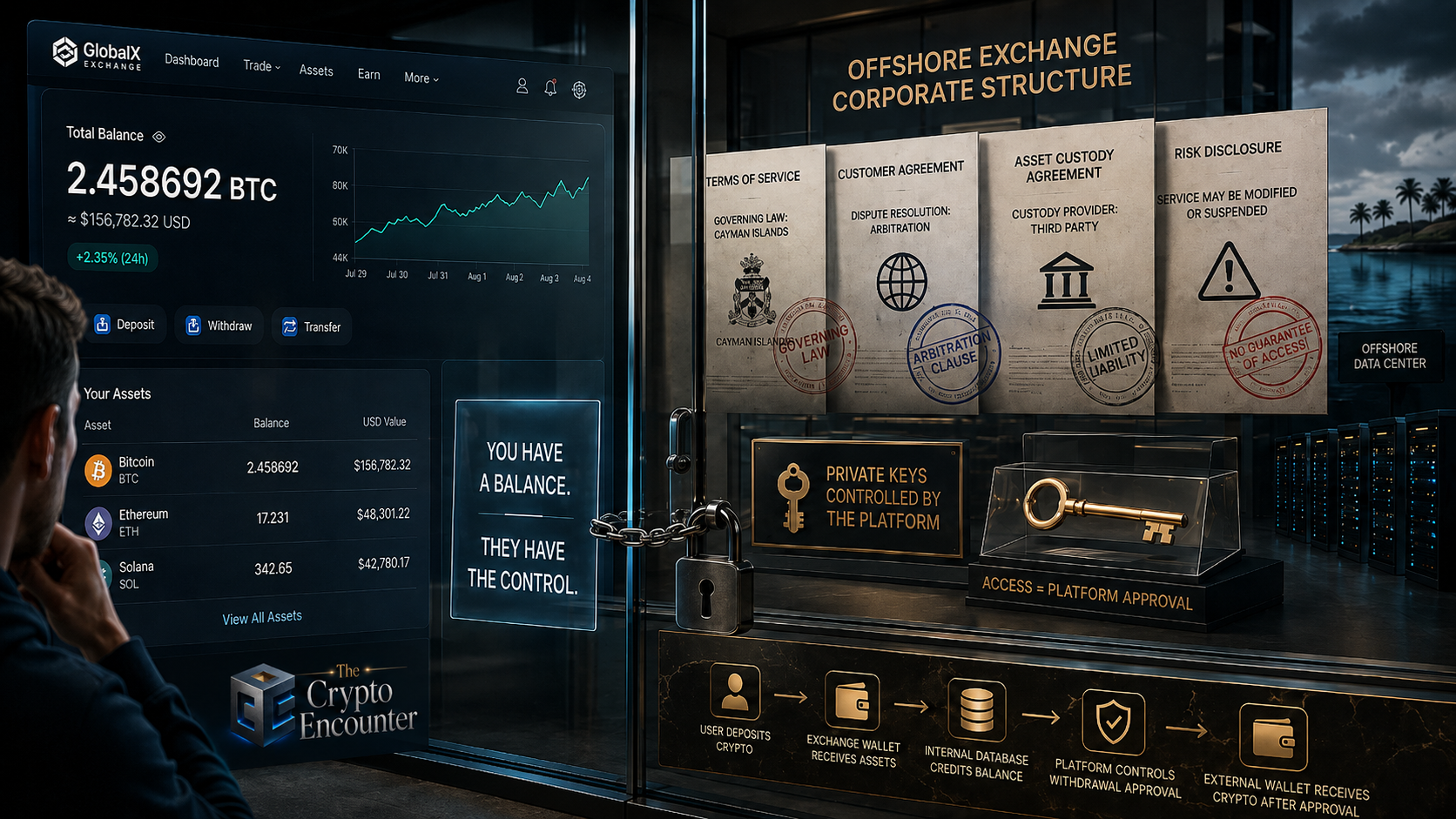
A crypto exchange balance looks like money in a personal account. However, the screen does not prove that users control the underlying assets. In most cases, the platform controls the wallets, private keys, withdrawal systems, compliance checks, and records that determine who receives what. Therefore, the offshore exchange problem begins with a simple misunderstanding: an account balance shows a claim against a platform, while direct ownership requires control over the crypto itself.
This difference matters when withdrawals stop, a company becomes insolvent, regulators intervene, or an exchange disputes a transaction. At that point, users may discover that access depends on contractual terms, corporate structure, local law, and the platform’s financial condition. This article explains the offshore exchange problem, how custody changes control, and what users should check before leaving significant funds on any trading platform.
TL;DR
- A displayed balance does not always equal direct control of crypto.
- Custodial exchanges hold the private keys and process withdrawals.
- Offshore structures can make regulation, legal claims, and asset recovery more complicated.
- Exchange terms often permit withdrawal delays, account restrictions, or service suspensions.
- Proof-of-reserves information does not automatically prove solvency.
- Users should treat exchanges as transaction venues, not automatically as long-term vaults.
Key Facts About the Offshore Exchange Problem
| Issue | What users may assume | What can happen in practice |
|---|---|---|
| Account balance | The coins sit in a personal wallet | The exchange may record an internal claim while controlling the blockchain wallet |
| Withdrawals | Funds remain available on demand | Compliance reviews, security incidents, maintenance, liquidity pressure, or legal orders may delay access |
| Regulation | The app is available, so it must be locally approved | A platform may serve users across borders without the same protections as a locally licensed institution |
| Solvency | Proof of assets means the exchange is financially safe | Liabilities, loans, collateral obligations, and related-party exposure may remain unclear |
| Bankruptcy | Customers simply receive their coins back | Local insolvency law may determine whether users own assets or hold creditor claims |
| Disputes | A local court or regulator will help | The contract may identify a foreign entity, foreign governing law, or overseas dispute process |
What Is the Offshore Exchange Problem?
The offshore exchange problem arises when a crypto platform serves customers outside the jurisdiction where its operating entity, licenses, assets, management, or legal agreements sit.
Being offshore does not automatically make an exchange dishonest or unsafe. International financial businesses often use entities in several countries. Nevertheless, the structure can increase uncertainty because the user, the exchange company, the custody provider, the regulator, and the relevant court may all exist in different places.
The Financial Action Task Force (FATF) guidance on virtual asset service providers explains how regulators approach cross-border crypto businesses and why offshore structures can complicate supervision.
The Financial Action Task Force defines an offshore virtual asset service provider as a provider formed under one jurisdiction’s laws that offers services to customers in another jurisdiction, whether or not it has a meaningful physical presence where it was formed. FATF has warned that offshore providers can create supervisory challenges, especially when jurisdictions apply inconsistent licensing and enforcement standards.
Consequently, the offshore exchange problem is less about geography alone and more about fragmented responsibility. Users may know the platform’s brand name but not the legal entity that owes them money.
Why Your Exchange Balance Is Not the Same as Wallet Control
When crypto enters a self-custody wallet, the person controlling the private key can authorize blockchain transactions. By contrast, when crypto enters a custodial exchange, the platform normally controls the operational wallets and private keys.
The user receives an account entry. That entry may show “1 BTC,” but the exchange decides when and how a withdrawal request becomes an on-chain transaction.
This arrangement offers convenience. For example, customers can trade quickly without paying a blockchain fee for every internal transaction. They can also use password recovery, customer support, limit orders, and fiat payment services.
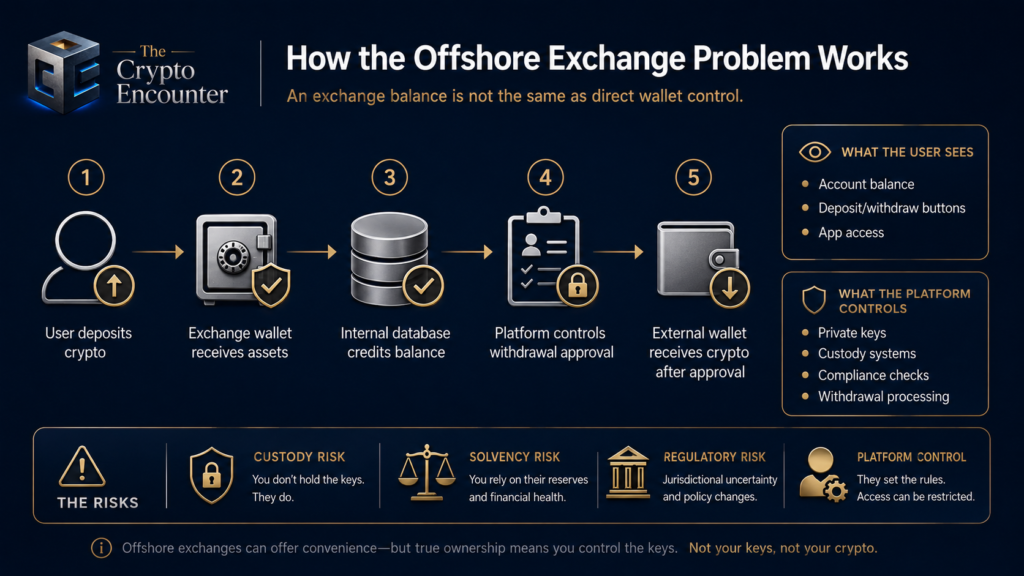
The offshore exchange problem begins when users mistake an exchange balance for direct ownership. Although the balance appears in the account immediately, the platform still controls the wallets, private keys, compliance checks, and withdrawal approval process
However, convenience creates dependency. The offshore exchange problem becomes visible because the customer needs several systems to work at once:
- The exchange must recognize the account balance.
- Its wallet infrastructure must remain secure.
- The company must hold enough accessible assets.
- Its compliance system must approve the withdrawal.
- No court, regulator, or sanctions authority may block the transfer.
- The platform must continue operating in the user’s jurisdiction.
Therefore, an exchange balance represents access under certain conditions. It does not provide the same technical control as a private wallet.
The Offshore Exchange Problem Hidden in Withdrawal Terms
Most users read deposit instructions more carefully than legal terms. Yet withdrawal clauses often reveal how much control the platform retains.
For example, OKX’s published terms state that users may request withdrawals, but the company may decline a request when applicable laws prevent it. The terms also say OKX may suspend withdrawals when it considers suspension appropriate to resolve incidents on the platform.
Similarly, regional Binance terms state that the platform may not process a withdrawal when it reasonably believes applicable law prevents execution. Some regional terms also say the company does not commit to a particular timeline for transferring assets to a user’s representatives.
Such clauses do not prove that an exchange will misuse customer funds. Platforms need tools to respond to hacking, fraud, sanctions, court orders, account takeovers, and technical faults. Still, the language confirms a crucial part of the offshore exchange problem: the customer cannot independently force the platform to broadcast a withdrawal.
The button belongs to the user. The transaction system belongs to the exchange.
Custody Risk: Who Actually Controls the Crypto?
Custody risk means the possibility that the party holding an asset cannot or will not return it when requested.
Readers who want a broader understanding of exchange and wallet security can also read our guide, What They Never Told You About the Security of Cryptocurrencies.
Several events can create that outcome:
- A hacker steals wallet assets.
- Employees misuse customer funds.
- The exchange lends or pledges assets.
- A banking partner freezes fiat reserves.
- A regulator restricts operations.
- A platform becomes insolvent.
- An account enters a compliance review.
- A technical failure stops withdrawals.
Although these events have different causes, they produce the same immediate result for the customer: a balance remains visible, but the assets cannot leave.
The offshore exchange problem intensifies when several corporate entities handle different parts of the service. One company may operate the website. Another may hold customer assets. A third may issue a card or provide derivatives. Meanwhile, the terms may assign the customer relationship to an entity unfamiliar to the user.
Before depositing, customers should identify the exact contracting company. They should also check its registered address, regulator, licensing status, custody terms, and dispute jurisdiction.
How FTX Exposed the Difference Between Balances and Assets
The collapse of FTX provides the clearest public example of why internal balances cannot prove that an exchange safely holds customer assets.
The U.S. Securities and Exchange Commission alleged that FTX customer funds were diverted to Alameda Research and used for trading, investments, real estate purchases, and other spending. The SEC also alleged that software gave Alameda special privileges despite public assurances that the exchange used sophisticated protections.
FTX users could view balances before the collapse. Nevertheless, the existence of those numbers did not establish that matching assets remained safely available.
This case illustrates the offshore exchange problem at its worst. Customers interacted with a global brand, while the corporate structure included entities across multiple jurisdictions. Once the business failed, users faced bankruptcy proceedings, asset tracing, legal claims, and long recovery timelines instead of ordinary withdrawals.
FTX involved alleged and later prosecuted misconduct, so it should not serve as proof that every offshore exchange behaves similarly. Even so, it demonstrates the structural weakness of relying entirely on records maintained by the same institution that controls the assets.
Solvency Risk Is Different From Custody Risk
Custody risk asks whether an exchange can return specific assets. Solvency risk asks whether the company owns enough assets to meet all its obligations.
The two risks overlap, although they are not identical.
An exchange could protect wallets from hackers yet still owe more than it owns. Alternatively, it could remain financially solvent but temporarily stop withdrawals after a security incident.
That distinction matters when evaluating the offshore exchange problem. A platform may publish wallet addresses or proof-of-reserves data. However, asset visibility alone does not answer every financial question.
A meaningful solvency assessment also needs information about:
- Customer liabilities
- Corporate debt
- Loans secured by customer or company assets
- Derivative obligations
- Assets held with third parties
- Related-party transactions
- Token valuations
- Off-balance-sheet commitments
A reserve snapshot may show assets at one moment. To understand how wider economic conditions can also affect institutional liquidity and investor behaviour, see Why Bitcoin Moves With the Fed. Nevertheless, it may not show the complete liability side of the balance sheet. Therefore, users should avoid treating proof of reserves as a substitute for an independent financial audit.
Regulation Does Not Follow the App Across Borders
Many customers assume that access to an exchange app means the platform can lawfully serve them. However, online availability does not necessarily confirm local authorization.
In 2023, the U.S. Commodity Futures Trading Commission charged Binance and related parties with operating an illegal digital asset derivatives exchange and willfully evading U.S. law. The CFTC alleged that Binance served U.S. customers while failing to meet registration and compliance requirements. Binance later reached resolutions with U.S. authorities.
Separately, Binance pleaded guilty to federal charges and agreed to a resolution involving approximately $4.3 billion in penalties. The U.S. Department of Justice said the case involved anti-money-laundering, unlicensed money-transmitting, and sanctions violations.
These proceedings did not allege that every Binance customer balance was missing. Instead, they reveal another layer of the offshore exchange problem. A platform can build an international customer base while regulators dispute whether it lawfully entered particular markets.
When that conflict becomes serious, users may face product restrictions, new identity checks, forced account migrations, withdrawal deadlines, or loss of access to certain services.
What Happens When an Offshore Exchange Freezes Withdrawals?
A withdrawal freeze can begin for legitimate reasons. For instance, an exchange may pause transfers during wallet maintenance or after detecting an attack. Short suspensions do not always indicate insolvency.
However, users usually cannot see the real cause immediately. As a result, the offshore exchange problem becomes an information problem as well as a custody problem.
Consider four possible scenarios.
Scenario 1: A Technical Suspension
The exchange detects a wallet fault and pauses one blockchain network. Trading may continue internally, while withdrawals resume after repairs.
Scenario 2: An Account-Specific Review
A compliance system flags unusual activity. The exchange requests identity documents or a source-of-funds explanation. Meanwhile, the user cannot withdraw.
Scenario 3: A Regulatory Restriction
A regulator or court orders the exchange to block certain customers, assets, or regions. The company may have little choice but to comply.
Scenario 4: A Solvency Crisis
The platform lacks enough liquid assets to honor withdrawal requests. It delays transfers while seeking financing, selling assets, or restructuring.
At first, all four scenarios may look similar on the customer’s screen. Each shows a pending or rejected withdrawal. Yet the potential outcomes differ dramatically.
Therefore, users should monitor more than status-page explanations. They should also watch for repeated delays, changing terms, executive departures, banking disruptions, unusual transfer limits, and unclear answers about liabilities.
The Offshore Exchange Problem During Bankruptcy
Bankruptcy replaces the exchange’s normal rules with an insolvency process. At that stage, the legal classification of customer assets becomes critical.
Several questions may determine recovery:
- Did the company hold assets in trust for customers?
- Were customer assets segregated from corporate funds?
- Can the exchange identify each customer’s holdings?
- Did the terms transfer title or permit lending?
- Which entity accepted the deposit?
- Which country’s insolvency law applies?
- Does the customer own specific crypto or only a monetary claim?
The answers can affect whether someone receives assets directly, files as a creditor, or waits for a court-approved distribution.
Moreover, crypto prices may move significantly during proceedings. Even when customers eventually recover substantial value, they may not receive the same assets, at the same time, or under the same valuation method they expected.
Thus, the offshore exchange problem can turn a simple withdrawal request into a cross-border legal claim.
How to Read Exchange Terms Without Reading Every Line
Legal agreements are long. Still, users can focus on a small number of clauses before depositing meaningful value.
1. Contracting Entity
Find the complete legal name of the company providing the service. A brand name alone offers limited information.
2. Governing Law
Check which country’s law governs the agreement. Then identify where disputes must be filed or arbitrated.
3. Custody and Ownership
Look for terms such as custody, beneficial ownership, title, trust, segregation, omnibus wallet, and customer assets.
4. Withdrawal Rights
Review when the exchange may delay, reject, cap, or suspend withdrawals.
5. Asset Use
Check whether the platform may lend, stake, pledge, transfer, rehypothecate, or otherwise use deposited assets.
6. Insolvency Treatment
Search for language explaining what may happen if the company, custodian, or banking partner fails.
7. Account Closure
Identify whether the exchange can terminate access without notice and how remaining assets will be returned.
This targeted review will not eliminate the offshore exchange problem. However, it can reveal whether the service matches the user’s risk tolerance.
Practical Ways to Reduce the Offshore Exchange Problem
No checklist can guarantee safety. Even regulated institutions can fail, while self-custody introduces private-key theft, device loss, phishing, and inheritance risks.
Nevertheless, users can reduce concentration and access risk.
First, keep only the amount needed for trading or near-term activity on an exchange. Next, test withdrawals before transferring a larger balance. Users should also enable strong multi-factor authentication and verify withdrawal addresses carefully.
Furthermore, avoid depending on one platform for every activity. A second verified route for buying or selling crypto may help when one provider faces disruption.
For long-term holdings, consider whether self-custody fits your technical ability. A private wallet offers direct control, although it also removes the possibility of password recovery or customer support reversing mistakes.
Finally, save account records, deposit confirmations, transaction IDs, and copies of relevant terms. These records may become important during a dispute or insolvency process.
The Real User Responsibility
Crypto platforms often present seamless interfaces. As a result, custody can feel invisible. Yet every deposit creates a decision about control.
Users do not need to reject centralized exchanges entirely. Exchanges offer liquidity, fiat access, trading tools, and convenience. However, customers should separate the usefulness of a platform from the safety of storing large balances there indefinitely.
The offshore exchange problem persists because the easiest action is often the riskiest assumption. Leaving assets on a familiar app feels simple, while evaluating legal entities, withdrawal clauses, and solvency information feels difficult.
Still, the essential question remains straightforward:
Can you move the asset without the platform’s permission?
When the answer is no, the exchange controls access, even when the account displays your name and balance.
Conclusion: The Offshore Exchange Problem Is About Control
The offshore exchange problem does not mean every international exchange will collapse or block its customers. Instead, it describes the gap between what an account balance appears to represent and what the user can legally and technically control.
Custody places private keys with the platform. Solvency determines whether sufficient assets exist. Regulation affects which services remain available. Terms define the exchange’s powers. Finally, insolvency law may decide whether customers own identifiable assets or hold claims against a failed company.
Therefore, users should view an exchange balance as conditional access rather than automatic proof of possession. Before leaving substantial crypto on any platform, check the contracting entity, custody model, withdrawal rights, regulatory status, and financial transparency. The SEC guidance on digital asset trading platforms also recommends confirming whether a platform is appropriately regulated before relying on it. Understanding the offshore exchange problem before access fails is far easier than learning about it during a freeze.
Frequently Asked Questions
What is the offshore exchange problem?
The offshore exchange problem occurs when users rely on a crypto platform whose legal entity, custody arrangements, regulators, and dispute system may sit outside the user’s country. This structure can complicate withdrawals, complaints, legal claims, and asset recovery.
Does an exchange balance mean I legally own the crypto?
Not always in the way users expect. The precise answer depends on the exchange’s terms and applicable law. A balance may represent a contractual claim while the platform controls the actual wallets and private keys.
Are offshore crypto exchanges illegal?
No. An offshore exchange can operate legally. However, it may lack authorization to serve customers in every country where its website remains accessible. Users should verify the platform’s status with their local regulator.
Can a crypto exchange stop me from withdrawing?
Yes, under circumstances described in its terms or required by law. Common reasons include security reviews, account verification, sanctions, court orders, fraud concerns, technical failures, and platform-wide incidents.
Does proof of reserves solve the offshore exchange problem?
No. Proof of reserves can provide useful asset information, but it may not disclose complete liabilities, loans, corporate obligations, related-party exposure, or whether customers have priority during insolvency.
Is self-custody always safer than an exchange?
No arrangement is risk-free. Self-custody removes exchange dependency but makes the user responsible for private keys, backups, transaction accuracy, phishing protection, and inheritance planning.
Disclaimer
This article is for informational and educational purposes only. It does not provide financial, investment, legal, tax, or accounting advice. Cryptocurrency and digital asset markets involve risk, including possible loss of capital. Readers should conduct their own research before making any financial decision