


Crypto spent years trying to build a financial system outside Wall Street. One of its fastest-growing sectors is now doing almost the opposite: bringing Wall Street’s assets onto blockchains.
Real-world asset tokenization, usually shortened to RWA tokenization, has moved from an institutional experiment into one of the strongest growth stories in digital finance.
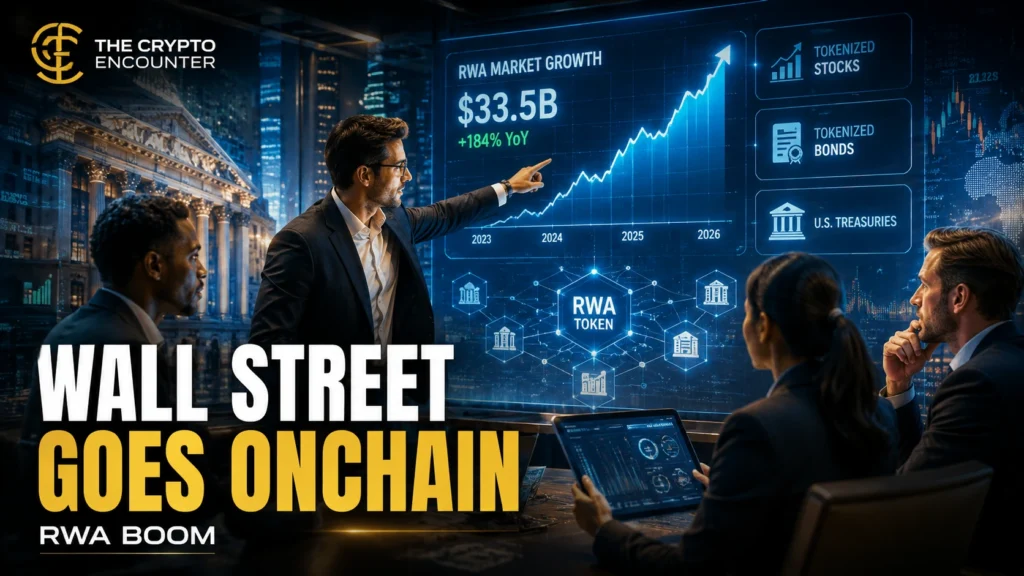
A CoinMarketCap market update circulated on August 19 said the value of on-chain tradable real-world assets reached approximately $33.5 billion in July 2026, compared with about $11.8 billion a year earlier.
That represents growth of roughly 184% in twelve months.
The headline number is impressive enough. The composition of the growth is more important.
Tokenized bonds and money market funds reportedly expanded by about 83%, adding approximately $6.5 billion. Tokenized stocks grew by roughly 422% over the same broad period.
Those are not the asset classes that defined earlier crypto bull markets.
There are no meme coins in that list.
No NFT collections.
No new Layer 1 promising to replace every existing blockchain.
The assets gaining traction are Treasuries, money market funds, bonds, publicly traded equities, private credit and other instruments that already exist inside traditional finance.
The blockchain is increasingly becoming the infrastructure underneath them rather than the investment thesis itself.
That gives the RWA boom a direction that is easy to miss.
Crypto’s fastest-growing institutional sector may ultimately succeed by becoming less recognizably “crypto.”
If the trend continues, blockchain adoption may not look like people abandoning banks, asset managers, securities markets and regulated funds. It may look like those institutions rebuilding parts of their existing businesses on programmable settlement rails.
That is a much larger opportunity than another speculative token cycle.
It also introduces a completely different set of risks involving securities law, custody, issuer rights, off-chain assets, redemption, legal ownership and the uncomfortable question of whether a token representing a real asset gives its holder the same rights as owning that asset directly.
RWA Tokenization in 2026: The Key Numbers
| Metric | Latest Relevant Figure | Why It Matters |
|---|---|---|
| On-chain tradable RWA value cited by CoinMarketCap | About $33.5B in July 2026 | Up from roughly $11.8B a year earlier |
| Approximate year-over-year growth | 184% | Nearly three times the year-earlier market size |
| RWA.xyz distributed asset value, Aug. 19 snapshot | About $38.27B | Shows continued expansion after the July comparison period |
| Tokenized U.S. Treasury value | About $10.9B | Treasuries remain one of tokenization’s largest real use cases |
| Tokenized stock value | About $1.08B | Equities have emerged as one of the fastest-growing RWA categories |
| Tokenized stock monthly transfer volume | About $2.1B | Shows that tokenized equities are being moved, not merely issued |
| Ethereum distributed RWA value | $17.31B | Ethereum remains the dominant RWA settlement network |
| Ethereum 30-day RWA transfer volume | $13.18B | Institutional activity is increasingly visible onchain |
| Solana distributed RWA value | $3.84B | High-throughput networks are gaining institutional products |
| Stellar distributed RWA value | $3.25B | Stellar remains significant in tokenized funds and payments |
| Ondo Stocks milestone | More than $1B TVL by May 2026 | Tokenized equities have moved beyond small pilot programs |
| Franklin Templeton BENJI suite | $1.98B AUM in April 2026 | Regulated tokenized funds are reaching billion-dollar scale |
RWA datasets use different definitions for distributed assets, represented assets, stablecoins and other tokenized claims. Figures should therefore be compared within the same methodology rather than treated as perfectly interchangeable measures of one market.
TL;DR: What Is Really Happening?
- CoinMarketCap says tradable RWA value rose from roughly $11.8 billion to $33.5 billion in a year, making tokenization one of crypto’s fastest-growing sectors.
- The strongest growth is coming from conventional financial assets such as Treasury products, money market funds, bonds and stocks rather than new crypto-native speculation.
- RWA.xyz data now show distributed tokenized asset value above the July $33.5 billion level, although definitions differ across datasets.
- Ethereum remains the dominant RWA blockchain, while Solana and Stellar are becoming meaningful competitors.
- Tokenized stocks are moving particularly quickly, with the CoinMarketCap update citing 422% growth and Ondo crossing $1 billion in tokenized-stock TVL earlier this year.
- BlackRock, Franklin Templeton, Securitize, Ondo and other financial companies are turning tokenized assets into usable collateral, settlement instruments and investment products.
- The SEC has made clear that tokenization does not cause a stock or bond to stop being a security.
- The biggest question is shifting from “Can assets be tokenized?” to “Can tokenized assets gain enough legal certainty, liquidity and interoperability to replace parts of existing financial-market infrastructure?”
What Is a Real-World Asset in Crypto?
A real-world asset token is a blockchain-based representation of an asset, claim or financial instrument whose economic value originates outside the native crypto ecosystem.
The underlying asset can be straightforward.
A Treasury bill.
A money market fund.
A share of stock.
A bond.
Private credit.
Real estate.
A commodity.
Or a fund holding a portfolio of such assets.
Tokenization places some element of ownership, entitlement, transfer, recordkeeping or economic exposure onto distributed-ledger infrastructure.
That does not mean every tokenized asset works the same way.
This is one of the most important distinctions in the entire RWA sector.
A token can represent a direct legally recognized security.
Another can represent an entitlement to securities held by a custodian.
A third product might provide synthetic exposure without giving its holder direct ownership of the referenced share at all.
The screen may show something that looks like a stock token in all three cases.
The legal rights can be fundamentally different.
The SEC Has Already Drawn an Important Line
The U.S. Securities and Exchange Commission’s staff addressed this distinction directly in January 2026.
In its statement explaining the regulatory treatment of tokenized securities, staff from three SEC divisions said a tokenized security remains a security regardless of whether ownership records are kept onchain or through conventional databases.
That principle may prove central to the next stage of RWA growth.
Blockchain can change the infrastructure.
It does not automatically change the legal nature of the asset.
The SEC also distinguished between issuer-sponsored tokenization and tokenization carried out by third parties.
That matters because third-party structures can introduce additional counterparty risk.
A holder may believe a token is equivalent to owning a stock when the legal relationship is actually with the company that issued the tokenized representation.
If that intermediary fails, the token holder could face risks that a direct shareholder might not face.
The lesson resembles a broader issue already visible in digital dollars. As The Crypto Encounter explained in its analysis of why a dollar token is not automatically the same thing as a bank deposit, the technology displaying value does not determine the legal claim behind it.
For RWA investors, that distinction becomes essential.
The $33.5 Billion Number Is Important, but It Needs Context
CoinMarketCap’s August update describes the RWA market reaching approximately $33.5 billion in July after sitting around $11.8 billion a year earlier.
That represents almost a tripling of the market.
However, RWA market-size numbers can vary materially depending on methodology.
Some trackers count only assets distributed directly onchain.
Others distinguish between distributed assets and represented assets.
Some include certain stablecoins or cash-equivalent products.
Others deliberately separate stablecoins from RWAs.
Different datasets may also treat private credit, real estate, funds and tokenized securities differently.
This explains why RWA.xyz’s real-time tokenized-asset analytics can display a larger distributed-asset figure than the $33.5 billion July benchmark.
Its network data for August 19 showed approximately $38.27 billion in distributed RWA value.
That should not automatically be interpreted as $4.77 billion of new investment arriving after July.
Part of the difference can reflect timing, asset additions and methodology.
The responsible conclusion is narrower and more useful.
Multiple datasets point in the same direction: tokenized real-world assets are growing rapidly, even if the exact total depends on what is being counted.
The Real Breakthrough Is Not Real Estate
The phrase “real-world assets” often makes people think of tokenized houses.
Real estate was one of the earliest popular narratives around RWA tokenization because fractional ownership was easy to visualize.
The current market tells a different story.
RWA.xyz showed tokenized real estate at only around $439 million in its recent asset-class data.
Tokenized U.S. Treasury products alone were near $10.9 billion.
That gap is revealing.
The biggest institutional demand is not necessarily for putting apartments on blockchains.
It is for making financial collateral and cash-management instruments programmable.
Wall Street already has trillions of dollars in bonds, funds, credit and securities.
Making even a small percentage of those assets operate onchain creates a much larger addressable market than building an entirely new crypto-native asset class from scratch.
Why Treasuries Became the Gateway Drug for Institutional Tokenization
Tokenized Treasury funds solve several problems at once.
They provide exposure to an asset institutions already understand.
They produce yield.
They are denominated in dollars.
They can be transferred or used inside blockchain-based systems.
And they avoid asking conservative investors to take direct Bitcoin or altcoin exposure.
That combination made Treasuries an unusually effective bridge between traditional finance and blockchain infrastructure.
BlackRock’s BUIDL fund became one of the clearest examples.
BUIDL invests primarily in cash, U.S. Treasury bills and repurchase agreements while giving eligible investors blockchain-based fund shares.
Franklin Templeton took a related path much earlier with its Franklin OnChain U.S. Government Money Fund.
By April 2026, Franklin said its BENJI suite had reached approximately $1.98 billion in assets under management, while its investor base had grown by more than 140% between April 2024 and March 2026.
These are no longer proof-of-concept experiments worth a few million dollars.
They are becoming serious cash-management products.
The Important Shift: Tokenized Funds Are Starting to Do Things
Asset value alone can exaggerate adoption if tokens simply sit motionless in wallets.
The next phase of tokenization depends on utility.
Can the asset become collateral?
Can it settle a trade?
Can it move between financial applications?
Can ownership transfer faster than through conventional systems?
Can the asset interact with lending markets?
Recent developments suggest institutions are moving in that direction.
BlackRock’s BUIDL has been integrated into collateral workflows involving major trading and banking infrastructure.
Franklin Templeton has enabled tokenized money-market-fund assets to serve as institutional off-exchange collateral.
Securitize said during its second-quarter results that it was building infrastructure for tokenized assets across issuance, ownership records, trading, custody, collateral and settlement.
That is a much more important development than merely issuing tokens.
The blockchain becomes valuable when the tokenized security can participate in a wider financial workflow.
Tokenized Stocks Are Now the Fastest-Moving Part of the Story
The CoinMarketCap update highlighted one number that deserves particular attention: tokenized stocks reportedly expanded by approximately 422%.
That makes equities one of the clearest signs that RWA tokenization is broadening beyond Treasury yield.
RWA.xyz’s stock dashboard recently showed roughly $1.08 billion of total tokenized-stock value, around $2.1 billion in monthly transfer volume and more than 189,000 holders.
Ondo has played a major role in that growth.
In May, the company announced that Ondo Stocks had crossed $1 billion in total value locked less than eight months after launch.
At the time, Ondo said it represented more than 70% of tokenized-equity issuer market share according to RWA.xyz and supported more than 260 tokenized U.S. stocks and ETFs across Ethereum, Solana and BNB Chain.
That is no longer an experiment involving obscure securities.
Tokenized versions of major U.S. equities and ETFs are becoming available to eligible investors through wallets, exchanges and onchain applications.
Why Tokenized Stocks Could Be Bigger Than the Current $1 Billion Suggests
The global equity market is worth well over $100 trillion.
A $1 billion tokenized-stock market remains tiny beside it.
That is precisely why the growth rate can be enormous.
Tokenization does not need to replace stock exchanges to create a significant industry.
If even a small percentage of international demand for U.S. equities moves through blockchain-based representations, the addressable market can become tens or hundreds of billions of dollars.
The potential attractions are easy to identify:
- longer trading hours;
- faster settlement;
- fractional ownership;
- programmable transfers;
- integration with digital wallets;
- use as collateral inside other financial applications;
- potentially broader international distribution.
But each benefit comes with legal and operational questions.
Does the token holder receive voting rights?
Who receives and distributes dividends?
Who legally owns the underlying share?
What happens if the token issuer fails?
Can tokens be frozen?
What jurisdiction governs a dispute?
What happens when a stock splits, merges or is delisted?
These questions explain why the RWA sector increasingly looks like financial-market infrastructure rather than conventional crypto investing.
Tokenization Does Not Remove Intermediaries. It Changes Them
One of the earliest blockchain promises was disintermediation.
Remove the middleman.
Let code replace trusted institutions.
RWA tokenization complicates that story.
A tokenized Treasury still needs an underlying Treasury.
Someone must custody it.
A fund needs a legal entity.
A securities token may need a transfer agent.
A broker-dealer may participate.
Compliance teams may conduct KYC and sanctions screening.
A custodian protects assets.
An issuer manages redemptions.
An oracle or pricing service may connect off-chain market data with blockchain applications.
Blockchain can remove certain reconciliation steps while leaving much of the institutional structure intact.
This resembles what The Crypto Encounter found when examining who actually holds the money behind stablecoins. A token may appear simple at the wallet layer while sitting on top of banks, custodians, money-market funds, reserve managers and compliance systems.
RWAs take the same layered structure and extend it to securities and credit.
Stablecoins Quietly Built the Infrastructure RWAs Needed
The RWA boom did not begin from zero.
Stablecoins spent years teaching blockchain markets how to move dollar-denominated value.
They created wallets.
Settlement liquidity.
On-chain exchange pairs.
Custody systems.
Compliance tools.
Institutional APIs.
Blockchain analytics.
And operational knowledge around moving regulated financial claims across public networks.
The stablecoin market was around $320 billion by the middle of 2026, vastly larger than tokenized securities.
That existing dollar infrastructure gives RWAs something previous blockchain experiments often lacked: a native settlement asset.
A tokenized Treasury fund can potentially settle against USDC.
A tokenized stock can be bought with stablecoins.
A lending market can accept an RWA token as collateral and lend digital dollars against it.
This is how separate product categories begin turning into an ecosystem.
It is also why stablecoin reserve, redemption and payment risks remain relevant even when the investment itself is a tokenized traditional asset.
A tokenized financial system can be only as resilient as the settlement assets connecting its parts.
Ethereum Still Holds the Institutional Center of Gravity
Ethereum remains the most important blockchain for distributed real-world assets.
RWA.xyz data for August 19 showed:
- $17.31 billion in distributed RWA value;
- 263,048 RWA holders;
- $13.18 billion in 30-day RWA transfer volume;
- 2,268 tracked RWA assets.
Against the approximately $38.27 billion distributed market total shown across RWA.xyz’s network data, Ethereum accounts for roughly 45%.
Its advantage comes from more than market history.
Ethereum has deep stablecoin liquidity, mature custody support, large institutional infrastructure providers, established token standards and a broad DeFi ecosystem.
Institutions also need privacy, however.
Public blockchains expose positions and transaction flows that traditional investment firms may consider commercially sensitive.
That is why developments such as confidential DeFi infrastructure on Ethereum could become important for tokenized funds, private credit and institutional RWAs.
Institutional adoption needs verifiability without necessarily requiring every commercial position to be visible to competitors.
Solana Is Becoming More Than a Meme-Coin Network
Solana’s RWA growth is another significant development.
RWA.xyz showed approximately $3.84 billion of distributed RWA value on Solana on August 19, up about 10.6% over 30 days.
The network had more than 338,000 RWA holders and around $2.92 billion in 30-day transfers.
That holder count was actually higher than Ethereum’s in the RWA.xyz snapshot, even though Ethereum held far more asset value.
The difference suggests the networks may be developing different usage profiles.
Solana’s low transaction costs and high throughput make it attractive for higher-frequency consumer or trading-oriented products, including tokenized equities.
Ethereum remains stronger in high-value institutional pools.
That competition matters because RWAs could become one of the most economically valuable blockchain use cases.
The network that hosts a meaningful portion of global financial assets gains transaction demand, developer activity and strategic importance even if end users barely notice which chain is underneath their investment.
Stellar’s Long Financial-Infrastructure Bet Is Paying Off
Stellar receives less attention than Ethereum and Solana in speculative crypto cycles.
RWA data show why that can be misleading.
The network carried approximately $3.25 billion in distributed RWA value as of August 19.
Its ecosystem included tokenized products from Spiko, Franklin Templeton, Ondo, WisdomTree and others.
Franklin Templeton’s early use of Stellar for its onchain government money market fund helped establish the network as an institutional tokenization venue years before the RWA narrative became fashionable.
This highlights another feature of the RWA market.
Token price performance and network utility do not always move together.
An infrastructure chain can become useful to major financial institutions without producing the same retail hype as a meme-coin ecosystem.
The RWA Boom Changes the Altcoin Question
For much of crypto’s history, investors judged blockchain networks largely through token speculation.
RWAs introduce a different metric.
How much economically productive value is actually using the network?
That distinction matters in a market where higher interest rates have forced investors to distinguish useful crypto infrastructure from narrative-driven altcoins.
A blockchain hosting billions of dollars of money-market funds and securities has a different economic role from one whose activity depends predominantly on speculative trading.
That does not automatically make its native token valuable.
Token economics still matter.
But the presence of RWAs gives analysts another way to evaluate whether blockchain activity represents durable financial use rather than temporary attention.
Why Interest Rates Helped Tokenized Treasuries Grow
Macro conditions played a major role in the RWA expansion.
U.S. interest rates remained high enough through much of 2025 and 2026 to make Treasury yield attractive.
Crypto investors had spent years holding stablecoins that generated no direct yield for the end user.
Tokenized Treasury funds created a new proposition.
Stay onchain while gaining exposure to government-bond yield.
That was particularly compelling when speculative crypto returns weakened.
The connection to monetary policy is direct.
If Treasury yields decline substantially, tokenized government funds may become less attractive on yield alone.
However, lower rates do not necessarily destroy the tokenization thesis.
The infrastructure benefits, faster settlement, programmable ownership, collateral use and global distribution can remain valuable even if yields decline.
For the wider macro context, The Crypto Encounter’s September Fed analysis explains how interest rates, Treasury markets, the dollar, gold and crypto are currently interacting.
The DeFi Connection Is Getting More Important
The deeper opportunity begins when tokenized traditional assets interact with decentralized or blockchain-based credit markets.
A tokenized Treasury can become collateral.
A tokenized stock can support lending.
A money market fund can function as a yield-bearing cash-management asset inside a trading account.
Private credit can be financed and transferred through programmable contracts.
This is the point where RWA tokenization and DeFi start merging.
That helps explain why major crypto businesses are increasingly interested in credit infrastructure. Kraken’s reported interest in Aave highlighted how collateral and credit are becoming strategic battlegrounds across crypto finance.
The value may eventually sit less in creating speculative tokens and more in controlling the rails that determine what assets can serve as collateral, where liquidity originates and how efficiently credit can move.
Crypto Cards Show What Happens When the Layers Connect
The connection is already visible in consumer-facing products.
XPlace, for example, has built a Visa product that lets eligible users borrow against crypto collateral while spending through conventional card infrastructure.
As The Crypto Encounter reported in its analysis of XPlace’s crypto-backed Visa model, the consumer sees a card while the underlying structure connects collateral, onchain credit, stablecoins and traditional payment settlement.
RWAs can push that architecture further.
Imagine borrowing not only against Bitcoin but against tokenized Treasury funds, stocks or diversified investment products.
A user could theoretically hold yield-bearing securities, pledge them as collateral and access spending or trading liquidity without moving back through conventional banking rails at every step.
That is where tokenization begins looking less like a new investment category and more like a financial operating system.
But Tokenized Assets Do Not Automatically Become Liquid Assets
Tokenization advocates frequently cite liquidity as a major benefit.
The claim needs qualification.
Putting an illiquid asset on a blockchain does not create buyers.
A tokenized building with no secondary demand remains difficult to sell.
A tokenized private-credit instrument can still have limited liquidity.
A security available 24 hours a day is not truly liquid if bid-ask spreads are wide or redemption depends on narrow windows.
Tokenization can reduce settlement friction.
It can allow fractional ownership.
It can make transfer technically easier.
Those features can support liquidity.
They cannot manufacture economic demand.
This distinction may become one of the biggest tests of the RWA market as issuance continues expanding.
24/7 Trading Can Also Create New Problems
Traditional U.S. stock markets close.
Tokenized markets increasingly do not.
Ondo introduced continuous minting and redemption for selected tokenized equities in 2026, expanding the concept of around-the-clock market access.
That sounds unambiguously positive until the underlying stock market is closed.
What anchors the token price during off-hours?
How wide should spreads become when the underlying security cannot be traded?
What happens during breaking news at 2 a.m. New York time?
Who provides liquidity?
Can market makers hedge their exposure?
These are solvable problems.
They are still market-structure problems.
The token can trade continuously while the economic asset it represents remains tied to conventional exchange hours.
The Most Important RWA Risk Is Often Off-Chain
Crypto investors naturally focus on smart contracts.
RWAs require them to think beyond code.
The blockchain can work perfectly while the off-chain arrangement fails.
A custodian can fail.
An issuer can become insolvent.
A legal claim can be disputed.
A property can be damaged.
A borrower can default.
A regulator can restrict transfers.
A token can lose redemption access.
A corporate action can be mishandled.
Smart-contract audits cannot eliminate these risks because they exist outside the smart contract.
This makes RWA due diligence fundamentally different from evaluating a crypto-native token.
The Token Is Only as Good as the Legal Claim Behind It
An RWA investor should be able to answer several questions before buying:
- What exactly does the token represent?
- Who legally owns the underlying asset?
- Is the token holder a direct owner, beneficial owner or creditor?
- Who holds the underlying security or cash?
- Can the token be redeemed?
- What happens if the issuer becomes insolvent?
- Which jurisdiction governs the arrangement?
- Can transfers be frozen or reversed?
- How are dividends, interest and corporate actions handled?
- Is there meaningful secondary-market liquidity?
These questions may sound old-fashioned in a blockchain article.
That is exactly the point.
Tokenization does not make centuries of property and securities law disappear.
Compliance Is Becoming a Product Feature
Early crypto culture often treated compliance as friction.
Institutional tokenization increasingly treats it as infrastructure.
Large asset managers need transfer restrictions.
They need identity verification.
They need sanctions controls.
They need ownership records regulators can audit.
They may need the ability to freeze or recover assets under defined legal circumstances.
This creates tension with crypto’s original philosophy of permissionless ownership.
But institutional assets operate under legal obligations whether the database sits on a server or a blockchain.
The result may be a financial ecosystem where public blockchains remain decentralized at the network layer while the assets running on them retain issuer-level controls.
That is already visible in stablecoins, where issuer-controlled freeze mechanisms show how blockchain settlement can coexist with centralized legal and compliance authority.
RWA Growth Does Not Mean Every RWA Token Is a Good Investment
Sector growth and investment quality are two different questions.
A 184% increase in tokenized value does not mean every RWA token will appreciate.
Many RWA protocols issue their own governance or utility tokens.
The value of those tokens may have little direct connection to the amount of real-world assets handled by the platform.
Revenue may not flow to token holders.
Governance rights may be limited.
Token supply can dilute.
Competition can compress fees.
A platform can grow assets under management while its speculative token underperforms.
Investors therefore need to separate three different things:
- growth in tokenized underlying assets;
- growth in the companies and platforms providing tokenization infrastructure;
- performance of crypto tokens associated with the RWA narrative.
They can move in entirely different directions.
The Most Powerful RWA Business May Not Need a Token at All
This may be one of the most important long-term consequences of institutional adoption.
Traditional asset managers do not need to launch speculative tokens to benefit from tokenization.
BlackRock can tokenize a fund.
Franklin Templeton can put money-market shares onchain.
A broker-dealer can provide custody.
A transfer agent can maintain ownership records.
An exchange can create tokenized trading infrastructure.
A bank can provide settlement services.
Each can generate revenue using blockchain without issuing a new cryptocurrency to retail investors.
This is why the RWA boom could expand blockchain usage while making parts of the industry less dependent on speculative token economics.
Why Wall Street Is Not Being Replaced
The early crypto narrative frequently predicted that blockchains would replace Wall Street.
The evidence in 2026 points toward a more complicated outcome.
Wall Street may adopt blockchains.
Asset managers are tokenizing funds.
Broker-dealers are building custody infrastructure.
Traditional transfer agents are working with tokenization providers.
Stock exchanges are exploring digital trading.
Large banks are experimenting with tokenized collateral and settlement.
That does not look like traditional finance disappearing.
It looks like traditional finance rebuilding selected functions with new rails.
This is arguably a stronger validation of blockchain technology than another speculative crypto rally.
Institutions are not adopting tokenization because they want a new ideology.
They are adopting it where they believe it can reduce friction, improve collateral mobility, widen distribution or make settlement more efficient.
The Regulatory Race Is Becoming Global
The United States is only one battlefield.
Europe, Singapore, Hong Kong, Switzerland and the United Arab Emirates have all developed frameworks or pilot programs for digital securities and tokenized financial products.
Ondo said in May that it had obtained approval to offer tokenized stocks and ETFs across 30 European countries and had become the first tokenized securities admitted for trading on a regulated multilateral trading facility in Abu Dhabi Global Market.
Securitize has also developed products under Dubai’s VARA framework.
This means tokenization may evolve through multiple regulatory hubs rather than one global regime.
The winners may be platforms capable of connecting those jurisdictions while preserving investor protections and legal clarity.
Why Tokenization Could Matter More Than Another Crypto Bull Market
Crypto bull markets increase asset prices.
Tokenization could increase the number of financial assets that use blockchain infrastructure at all.
The scale difference is enormous.
Stocks, government bonds, corporate bonds, money market funds, private credit and investment funds represent hundreds of trillions of dollars globally.
No credible analysis requires all of those assets to move onchain.
Even a low-single-digit percentage would produce a tokenized market dramatically larger than today’s $30 billion to $40 billion range.
That is why institutional firms are investing before the market becomes enormous.
The infrastructure needs to exist first.
The Crypto Encounter Take: Crypto’s Biggest Win May Be Becoming Invisible
The $33.5 billion headline is easy to celebrate as another crypto growth statistic.
That interpretation undersells what is happening.
The real RWA story is not that blockchain has invented another asset class.
It is that existing finance is beginning to use blockchain without needing to reinvent the assets themselves.
A Treasury remains a Treasury.
A stock remains a security.
A money market fund remains a regulated fund.
The database underneath ownership and settlement changes.
That sounds less revolutionary than creating an entirely new monetary system.
It may be more commercially significant.
Tokenized Treasuries now sit at billion-dollar scale.
Tokenized equities have moved past proof-of-concept territory.
Major asset managers are operating onchain products.
Blockchain-based securities are beginning to serve as collateral.
Networks such as Ethereum, Solana and Stellar are competing to host assets whose value originates in traditional finance.
Meanwhile, regulators are increasingly defining how existing securities laws apply instead of debating whether tokenization exists at all.
The sector is moving from:
“Can we put this asset on a blockchain?”
to:
“What becomes possible once the asset is there?”
That second question is far more important.
If a Treasury token can move instantly, serve as collateral, generate yield and settle against digital dollars, the blockchain becomes financial infrastructure.
If a stock token can be used across wallets, exchanges, lending markets and international investment platforms, equity-market distribution changes.
If private credit becomes programmable, lenders can potentially manage ownership and cash flows differently.
If none of those tokens develop reliable liquidity, legal certainty or interoperability, the RWA boom could remain a collection of sophisticated digital wrappers around existing finance.
That is the tension investors should watch.
The greatest success for RWA tokenization may ultimately make the technology less visible.
People do not think about the database maintaining their brokerage account today.
They do not care which message format settles a card purchase.
They rarely know what software processes their mutual fund records.
If tokenization truly wins, future investors may not think of themselves as “RWA users” either.
They may simply buy a fund, borrow against a security, send collateral or settle a trade.
The blockchain will sit underneath.
That would represent a profound change from the crypto industry’s first decade.
Crypto spent years asking people to enter a new financial world.
RWA tokenization is trying something different.
It is bringing the financial world people already use onto crypto’s infrastructure.
What Happens Next?
The next phase of the RWA market will probably be judged by five developments.
1. Whether Tokenized Stocks Keep Growing
Equities have delivered extraordinary percentage growth from a small base. Continued expansion above the billion-dollar level would demonstrate that the category has staying power beyond novelty.
2. Whether Treasuries Become Everyday Collateral
Tokenized government securities become substantially more useful if institutions can move them seamlessly between investment, trading and lending workflows.
3. Whether Liquidity Catches Up With Issuance
Creating thousands of tokenized assets is easy compared with creating deep markets for them. Transfer volumes, spreads, active users and redemption quality will matter increasingly.
4. Whether Regulations Converge
A fragmented world where the same token carries different rights across jurisdictions can limit scale. Greater legal interoperability would accelerate institutional adoption.
5. Whether Users Care About the Blockchain at All
The strongest sign of maturity may come when tokenization stops being the product’s main marketing point. Once users choose products because they are faster, cheaper or more useful rather than because they are “onchain,” the technology will have moved into infrastructure.
Frequently Asked Questions About RWA Tokenization
What are real-world assets in crypto?
Real-world assets, or RWAs, are blockchain-based representations of assets or financial claims whose value comes from outside the native crypto economy. Examples include Treasury securities, stocks, bonds, money market funds, private credit, commodities and real estate.
How big is the RWA tokenization market in 2026?
CoinMarketCap’s August 19 update cited approximately $33.5 billion in on-chain tradable RWA value for July 2026, up from about $11.8 billion a year earlier. RWA.xyz’s later August 19 network data showed roughly $38.27 billion in distributed asset value. The figures use different snapshots and methodologies, so they should not be treated as perfectly interchangeable.
Why are real-world assets growing so fast?
Growth is being driven by institutional interest in tokenized Treasuries, money market funds, bonds, stocks and credit. High interest rates increased demand for tokenized yield products, while improving regulatory clarity and institutional blockchain infrastructure have made more financial products viable onchain.
What are tokenized Treasury bills?
Tokenized Treasury products are blockchain-based fund shares or securities that provide economic exposure to U.S. government debt or Treasury-focused funds. The precise legal structure varies by product.
Are tokenized stocks the same as normal stocks?
Not always. Some tokenized shares can be integrated directly with official ownership records. Other products represent securities held through a custodian, while some may provide synthetic exposure. Investors should verify exactly what legal rights a token provides.
Does the SEC regulate tokenized stocks?
Yes, when a tokenized instrument is a security under U.S. law. SEC staff stated in January 2026 that the format used to record or transfer a security does not change the application of federal securities laws.
Which blockchain has the most tokenized real-world assets?
Ethereum remains the largest network by distributed RWA value in RWA.xyz data, with approximately $17.31 billion as of August 19, 2026. Solana and Stellar also hold multi-billion-dollar RWA markets.
Why is Ethereum popular for RWA tokenization?
Ethereum combines institutional custody support, stablecoin liquidity, mature smart-contract standards, DeFi infrastructure and a large developer ecosystem. Those characteristics make it attractive for asset managers and tokenization platforms.
Are stablecoins real-world assets?
Definitions vary. Stablecoins represent claims or value linked to real-world currencies and reserve assets, but many RWA analytics platforms track stablecoins separately from tokenized securities, credit and funds. Investors should check a dataset’s methodology before comparing market totals.
Can tokenized real-world assets be used in DeFi?
Increasingly, yes. Tokenized funds and securities can potentially serve as collateral, settlement assets or components of lending and trading strategies. Access depends on the token’s legal structure, transfer restrictions and protocol integrations.
Are tokenized assets available 24/7?
Some are transferable or tradable around the clock, but this does not mean the underlying traditional market is continuously open. Liquidity, minting, redemption and price discovery can differ outside normal trading hours.
Are RWAs safer than cryptocurrencies?
Not automatically. RWAs can reduce exposure to crypto-native price volatility when the underlying asset is a Treasury or money market fund, but they introduce issuer, custody, legal, redemption, counterparty, smart-contract and regulatory risks.
Can tokenized assets be frozen?
Some can. Regulated issuers may maintain compliance controls, transfer restrictions, allowlists, freeze functions or recovery mechanisms. The exact powers depend on the product and legal structure.
What happens if an RWA issuer fails?
The outcome depends on the legal claim represented by the token. Direct ownership structures can differ significantly from custodial or synthetic structures. Investors should understand bankruptcy treatment and custody arrangements before purchasing.
Will RWAs replace traditional finance?
The current evidence suggests integration is more likely than wholesale replacement. Banks, asset managers, broker-dealers, custodians and transfer agents are increasingly participating in tokenization rather than disappearing from the system.
Could the RWA market reach trillions of dollars?
It is possible over a long enough period because the underlying markets for bonds, equities, funds, credit and real estate are enormous. However, trillion-dollar forecasts remain projections rather than guarantees. Regulatory certainty, liquidity, interoperability and institutional adoption will determine how much activity actually moves onchain.
Are RWA crypto tokens the same thing as tokenized assets?
No. A protocol may issue a governance or utility token associated with an RWA platform, but that token may not represent ownership of the underlying real-world assets. Investors should not assume growth in tokenized asset value automatically benefits a related cryptocurrency.
What is the biggest opportunity in RWA tokenization?
The largest opportunity may be making traditional assets programmable so they can move, settle, generate yield and serve as collateral inside digital financial systems more efficiently.
What is the biggest risk?
The largest structural risk is assuming that blockchain verification guarantees the off-chain asset and legal claim. The blockchain can accurately record a token while custody, issuer solvency, redemption rights or the underlying asset still fail.
Methodology and Editorial Note
This analysis uses the CoinMarketCap market update dated August 19, 2026 as its starting point and independently compares the supplied figures with current institutional and market data.
RWA market totals vary according to methodology. Some providers separate distributed and represented assets, while stablecoins may be included or excluded depending on the analysis. For that reason, this article avoids presenting figures from different methodologies as though they form a perfectly continuous time series.
Current network and asset-class figures cited in the article were checked against RWA.xyz data available around August 19-20, 2026. Regulatory analysis relies on the SEC staff’s January 2026 statement on tokenized securities. Company-specific figures are attributed to the companies or platforms that reported them and should not be interpreted as independent guarantees of future performance.
Disclaimer
This article is for informational and educational purposes only and does not constitute financial, investment, securities, legal, tax or trading advice.
Tokenized real-world assets can carry risks involving issuer solvency, custody, smart contracts, blockchain networks, liquidity, redemption, legal ownership, jurisdiction, regulatory restrictions, pricing, counterparties and the performance of the underlying assets. A tokenized Treasury, stock, fund or credit instrument is not automatically safer because it operates on a blockchain.
Market values and adoption figures can change materially after publication. Readers should review the legal documents, issuer disclosures, custody arrangements, redemption rules and applicable regulations for any tokenized product before investing. Anyone making significant financial decisions should consider their individual circumstances and seek appropriately qualified professional advice where necessary.