

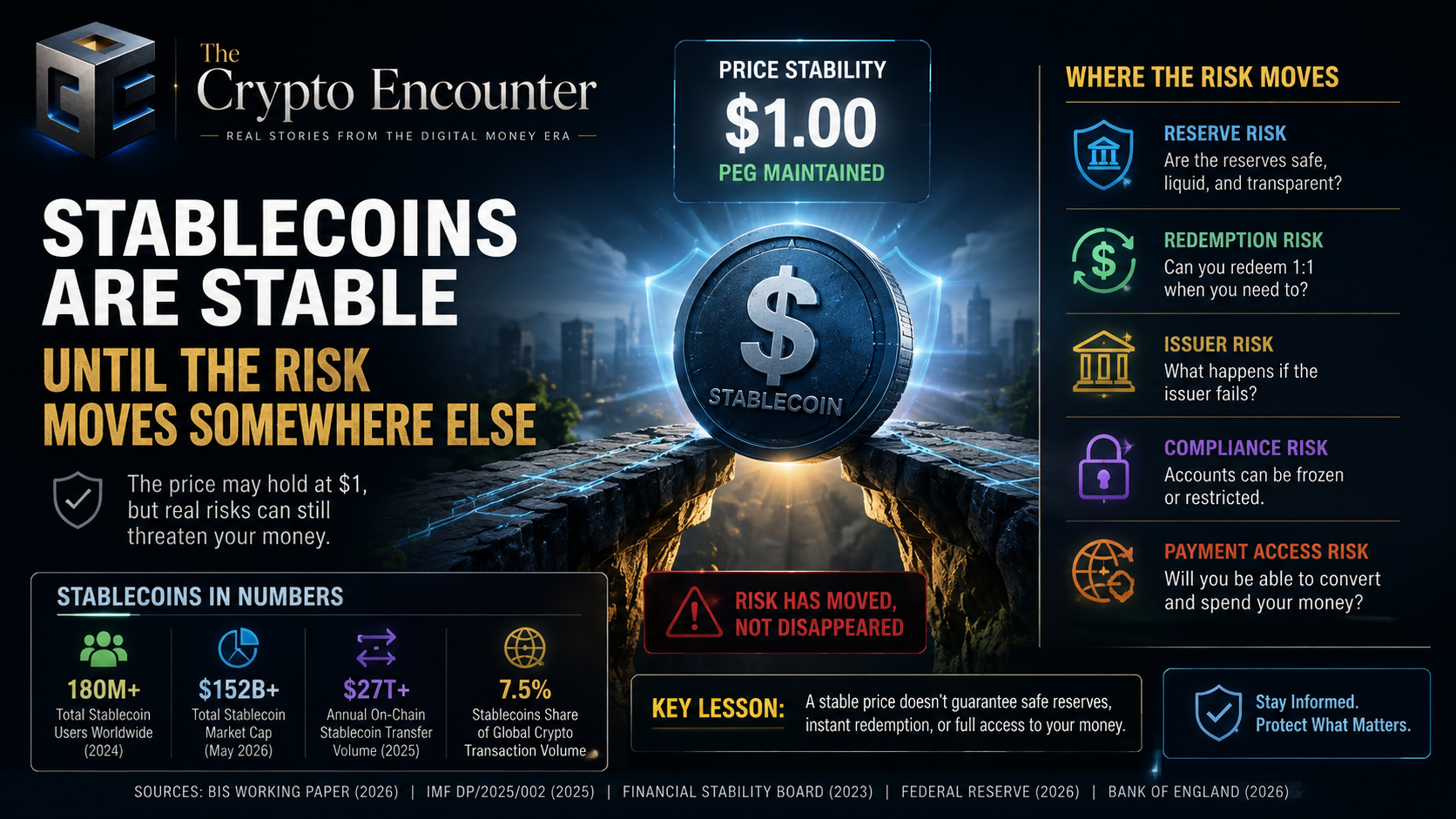
Crypto is increasingly used for remittances, savings, and everyday transfers, making stablecoins an important bridge between digital assets and familiar money. Their prices are designed to stay close to a reference currency, often the U.S. dollar, which can make them appear safer and easier to use than more volatile cryptocurrencies. But stablecoin risks do not disappear simply because the price remains near $1. Instead, those risks can move into the reserves supporting the token, the issuer managing them, redemption arrangements, compliance controls, custody structures, and payment access.
For readers of The Crypto Encounter, the important question is not only whether a stablecoin maintains its price, but whether that digital dollar remains accessible, redeemable, and usable when circumstances become difficult. Understanding where the risk moves is essential before treating stablecoins as everyday money.
Why Stablecoin Risks Move Beyond the Price
A stablecoin is designed to track an asset such as the U.S. dollar. Fiat-backed coins depend on reserves and an issuer managing issuance and redemption. A stable price is an outcome, not proof that the system is fully protected.
The Reserve Bank of Australia’s stablecoin analysis identifies liquidity, operational, cyber, and legal risks, while the Financial Stability Board’s stablecoin recommendations emphasize clear redemption rights.
Reserves Are the First Line of Stability
Reserve quality matters because redemption depends on assets that can actually be used when holders want their money back. If reserves are insufficient, difficult to sell, or exposed to losses, confidence can weaken.
A 2026 BIS study on stablecoin stability highlights a liquidity mismatch between rapid redemptions and slower-to-sell reserve assets.
That is a central stablecoin risk. Users should ask what the reserves contain, who holds them, how safeguards protect them, and what legal claim holders have.
Stablecoin Payment Risks Matter for Remittances
Stablecoins can make cross-border transfers faster and may reduce some costs. The Federal Reserve has identified remittances and global trade as potential use cases. Yet a fast blockchain transfer does not guarantee easy access afterward.

Imagine a worker sending $500 overseas. The transaction may confirm quickly, but the recipient could face problems converting it into local currency because of withdrawal restrictions, compliance checks, or weak liquidity.
These are stablecoin payment risks, not necessarily price risks. The token may remain near $1 while the user’s ability to access or spend that $1 becomes uncertain.
Compliance also matters. Issuers and intermediaries may use sanctions screening, transaction monitoring, and address restrictions. Stablecoins do not function exactly like physical cash.
Redemption Is the Real Test
The strongest test of a stablecoin comes when users want to leave the system.
A token trading around $1 is not automatically a token every holder can redeem directly for $1. Access may depend on eligibility, minimum amounts, fees, intermediaries, and issuer terms.
The Bank of England’s 2026 stablecoin framework stresses redemption in normal and stressed conditions. The Financial Stability Board also calls for timely redemption.
This exposes another stablecoin risk: access risk. Users may hold a stable-looking asset while depending on several institutions to turn it into bank money.
Before treating a stablecoin as digital cash, check who can redeem it, what fees apply, and what happens if the issuer fails.
Stablecoin Risks Include Freezes and Compliance
Stablecoins operate within legal and technical systems. Issuers or intermediaries may restrict assets because of sanctions, court orders, fraud investigations, or compliance requirements.
Transferability can therefore be conditional, creating further stablecoin payment risks. For remittance users, different providers and rules can affect transactions even when the blockchain continues operating.
The IMF’s stablecoin analysis identifies governance, reserve custody, redemption, operational risk, and concentration as important. It also notes that insolvency may leave holders with different legal claims.
What Users Should Check for Stablecoin Risks
Users can evaluate stablecoin risks without becoming experts.
| Check | Why it matters |
| Reserves | Supports the peg |
| Redemption | Explains how holders exit |
| Custody | Shows who controls backing assets |
| Jurisdiction | Identifies the legal framework |
| Compliance | Explains possible restrictions |
| Liquidity | Matters when converting to cash |
These stablecoin payment risks must be considered together. Strong reserves may not solve weak redemption. Clear rules may not solve poor liquidity.
Regulation Helps, But Does Not Eliminate Risk
Regulators increasingly focus on reserves, redemption, consumer protection, operational resilience, and anti-money-laundering controls. In 2026, the Federal Reserve said the U.S. GENIUS Act created a stablecoin framework while noting that implementation details remain important.
Regulation can improve standards and accountability, but cross-border use still creates legal complexity.
That is why stablecoin payment risks can become legal and operational risks as well as financial ones. Safeguards can reduce some stablecoin risks, but they cannot eliminate every failure point.
The Risk Has Moved, Not Disappeared
Stablecoins can reduce volatility. They still depend on financial and technical infrastructure. The 2026 BIS research links reserve liquidity to redemption pressure, while IMF research examines how redemptions can trigger reserve sales. The lesson is clear: stability depends on what happens behind the token under stress.
For broader context, readers can explore The Lie Behind Encrypted Crypto Payments, which looks at the security gaps that can exist between crypto’s technical infrastructure and the way users actually make payments.
Conclusion
Stablecoins can make digital money practical, but stability rests on infrastructure users may never see. Stablecoin risks can span reserves, redemptions, issuer operations, compliance, and legal protections.
For households and remittance users, stablecoin payment risks matter because receiving a token is only part of receiving usable money. Understand what supports the peg, who controls access, and what happens under stress.
FAQs
Are stablecoins risk-free because they stay near $1?
No. Stablecoin risks can involve reserves, redemption, custody, compliance, and insolvency.
Are stablecoins useful for remittances?
They can be, but stablecoin payment risks include conversion, liquidity, and compliance problems.
What should users check first?
Review reserves, redemption terms, issuer jurisdiction, custody, transparency, and conversion options, including stablecoin payment risks.
Can stablecoins be frozen?
Some arrangements can restrict or freeze tokens. Users should read the issuer’s terms.
Disclaimer
This article is for informational and educational purposes only and does not constitute financial, investment, legal, tax, or accounting advice. Stablecoins involve issuer, reserve, redemption, liquidity, compliance, operational, custody, and regulatory risks. Readers should verify information with sources and consider rules that apply in their jurisdiction. No stablecoin should be treated as guaranteed cash or risk-free. The Crypto Encounter does not guarantee accuracy, availability, redemption, value, or protection of a stablecoin or service, and readers remain responsible for their decisions.