


The blockchain was never your bodyguard. It can verify transactions, protect a shared record, and make unauthorized changes extremely difficult. However, it cannot inspect the link you click, stop you from revealing a recovery phrase, or question a payment you approve under pressure.
That distinction matters because most ordinary users do not interact directly with a blockchain. Instead, they use wallets, exchanges, browsers, smartphones, messaging apps, and websites. Each layer creates another opportunity for fraud, theft, malware, or human error.
Therefore, secure blockchain technology does not automatically make every crypto transaction safe. The network may process your instruction correctly even when a criminal manipulated you into giving it. Understanding that gap can help users avoid phishing, fake investments, wallet-draining approvals, impersonation scams, and irreversible transfers.
Key Takeaways
- A blockchain protects its transaction record, not every person using it.
- Wallets, devices, websites, and private keys sit outside the blockchain’s core security.
- A technically valid transaction may still result from fraud or manipulation.
- Blockchain finality can make recovery harder after a scam succeeds.
- Verification, separation, and slower decision-making provide stronger personal protection.
The Blockchain Was Never Your Bodyguard Because Protocol Security Has Limits
A blockchain is a shared digital ledger. Network participants follow agreed rules to validate transactions and maintain the ledger’s history.
That system can make the record highly resistant to unauthorized alteration. Yet protocol security has a narrow purpose. It helps the network determine whether a transaction follows its technical rules.
For example, a blockchain may check whether:
- The transaction carries a valid digital signature.
- The sending address has enough funds.
- The transaction follows the network’s format.
- The same funds have not already been spent.
However, the network usually cannot determine why you signed the transaction. It cannot see whether a scammer frightened you, whether a fake website misled you, or whether malicious software replaced the address you intended to use.
Consequently, the blockchain may work exactly as designed while the user still loses money.
That is the central meaning behind the blockchain was never your bodyguard. Protocol integrity and personal safety overlap, but they are not the same thing.
That distinction matters because protocol integrity and personal safety overlap, but they are not the same thing. Our guide to the difference between crypto security and safety explains why secure technology can still leave ordinary users exposed.
What Blockchain Security Actually Protects
Blockchain security primarily protects the ledger and its consensus process.
Consensus refers to the method a blockchain uses to agree on valid transactions and the current state of the network. Different networks use different mechanisms. Still, the objective remains similar: prevent participants from rewriting records or spending the same assets twice without satisfying the network’s rules.
Cryptography also helps prove that someone controlling a private key authorized a transaction. Nevertheless, cryptography cannot prove that the owner understood the transaction or intended its real consequences.
Ethereum’s official security guidance explains that a recovery phrase acts as the master key to a wallet. Anyone who obtains it may gain access to the accounts connected to that wallet. The guidance also warns users never to share a recovery phrase with a supposed support representative. Readers can review Ethereum’s complete security and scam-prevention guidance.
Ethereum’s public security guidance makes this responsibility clear. A recovery phrase acts as the master key to a wallet, and transactions sent through the network are irreversible. Ethereum also warns that no legitimate support service should ask for a user’s recovery phrase.
Therefore, blockchain security generally protects:
| Security function | What it does | What it does not do |
|---|---|---|
| Transaction validation | Checks whether a transaction follows protocol rules | Decides whether the transaction is wise |
| Digital signatures | Proves that the relevant private key authorized an action | Proves the user understood the action |
| Ledger integrity | Makes past records difficult to alter | Reverses a scam payment |
| Consensus | Helps the network agree on valid activity | Investigates fraud against an individual |
| Public verification | Allows activity to be independently checked | Identifies every criminal in the real world |
This difference explains why the blockchain was never your bodyguard. It guards the record more effectively than it guards the person creating the record.
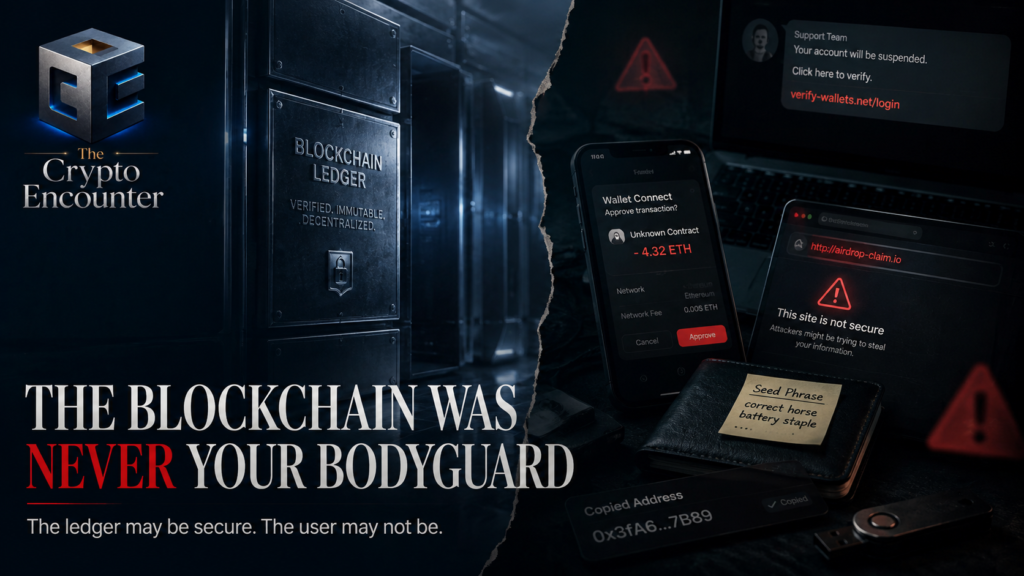
The blockchain may protect its ledger, but users remain exposed through wallets, devices, links, approvals, and human behavior.
The Blockchain Was Never Your Bodyguard Against Phishing
Phishing uses deception to make a person reveal information, visit a fake website, install malicious software, or approve an unwanted action.
A phishing message may imitate:
- A wallet provider
- A crypto exchange
- A token project
- A customer-support agent
- A government agency
- A friend or business contact
- A security alert
The link may lead to a convincing copy of a real website. Once there, the victim may enter a password, reveal a recovery phrase, connect a wallet, or sign a malicious request.
The Federal Trade Commission warns that cryptocurrency scammers often impersonate businesses, government agencies, romantic partners, and investment professionals. They may also pressure victims to send cryptocurrency to a specific wallet or use a crypto ATM. The FTC’s cryptocurrency scam guide explains how these schemes operate and where victims can report them.
The Federal Trade Commission warns that crypto scammers frequently impersonate businesses, government agencies, or potential romantic partners. Scammers may also direct victims to send funds to a specific wallet or scan a QR code at a cryptocurrency ATM. Once transferred, the funds often become difficult to recover.
Meanwhile, the blockchain sees only a signed transaction. It does not see the fake email, cloned website, or emotional pressure that came first.
Again, the blockchain was never your bodyguard at the moment when deception entered the process.
Your Wallet Is an Interface, Not a Protective Intelligence
A crypto wallet does not usually store coins in the same way a physical wallet stores cash. Instead, it manages the keys and account information needed to control assets recorded on a blockchain.
A private key authorizes transactions. A recovery phrase can regenerate the keys for many self-custody wallets. Therefore, anyone who obtains that recovery phrase may gain control of the wallet.
Although many wallets display warnings, they cannot always determine whether a request reflects your true intention. A transaction may look technical, unclear, or routine. Yet it could transfer tokens, authorize future spending, or give a malicious smart contract broad access.
The blockchain was never your bodyguard during that approval process. The wallet may submit the exact instruction you signed, even though you misunderstood it.
Before approving anything, users should ask:
- Which website initiated this request?
- What asset can the request access?
- Is this a transfer, login signature, token approval, or contract interaction?
- Does the request grant unlimited spending permission?
- Can I verify the destination independently?
A signature should never become a reflex. In crypto, a rushed click may carry financial authority.
Secure Networks Can Still Process Fraudulent Intentions
Suppose a scammer impersonates an exchange employee and claims that your account faces an urgent security threat. The scammer tells you to move your crypto into a “protected wallet.”
You authorize the transfer. The blockchain confirms your signature, checks your balance, validates the destination address, and records the transaction.
Technically, nothing failed.
The network followed its rules. The wallet transmitted your instruction. The scammer, however, controlled the story that caused you to act.
This example reveals the uncomfortable logic behind the blockchain was never your bodyguard. A blockchain can distinguish a valid signature from an invalid one. It cannot reliably distinguish informed consent from manipulated consent.
Scammers exploit that gap through fear, urgency, trust, greed, embarrassment, and confusion.
The Blockchain Was Never Your Bodyguard Against Device Compromise
Crypto security also depends on the device used to access a wallet or exchange.
Crypto security also depends on the device used to access a wallet or exchange. Abdul Qadir’s analysis of crypto’s wider password and account-security problem explains how passwords, recovery phrases, email accounts, devices, phishing links, and human decisions can expose users even when the underlying blockchain remains secure.
Malware can:
- Record keystrokes
- Capture screenshots
- Steal browser data
- Replace copied wallet addresses
- Display fake wallet prompts
- Redirect users to imitation websites
- Take control of active sessions
For instance, clipboard malware may detect when someone copies a wallet address. It then replaces that address with one controlled by the attacker. Because crypto addresses contain long strings of characters, the user may fail to notice the substitution.
The blockchain will not correct the address. Instead, it will process the submitted destination.
Therefore, the blockchain was never your bodyguard against a compromised phone, infected computer, malicious browser extension, or careless download.
CISA repeatedly recommends phishing-resistant multifactor authentication, particularly security methods based on FIDO or WebAuthn, because ordinary passwords and weaker authentication methods remain vulnerable to phishing and account takeover.
Smart Contracts Follow Code, Not Human Expectations
A smart contract is code deployed on a blockchain. It can automatically perform actions when users or other contracts meet specified conditions.
However, smart contracts do not understand fairness, customer expectations, or moral intent. They execute programmed logic.
As a result, users may face risk from:
- Coding errors
- Malicious functions
- Excessive token approvals
- Hidden transfer restrictions
- Manipulated price feeds
- Fake decentralized applications
- Fraudulent token contracts
- Poorly designed administrative controls
Even an audited contract can carry risk. An audit reviews code within a defined scope and period. It does not guarantee permanent safety, honest administrators, secure websites, or responsible user behavior.
The blockchain was never your bodyguard when code contained a flaw or when a project presented dangerous permissions as a normal transaction.
Irreversibility Can Protect the Ledger and Harm the Victim
Traditional payment systems may allow chargebacks, account freezes, or intervention by a financial institution. Crypto transfers often provide fewer recovery options, especially when users control their own wallets.
Irreversibility supports final settlement. Once a valid transaction reaches sufficient confirmation, the sender generally cannot cancel it through a central customer-service department.
Yet the same feature gives scammers an advantage. After a victim sends funds, the attacker may move them across several addresses, exchange them for other assets, or route them through different services.
The blockchain was never your bodyguard after the transfer because its job is to preserve the validated record, not erase an authorized mistake.
According to the FBI’s 2025 Internet Crime Report, cryptocurrency investment fraud produced the highest reported financial losses to Americans that year, reaching $7.2 billion. The figure reflects reported complaints, so it does not necessarily capture every victim or every loss.
Moreover, victims may encounter a second scam. The FBI has warned about fraudulent recovery firms and fictitious law offices that target people who already lost cryptocurrency. In one reporting period, victims of such fake legal services reported more than $9.9 million in additional losses.
The Blockchain Was Never Your Bodyguard Against Human Behavior
Scammers rarely need to defeat blockchain cryptography. Instead, they search for an easier route through the user.
Common pressure tactics include:
Urgency
The scammer claims that the account, investment, or wallet requires immediate action.
Authority
A criminal pretends to represent an exchange, regulator, bank, company, or law-enforcement agency.
Secrecy
The victim receives instructions not to speak with relatives, financial institutions, or customer support.
Trust
The scammer builds a relationship over days, weeks, or months before requesting money.
Greed
A fake investment platform displays invented profits and encourages larger deposits.
Fear of loss
The victim hears that existing funds will disappear unless they transfer more money or pay a fee.
These tactics work because people act differently under stress. Urgency reduces careful checking. Authority discourages questioning. Social trust lowers suspicion.
For that reason, the blockchain was never your bodyguard against the emotional conditions that shape a decision.
Practical Protection When the Blockchain Was Never Your Bodyguard
Since no blockchain can supervise every decision, users need security habits that operate before a transaction reaches the network.
Pause before signing
Unexpected urgency should increase caution. Take time to inspect the request and verify the situation through a separate channel.
Never share a recovery phrase
A legitimate wallet provider, exchange employee, moderator, or support agent should not need it. Anyone who obtains the phrase may control the wallet.
Verify websites independently
Avoid opening wallet or exchange links from unsolicited messages. Instead, use a saved bookmark or manually enter the known address.
Read transaction details
Check the destination, asset, network, amount, and permissions. For large transfers, compare the full destination address rather than only the first and last few characters.
Use a small test transaction
When sending a significant amount to a new address, consider sending a small test first. Confirm receipt before transferring the remainder.
Separate crypto activities
Keep long-term holdings separate from wallets used for experimental applications, token claims, or unfamiliar websites.
Use stronger account protection
Enable phishing-resistant authentication where supported. Also protect the email account connected to an exchange because attackers may use email access to reset credentials.
Keep software current
Update the operating system, browser, wallet application, and security tools. Furthermore, remove browser extensions you no longer need.
Verify support contacts
Do not trust direct messages from supposed moderators or customer-service representatives. Reach support through the official website or application.
Question guaranteed returns
The FTC warns that promises of guaranteed profit, free money, or risk-free cryptocurrency returns are common scam indicators.
The blockchain was never your bodyguard, so personal safeguards must begin before the transaction.
What To Do After a Suspected Crypto Scam
Speed matters, although recovery is never guaranteed.
First, stop communicating with the suspected scammer. Do not send another payment for taxes, verification, unlocking, recovery, or legal assistance.
Next, preserve evidence. Save:
- Wallet addresses
- Transaction hashes
- Email messages
- Website addresses
- Usernames
- Phone numbers
- Screenshots
- Receipts
- Dates and payment instructions
Then contact the relevant exchange or wallet provider through its official support channel. If funds reached a centralized service, that company may have procedures for reviewing fraudulent activity. However, it may not be able to recover the assets.
Victims in the United States can file a report with the FBI’s Internet Crime Complaint Center. The FBI advises users to provide transaction details and related evidence, even when they remain unsure about the correct complaint category.
Finally, watch for recovery scams. A person who guarantees the return of stolen cryptocurrency may be attempting to exploit the loss again.
Why the Blockchain Was Never Your Bodyguard Remains the Essential Safety Lesson
Crypto shifts control toward the user. Yet greater control also moves more responsibility toward the user.
Banks, payment processors, and regulated custodians often provide identity checks, fraud teams, transaction monitoring, dispute procedures, and account-recovery systems. Self-custody can remove some intermediaries, but it may also remove those protections.
The blockchain was never your bodyguard because decentralization does not automatically create personal supervision. A decentralized network can validate ownership without verifying judgment. It can preserve a transaction without confirming that the transaction was safe.
Therefore, users should treat every wallet connection, signature request, transfer, and recovery phrase as a security decision.
Conclusion: The Blockchain Was Never Your Bodyguard
The blockchain was never your bodyguard. It can protect a network’s ledger while leaving users exposed through wallets, browsers, devices, messages, smart contracts, and human behavior.
That does not make blockchain technology useless or inherently unsafe. Instead, it defines the technology’s real boundary. A secure protocol can process an unsafe decision with perfect accuracy.
Therefore, personal crypto safety depends on deliberate verification. Slow down. Check the source. Inspect permissions. Protect recovery information. Separate high-value assets from risky activity. Most importantly, never confuse a tamper-resistant ledger with a system that can rescue you from every scam or mistake.
Once users understand that the blockchain was never your bodyguard, they can replace false confidence with practical security.
Frequently Asked Questions
Why does “the blockchain was never your bodyguard” matter?
The blockchain was never your bodyguard because blockchain security protects the ledger and transaction process. It does not automatically protect wallets, devices, passwords, recovery phrases, websites, or individual decisions.
Can someone steal crypto without hacking the blockchain?
Yes. Criminals can steal crypto through phishing, malware, account takeover, impersonation, malicious approvals, or stolen recovery phrases. In those cases, the blockchain itself may continue functioning normally.
Can a blockchain reverse a scam transaction?
Usually, no. Public blockchains generally treat valid, confirmed transactions as final. Exchanges, investigators, or courts may sometimes help trace or restrict funds, but recovery is uncertain.
Is a hardware wallet enough to prevent crypto scams?
A hardware wallet can reduce exposure of private keys. However, it cannot prevent every threat. A user can still approve a malicious transaction, visit a fake website, reveal a recovery phrase, or send funds to the wrong address.
What information should no crypto user share?
Never share a private key or recovery phrase. Also avoid sharing passwords, authentication codes, remote-access credentials, and sensitive wallet screenshots.
What should I do before sending crypto?
Verify the recipient through a separate channel. Check the network and full address. Review the transaction amount. Then use a small test payment when practical.