

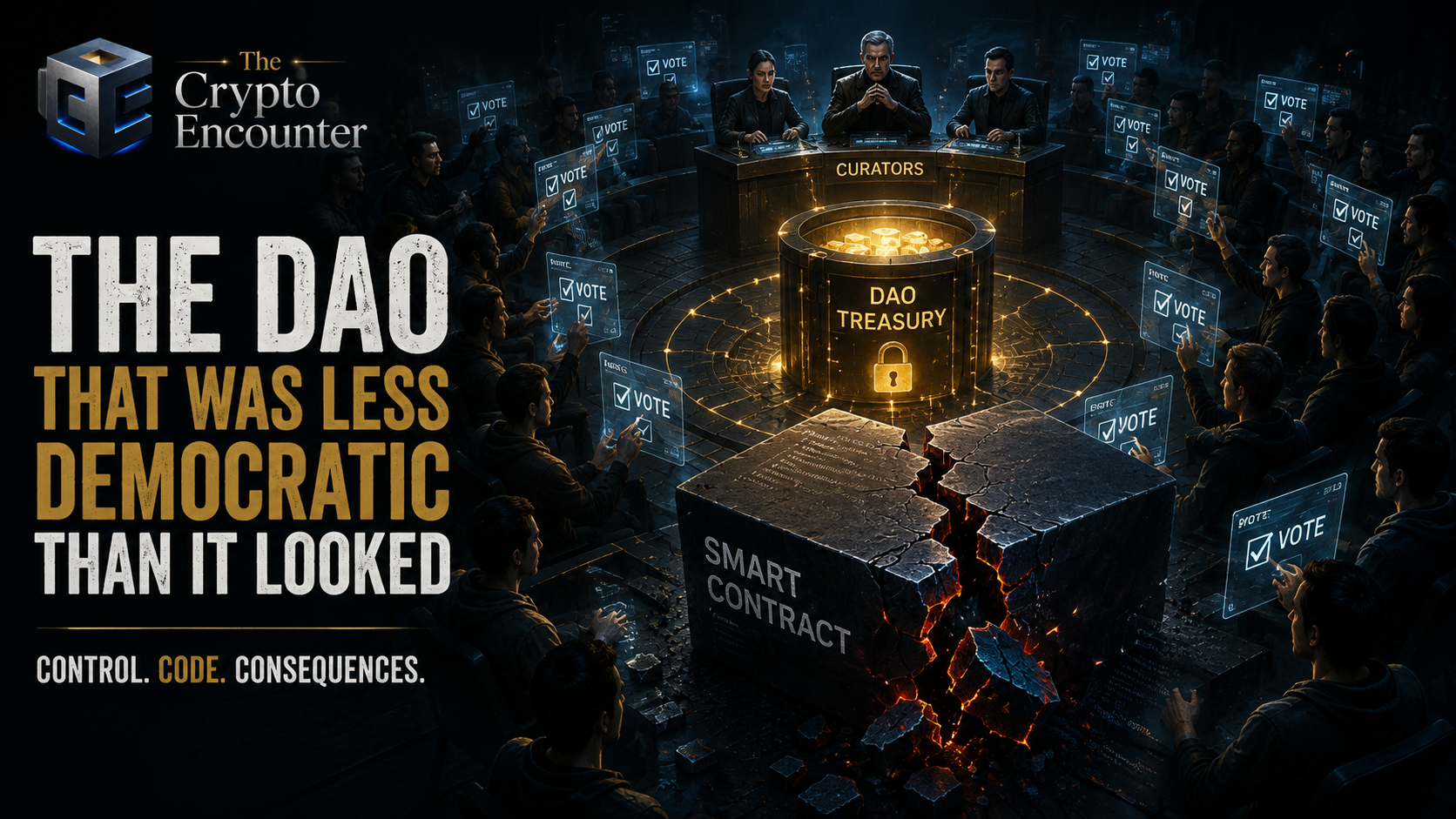
The DAO promised something that sounded radically democratic: investors could pool money, vote on proposals, and let software enforce the results without a traditional company controlling the process. Yet the reality exposed a harder lesson about decentralized finance. A DAO can remove a corporate custodian without removing concentrated influence, flawed incentives, vulnerable code, or user risk. In the case of The DAO, token-weighted voting, powerful curators, a flawed smart contract, and a controversial rescue eventually showed how much control still existed beneath the decentralized structure.
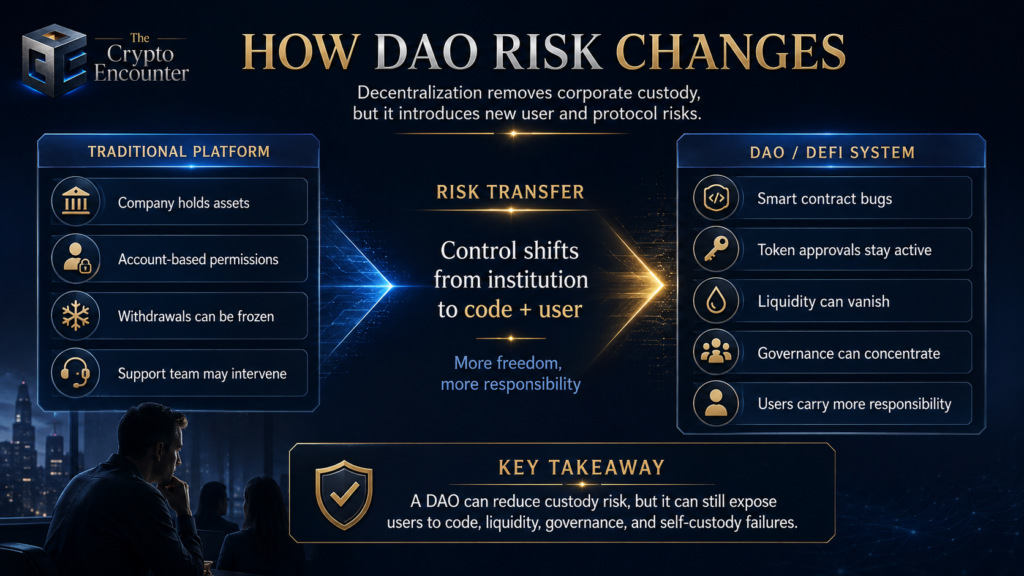
That distinction still matters. Modern DeFi users often interact directly with smart contracts, decentralized exchanges, lending markets, liquidity pools, and governance systems. Therefore, they may avoid handing assets to a conventional company. However, they also accept a different set of risks. Code can fail. Token approvals can remain active. Liquidity can disappear. Governance power can concentrate. Moreover, when something goes wrong, there may be no customer-service department capable of reversing the transaction.
The central lesson from The DAO is simple: decentralization changes who controls the system, but it does not automatically make the system democratic, safe, or forgiving.
What Was The DAO Supposed to Be?
The DAO launched on Ethereum in 2016 as an experimental form of decentralized investment organization. Instead of relying on executives or a conventional board, it planned to let token holders decide which projects should receive funding.
Investors exchanged Ether for DAO tokens. Those tokens gave holders voting and economic rights. According to the U.S. Securities and Exchange Commission’s later investigation, The DAO raised approximately 12 million ETH during its offering. At the time the offering closed, that Ether was worth roughly $150 million.
The concept looked unusually open.
A contractor could submit a project proposal. DAO token holders could then vote on whether the organization should fund it. Meanwhile, smart contracts would enforce many of the rules automatically.
In plain English, a smart contract is software running on a blockchain that performs predefined actions when its conditions are met. It can move funds, record votes, issue tokens, or interact with other programs without requiring an employee to manually approve each step.
That automation created an important advantage. Participants did not need to trust a single company to hold the pool of money.
Nevertheless, eliminating one trusted intermediary did not eliminate trust itself.
Users still had to trust the code, the governance design, the people controlling important administrative functions, and their own ability to understand what they were approving.
Why The DAO Was Less Democratic Than It Appeared
The strongest evidence comes from the governance mechanics themselves.
DAO token holders could vote, but votes were weighted according to the number of tokens they controlled. Someone holding substantially more tokens therefore had substantially more influence.
That system resembles shareholder voting more closely than one-person, one-vote democracy.
More importantly, token holders could not simply vote on every imaginable proposal.
Before a proposal reached them, one or more Curators had to review it. Slock.it, the company whose co-founders created The DAO, initially selected these Curators. According to the SEC’s investigation, the Curators maintained important control over which proposals could reach a vote and receive funding. They could also influence the order and frequency of proposals.
Consequently, the visible voting layer did not represent the entire control structure.
A useful analogy is an election in which citizens can vote freely, but a smaller committee decides which candidates may appear on the ballot. Voting still matters. Yet control over access to the ballot also matters.
The DAO contained another unusual governance problem.
Researchers warned before the exploit that its voting design could encourage holders to vote “yes” or abstain rather than vote “no.” Tokens used in a vote became temporarily restricted until that voting cycle ended. Tokens that did not participate remained transferable. The SEC later documented this concern in its report.
As a result, the DAO voting process could distort the signal it was supposed to capture.
A blockchain can record a vote perfectly while the voting system itself remains poorly designed.
That difference is crucial.
DAO Governance Does Not Automatically Mean Equal Control
The word “decentralized” often describes infrastructure. It does not necessarily describe the distribution of power.
A DAO may operate through public smart contracts while a small number of wallets still control most governance tokens. Likewise, a protocol may allow anyone to submit ideas while only a smaller group can move them toward execution.
Therefore, users should separate three questions.
First, who can vote?
Second, how much voting power does each participant possess?
Third, who controls what can actually reach a vote or become executable?
Those questions reveal more than the DAO label alone.
Token-weighted governance can also create a direct economic trade-off. Wealthier participants may gain more influence precisely because they own more of the governance asset. That arrangement may align financial exposure with decision-making power. However, it can also concentrate control.
Moreover, participation rates matter. A widely distributed DAO token does not guarantee widely distributed governance if most holders rarely vote.
A protocol can have thousands of token holders while a much smaller group determines important decisions.
The DAO Hack Exposed the Risk Behind “Code Is Law”
The governance problems became secondary when The DAO suffered a catastrophic technical failure.
In June 2016, an attacker exploited a flaw in its smart contract. The vulnerability allowed repeated withdrawals before the contract correctly updated its internal accounting. Ethereum’s official smart-contract security documentation identifies this class of attack as reentrancy and connects the technique directly to the 2016 DAO incident.
Ethereum’s historical record states that more than 3.6 million ETH was drained from the vulnerable DAO contract.
The important public lesson goes beyond the programming bug.
Users had removed a conventional corporate custodian from the equation. Yet they had placed enormous responsibility on software.
A bank can potentially freeze an erroneous transfer. A centralized exchange may sometimes suspend withdrawals during an incident. By contrast, a smart contract normally executes whatever its code permits.
Therefore, blockchain automation creates a different form of trust.
Instead of asking, “Do I trust this company with my money?” a DeFi user may need to ask, “Do I trust this code to behave correctly under every important condition?”
That is a much harder question than it sounds.
The DAO Rescue Revealed Another Layer of Control
After the exploit, Ethereum faced a difficult decision.
Community members debated whether the blockchain should effectively preserve the consequences of the attack or change Ethereum’s state so affected users could recover funds.
Ethereum ultimately implemented the DAO fork at block 1,920,000 on July 20, 2016. Ethereum.org states that the fork redirected funds from affected contracts into a withdrawal contract. Its historical account also says more than 85% of votes cast supported the fork.
However, not everyone accepted that decision.
Some participants continued using the original chain. That chain became Ethereum Classic.
This episode introduced a deeper question about DAO systems and decentralized networks.
If software rules the system, what happens when the community decides the software produced an unacceptable outcome?
The answer, at least in this case, was social governance.
Developers, miners, users, token holders, exchanges, and other stakeholders had to make human decisions about what should happen next.
Therefore, decentralization did not eliminate human judgment. Instead, it relocated that judgment into a more complicated network of participants.
DAO Risk Today Extends Beyond Governance Votes
The 2016 incident remains useful because modern DeFi has expanded the number of ways users can assume risk.
Consider token approvals.
When a user trades an ERC-20 token through a decentralized application, the application may ask for permission to spend tokens from the user’s wallet. That permission is called an allowance.
Ethereum’s ERC-20 documentation explains that an approved spender can transfer tokens on behalf of the owner up to the authorized amount. Some decentralized applications have historically requested large or unlimited allowances. Ethereum improvement proposals specifically identify persistent or unlimited approvals as a security concern because authorization can remain available long after the user completes the original interaction.
For example, imagine that Sarah connects her wallet to a DeFi application and approves unlimited spending of a stablecoin.
She deposits $500.
Months later, she may believe the interaction ended. Yet the approval could still exist.
If the approved contract, connected system, or relevant interface later becomes dangerous, that authorization can create additional exposure.
The important point is not that every approval is malicious. Rather, self-custody requires users to understand permissions that traditional financial applications often hide behind account controls.
A DEX Removes Custody, Not Every Form of Platform Risk
Decentralized exchanges illustrate the same trade-off.
On a centralized exchange, the company normally controls wallets and internal account balances. Therefore, users face direct custody risk. If withdrawals stop, the user may have limited immediate control.
Readers comparing those arrangements can also review why crypto exchanges are not banks, which explains why exchange custody does not necessarily provide the consumer protections associated with traditional banking.
A decentralized exchange can work differently. Users may trade directly from their wallets through smart contracts.
That reduces one important dependency.
Still, the DEX model introduces others.
Users depend on contract security. They must verify the network and token. They may need to understand approvals. Meanwhile, trades can suffer from low liquidity or high price impact. A compromised interface may also try to direct users toward dangerous transactions even when the underlying blockchain continues operating correctly.
Consequently, “non-custodial” does not mean “risk-free.”
It means custody risk has changed form.
DAO and DeFi Liquidity Can Disappear When Users Need It Most
Liquidity creates another frequently misunderstood risk.
Liquidity simply describes how easily an asset can be bought or sold without causing a large price change.
Suppose a token appears to trade at $1.
A user holding $100 might successfully sell near that price. However, someone trying to sell $100,000 into a shallow liquidity pool could receive far less than expected because the transaction itself pushes the price downward.
Therefore, the displayed token price does not tell users how much money they can actually exit with.
A DAO treasury can face similar problems.
A treasury may look valuable because it holds millions of dollars in governance tokens. Yet if those tokens trade in thin markets, converting a large position into stable assets may severely affect the price.
The distinction between accounting value and realizable liquidity becomes especially important during stress.
When many holders attempt to exit simultaneously, liquidity conditions can deteriorate quickly.
High Yield Does Not Remove the Need to Ask Where the Return Comes From
DeFi yields create another layer of responsibility.
A protocol may offer users returns for supplying liquidity, lending tokens, staking assets, or accepting additional market risk.
However, an advertised percentage does not explain the economic source of the yield.
Users should ask what produces the return.
Borrowers may be paying interest. Traders may be paying transaction fees. A protocol may distribute newly issued tokens. Alternatively, temporary incentives may subsidize returns.
Each source carries different risks.
Moreover, a high headline yield can distract from the value of the asset being earned. Receiving a large number of reward tokens does not help if those tokens lose most of their market value.
Therefore, a DAO or DeFi protocol should never be evaluated only by its advertised annual percentage yield.
The underlying cash flow, token economics, liquidity, contract design, and governance structure matter more.
What Ordinary Users Actually Control in a DAO System
Self-custody gives users something powerful: direct control over cryptographic keys and blockchain assets. That distinction becomes clearer in our guide to the difference between owning crypto and controlling crypto, which explains how custody can separate ownership from practical control.
Yet control also creates responsibility.
A user who controls the wallet must protect the recovery phrase. That person must check wallet signatures, verify addresses, review token approvals, understand the network being used, and decide which smart contracts deserve access.
The Crypto Encounter’s own risk policy similarly notes that self-custody users remain responsible for wallets, private keys, seed phrases, approvals, and transactions, while phishing, exploits, or lost credentials can cause permanent losses.
That does not make decentralized systems inherently worse than centralized ones.
It makes the risk allocation different.
A bank customer delegates substantial responsibility to the institution. A DeFi participant may reclaim much of that control. Consequently, the participant also inherits tasks that institutions traditionally handle.
Five Questions to Ask Before Trusting a DAO or DeFi Protocol
Readers do not need to audit Solidity code to make better decisions.
Instead, several practical questions can reveal where control and risk actually sit.
- Who can change the protocol?
Check whether governance token holders control upgrades, whether administrators retain special keys, and whether a smaller security council or multisignature wallet has emergency powers.
- How concentrated is voting power?
A DAO with open voting can still have concentrated governance if a few wallets control a large share of votes.
- What permissions am I granting?
Before approving tokens, check the asset, spending limit, contract, and duration. Revisit old approvals when they are no longer needed.
- Can I actually exit?
Look beyond the quoted token price. Consider trading depth, liquidity, withdrawal mechanics, lockups, and potential price impact.
- What happens when something breaks?
Examine whether the system can pause contracts, upgrade code, reimburse users, or take emergency action. If nobody can intervene, understand what that means. If administrators can intervene, understand who they are.
These questions expose the actual control structure far better than a decentralized label.
What The DAO Changed for Crypto Regulation
The DAO also became an important U.S. regulatory case.
In July 2017, the SEC concluded that DAO tokens, under the facts it examined, were securities. The regulator emphasized that blockchain technology and decentralized terminology do not automatically remove an arrangement from U.S. securities laws.
That conclusion matters because technical decentralization and legal classification answer different questions.
A protocol may distribute voting among token holders while still creating legal obligations for the people or entities involved.
Likewise, automated software does not eliminate accountability simply because a blockchain executes the transactions.
Regulation varies by jurisdiction and continues to evolve. Therefore, users should avoid assuming that a DAO label provides a particular legal status.
The Lasting Lesson From The DAO
The most useful lesson from The DAO is not that decentralized finance failed.
Instead, the episode showed that decentralization moves risk around.
Corporate custody can become smart-contract risk. Management discretion can become token governance. Account permissions can become wallet approvals. Market-maker dependence can become liquidity-pool dependence. Customer support can become personal responsibility.
Meanwhile, human influence does not disappear simply because software performs the final transaction.
The DAO offered token holders a real ability to vote. Yet Curators controlled important gateways, voting incentives could distort participation, ownership determined voting weight, vulnerable code controlled enormous sums, and Ethereum’s wider community eventually had to decide how to respond when that code failed.
For ordinary users, that history remains highly relevant.
Before trusting any DAO, DEX, lending protocol, or yield product, the better question is not simply whether it is decentralized.
Ask where the control went, who can exercise it, what the code can do, what permissions you granted, how easily you can exit, and who carries the loss if the system fails.
That is where the real risk usually becomes visible.
FAQs
What is a DAO?
A DAO, or decentralized autonomous organization, is an organization that uses blockchain-based rules and smart contracts to coordinate decisions, assets, or governance. Different DAOs distribute control differently, so the label alone does not guarantee equal voting power or complete decentralization.
Why was The DAO less democratic than it appeared?
DAO token holders could vote, but voting power depended on token ownership. In addition, Curators selected by Slock.it controlled important aspects of which proposals could reach voters. Researchers also identified incentives that could favor yes votes or abstention.
What happened to The DAO in 2016?
An attacker exploited a smart-contract vulnerability and drained more than 3.6 million ETH from affected contracts. Ethereum later implemented a hard fork that enabled recovery of the affected funds.
Is a DAO safer than a centralized company?
Not automatically. A DAO can reduce certain custody or management risks, but users may instead face smart-contract vulnerabilities, concentrated governance, liquidity problems, malicious approvals, operational failures, and greater personal responsibility.
What is a token approval?
A token approval gives another blockchain address or smart contract permission to spend a specified amount of tokens from a user’s wallet. Large or persistent approvals can create additional exposure if the approved spender later becomes unsafe.
Does self-custody remove platform risk?
No. Self-custody gives users direct control over their keys, but they can still interact with vulnerable contracts, deceptive interfaces, illiquid markets, or unsafe token approvals. Users also become responsible for wallet security and transaction verification.
Disclaimer
This article is for informational and educational purposes only. It does not provide financial, investment, legal, tax, or accounting advice. Cryptocurrency and digital asset markets involve risk, including possible loss of capital. Readers should conduct their own research before making any financial decision.