

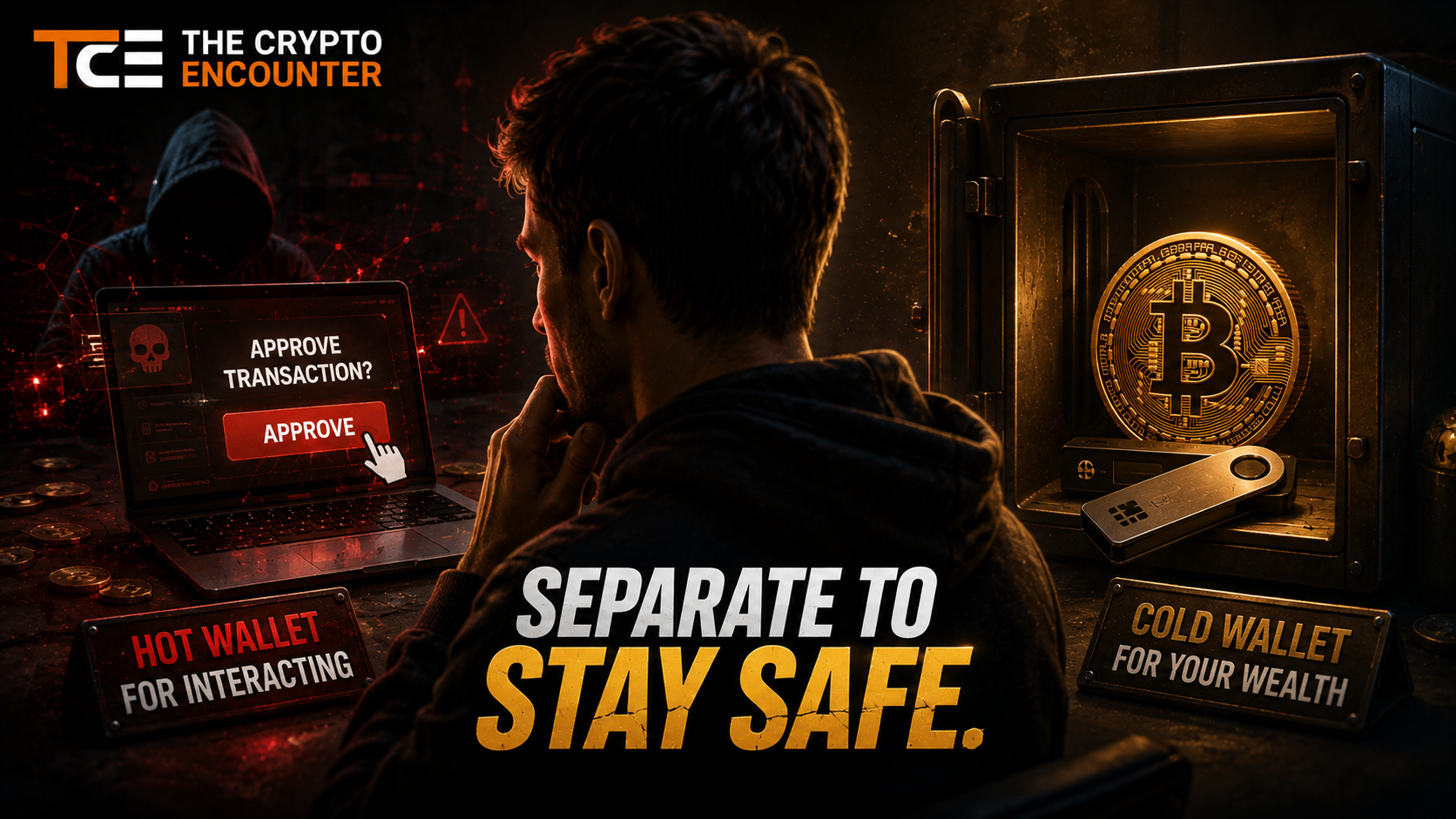
The single most effective habit in DeFi security has nothing to do with picking safer protocols. It’s keeping the wallet you use to connect to websites, approve contracts, and try new platforms completely separate from the wallet that holds the bulk of your savings. In December 2021, attackers drained roughly $120 million from BadgerDAO users, and blockchain data on the incident showed the attacker deliberately targeted wallets holding larger balances, including one user who lost roughly 900 Bitcoin in a single transaction. The protocol’s smart contracts were never touched. The attacker compromised the website’s front end instead, and every wallet that had approved a transaction through that compromised interface was exposed, regardless of how careful its owner had otherwise been.
That distinction, between the risk inside a smart contract and the risk sitting in a wallet connected to whatever website happens to serve that contract’s interface, is exactly what the wallet separation rule is built to address.
Key Facts
| Fact | Detail | Source |
|---|---|---|
| BadgerDAO hack, total loss | Approximately $120 million stolen in December 2021 after an attacker compromised a Cloudflare API key and injected a malicious script into BadgerDAO’s website | CoinDesk, “BadgerDAO Reveals Details of How It Was Hacked for $120M” |
| How the attack actually worked | The injected script silently added unlimited spending approvals to a malicious address whenever a user attempted a normal transaction on the site, without altering the underlying smart contracts at all | Halborn, “Explained: The BadgerDAO Hack” |
| Attacker’s targeting method | The script was applied selectively over a roughly three-week period and, according to a technical post-mortem, specifically avoided the protocol’s own multisig signers while targeting wallets holding larger balances | Quadriga Initiative, incident case study |
| Largest single loss and institutional exposure | One user lost roughly 900 Bitcoin in the attack; Celsius Network’s CEO later confirmed the lending platform itself lost $50 million in the same incident | CryptoSlate, “Bitcoin DeFi tool BadgerDAO hit by estimated $120 million hack” |
TL;DR
- The wallet separation rule means using one wallet, holding only a small, disposable balance, for connecting to DeFi sites and approving smart contracts, while keeping the bulk of your holdings in a separate wallet that never interacts with a dApp at all.
- BadgerDAO’s $120 million hack didn’t involve any flaw in the protocol’s audited smart contracts. The attacker compromised the website serving those contracts and used it to collect unlimited spending approvals from users’ wallets.
- The attacker specifically targeted wallets holding larger balances, which means the size of the balance sitting in your interaction wallet directly affects how attractive a target you are, independent of how careful you are about clicking links.
- This isn’t only a retail investor problem. Celsius Network, a major institutional crypto lender, lost $50 million in the exact same incident.
- No amount of caution about phishing links protects you if the legitimate website itself has been compromised, which is precisely why wallet separation, not vigilance alone, is the more durable defense.
What the Wallet Separation Rule Actually Means
In practice, the rule works like this: maintain at least two wallets, structurally separated, each with a distinct job. One, sometimes called a hot or interaction wallet, is used for everything that involves signing a transaction on a website: connecting to a DeFi protocol, minting an NFT, claiming an airdrop, trying a new platform. This wallet should hold only an amount you’d be comfortable losing entirely, funded incrementally as needed rather than kept flush with a large balance by default. The other, a storage wallet, holds the bulk of your actual savings and never connects to a website, never signs a dApp transaction, and ideally lives on a hardware device that’s only used to receive and occasionally move funds directly between your own addresses.
This isn’t a workaround for a specific kind of scam. It’s a structural response to the fact that a DeFi transaction’s risk isn’t limited to whatever smart contract you think you’re interacting with. It also includes the website serving you that contract’s interface, the browser extension relaying your signature, and any other piece of software sitting between you and the blockchain, all of which are potential points of compromise entirely outside the protocol’s own code.
Why BadgerDAO Is the Case That Proves the Rule
BadgerDAO was, by most accounts, a well-regarded DeFi protocol with properly audited smart contracts. The attack that cost its users $120 million in December 2021 never touched that audited code. Instead, according to Halborn’s technical breakdown of the incident, an attacker compromised a Cloudflare API key connected to BadgerDAO’s website and used it to inject a malicious script directly into the site’s front end. That script activated selectively, and when it did, it silently attached an additional, unlimited spending approval to whatever legitimate transaction a user was already trying to complete, granting the attacker’s address permission to move funds from that user’s wallet at will.
What makes this case especially relevant to the separation rule is a detail from the technical post-mortem published after the incident: the attacker’s script ran intermittently over roughly three weeks and, according to that analysis, specifically avoided targeting wallets belonging to Badger’s own multisig signers while deliberately targeting wallets holding larger balances. In other words, the size of the balance connected to the compromised interface was itself a variable the attacker was actively selecting for. A user who had connected a wallet holding a small, disposable amount would have represented a far less attractive target than one who had connected a wallet holding a significant fraction of their net worth, exactly the distinction the separation rule is meant to create in advance.
This Isn’t Just a Retail Mistake
It would be easy to read BadgerDAO’s case as a lesson only for individual users who weren’t careful enough. The details argue against that framing. One of the affected users lost approximately 900 Bitcoin in a single transaction, worth tens of millions of dollars at the time, and Celsius Network, a major institutional crypto lending platform with its own security and treasury operations, confirmed it lost $50 million in the very same incident. If a professional lending institution’s operational wallet was exposed by connecting to a legitimate, previously trusted protocol’s compromised front end, the lesson isn’t really about individual carelessness. It’s about the structural fact that any wallet connected to any website carries a distinct category of risk that no amount of institutional sophistication fully removes, only wallet segregation meaningfully reduces.
Comparison: Single-Wallet Use vs. Separated-Wallet Use
| Single Wallet for Everything | Separated Interaction and Storage Wallets | |
|---|---|---|
| Exposure if a dApp’s front end is compromised | Your entire balance is at risk | Only the small balance in your interaction wallet is at risk |
| Exposure if you approve a malicious contract by mistake | Your entire balance is at risk | Limited to whatever the interaction wallet currently holds |
| Convenience | Simpler day-to-day, one wallet to manage | Requires deliberately moving funds between wallets as needed |
| How attractive a target you are to a selective attacker | High, especially if your wallet is known or visibly holds significant funds | Low; a near-empty interaction wallet offers little incentive to target specifically |
| Real-world outcome under this exact scenario | Celsius and individual BadgerDAO users with large connected balances lost significant funds | Users with minimal balances connected to the same compromised site had comparably little exposed |
Practical Guidance
- Maintain a dedicated interaction wallet funded only with what you’re actively using for a specific DeFi activity, and refill it as needed rather than keeping it consistently well-funded.
- Keep your primary holdings in a separate wallet, ideally a hardware wallet, that never connects to a website or approves a smart contract transaction.
- Periodically review and revoke old token approvals granted from your interaction wallet using a reputable revocation tool tied to a block explorer, since unused approvals remain a standing risk even after you’ve stopped using a given protocol.
- Treat a protocol’s reputation and audit history as relevant to smart contract risk specifically, not as a guarantee against front-end compromise, since BadgerDAO had both a solid reputation and audited contracts when its website was compromised.
- If you manage funds for an organization or on behalf of others, apply the same separation principle at the operational level, since Celsius’s $50 million loss shows institutional treasury management is not automatically exempt from this risk.
What Happens Next
Expect front-end compromises to remain a persistent DeFi risk category distinct from smart contract exploits, since protocols increasingly invest heavily in contract audits while website infrastructure, content delivery networks, and API key management often receive comparatively less security attention. Wallet software providers have continued adding clearer transaction-preview features intended to make an unexpected approval more visible before signing, but as BadgerDAO showed, an attacker who fully controls the interface can make a malicious request look identical to a legitimate one. Until interface-layer security matches the scrutiny given to smart contract code, the practical responsibility for limiting exposure will continue to fall on how users structure their own wallets, not on how a given protocol markets its audit history.
FAQs
If a DeFi protocol’s smart contracts are fully audited, is it safe to connect my main wallet?
Not necessarily. BadgerDAO’s smart contracts were properly audited and were never compromised in its 2021 hack. The attacker instead compromised the protocol’s website, a layer that audits of smart contract code don’t cover.
How much money should I keep in a DeFi interaction wallet?
Only what you’re actively using for a specific transaction or activity, refilled as needed. The BadgerDAO attacker specifically targeted wallets holding larger balances, so keeping a low balance in your interaction wallet directly reduces how attractive a target you present.
Did only inexperienced users lose funds in the BadgerDAO hack?
No. Celsius Network, a major institutional crypto lending platform, confirmed it lost $50 million in the same incident, showing this risk applies regardless of sophistication if wallet separation isn’t practiced.
Does wallet separation protect against every kind of DeFi risk?
No single practice eliminates every risk. It specifically limits how much is exposed if the wallet you use to interact with a website is compromised, whether through a malicious front end, a phishing site, or a fraudulent approval request.
Sources
- CoinDesk, “BadgerDAO Reveals Details of How It Was Hacked for $120M”
- Halborn, “Explained: The BadgerDAO Hack (December 2021)”
- Quadriga Initiative, “Dec 2021 – BadgerDAO Malicious Code Injected”
- CryptoSlate, “Bitcoin DeFi tool BadgerDAO hit by estimated $120 million hack”
This article is for educational purposes and does not constitute financial or legal advice. No wallet configuration eliminates the risk of loss when interacting with DeFi protocols. If you are making decisions about how to structure significant crypto holdings, consider consulting a licensed financial advisor.