

The Short Answer
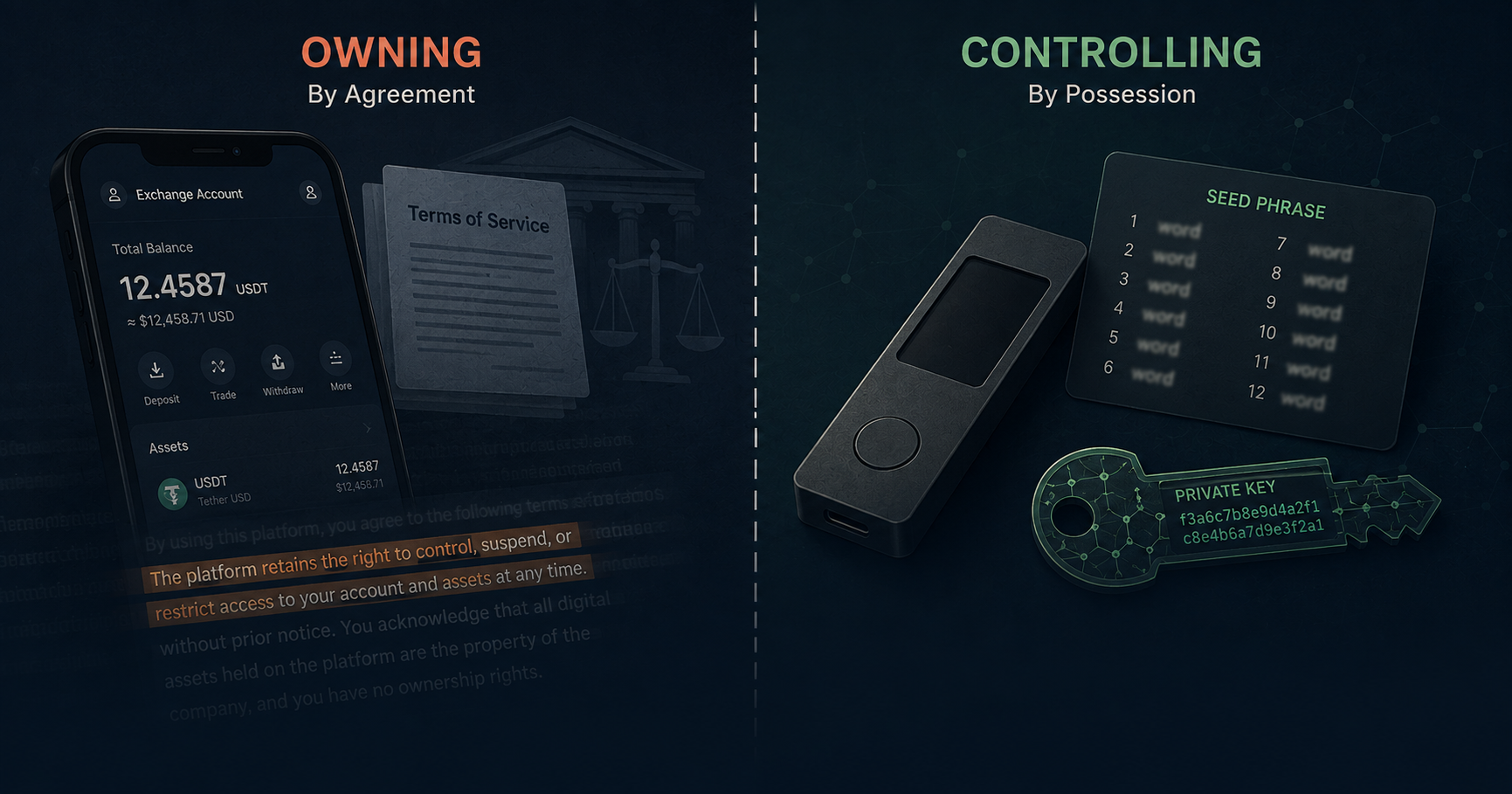
Owning crypto means you have a claim to it. Controlling crypto means you can actually move it without asking anyone’s permission. Those sound like the same thing, and on a self-custody wallet they usually are. On an exchange, a lending platform, or almost any account where someone else holds the keys, they can come apart completely, and a bankruptcy court, not the blockchain, ends up deciding who was right.
That gap has already cost hundreds of thousands of people their savings, not through a hack, but through the ordinary, boring mechanics of contract law. Understanding where ownership and control separate is one of the few pieces of crypto knowledge that can genuinely prevent a loss before it happens, rather than just explain one after the fact.
Key Facts
| Case | What Happened | Outcome for “Owners” | Source |
|---|---|---|---|
| Celsius Network Earn Accounts | ~600,000 accounts, roughly $4.2 billion in assets, deposited under terms of service | A bankruptcy judge ruled customers transferred ownership to Celsius; depositors became unsecured creditors | Judge Martin Glenn, In re Celsius Network LLC, Jan. 4, 2023 |
| QuadrigaCX | Founder Gerald Cotten died in December 2018; roughly $190 million (CAD) in customer crypto reported missing | Ontario Securities Commission found most of the shortfall, about $115 million (CAD) of a total $169 million (CAD), came from Cotten’s fraudulent trading, not lost keys | Ontario Securities Commission, QuadrigaCX investigative report, June 2020 |
| Mt. Gox | Exchange collapsed in 2014 after losing roughly 850,000 bitcoin | Creditors waited over a decade; base repayments to remaining creditors began only in 2024–2025 | Mt. Gox Rehabilitation Trustee public filings |
TL;DR
- “Not your keys, not your coins” is a real legal principle, not just a slogan. Courts have ruled on exactly this question.
- Depositing crypto into an exchange or lending account is often, legally, a transfer of ownership under that platform’s terms of service, not a storage arrangement.
- QuadrigaCX is usually told as a story about a founder who died with the only keys. The regulator’s own investigation found that framing was largely wrong: most of the money was gone before he died, taken through fraud.
- Self-custody solves the ownership problem but replaces it with a different one: total personal responsibility, with no institution to sue and no support line to call if something goes wrong.
- Whether you “own” crypto sitting on a platform depends on documents almost nobody reads before clicking accept.
What “Owning” Actually Means in Crypto
In everyday language, owning crypto means it shows up as a balance somewhere with your name on it. Legally, that’s not what determines ownership. What determines it is the underlying agreement governing that balance, and on centralized platforms, that agreement is the terms of service.
When Celsius Network filed for bankruptcy in 2022, the central legal question wasn’t whether the company owed customers money. It was whether the crypto sitting in customer “Earn” accounts still belonged to the customers at all, or whether it had become Celsius’s property the moment it was deposited. On January 4, 2023, Judge Martin Glenn of the U.S. Bankruptcy Court for the Southern District of New York ruled that Celsius’s terms of service, which customers had accepted through a standard clickwrap agreement, unambiguously transferred title and ownership of those assets to Celsius. Roughly 600,000 accounts holding about $4.2 billion in assets were affected. Customers weren’t victims of a hack. They were, legally, unsecured creditors waiting in line behind other claims, because a contract most of them never read had already settled the ownership question before the company ever collapsed.
This is the mechanism competing coverage of crypto exchange collapses tends to skip past. The headline is usually “customers lost their crypto.” The more accurate and more useful headline is “a contract determined customers never legally owned what they thought they owned.”
The QuadrigaCX Story Isn’t the Story Most People Remember
QuadrigaCX is frequently cited as the ultimate cautionary tale about self-custody risk: a founder, Gerald Cotten, died suddenly in December 2018 while the only person who knew the exchange’s private keys, and roughly $190 million (CAD) in customer crypto reportedly became permanently inaccessible.
The actual investigation tells a different story. The Ontario Securities Commission’s 2020 report, based on analysis of more than 368,000 client accounts and six million transactions, found that the platform’s collapse was the result of fraud, not a lost-keys accident. Cotten had opened accounts under aliases, credited himself with fictitious balances, and traded against unsuspecting Quadriga clients for years, running what the OSC described as an old-fashioned Ponzi scheme wrapped in crypto terminology. Of the roughly $169 million (CAD) in total client losses the OSC documented, approximately $115 million (CAD) came directly from Cotten’s fraudulent trading activity, not from crypto becoming technically unreachable after his death.
This distinction matters because it shows control can be a fiction just as easily as ownership. Quadriga customers didn’t lose their money because nobody controlled the keys. They lost it because the person who controlled the keys had already spent much of what they thought was still there. A platform claiming exclusive control over customer assets is only as trustworthy as the person or company holding that control, and there was no external check on Cotten’s actions until it was far too late.
Custodial vs. Self-Custody: Where the Risk Actually Moves
| Custodial (Exchange/Platform) | Self-Custody (Personal Wallet) | |
|---|---|---|
| Who holds the private keys | The platform | You |
| What you legally have | A claim defined by the platform’s terms of service | Direct ownership of an on-chain asset |
| Risk if the platform fails | Ownership may not survive bankruptcy, as in Celsius | Not applicable; there is no platform to fail |
| Risk if you make a mistake | Platform may have account recovery options | Often no recovery option if keys or seed phrase are lost |
| Risk if the custodian is dishonest | Fraud can go undetected for years, as in QuadrigaCX | Not applicable; you are the custodian |
| Legal recourse if something goes wrong | Bankruptcy court, unsecured creditor claims, or litigation | Generally none; blockchain transactions are final |
Neither column is simply “safer.” Custody concentrates risk in an institution you’re trusting to be both honest and solvent. Self-custody concentrates risk in you, permanently, with no fallback if you lose a device, forget a passphrase, or don’t tell anyone how to access your assets if you die.
The Regulatory Gap Behind All of This
There is currently no unified federal framework in the United States that automatically protects crypto held on a platform the way FDIC insurance protects a bank deposit or SIPC coverage protects a brokerage account. Whether customer crypto counts as the platform’s property or the customer’s property in a bankruptcy is decided case by case, based on the specific contract language a court is asked to interpret. Celsius’s outcome turned on its Earn Account terms of service; Judge Glenn’s ruling explicitly did not decide ownership for Celsius’s separate Custody Program or Borrow Program accounts, which operated under different terms.
This means two customers of two different platforms, holding what looks like the same kind of crypto balance, can have completely different legal rights depending entirely on wording most users scroll past. Regulators, including state securities agencies, have raised concerns about this gap, but as of this writing there is no comprehensive U.S. rule requiring platforms to segregate customer crypto from company assets the way securities law requires for a traditional brokerage.
Practical Guidance
- Before depositing crypto on any platform, check whether its terms of service describe your assets as held “on your behalf” (custodial, ownership likely retained) or as being “transferred,” “loaned,” or used to generate yield (ownership may pass to the platform).
- Treat any product promising fixed returns on deposited crypto, like Celsius’s Earn program once did, as a lending arrangement with credit risk, not a savings account.
- If you hold crypto in self-custody, create a documented, secure plan for what happens to your seed phrase if you become incapacitated or die. QuadrigaCX shows what happens when only one person knows the access details, whether that person is honest or not.
- Diversify custody. Holding meaningful savings entirely on one exchange or entirely in one uninsured self-custody wallet concentrates a different kind of risk in each case.
- Read exchange bankruptcy disclosures and 10-Q filings when available. Coinbase, for example, has disclosed in SEC filings that customer assets could become subject to bankruptcy proceedings in an insolvency event.
What Happens Next
Expect continued legal disputes rather than a quick regulatory fix. The Celsius precedent will likely be cited in future crypto platform bankruptcies, and courts will keep parsing whatever terms of service each company used at the time. Meanwhile, self-custody tools focused on inheritance and multi-party key recovery are becoming more common, a direct response to the QuadrigaCX-style single point of failure. Ownership and control will likely keep drifting apart on custodial platforms until, and unless, regulation requires clearer, standardized language about what happens to customer crypto when a platform fails.
FAQs
If I deposit crypto on an exchange, do I still own it? It depends entirely on that platform’s terms of service. Some structures preserve customer ownership; others, like Celsius’s Earn program, were ruled to transfer ownership to the company itself.
Is self-custody automatically safer than using an exchange? Not automatically. It removes platform bankruptcy and fraud risk but replaces it with full personal responsibility for key security, backup, and inheritance planning, with no institution to appeal to if something goes wrong.
Did QuadrigaCX customers lose money because the founder died? Not primarily. Ontario’s securities regulator found most of the shortfall came from years of fraudulent trading by the founder, not from crypto becoming inaccessible after his death.
Is there deposit insurance for crypto held on an exchange? No equivalent to FDIC or SIPC coverage currently exists at the federal level for crypto assets held on most platforms in the United States.
Sources
- Judge Martin Glenn, Memorandum Opinion, In re Celsius Network LLC, Case No. 22-10964 (MG), Bankr. S.D.N.Y., Jan. 4, 2023
- Ontario Securities Commission, QuadrigaCX: A Review by Staff of the Ontario Securities Commission (2020)
- CBC News, “Crypto exchange Quadriga was a fraud and founder was running Ponzi scheme, OSC report finds”
- Mt. Gox Rehabilitation Trustee, official creditor repayment notices
This article is for educational purposes and does not constitute financial or legal advice. Cryptocurrency held on third-party platforms may not be legally protected as customer property. Self-custody carries its own risks, including permanent loss of access. If you are making decisions about custody of significant assets, consider consulting a licensed attorney or financial advisor.