

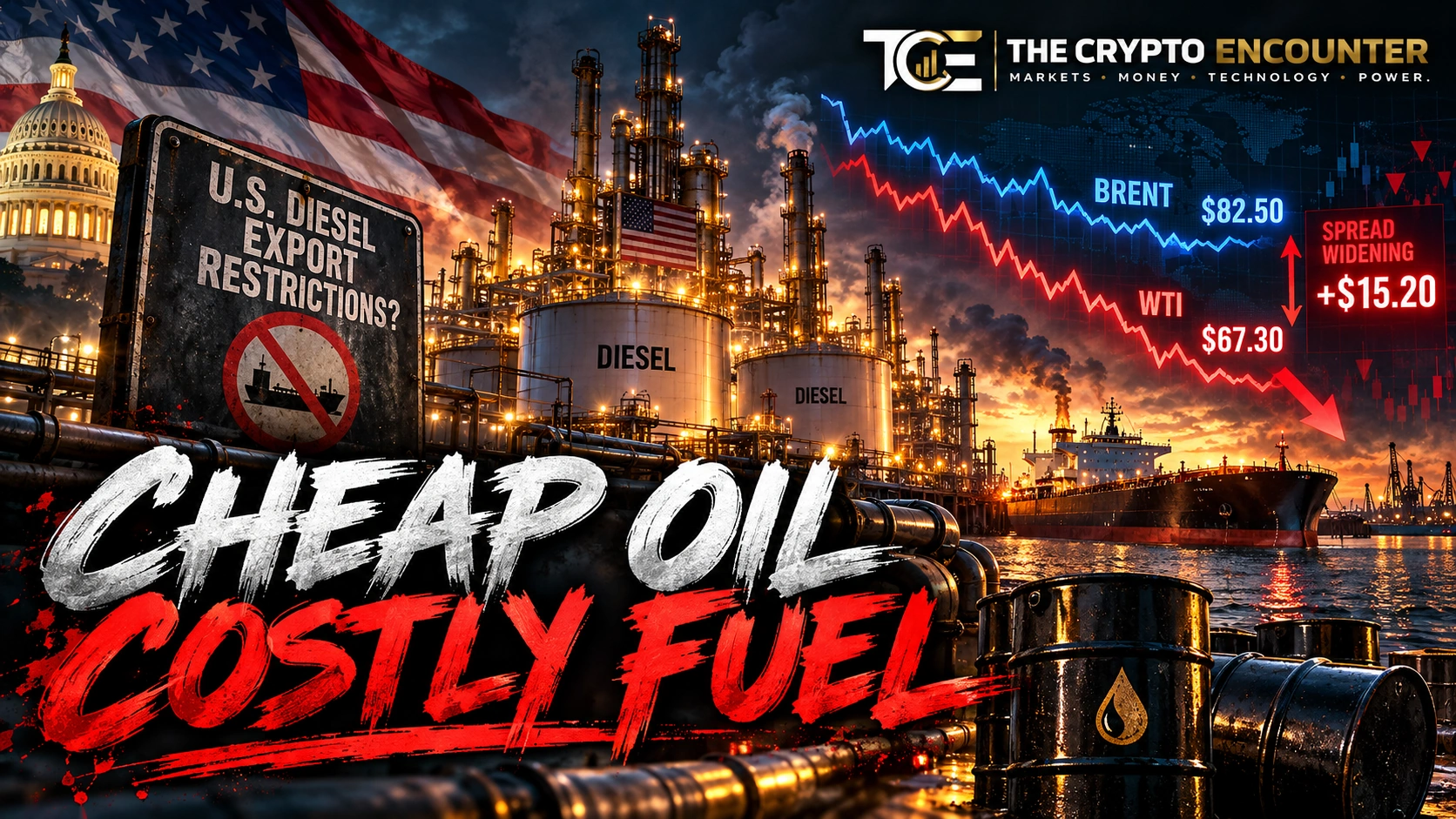
America is debating how to make diesel cheaper. The oil market is warning that one proposed solution could make U.S. crude cheaper first and other fuels more expensive later.
Talk of restricting U.S. diesel exports has pushed the price gap between West Texas Intermediate crude and the international Brent benchmark to its widest level in months.
WTI traded as much as $12.02 per barrel below Brent on September 24, according to LSEG data cited by Reuters.
That is not simply an oil-price curiosity.
It is the market trying to price what happens if U.S. refiners lose access to overseas buyers for one of their most important products.
A diesel export restriction could initially keep more diesel inside the United States and potentially relieve some domestic price pressure.
But refiners cannot keep producing unlimited diesel if storage fills and foreign buyers disappear.
Eventually, they may have to process less crude.
Less crude processing also means less gasoline, less jet fuel and fewer other refined products.
That is where the policy becomes counterintuitive.
The same measure intended to increase domestic diesel availability could reduce total U.S. refinery output and put upward pressure on other fuel prices.
The widening WTI-Brent spread suggests traders are already taking that possibility seriously.
- WTI traded as much as $12.02 per barrel below Brent, its widest discount since May 6.
- The widening spread reflects expectations that U.S. refiners could process less crude if diesel exports are restricted.
- Analysts cited by Reuters estimate refinery crude runs could fall by more than 2 million barrels per day in a full-ban scenario.
- The United States is a major diesel exporter, with roughly 1.2 million barrels per day of net exports according to Morgan Stanley figures cited by Reuters.
- The White House has denied that it is preparing a flat 90-day export ban.
- Energy Secretary Chris Wright has argued that a ban could eventually increase gasoline and jet-fuel prices.
- U.S. diesel inventories remain unusually low while global distillate supply is constrained.
- High diesel prices matter beyond motorists because diesel powers trucking, agriculture, rail freight and heavy equipment.
- Persistent fuel inflation could complicate Federal Reserve policy and affect stocks, bonds, commodities and crypto markets.
Why Is WTI Trading So Far Below Brent?
WTI and Brent are both crude-oil benchmarks, but they represent different physical markets.
WTI is the primary U.S. benchmark.
Brent is the dominant international benchmark for crude traded across much of the global market.
WTI frequently trades below Brent because of differences in location, transportation, crude quality and regional supply-demand conditions.
But a discount of more than $12 per barrel is unusually wide.
The reason matters.
Markets are not simply saying there is too much American crude.
They are increasingly questioning how much crude U.S. refiners would want to process if they could no longer freely export the diesel produced alongside gasoline, jet fuel and other petroleum products.
On September 25, Brent settled at $104.32 per barrel while WTI closed at $92.41, leaving a spread of almost $12.
That gap reflects both domestic and international forces.
Global crude remains supported by supply concerns linked to the Middle East.
U.S. crude faces a different problem: potentially weaker refinery demand at home combined with expensive transportation abroad.
This is a useful example of why commodity markets cannot be understood from one headline price.
The Crypto Encounter’s broader analysis of oil, inflation and Federal Reserve policy has already shown how the same energy shock can produce completely different signals across crude, bonds, currencies, gold and Bitcoin.
Would a US Diesel Export Ban Actually Lower Diesel Prices?
Possibly in the short term.
That is the logic behind the proposal.
If diesel that would normally be shipped overseas remains inside the United States, domestic inventories could initially rise.
Greater local supply could reduce pressure on wholesale diesel prices.
The problem begins when storage fills.
Diesel is not produced independently from the rest of a refinery.
A refinery takes crude oil and converts it into several products, including:
- diesel and other distillates;
- gasoline;
- jet fuel;
- petrochemical feedstocks;
- heating oil; and
- other petroleum products.
If a refiner cannot sell enough diesel, it cannot simply keep running at full capacity indefinitely while allowing diesel tanks to overflow.
It eventually has to reduce refinery throughput.
That means buying less crude and producing less of everything else.
This is why U.S. Energy Secretary Chris Wright has publicly argued that a blanket export ban could become counterproductive.
How Much Could US Refinery Output Fall?
The estimates are significant.
Wood Mackenzie analysts cited by Reuters calculated that blocking diesel exports could leave roughly 700,000 barrels per day of excess diesel and gasoil inside the United States.
At that rate, Gulf Coast storage could reach capacity in a little over one month.
To avoid overflowing storage, refiners could then have to cut crude runs by more than 2 million barrels per day.
That would represent roughly 12% of current U.S. refinery crude throughput.
| Potential Market Effect | Why It Could Happen |
|---|---|
| More Domestic Diesel Initially | Exports remain inside the United States |
| Diesel Storage Fills | Refiners lose access to overseas buyers |
| Refinery Runs Decline | Plants cannot indefinitely produce unwanted diesel |
| WTI Demand Weakens | Refiners require less domestic crude |
| Gasoline Output Declines | Less crude processing produces less gasoline too |
| Jet-Fuel Output Declines | The same refinery throughput supports aviation fuel production |
This is the mechanism behind the widening WTI discount.
Markets are pricing crude demand before any hypothetical refinery cuts have actually occurred.
Why Can Cheaper WTI Still Mean More Expensive Fuel?
This is the part that sounds wrong until the refining economics are separated from crude prices.
Crude oil is an input.
Diesel, gasoline and jet fuel are finished products.
The price of an input can fall while the price of the finished product rises if the bottleneck sits between them.
That bottleneck is currently refining capacity and distillate availability.
Imagine wheat becoming cheaper while half the country’s bakeries close.
Cheap wheat does not guarantee cheap bread when bakery capacity is the constraint.
The same principle applies here.
Cheaper WTI helps refiners by lowering one input cost.
But if export restrictions force refineries to cut operations, fewer barrels of finished fuel reach the market.
Energy Secretary Wright has specifically warned that this could put upward pressure on gasoline and jet fuel.
That is also why energy prices matter to the wider economy far beyond the oil market. Transportation costs eventually appear in manufacturing, food distribution, travel and consumer inflation.
Why Is Diesel So Expensive in the United States?
The current diesel problem is not primarily the result of insufficient U.S. crude production.
It is a refined-product shortage occurring inside a disrupted global market.
The U.S. Energy Information Administration reported that average U.S. retail diesel prices reached $6.29 per gallon on September 14.
Reuters reported prices above $6.50 later in the month.
Several pressures are working together.
Middle Eastern diesel exports have been disrupted by war and shipping constraints.
Russian refinery output and exports have been affected by attacks and export restrictions.
China has supplied less distillate to global markets during parts of the year.
Freight costs have surged.
Meanwhile, U.S. inventories remain unusually low.
The EIA’s September Short-Term Energy Outlook expects U.S. distillate inventories to remain below normal levels through much of 2027.
That is important because diesel prices respond to the balance between finished-fuel supply and demand, not simply the number of crude barrels produced underground.
How Low Are US Diesel Inventories?
U.S. distillate inventories stood at approximately 107.4 million barrels for the week ending September 18, according to EIA data.
Ultra-low-sulfur distillate stocks, which include much of the diesel used for transportation, were around 96.4 million barrels.
The EIA expects total distillate inventories to remain below the recent five-year range through much of 2027.
The agency also notes that seasonal conditions could make the problem more difficult.
Refineries typically undergo maintenance during the fall.
At the same time, agricultural demand increases during harvest season.
Winter eventually increases heating-oil demand in parts of the northeastern United States.
That means the market is heading into a seasonally sensitive period with limited inventory cushion.
This is one reason a policy that changes refinery incentives could have consequences beyond the immediate diesel price.
How Much Diesel Does the United States Export?
The United States is one of the most important diesel suppliers in the global market.
Morgan Stanley data cited by Reuters put U.S. net diesel exports near 1.2 million barrels per day, compared with roughly 5.1 million barrels per day of production.
Recent EIA weekly data showed distillate exports at approximately 1.33 million barrels per day for the week ending September 18.
Those exports have become particularly important because supplies from other major producing regions have fallen.
That makes the policy question global.
Keeping more diesel in the United States does not create additional diesel for the world.
It redistributes existing supply.
If U.S. exports disappear while Europe, Latin America and other importing regions still need fuel, international prices could rise further.
Why Could a Diesel Export Restriction Hurt Europe?
Europe is highly exposed to global distillate markets.
The loss of Russian petroleum-product supply over recent years already forced European buyers to source more fuel from alternative suppliers.
Middle Eastern disruptions have tightened the market further.
U.S. diesel has consequently become an important source of replacement supply.
If American exports were restricted, European buyers would have to compete more aggressively for barrels from elsewhere.
That could raise European diesel prices and refinery margins even if U.S. diesel temporarily becomes cheaper.
The consequences could then move through:
- road freight;
- agriculture;
- manufacturing;
- construction;
- public transportation; and
- consumer prices.
This is another example of the global transmission mechanism discussed in The Crypto Encounter’s analysis of how U.S. financial conditions travel across borders.
Energy markets transmit shocks even faster because physical barrels must actually move from one region to another.
Why Is the WTI-Brent Spread Important?
The WTI-Brent spread is more than a comparison between two oil prices.
It helps traders understand where crude is relatively scarce and where it is relatively abundant.
A wider WTI discount normally encourages U.S. crude exports.
If an American barrel becomes much cheaper than a European benchmark barrel, traders may buy U.S. crude and ship it abroad.
That arbitrage helps reconnect the markets.
But 2026 has introduced another problem.
Shipping itself has become extremely expensive.
Reuters reported that moving a very large crude carrier from the U.S. Gulf Coast to Asia currently costs around $50 million, compared with about $16 million before the Iran conflict increased war-risk premiums.
That means WTI may need to trade much further below Brent before the export trade becomes economically attractive.
In other words:
A wide spread creates an opportunity on paper. High freight costs can prevent that opportunity from working in the physical market.
This distinction mirrors a broader theme in commodity trading.
Price is only useful when the product can actually move.
Why Are US Crude Exports Not Surging Despite Cheap WTI?
Normally, a $10-plus WTI discount would attract overseas buyers.
This time, physical logistics are getting in the way.
Kpler data cited by Reuters showed U.S. crude exports rose only about 45,000 barrels per day from July to August, reaching approximately 3.72 million barrels per day.
September exports were on track to decline on a three-month-average basis for the third consecutive month.
That disconnect between futures prices and physical exports is important.
WTI can look extremely cheap relative to Brent without immediately attracting enough foreign demand to close the spread.
The market therefore remains caught between weak domestic expectations and expensive international logistics.
Is the United States Actually Banning Diesel Exports?
No final ban has been announced.
This distinction is essential.
The White House denied a report that it was preparing a flat 90-day diesel export ban.
Energy Secretary Chris Wright has publicly said a blanket ban would not work and could reduce refinery throughput.
Reuters also reported that President Donald Trump had expressed support for restricting exports and that administration officials were exploring alternatives, including voluntary restraint by refiners.
The policy situation therefore remains unresolved.
The market is reacting to the possibility of restrictions rather than to a final regulation already in force.
Investors and consumers should distinguish between:
| Status | What It Means |
|---|---|
| Political Support | Some officials or lawmakers favor restrictions |
| Policy Discussion | Officials are considering possible approaches |
| Voluntary Restraint | Refiners could potentially reduce exports without a formal legal ban |
| Formal Export Ban | Would require an actual government action establishing restrictions |
As of this article’s publication, the final step has not occurred.
Why Would Refiners Oppose an Export Ban?
Refiners operate around the economics of the entire barrel.
They do not generally process crude solely to make diesel for one market.
Exports give refiners access to customers for products that domestic consumers may not absorb at the same time or in the same quantities.
Removing that outlet changes refinery economics.
A refinery with nowhere to send excess diesel may lower throughput even if domestic gasoline demand remains strong.
That is why major industry groups have argued that restricting exports could reduce total fuel production.
This does not prove that every form of export restraint would have the same effect.
A targeted or voluntary mechanism could operate differently from a complete ban.
The final design would matter enormously.
What Does the Diesel Crisis Mean for US Inflation?
Diesel has an unusually broad economic footprint.
It powers trucks that move food and consumer goods.
It powers agricultural machinery.
It supports rail freight.
It fuels construction and industrial equipment.
Higher diesel costs therefore reach consumers indirectly even when they do not drive diesel-powered vehicles themselves.
The EIA notes that high diesel prices can raise road and rail freight costs across the economy.
Its analysis of diesel-price components also shows why refinery margins have become an unusually important part of current fuel prices.
This matters for monetary policy.
The Federal Reserve cannot produce diesel.
It cannot increase refinery capacity.
It cannot lower ocean freight costs.
It can only respond if energy inflation begins spreading into broader wages, prices and inflation expectations.
That is the same supply-shock problem explored in our September Federal Reserve outlook.
Could Expensive Diesel Delay Lower Interest Rates?
Potentially, but one fuel price does not determine Federal Reserve policy.
Policymakers monitor broader inflation, labor markets, growth, wages and financial conditions.
A prolonged diesel shock can nevertheless matter because freight and transportation costs feed into many sectors.
If businesses pass those costs on to consumers, headline inflation can remain elevated.
If higher fuel costs then influence wage negotiations or inflation expectations, the problem can become broader.
The Federal Reserve’s challenge is that higher interest rates cannot fix a refinery shortage.
They can only suppress demand elsewhere in the economy.
That tension was visible when three Fed officials pushed for tighter policy as energy risks complicated the inflation outlook.
The more persistent the energy shock becomes, the harder the monetary-policy trade-off becomes.
Why Should Bitcoin and Crypto Investors Care About Diesel?
Because diesel can become a bridge between the physical economy and financial liquidity.
The chain is indirect but important:
- diesel prices rise;
- transportation and production costs increase;
- inflation pressure remains elevated;
- interest-rate expectations become more restrictive;
- Treasury yields and the dollar can strengthen;
- financial liquidity becomes less favorable; and
- risk assets, including crypto, can face pressure.
Bitcoin does not consume diesel as part of its monetary policy.
Its investors still trade inside the same global financial system.
That is why Bitcoin remains sensitive to the Federal Reserve even though the Fed cannot alter Bitcoin’s supply.
The relationship became visible again during geopolitical stress earlier this year.
Bitcoin initially held up better than several traditional assets during renewed U.S.-Iran tensions, but later weakness showed that crypto had not escaped the broader risk environment.
Why Can Oil Prices and Bitcoin Move in Opposite Directions?
Oil and Bitcoin respond to different immediate supply-and-demand structures.
An oil shortage can push crude higher.
The same shortage can hurt Bitcoin if investors conclude that higher energy costs will keep inflation and interest rates elevated.
That does not create a fixed inverse relationship.
Bitcoin can rise while oil rises if crypto-specific demand is strong enough.
Oil can fall while Bitcoin falls if the reason for falling oil is collapsing global demand.
The important point is the transmission mechanism.
Energy prices influence inflation expectations.
Inflation expectations influence interest-rate expectations.
Interest rates influence financial liquidity.
Liquidity influences the amount investors are willing to allocate to volatile assets.
The Crypto Encounter’s analysis of Bitcoin’s major cost-basis resistance zone showed why macro demand must still be strong enough to absorb crypto-native selling pressure.
What Should Markets Watch Next?
The diesel story now has several moving parts.
| Signal | Why It Matters |
|---|---|
| Export Policy | Determines whether restrictions move from discussion to implementation |
| WTI-Brent Spread | Shows how strongly the market is discounting U.S. crude |
| Refinery Utilization | Would reveal whether refiners actually begin reducing throughput |
| Distillate Inventories | Shows whether additional domestic diesel is rebuilding depleted stocks |
| Diesel Crack Spreads | Measures refinery economics around distillate production |
| Gasoline and Jet-Fuel Prices | Could reveal unintended effects from lower refinery runs |
| Freight Rates | Determine whether cheap WTI can actually reach overseas buyers |
| Middle East Supply | Could relieve or intensify the global distillate shortage |
Investors should also watch whether current geopolitical tensions ease enough to restore more normal tanker movements.
The Crypto Encounter View: The Market Is Warning About the Second Move
The political appeal of keeping more diesel inside the United States is easy to understand.
Diesel above $6 per gallon hurts truckers.
It hurts farmers.
It raises freight costs.
It reaches consumers through almost everything that has to be transported.
When a commodity is painfully expensive, exporting millions of barrels can look counterintuitive.
But refinery economics do not stop at the border.
U.S. refineries were built around access to both domestic and international markets.
Take away one major outlet and the system adjusts.
First, more diesel stays home.
Then storage fills.
Then refiners reduce crude runs.
Then WTI demand weakens.
Then less gasoline and jet fuel are produced alongside the diesel.
That sequence is not guaranteed.
It is the scenario the market is increasingly pricing.
And that is why the WTI-Brent spread deserves more attention than the political headline.
A $12 discount for American crude sounds like good news for a country worried about fuel costs.
It may actually be the market warning that U.S. refiners expect to need fewer barrels.
The first-order effect of an export restriction could be cheaper diesel.
The second-order effects could be lower refinery throughput, weaker WTI, tighter gasoline and aviation-fuel supply, higher global diesel prices and a more complicated inflation problem.
Commodity policy is full of these second moves.
The first move gets the headline.
The second move determines whether the policy actually worked.
Frequently Asked Questions About a US Diesel Export Ban
Is the United States Banning Diesel Exports?
No final nationwide diesel export ban has been announced. The White House denied reports that it was preparing a flat 90-day ban, while officials have discussed possible measures including voluntary restraint. The policy situation remains unresolved.
Why Is WTI So Much Cheaper Than Brent?
WTI’s discount widened because traders expect U.S. refinery demand for domestic crude could weaken if refiners lose access to overseas diesel buyers. High international shipping costs are also limiting the normal arbitrage that would otherwise encourage more U.S. crude exports.
How Wide Is the WTI-Brent Spread?
WTI traded as much as $12.02 per barrel below Brent on September 24, according to LSEG data cited by Reuters. On September 25, Brent settled at $104.32 while WTI settled at $92.41.
Would a Diesel Export Ban Lower US Diesel Prices?
It could initially increase domestic diesel availability and reduce some price pressure. The longer-term effect is less certain because refiners may eventually cut throughput if storage fills, potentially reducing total U.S. fuel production.
Why Could Gasoline Prices Rise After a Diesel Export Ban?
Gasoline and diesel are produced from the same refinery system. If refiners cut crude processing because they cannot sell excess diesel, they also produce less gasoline and jet fuel.
How Much Diesel Does the United States Export?
Recent figures place U.S. distillate exports above 1 million barrels per day. Morgan Stanley data cited by Reuters estimated net diesel exports at about 1.2 million barrels per day, while EIA weekly data showed approximately 1.33 million barrels per day of distillate exports for the week ending September 18.
Why Are Diesel Prices So High?
Global diesel supply has tightened because of disruptions affecting Middle Eastern and Russian refining and exports, reduced supply from some other regions, high freight costs and unusually low U.S. distillate inventories.
What Is a Diesel Crack Spread?
A diesel crack spread measures the difference between the value of diesel and the crude oil used to produce it. Large crack spreads usually indicate strong refinery margins for producing diesel and often signal tight refined-product supply.
Why Does the WTI-Brent Spread Affect US Oil Exports?
A cheaper WTI price normally makes U.S. crude attractive to overseas buyers. However, the trade works only when the price discount is large enough to cover transportation and other costs. High tanker rates can prevent the arbitrage from working even when WTI appears very cheap.
Could a Diesel Export Ban Affect Inflation?
Yes. Diesel affects trucking, agriculture, manufacturing and freight. Lower diesel prices could reduce some domestic inflation pressure, while reduced refinery throughput and higher gasoline or jet-fuel prices could push in the opposite direction.
Could Diesel Prices Affect Federal Reserve Policy?
Energy prices are one input into the inflation outlook. The Fed would not normally respond to diesel alone, but persistent fuel inflation that spreads into broader prices, wages or inflation expectations could affect monetary-policy decisions.
Why Does This Matter to Bitcoin and Crypto?
Energy shocks can influence inflation, Treasury yields, the U.S. dollar and Federal Reserve expectations. Those variables affect global liquidity and investor risk appetite, which can in turn influence Bitcoin, Ethereum and other digital assets.
Disclaimer
This article is for informational and educational purposes only. It does not constitute financial, investment, commodity-trading, legal or policy advice. Discussions of a possible U.S. diesel export restriction remain fluid, and no final blanket ban had been announced at the time of publication. Oil, fuel and cryptocurrency markets are volatile, and prices can change quickly in response to geopolitical, regulatory, economic and supply-chain developments.