

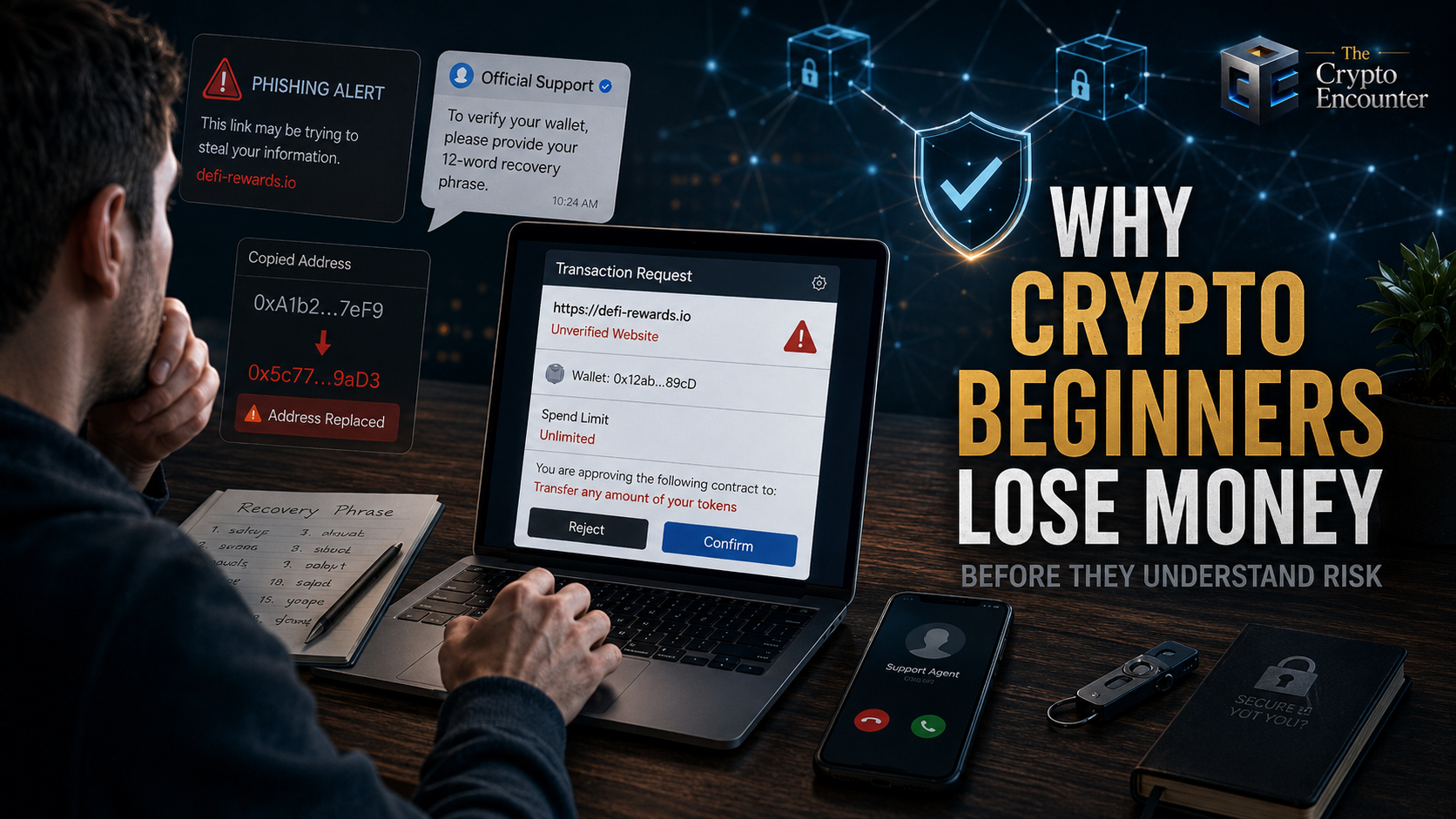
Why crypto beginners lose money is rarely explained by one bad investment. A beginner may buy an unreliable token, but losses also happen through fake websites, stolen passwords, exposed recovery phrases, malicious wallet approvals, impersonation scams, and transfers to the wrong address. In many cases, the blockchain continues working exactly as designed while the user loses control of the assets.
That distinction matters. A cryptocurrency network can resist unauthorized changes at the protocol level, yet it cannot judge whether someone was deceived into approving a transaction. Consequently, beginners must protect much more than the coins themselves. They must protect their devices, login credentials, wallet permissions, recovery information, judgment, and attention.
This guide explains why crypto beginners lose money, how ordinary actions become security failures, and which habits can reduce avoidable losses.
Key Takeaways
- Blockchain security does not automatically protect wallets, devices, exchange accounts, or individual decisions.
- Crypto transactions may be irreversible, so a mistaken or fraudulent transfer can be difficult or impossible to recover.
- Scammers exploit urgency, authority, excitement, fear, loneliness, and confusion more often than they attack a blockchain directly.
- A recovery phrase is effectively a master key. Anyone who obtains it may gain control of the associated wallet.
- Beginners should verify websites, use strong account security, test unfamiliar transfers, review wallet permissions, and treat unsolicited investment help as suspicious.
Why Crypto Beginners Lose Money Even When the Blockchain Is Secure
Blockchains use cryptography and network consensus to record and verify transactions. Those technical protections help prevent someone from simply rewriting the ledger or spending assets they do not control.
However, the protocol only evaluates whether a transaction carries valid authorization. It does not know whether the wallet owner understood the request, trusted the wrong website, or acted under pressure.
Suppose a user connects a wallet to a fraudulent website and approves permission for a malicious contract to move tokens. From the blockchain’s perspective, the wallet submitted a valid authorization. From the user’s perspective, the assets were stolen. Ethereum’s official security and scam-prevention guidance warns that transactions sent through the network are irreversible and that users should never share their wallet recovery phrase.
This gap is central to understanding why crypto beginners lose money. Protocol security protects the system’s rules. Personal security protects the person using those rules.
That difference also explains the crypto security gap between experts and ordinary users. Experienced users tend to build layers around wallets, devices, accounts, and transaction habits, while beginners may encounter irreversible tools before understanding how those layers interact.
Ethereum’s official security guidance states that transactions sent through its network are irreversible. It also warns that anyone who obtains a wallet’s recovery phrase can access the associated accounts and assets.
The Security Chain Is Larger Than the Wallet
A cryptocurrency wallet does not usually “hold” coins like a physical wallet holds cash. Instead, it manages the keys that allow a user to control blockchain-based assets.
Several connected elements affect that control:
| Security layer | What can go wrong | Possible consequence |
|---|---|---|
| Blockchain protocol | Network or smart-contract vulnerability | Assets or applications may be disrupted |
| Wallet software | Fake extension, malicious update, weak design | Private information or transaction authority may be stolen |
| Exchange account | Stolen password, email compromise, weak authentication | Unauthorized trades or withdrawals |
| Personal device | Malware, remote access, clipboard manipulation | Credentials or wallet addresses may be intercepted |
| Website or link | Phishing page or fake application | User signs a harmful transaction |
| Recovery phrase | Shared, photographed, uploaded, or exposed | Complete wallet takeover |
| Human judgment | Urgency, greed, fear, misplaced trust | Voluntary transfer to a scammer |
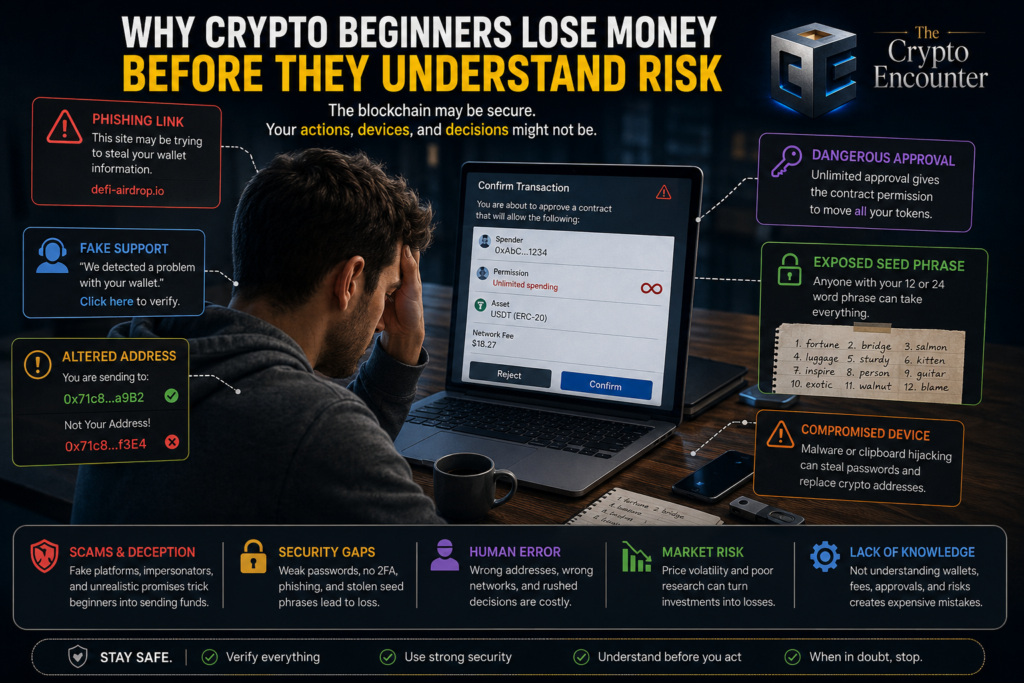
Crypto networks may remain secure while users lose money through phishing links, fake support messages, exposed recovery phrases, malicious approvals, compromised devices, and rushed decisions.
Because each layer creates a different failure point, buying a hardware wallet alone does not eliminate risk. A user can still send funds to a scammer, reveal a recovery phrase, or approve a dangerous transaction.
Therefore, why crypto beginners lose money has as much to do with digital behavior as cryptography.
Why Crypto Beginners Lose Money Through False Trust
Traditional finance teaches customers to look for familiar signals. A professional website, customer-support agent, account dashboard, or branded application may appear credible.
Scammers copy those signals.
A fraudulent platform can display a rising balance even when no genuine investment exists. Likewise, an impersonator can use a company logo, copied employee photograph, or convincing support script. The victim sees apparent professionalism, while the scammer controls every number on the screen.
According to the FBI’s 2025 Internet Crime Report, cryptocurrency investment fraud produced the highest reported financial losses to Americans in 2025, totaling approximately $7.2 billion. Complaint data reflects reported cases rather than every loss, so the true total cannot be confirmed from that figure alone.
Earlier FBI intervention data also showed how deception can remain invisible to victims. In one cryptocurrency investment-fraud initiative reported in the FBI’s 2024 annual report, 76% of the 4,323 contacted victims did not know they were being scammed when authorities warned them.
These findings help explain why crypto beginners lose money before recognizing danger. The scam is often designed to feel legitimate until the victim attempts a withdrawal.
A Profit on the Screen May Not Be Real
Fake investment platforms commonly show invented profits. Initially, the victim may deposit a modest amount and watch the account value rise. In some cases, the platform may even allow a small withdrawal to create confidence.
Afterward, the scammer encourages a larger deposit. When the victim tries to withdraw, the platform may demand a tax, verification payment, unlocking fee, insurance charge, or additional deposit.
Sending that payment rarely solves the problem because the displayed account never represented recoverable assets.
The Federal Trade Commission warns consumers not to trust guarantees of quick or easy cryptocurrency profits. It also states that legitimate businesses and government agencies will not instruct someone to send cryptocurrency in advance to protect money or resolve a supposed problem.
Therefore, why crypto beginners lose money cannot be separated from how convincingly fake platforms imitate genuine financial services.
Why Crypto Beginners Lose Money Through Recovery-Phrase Scams
A recovery phrase, sometimes called a seed phrase, is a series of words that can restore access to a self-custody wallet. It should be treated like the master key to every asset controlled by that wallet.
No legitimate support representative needs the phrase to troubleshoot a transaction. Moreover, wallet providers generally cannot reset it or reverse access after someone else obtains it.
Common recovery-phrase traps include:
- A fake support account asking users to “verify” their wallets
- A phishing page requesting the phrase to reconnect or upgrade an account
- A fraudulent airdrop asking users to import an existing wallet
- A form claiming that the wallet must be synchronized
- Malware capturing a phrase stored in notes, email, cloud storage, or photographs
Ethereum’s official support materials state that a self-custody wallet generally cannot be restored without the seed phrase or private keys. No central support desk can reset the wallet in the way a bank might reset an online-banking password.
That responsibility is one reason why crypto beginners lose money. Self-custody gives users direct control, but direct control also removes many conventional recovery mechanisms.
A Wallet Connection Is Not Always Harmless
Connecting a wallet to a decentralized application usually reveals the public wallet address. By itself, that connection does not necessarily allow the application to remove assets.
The danger often appears in the next step.
A website may ask the user to sign a message, approve token spending, or authorize a contract interaction. Beginners sometimes treat every wallet prompt as a routine login request. Yet different prompts can grant very different powers.
For example, a token approval may allow a smart contract to transfer a specified amount. An unlimited approval may remain active until the user revokes it. Meanwhile, a malicious signature may authorize an action the interface describes misleadingly.
As a result, why crypto beginners lose money may depend on a single approval they did not understand.
Before signing, users should identify:
- The website requesting access
- The wallet account involved
- The asset and amount covered
- Whether the approval is limited or unlimited
- Whether the application is established and independently verifiable
A wallet warning should never be dismissed simply because an online tutorial says to continue.
Why Crypto Beginners Lose Money Through Device and Account Weaknesses
Self-custody receives much of the attention, but exchange accounts also create security risks.
An attacker may compromise the email account connected to an exchange, steal a reused password, intercept a weak authentication method, or persuade a mobile carrier to transfer a phone number. These connected weaknesses explain why crypto security extends beyond passwords. A strong exchange password cannot compensate for a compromised email account, fraudulent recovery process, malicious link, exposed recovery phrase, or infected device. Once access is gained, the attacker may change account settings or attempt a withdrawal.
Additionally, malware can replace a copied wallet address with the attacker’s address. Because cryptocurrency addresses are long and difficult to read, a user may check only the first and last few characters. Some attackers deliberately create addresses with similar-looking character patterns.
Phishing-resistant multifactor authentication provides stronger protection than a password alone. CISA recommends phishing-resistant MFA for sensitive services where possible, particularly methods based on FIDO or WebAuthn standards.
Still, authentication cannot prevent every voluntary transfer. That limitation again shows why crypto beginners lose money despite using a reputable platform.
Human Behavior Is the Main Attack Surface
Many scams are built around emotional timing rather than technical brilliance.
Urgency reduces verification
A message claims an account will be frozen in 15 minutes. Another warns that an investment opportunity will disappear. Because the victim feels rushed, checking the sender, domain, or request begins to seem less important.
Authority suppresses doubt
The scammer pretends to represent an exchange, regulator, police department, tax authority, or well-known company. Consequently, the victim follows instructions that would otherwise appear suspicious.
Greed changes the standard of proof
A promise of unusual returns can make weak evidence feel convincing. Screenshots, testimonials, dashboards, and group-chat messages then appear to confirm the opportunity.
Loss creates a desire for recovery
After a scam, victims often become targets again. Someone may claim to be a lawyer, investigator, hacker, or recovery specialist who can retrieve the stolen cryptocurrency for an upfront fee.
The FTC warns that recovery scams target people who have already lost money and then request another payment. The FBI has also documented fictitious law firms targeting cryptocurrency scam victims, including reported secondary losses exceeding $9.9 million between February 2023 and February 2024.
Thus, why crypto beginners lose money sometimes becomes a cycle rather than a single event.
Market Risk and Security Risk Are Different
Price declines are not automatically scams. Likewise, a profitable token does not automatically indicate that the buying process was safe.
Market risk means an asset may lose value because of supply, demand, liquidity, competition, regulation, leverage, or changing sentiment.
Security risk means the user may lose control of the asset through theft, credential compromise, malicious software, or harmful authorization.
Fraud risk means another person intentionally misrepresents an opportunity, service, identity, or transaction.
Operational risk involves mistakes such as using the wrong network, sending assets to an incompatible address, losing recovery information, or misunderstanding withdrawal requirements.
Beginners often focus almost entirely on whether a coin’s price will rise. However, why crypto beginners lose money frequently has nothing to do with price direction. A successful market prediction is useless when the asset is sent to a scammer or locked behind a lost key.
A Practical Safety Routine for New Crypto Users
No checklist guarantees safety. Nevertheless, consistent habits can reduce avoidable exposure.
Before creating an account or wallet
Use the official website or a trusted application store listing. Check the developer name, spelling, download history, domain, and independent references. Avoid installation links sent through unsolicited direct messages.
Next, secure the associated email account with a unique password and phishing-resistant MFA where available.
Before funding a wallet
Write down the recovery phrase privately and offline. Do not photograph it, email it, upload it to cloud storage, or enter it into an unfamiliar website.
Then, learn how the wallet displays network fees, addresses, approvals, and contract requests before depositing a significant amount.
Before sending cryptocurrency
Compare the complete destination address. Confirm the blockchain network and supported asset. For an unfamiliar destination, send a small test transaction first when fees make that practical.
This step is especially important because blockchain transfers may be irreversible.
Before connecting to an application
Open the application through a verified bookmark or independently confirmed domain. Review every wallet prompt. Reject requests whose purpose, asset scope, or spending authority remains unclear.
Before accepting investment help
Ask why the person contacted you, how they earn money, whether they control the platform, and why payment must use cryptocurrency.
Any guarantee, secret strategy, urgent deadline, or withdrawal fee should trigger additional scrutiny.
These practices address several reasons why crypto beginners lose money without pretending that all risk can be removed.
What to Do After Suspected Theft or Fraud
Speed matters, although recovery is never guaranteed.
First, stop communicating with the suspected scammer. Do not pay additional taxes, verification fees, or recovery charges.
Next, preserve evidence. Save transaction hashes, wallet addresses, email headers, usernames, telephone numbers, website domains, chat records, receipts, and screenshots.
Then, contact the relevant exchange or wallet provider through its verified support channel. A centralized exchange may be able to restrict an account under its control, but it generally cannot reverse a completed blockchain transfer.
Victims in the United States can report cryptocurrency-related fraud through the FBI’s Internet Crime Complaint Center. The FBI encourages filing even when the person is uncertain whether the complaint qualifies. Consumers may also report fraud to the FTC.
Finally, assume that recovery scammers may make contact. Publicly discussing a loss can expose victims to accounts claiming they can retrieve funds for a fee.
Why Crypto Beginners Lose Money Before Understanding the Real Risk
The most important lesson is not that cryptocurrency technology is inherently unsafe. Instead, its protections operate within defined boundaries.
A blockchain can verify a signature. It cannot verify that the signer understood a deceptive interface.
A wallet can protect a private key. It cannot stop its owner from revealing the recovery phrase.
An exchange can secure its infrastructure. It cannot fully protect a customer whose email account has been compromised.
For that reason, why crypto beginners lose money is best understood as a problem of fragmented responsibility. Security is distributed across protocols, software providers, platforms, devices, and users. Unfortunately, beginners may not discover where their responsibility begins until after an irreversible action.
Better public education should therefore begin before the first purchase. Learning to verify, pause, question, test, and protect recovery information may be more valuable than learning how to predict the next price movement.
FAQs
Why do crypto beginners lose money so easily?
Why crypto beginners lose money often involves a combination of volatile assets, misleading investment claims, exposed credentials, phishing websites, harmful wallet approvals, and irreversible mistakes. Limited familiarity makes it harder to distinguish a normal crypto process from a fraudulent request.
Can cryptocurrency be stolen if the blockchain is secure?
Yes. A blockchain may remain technically secure while someone steals a recovery phrase, compromises an exchange account, infects a device, or tricks the owner into approving a transfer. Protocol security does not guarantee user-level safety.
Can a crypto transaction be reversed?
Usually, a completed blockchain transaction cannot be reversed by a bank, wallet provider, or customer-support department. An exchange may sometimes freeze assets that remain inside accounts it controls, but recovery depends on the circumstances and is never guaranteed.
Should a wallet-support agent ask for a recovery phrase?
No. A legitimate support representative should not need a recovery phrase or private key. Anyone requesting it should be treated as a potential scammer.
Does a hardware wallet prevent every crypto scam?
No. A hardware wallet may protect keys from certain online attacks, but it cannot prevent users from sending assets to a scammer, approving a malicious contract, exposing the recovery phrase, or purchasing a fraudulent token.
What is the first warning sign of a crypto investment scam?
Guaranteed returns, unsolicited investment coaching, pressure to act quickly, romantic or social-media contacts offering investment help, fake profit dashboards, and extra fees required to withdraw funds are major warning signs.
Disclaimer
This article is for informational and educational purposes only. It does not provide financial, investment, legal, tax, cybersecurity, or accounting advice. Cryptocurrency and digital assets involve significant risks, including fraud, theft, operational errors, price volatility, and possible loss of capital. No security practice can eliminate every risk.