

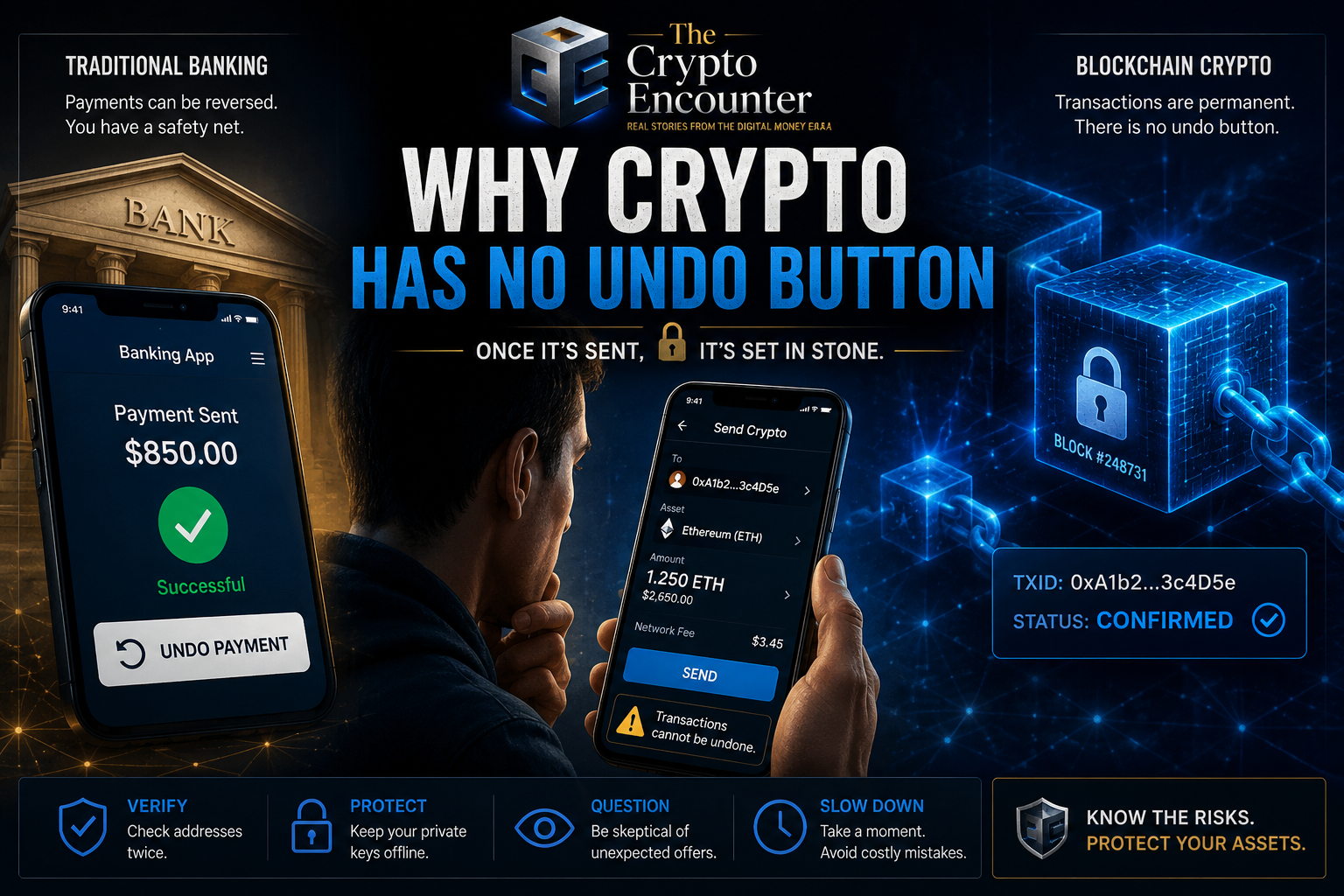
Every day, people lose cryptocurrency without being hacked at the blockchain level. Understanding why crypto has no undo button starts with recognizing that most losses happen because users click fake links, approve malicious wallet permissions, send funds to the wrong address, or trust the wrong person. Unlike a bank transfer or credit card payment, most crypto transactions cannot simply be reversed
That is why people often say crypto has no undo button.
The blockchain is designed to be permanent. Once a valid transaction is confirmed, there is usually no central authority that can cancel it or recover the funds. This design helps make cryptocurrencies resistant to censorship and fraud. At the same time, it shifts much more responsibility to the individual user.
Understanding why crypto has no undo button is one of the most important lessons for anyone entering the crypto space. This article explains how blockchain transactions work, why mistakes are usually permanent, the scams that take advantage of this reality, and the practical habits that can dramatically reduce your risk.
TL;DR
| Key Point | What It Means |
|---|---|
| Crypto has no undo button | Most confirmed blockchain transactions cannot be reversed. |
| The blockchain is secure | The protocol usually works exactly as designed. |
| Users remain vulnerable | Wallets, devices, fake websites, and human mistakes create most losses. |
| Scammers exploit urgency | They rely on fear, excitement, and trust rather than technical hacking. |
| Prevention is your best defense | Careful habits matter more than expensive software. |
Why Crypto Has No Undo Button
The phrase “crypto has no undo button” refers to a basic feature of blockchain technology.
When you send cryptocurrency, your wallet creates a transaction and broadcasts it to the blockchain network. Once network validators confirm that transaction and it becomes part of the blockchain, it becomes extremely difficult or impossible to reverse.
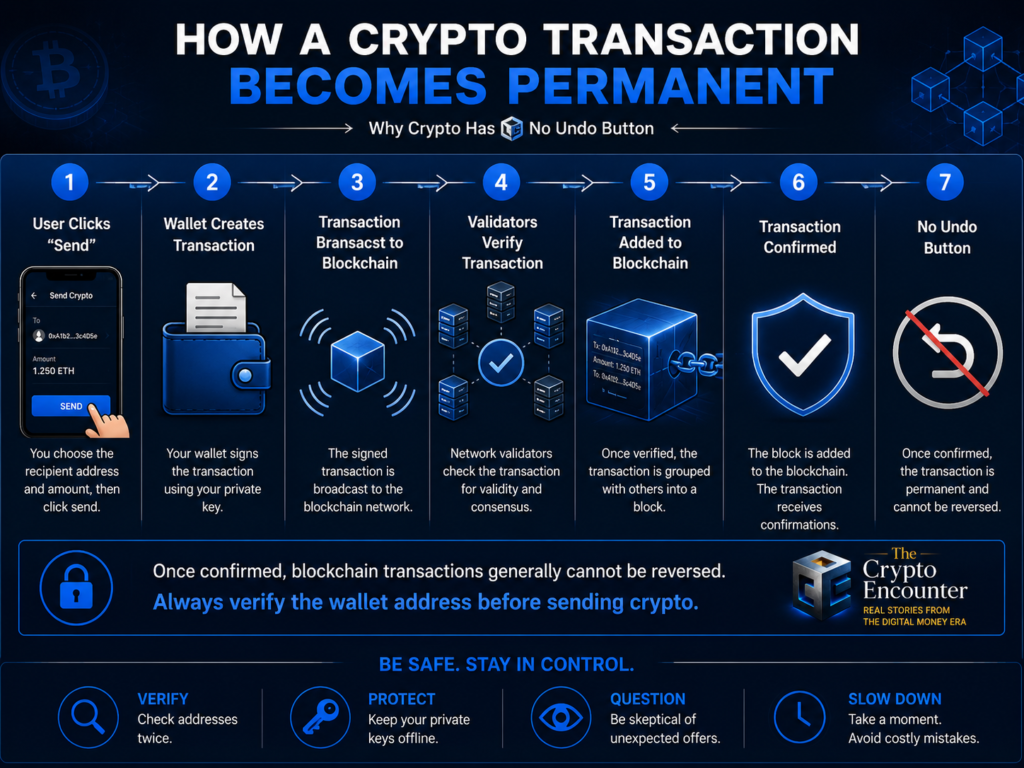
This is not a software bug.
It is one of blockchain’s core design principles.
Banks can often reverse fraudulent transfers because they control their own payment systems. Credit card companies may issue chargebacks because they act as trusted intermediaries between buyers and sellers.
Blockchain networks work differently.
There is usually no company, customer support department, or payment processor controlling Bitcoin or Ethereum. Instead, thousands of computers independently verify transactions according to agreed rules.
That decentralization provides important benefits, but it also removes the safety net many people expect from traditional finance.
Why This Matters More Than Most Beginners Realize
Many new users believe crypto works like online banking.
It does not.
If you accidentally transfer funds to the wrong wallet address, there may be nobody capable of recovering them.
If you approve a malicious smart contract, the blockchain may simply execute exactly what you authorized.
If someone tricks you into revealing your recovery phrase, they can often restore your wallet on another device and move your assets within minutes. This is why crypto’s password problem extends far beyond choosing a strong login password.
The blockchain cannot distinguish between an intentional transaction and one made because you were deceived.
It only verifies whether the transaction follows the network’s rules.
The Blockchain Usually Isn’t the Problem
One of the biggest misunderstandings about crypto is the belief that the blockchain itself is constantly being hacked.
In reality, major blockchain networks such as Bitcoin and Ethereum have demonstrated strong security over many years through decentralized consensus and cryptographic verification. The official Ethereum documentation explains how network validation and transaction confirmation work.
Most losses happen somewhere else.
The weak points usually include:
- Fake wallet websites
- Phishing emails
- Scam advertisements
- Compromised computers
- Fake mobile applications
- Social engineering
- Human error
- Stolen recovery phrases
Think of it like a high-security vault.
The vault itself may be extremely secure.
But if someone convinces you to hand them the key, the vault cannot protect you.
That distinction explains why crypto has no undo button while still remaining one of the most secure financial technologies ever created.
Where People Actually Lose Their Crypto
Most crypto theft follows familiar patterns.
Fake Websites
A user searches for a wallet online.
The first search result looks legitimate.
The website copies the real company’s branding almost perfectly.
The victim enters their recovery phrase.
Within seconds, the attacker empties the wallet.
Nothing about the blockchain failed.
The user unknowingly gave away complete access.
Wallet Approval Scams
Modern crypto wallets frequently ask users to approve smart contract permissions.
Many approvals are perfectly legitimate.
Others are designed to give attackers permission to move assets later.
Because the user approved the transaction themselves, the blockchain processes it exactly as instructed.
Again, crypto has no undo button.
Sending Funds to the Wrong Address
Cryptocurrency wallet addresses are long strings of letters and numbers.
Even a small mistake can have permanent consequences.
Common examples include:
- Copying the wrong address
- Malware replacing copied wallet addresses
- Sending tokens on the wrong blockchain network
- Sending unsupported assets to exchange wallets
Unlike sending money to the wrong bank account, there is often no customer service department that can retrieve the funds.
That is why experienced users always send a small test transaction before transferring large amounts.
The Human Brain Is the Biggest Security Risk
Most successful crypto scams are psychological rather than technical.
Scammers understand how people make decisions under pressure.
They create situations that trigger:
- Fear
- Excitement
- Urgency
- Greed
- Trust
- Curiosity
For example:
“You’ve won an airdrop.”
“Your wallet will be suspended.”
“Claim your rewards before they expire.”
“Verify your wallet immediately.”
These messages encourage fast decisions.
Good security requires slowing down instead.
Whenever someone pressures you to act immediately, that pressure itself should be treated as a warning sign.
Why Self-Custody Comes With Greater Responsibility
One of crypto’s biggest advantages is self-custody.
Instead of trusting a bank, users can control their own assets directly.
That freedom comes with responsibility.
If you hold your own private keys:
- You control your funds.
- You are responsible for backups.
- You are responsible for device security.
- You are responsible for checking every transaction.
- You are responsible for protecting your recovery phrase.
There is no password reset button for most self-custody wallets.
There is no account recovery team waiting to restore access.
That independence is powerful, but only if users understand what it requires.
Can You Reverse a Crypto Transaction?
Many people search for ways to recover lost cryptocurrency after making a mistake.
The answer depends on what happened.
In most cases, once a blockchain transaction has been confirmed, it cannot simply be reversed.
However, there are a few situations where action may still help.
| Situation | Can It Be Reversed? |
|---|---|
| Sent crypto to the wrong wallet | Usually no |
| Approved a malicious smart contract | Usually no, but revoke future permissions if possible |
| Sent funds to a regulated exchange account | Sometimes, if contacted immediately |
| Stolen through phishing | Recovery is unlikely |
| Sent to your own incorrect wallet | Depends on whether you control the destination wallet |
The key lesson remains the same: prevention is far more effective than recovery.
The Biggest Myth About Crypto Security
A secure blockchain does not automatically mean that every wallet, exchange, website, or user action is secure. Read our broader guide to what cryptocurrency security really protects for a breakdown of protocol, wallet, exchange, contract, privacy, legal, and recovery risks.
Many people believe crypto is dangerous because “hackers can break the blockchain.”
That is rarely what happens.
Most attacks never touch the blockchain itself.
Instead, attackers target people.
Security professionals often describe this as attacking the weakest link.
A blockchain can be mathematically secure, yet users can still lose everything if they:
- Store their recovery phrase online.
- Connect their wallet to fake websites.
- Install malicious browser extensions.
- Ignore wallet warnings.
- Trust strangers offering investment opportunities.
- Download fake mobile apps.
The blockchain performs exactly as designed.
Unfortunately, scammers also understand exactly how people behave.
What Should You Do If You Make a Mistake?
If you believe something has gone wrong, act immediately.
1. Stop Making Additional Transactions
Many victims panic and unknowingly approve even more malicious transactions.
Pause before taking further action.
2. Disconnect From Suspicious Websites
If you connected your wallet to a website you no longer trust, disconnect it and review any active permissions.
3. Move Remaining Assets
If your wallet may be compromised but still contains funds, consider moving the remaining assets to a new wallet created with a completely new recovery phrase.
4. Contact the Relevant Platform
If an exchange is involved, contact its official support immediately.
Some exchanges may be able to assist before funds leave their controlled wallets.
5. Report the Scam
Reporting scams helps investigators identify fraudulent websites and warn other users.
Depending on your jurisdiction, reports can often be made to consumer protection agencies, cybercrime units, or financial regulators. Victims should also report incidents to the Federal Trade Commission when applicable.
A Simple Crypto Safety Checklist
Understanding why crypto has no undo button should change how you approach every transaction.
Before sending cryptocurrency, ask yourself these questions.
Wallet Safety
✔ Is this the correct wallet address?
✔ Did I verify every character?
✔ Am I sending on the correct blockchain network?
Website Safety
✔ Did I type the website manually or use a trusted bookmark?
✔ Does the domain name exactly match the official website?
✔ Am I being asked for my recovery phrase?
If the answer to the last question is yes, stop immediately.
Legitimate wallet providers will never ask for your recovery phrase through a website or customer support conversation.
Device Safety
✔ Is my computer free from malware?
✔ Is two-factor authentication enabled where available?
✔ Have I updated my wallet software?
Decision Safety
✔ Am I feeling rushed?
✔ Has someone promised guaranteed profits?
✔ Is someone asking me to keep this secret?
Pressure is one of the strongest indicators of fraud.
Why Education Is Your Best Security Tool
Crypto security is often portrayed as a technical problem.
In reality, it is usually an education problem.
The safest users are not necessarily software engineers.
They are people who develop careful habits.
They verify addresses twice.
They ignore unexpected messages.
They keep recovery phrases offline.
They question anything that creates urgency.
Over time, these simple behaviors reduce risk far more effectively than relying on luck.
Why Crypto Has No Undo Button Is Actually a Strength
At first glance, the lack of an undo button sounds like a flaw.
In reality, it is closely tied to what makes blockchain technology valuable.
Because transactions cannot easily be changed or deleted, the blockchain provides a permanent and transparent record. This helps prevent unauthorized reversals, reduces dependence on centralized intermediaries, and supports a system where ownership is verified through cryptography rather than trust in a single institution.
The same feature that protects honest users also demands greater personal responsibility.
That balance is one of the defining characteristics of cryptocurrency.
Understanding it is the first step toward using crypto safely.
Conclusion
Crypto has no undo button because blockchain networks are designed to create permanent, verifiable records of transactions. That permanence helps make cryptocurrencies secure and resistant to manipulation, but it also means users carry greater responsibility than they do in traditional finance.
Most losses happen because of human error, phishing, fake websites, compromised devices, or social engineering rather than failures in Bitcoin, Ethereum, or other major blockchain networks.
The most effective defense is not fear. It is preparation.
Verify every wallet address. Protect your recovery phrase. Slow down before approving transactions. Treat unexpected offers with skepticism. Small habits can prevent losses that no customer support team can reverse.
The more you understand why crypto has no undo button, the safer your journey into digital assets is likely to be.
Frequently Asked Questions
Why does crypto have no undo button?
Blockchain transactions are designed to be permanent after network confirmation. This prevents unauthorized reversals and removes the need for a central authority to approve or cancel payments.
Can Bitcoin transactions be reversed?
Generally, no. Once a Bitcoin transaction has received sufficient confirmations, reversing it is not possible without the recipient voluntarily returning the funds.
What happens if I send crypto to the wrong address?
If the destination wallet is controlled by someone else and they choose not to return the funds, recovery is usually impossible.
Is crypto less secure than online banking?
Not necessarily. Major blockchain networks are highly secure, but users assume greater responsibility for protecting their wallets, devices, and recovery phrases.
What is the safest way to protect cryptocurrency?
Use a reputable wallet, store your recovery phrase offline, enable security features such as two-factor authentication where applicable, verify wallet addresses before sending funds, and never share your private keys or recovery phrase.