

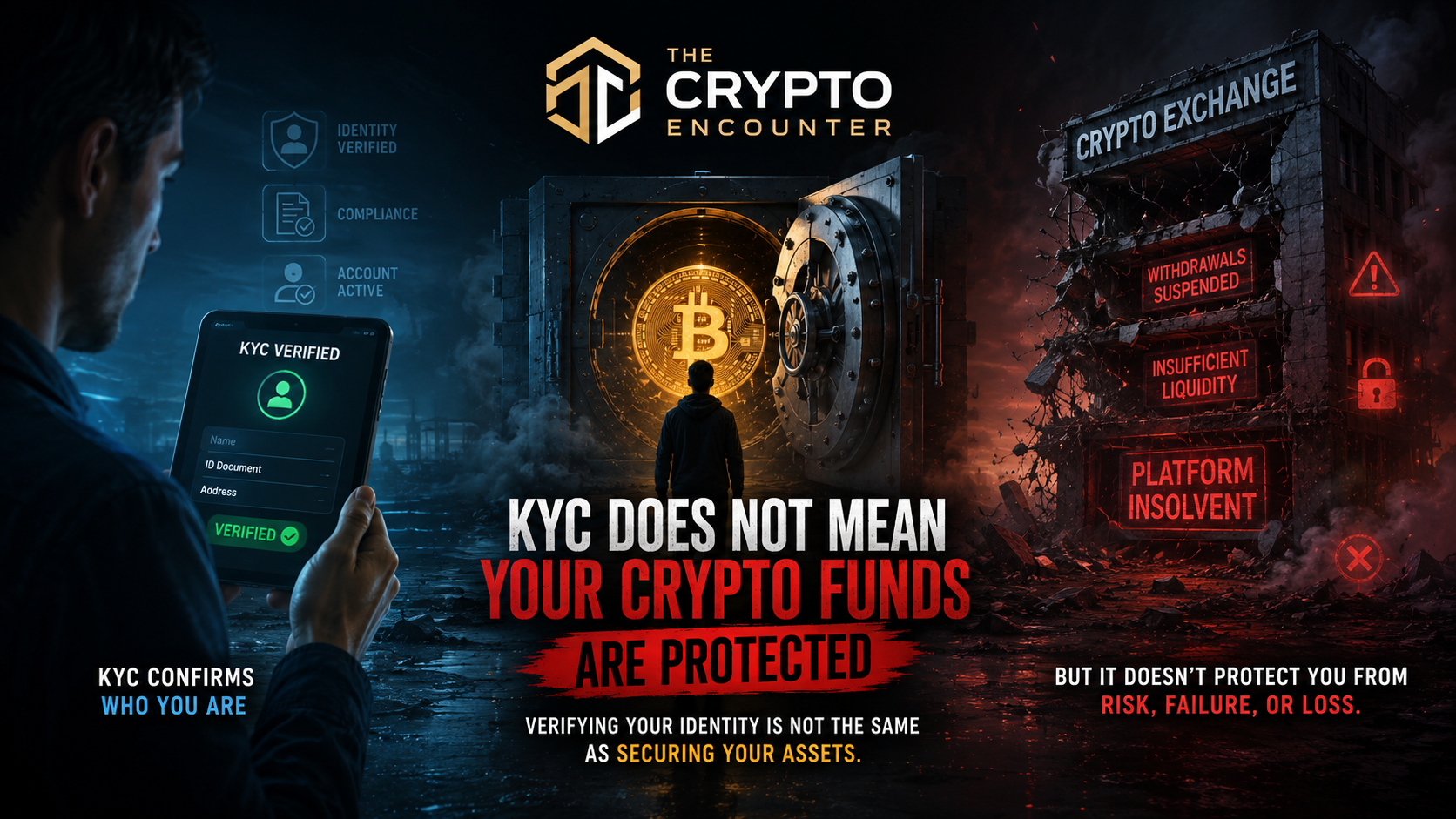
What happens to your crypto if an exchange suddenly cannot process withdrawals? Your funds may become inaccessible, even if your identity has been verified and your balance is still visible. Why does that happen? Because KYC fund protection is not the same as actual access to your assets. KYC confirms who you are, but it does not guarantee that you can access or recover your crypto. That is where crypto exchange custody becomes important. Who controls your assets, private keys, and withdrawals can directly affect your crypto funds protection when an exchange faces liquidity problems, operational failures, or insolvency. As The Crypto Encounter explains through its educational crypto coverage, understanding these risks is essential before assuming that a verified account means protected funds.
So, what does the balance on your screen actually represent? It may be an internal record showing how much the exchange says you are entitled to, while the exchange or its custody provider controls the private keys behind those assets. Who controls those keys matters because that control determines who can move the crypto. And where does KYC fit in? KYC supports customer identification and anti-money-laundering compliance, but it does not guarantee that your assets are segregated, fully backed, insured, withdrawable, or protected if the platform becomes insolvent.
TL;DR: KYC Is About Identity, Not Asset Protection
- KYC verifies identity. It helps exchanges identify customers and comply with financial-crime rules.
- Custody determines control. The party controlling the private keys has the technical ability to authorize blockchain transactions.
- An exchange balance is not the same as self-custody. A balance displayed on an exchange depends on the platform’s systems and ability to honor withdrawals.
- Regulation does not automatically equal insurance. Different assets and jurisdictions can have different protections.
- Exchange failure can become an insolvency problem. If withdrawals stop, recovering assets may depend on custody arrangements, contracts, applicable law, and bankruptcy proceedings.
- Self-custody changes the risk rather than eliminating it. You reduce dependence on an exchange but become responsible for protecting your own keys and recovery information.
KYC and Custody Solve Different Problems
KYC answers an identity question.
Custody answers a control question.
When you complete KYC, an exchange may request your name, address, date of birth, government identification, proof of address, and other information.
These procedures can help financial institutions identify customers, monitor activity, and comply with anti-money-laundering requirements.
But it doesn’t tell you where your crypto is stored or who controls the private keys.
A crypto asset exists as a record on a blockchain. The private key is what allows someone to authorize transactions involving that asset.
When an exchange provides hosted custody, the customer generally does not control those keys directly. Instead, the exchange or its custody provider does.
That creates an important difference between ownership and access.
Your exchange screen may show that you have 1 BTC. But whether you can actually move that BTC depends on the exchange’s custody infrastructure, internal controls, withdrawal systems, compliance procedures, liquidity, and ability to honor customer claims.
KYC vs. Actual Fund Protection
| What users often assume | What it actually tells you |
| “The exchange knows who I am, so my funds are protected.” | The exchange has verified information about your identity. |
| “My balance appears in my account, so I can withdraw it whenever I want.” | The platform records a balance, but withdrawals still depend on its systems and ability to deliver the asset. |
| “The exchange is regulated, so my crypto is insured.” | Regulation and insurance are separate questions, and protections vary by asset, jurisdiction, and account type. |
| “The exchange uses KYC, so it cannot misuse customer assets.” | KYC does not by itself prove how customer assets are held, segregated, or controlled. |
| “If the exchange fails, I will automatically get my crypto back.” | Recovery can depend on custody arrangements, insolvency law, segregation, applicable protections, and the facts of the failure. |
Why KYC Fund Protection Is Not the Same as Private-Key Control
This is one of the most important concepts for exchange users to understand, especially when considering KYC fund protection on a KYC crypto exchange. Suppose you buy 0.5 BTC on an exchange. The platform shows a 0.5 BTC balance in your account, but does that mean you directly control those coins? Not necessarily.
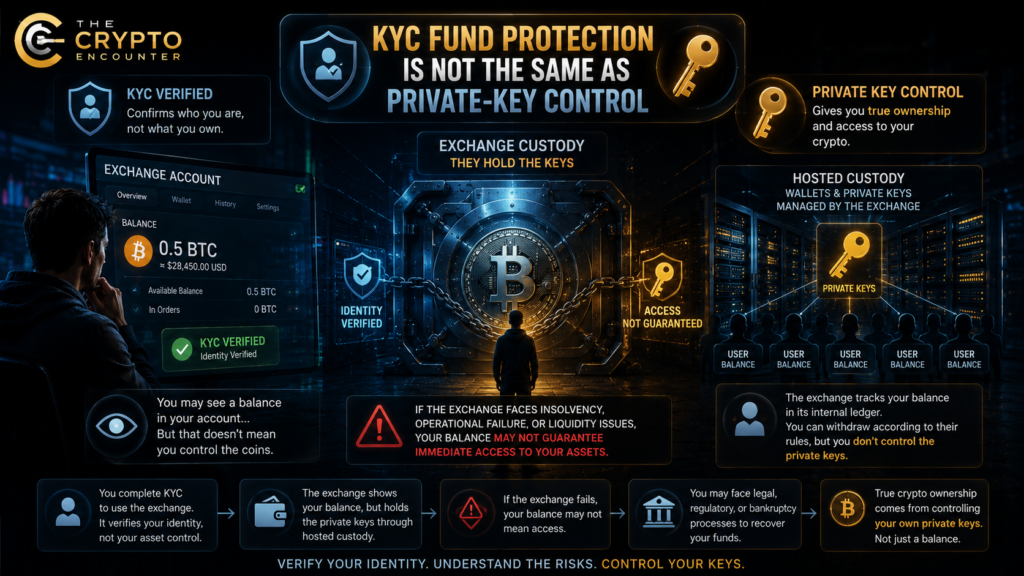
You may reasonably assume that the exchange has simply placed your Bitcoin into a digital wallet belonging to you. However, crypto custody risks can arise when the platform or its custody provider controls the private keys. Understanding how these security risks work is essential, particularly when you are relying on an exchange to safeguard your assets. If the exchange faces insolvency, your displayed balance may not guarantee immediate access to the underlying assets. This broader issue of digital-asset security is also explored in What They Never Told You About the Security of Cryptocurrencies.
Hosted custody can be more complicated. The exchange may maintain wallets and private keys on behalf of many customers while tracking individual balances through its own internal ledger. The exchange interface can display the amount you are entitled to withdraw, without granting you direct control over the private keys.
The practical test is simple:
Who can authorize the blockchain transaction?
If the exchange controls the relevant private keys, you are relying on that intermediary to maintain access to your assets.
Platform Risk Can Appear Even When the Blockchain Is Working
Bitcoin’s network can continue operating normally while an exchange becomes unable to process withdrawals.
That is because blockchain security and platform solvency are separate issues.
An exchange can face problems involving:
- Insufficient liquidity
- Weak internal controls
- Cyberattacks
- Operational failures
- Legal or regulatory restrictions
- Withdrawal freezes
- Insolvency
- Improper handling of customer assets
This is why “regulated” should never be treated as a synonym for “risk-free.”
An exchange can have compliance procedures while still exposing users to risks that KYC does not address.
FTX Showed Why the Distinction Matters
The collapse of FTX provides a clear example of why users should look beyond an account interface and KYC process. In December 2022, the U.S. Securities and Exchange Commission (SEC) alleged that FTX had promoted itself as a safe trading platform with measures intended to protect customer assets, while customer assets were allegedly diverted to Alameda Research.
According to the SEC’s complaint against FTX executives, FTX allegedly gave Alameda special treatment and allowed customer funds to be diverted for purposes outside ordinary customer custody. The lesson is not that every centralized exchange behaves like FTX.
It is that customers need to understand an exchange’s controls because they ultimately depend on those controls when they do not hold the private keys themselves. The FTX collapse also shows that when a platform fails, recovering assets can become a legal and bankruptcy issue rather than a normal withdrawal request.
Regulation Can Help, but It Is Not One Universal Safety Net
Regulation matters because rules around custody, asset segregation, capital requirements, disclosures, conflicts of interest, and customer protection can reduce certain risks. The SEC’s guidance and materials on crypto-asset custody highlight why custody arrangements and control of customer assets deserve careful attention. But users should always ask: Which rules apply to which entity and which asset?
A crypto exchange may operate under one regulatory framework for one service while different rules apply to another service or asset. The same principle applies to insurance. The FDIC’s guidance on crypto companies and deposit insurance makes clear that FDIC deposit insurance does not cover crypto assets or protect against the insolvency of non-bank crypto companies. Users should therefore avoid treating terms such as regulated, licensed, custodied, or insured as interchangeable. They are not.
What to Check for KYC Fund Protection Before Keeping Crypto on an Exchange
Before leaving significant funds on an exchange, investigate these questions.
1. Who Controls the Private Keys?
Determine whether the service is:
- Custodial
- Self-custodial
- A combination of both
The answer affects who has direct technical control over transactions.
2. Are Customer Assets Segregated?
Find out whether customer assets are legally and operationally separated from company assets.
Also check whether the platform clearly explains how that separation works.
3. What Happens During Insolvency?
Read the user agreement.
Determine how customer assets and claims are treated if the company enters bankruptcy or another insolvency process.
4. What Protections Actually Apply?
Do not assume that KYC, licensing, insurance, or another regulatory label automatically protects crypto holdings.
Find out exactly what protection exists and which assets it covers.
5. Can Withdrawals Be Restricted?
Review the platform’s terms for circumstances in which it can freeze, delay, suspend, or restrict withdrawals.
A balance that cannot be withdrawn when needed is a very different thing from immediately controlled crypto.
6. How Much Control Do You Need?
If you use an exchange primarily for active trading, keeping some assets there may provide convenience.
If you are holding long-term assets and do not need exchange liquidity, self-custody may reduce dependence on a centralized platform.
But self-custody introduces another category of risk.
Losing a private key, exposing a recovery phrase, falling for phishing, or approving a malicious transaction can result in permanent loss.
There is no custody model without risk.
What Happens If an Exchange Freezes Withdrawals?
A withdrawal freeze is where the difference between an account balance and accessible crypto becomes especially important.
If you control the private keys yourself, you generally do not need an exchange to approve a normal blockchain transaction.
If an exchange controls the keys, you depend on the platform to process your withdrawal.
A freeze can therefore turn an apparently simple transaction into a platform-level problem.
The underlying blockchain may remain operational.
Your account may still display your balance.
Your KYC information may still be verified.
Yet you may be unable to move the assets.
That is the core custody risk many users overlook.
Conclusion
KYC can tell an exchange who you are, but it cannot tell you whether your crypto will remain accessible when conditions change. That is why KYC fund protection should not be confused with actual asset security. Your access depends on custody arrangements, private-key control, asset segregation, platform liquidity, operational safeguards, applicable regulations, and what happens if the company becomes insolvent. An exchange balance can therefore represent a claim on assets without giving you the same direct control you would have through self-custody. None of this makes exchanges inherently unsafe, or self-custody automatically safer. Each model carries different risks and responsibilities. The practical lesson is to look beyond the KYC badge, understand who controls your assets, what protections actually apply, and what your options are if withdrawals stop or the platform fails.
FAQs
Does KYC protect my crypto?
No. KYC primarily verifies your identity and supports compliance and anti-money-laundering controls. It does not automatically guarantee that your crypto is insured, segregated, solvently backed, or immediately withdrawable.
Does a regulated crypto exchange guarantee my funds?
No. Regulation can provide important protections, but the exact protections depend on the jurisdiction, entity, asset, service, and regulatory regime.
Does KYC mean the exchange owns my crypto?
Not necessarily. KYC concerns identity verification. Ownership and custody are separate questions.
Is self-custody risk-free?
No. Self-custody can reduce dependence on an exchange, but it makes the user responsible for protecting private keys or recovery information.
What should I check before keeping crypto on an exchange?
Check who controls the keys, whether customer assets are segregated, what protections apply, whether withdrawals can be restricted, how insolvency is handled, and what the platform’s user agreement says about customer assets.
Disclaimer
This article is for educational purposes only and does not constitute financial, investment, legal, or tax advice. Crypto assets involve significant risks, including theft, fraud, withdrawal restrictions, platform failure, and insolvency. Protections vary by jurisdiction, asset, and provider. Readers should conduct independent research before making financial decisions.