

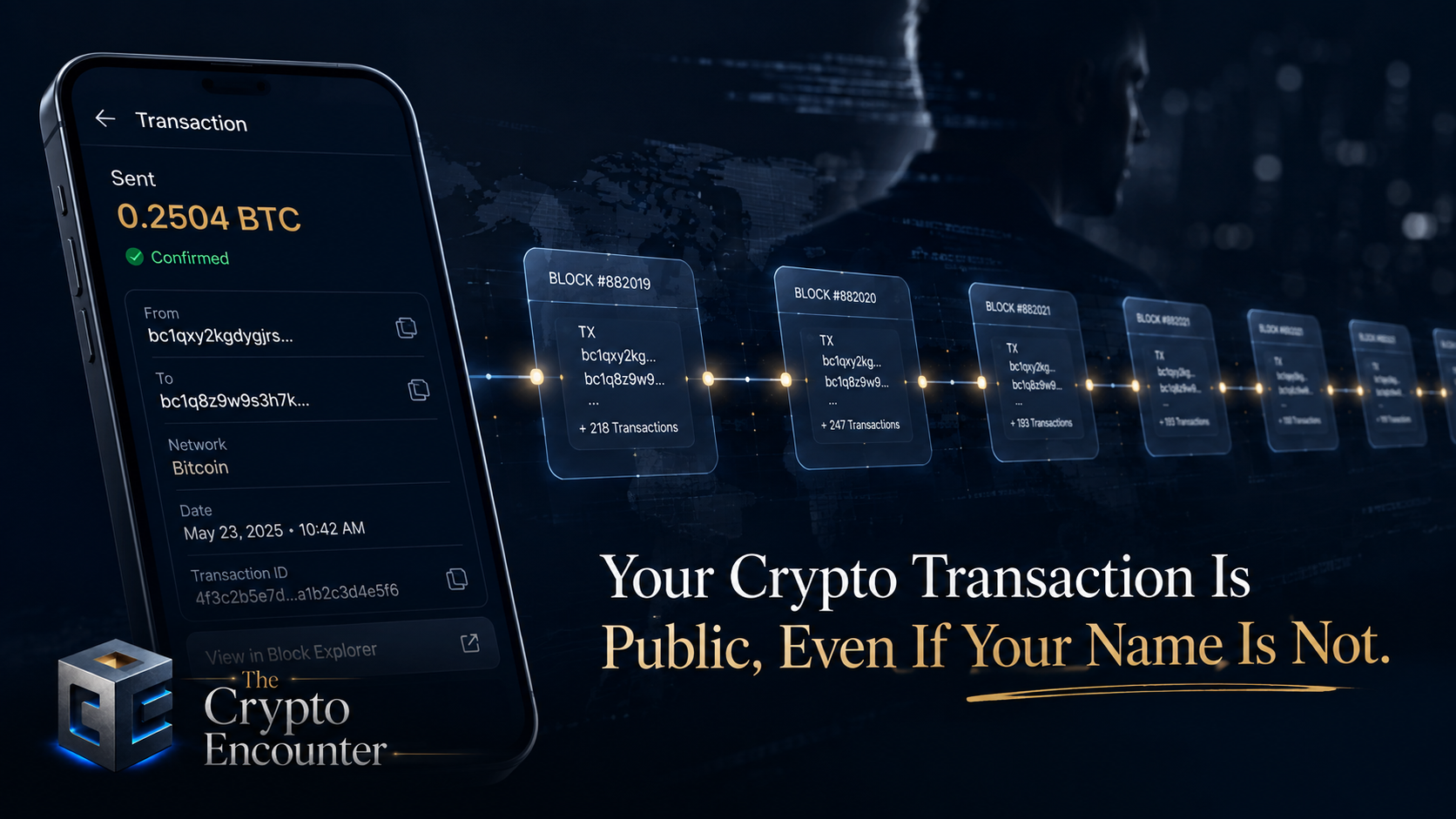
Your crypto transaction is public when you use a transparent blockchain such as Bitcoin or Ethereum. The record may not display your legal name. However, it can reveal your wallet address, transaction amount, timing, destination, token activity, and previous wallet history.
That difference matters. A wallet address may look anonymous, yet one link to your real identity can expose far more than a single payment. For example, an exchange account, public donation, social media post, compromised device, or reused address may connect you to an on-chain trail.
Therefore, blockchain security does not automatically create personal privacy. The protocol may process a payment exactly as designed while a scammer exploits your device, habits, trust, or exposed wallet activity.
The Essential Facts
| Question | Direct answer |
|---|---|
| Is your name normally written on a blockchain? | Usually not. Most public blockchains display addresses rather than legal names. |
| Is your crypto transaction public? | Yes, on transparent public blockchains such as Bitcoin and Ethereum. |
| What can observers see? | Addresses, amounts, timestamps, transaction history, fees, tokens, and contract interactions. |
| Can someone connect a wallet to a person? | Yes. Exchanges, public posts, payment records, data leaks, and behavior can create that connection. |
| Can a confirmed transaction usually be reversed? | Generally, no. The recipient normally must return the funds voluntarily. |
| Does a hardware wallet make transactions private? | No. It can protect private keys, but it does not hide public blockchain activity. |
| What is the main personal risk? | Someone may use wallet information to profile, deceive, impersonate, pressure, or target the owner. |
Why Your Crypto Transaction Is Public on a Blockchain
A blockchain works as a shared transaction record. Network participants use that record to check whether funds exist, prevent double-spending, and confirm valid transfers.
Consequently, public visibility supports verification. It allows independent computers to agree on who transferred which digital assets and whether the transaction followed the network’s rules.
Bitcoin’s privacy guidance states that Bitcoin transactions remain public, traceable, and permanently stored on the network. It also warns that addresses collect a history once users begin using them.
Ethereum works in a similarly transparent way. According to Ethereum’s privacy documentation, transactions written to Ethereum are public and permanent by default. Payments and other routine actions can therefore reveal information to unintended observers.
Therefore, your crypto transaction is public because transparency forms part of how many major blockchain networks operate. Encryption protects specific functions, such as transaction authorization. It does not automatically hide the transaction record.
What “Public” Actually Means
When your crypto transaction is public, an observer may see several pieces of information:
- The sending wallet address
- The receiving wallet address
- The transferred amount
- The transaction fee
- The date and time
- The transaction status
- The assets held by an address
- Previous and later transfers
- Tokens exchanged through decentralized applications
- Smart contracts that the wallet used
A blockchain explorer turns this raw network data into a searchable website. Anyone can paste a wallet address or transaction identifier into the explorer and inspect the associated activity. Ethereum describes block explorers as portals that display blocks, transactions, accounts, and other on-chain activity.
Still, a block explorer does not normally place a person’s passport name beside an address. This point creates the impression of anonymity. More accurately, many public blockchains offer pseudonymity.
Pseudonymous does not mean anonymous
A pseudonym replaces your identity with another label. On a blockchain, that label usually takes the form of a wallet address.
However, the address can still develop an identifiable pattern. Once someone connects that address to you, past and future activity may become easier to follow.
For example, imagine that you publish a wallet address to receive payment for freelance work. Later, you use the same wallet for savings, token swaps, donations, and purchases. A client who knows the original address could potentially inspect the wider history.
Thus, your crypto transaction is public even though your name does not appear in the transaction itself.
How a Public Wallet Becomes Linked to Your Identity
A blockchain address does not need to contain personal information to become personally revealing. Instead, identity often enters through activity outside the blockchain.
An exchange knows the withdrawal address
A regulated crypto exchange may collect identifying information when a customer creates an account. If that customer withdraws funds to a personal wallet, the exchange can associate the withdrawal with the account.
The blockchain remains public, while the exchange holds the identity connection in its private records.
You post the address online
Creators, charities, freelancers, businesses, and community members sometimes publish wallet addresses. Once a public profile displays an address, visitors can associate it with that profile.
Even deleting the post may not remove screenshots, archived pages, copied messages, or the permanent blockchain history.
A payment reveals the connection
Suppose a friend sends you crypto and knows your identity. That friend now knows at least one address connected to you. Similarly, a merchant may connect your wallet with an order, delivery address, email account, or customer record.
Because your crypto transaction is public, that connection can expose more activity than the original payment.
Address reuse creates a larger trail
Reusing one address makes tracking easier because several activities gather around the same identifier. Bitcoin’s privacy guidance specifically advises users to use new addresses to help protect privacy.
However, using different addresses does not guarantee anonymity. Transaction patterns, transfers between your own wallets, exchange withdrawals, and other data can still create links.
Your behavior supplies clues
Timing can reveal connections. So can repeated amounts, routine transfers, token choices, interactions with specific applications, and movements between known services.
Individually, each clue may prove little. Combined, however, they can create a persuasive profile.
Your Crypto Transaction Is Public, but Your Private Key Must Stay Secret
Many beginners confuse a public wallet address with a private key or recovery phrase. The distinction is critical.
A public address functions somewhat like payment information. You can share it when you want someone to send assets to your wallet.
A private key authorizes transactions. A recovery phrase can recreate access to the wallet. Anyone who obtains either may gain control of the assets.
Therefore, never share:
- Your recovery or seed phrase
- Your private key
- Wallet backup files
- Passwords or authentication codes
- A screen-share view that exposes sensitive wallet information
Your crypto transaction is public, but your signing credentials should remain private. No legitimate wallet support agent, exchange employee, investment manager, law-enforcement officer, or recovery service needs your seed phrase.
Protocol Security Does Not Protect You From Human Manipulation
A blockchain can confirm a technically valid transaction even when a scammer deceived the sender.
This weakness also connects to crypto’s password problem, where secure systems still fail users when criminals obtain credentials through impersonation, phishing, or misplaced trust.
For example, the network cannot determine that:
- A fake support agent requested the payment
- A criminal replaced the recipient’s address
- A malicious website displayed a deceptive wallet prompt
- Someone copied an address from poisoned transaction history
- The sender misunderstood a token approval
- Malware controlled the sender’s clipboard
- A romance scammer invented an emergency
- A fake investment platform showed fabricated profits
In each case, cryptography may work correctly. The network verifies the signature and processes the instruction. Unfortunately, the user may still lose the assets.
This core tension explains why your crypto transaction is public while your intentions remain invisible to the network.
How Scammers Use Public Transaction Information
Public records can help investigators, compliance teams, and victims trace funds. However, criminals can also inspect the same information.
They identify wallets worth targeting
A scammer may inspect an address and see a valuable balance or regular incoming payments. That knowledge can guide phishing, impersonation, malware, extortion, or social engineering attempts.
The scammer does not need to break the blockchain. Instead, the criminal can target the person who controls the wallet.
They make fake stories appear credible
Suppose a criminal knows that you recently received a token or interacted with a decentralized application. The criminal may pose as support staff and mention that real activity.
The message feels convincing because it contains accurate details. Nevertheless, the scammer obtained those details from public data.
They imitate previous transactions
Some attackers send tiny transfers from addresses that resemble addresses a victim used before. Later, the victim may copy the wrong address from transaction history.
Since your crypto transaction is public, criminals can observe common counterparties and create deceptive lookalikes. Always compare the complete address rather than checking only the first and last few characters.
They exploit fear after a loss
Victims sometimes receive messages from people claiming they can recover stolen crypto. The FBI warns that fraudulent recovery services target people who have already lost funds and then demand additional money or information.
Similarly, the Federal Trade Commission advises consumers not to pay unsolicited recovery services. Legitimate organizations do not contact victims unexpectedly and guarantee that they can retrieve lost crypto.
Real-World Scams Do Not Need to Defeat the Blockchain
Crypto fraud often relies on urgency, authority, trust, or confusion.
Our guide to how criminals really steal crypto explains why attackers usually target wallets, devices, recovery phrases, and human decisions instead of breaking Bitcoin’s underlying network.
The FTC warns that scammers may direct victims to buy cryptocurrency at an ATM and scan a QR code that sends funds into the criminal’s wallet. Once the victim completes the transfer, the money goes directly to the scammer.
Investment scams follow another pattern. According to the FBI, criminals may build trust, display fake investment gains, and repeatedly persuade victims to deposit more cryptocurrency. In reality, the fraudsters control the supposed investment.
These schemes succeed because the victim authorizes the transfer. Therefore, your crypto transaction is public and verifiable, yet the record cannot show whether a criminal manipulated you.
A Practical Example of How Exposure Grows
Consider a fictional user named Daniel.
First, Daniel buys crypto through an exchange that verifies his identity. Next, he withdraws the assets to a personal wallet. Then, he posts that wallet address beneath a social media giveaway.
At that point, several connections exist:
- The exchange can connect Daniel’s identity to the withdrawal.
- Social media users can connect his profile to the wallet address.
- Blockchain observers can review the wallet’s activity.
- Scammers can study its balance, tokens, and transaction patterns.
- Future interactions may reveal services Daniel uses.
Later, a scammer sends Daniel a message about a real token in his wallet. The scammer claims that Daniel must “verify” the wallet through a link. Because the message includes genuine information, Daniel trusts it.
The link opens a fake website. Daniel connects his wallet and approves a malicious request. The attacker drains his tokens.
The blockchain did not fail. Daniel’s wallet software may also have performed exactly as instructed. The attacker succeeded by combining public information with deception.
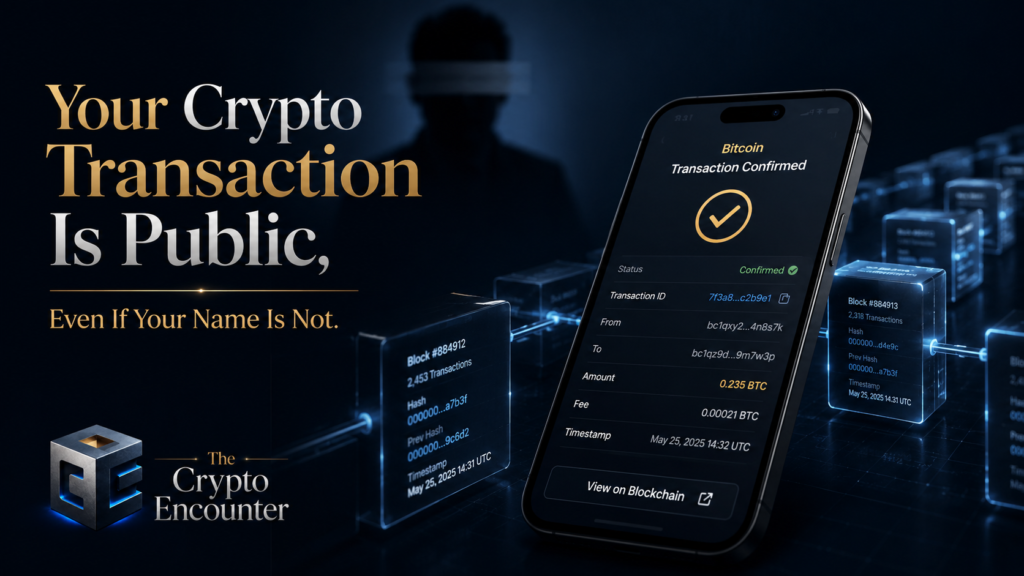
A public wallet address can connect transaction history, exchange activity, social profiles, and targeted scam attempts.
Your Crypto Transaction Is Public Across Multiple Wallets Too
Creating a second wallet can improve separation. However, it only helps when your behavior keeps those wallets separate.
For instance, you may publicly use Wallet A and privately use Wallet B. If you transfer funds directly from A to B, an observer can see the connection. Likewise, funding both wallets from the same identifiable exchange account may create another clue.
A safer privacy structure requires more than generating new addresses. It requires careful separation of purposes, accounts, devices, services, and public disclosures.
Even then, no ordinary user should assume perfect anonymity. Blockchain analysis can combine on-chain transactions with information from exchanges, websites, compromised databases, and investigative records.
How to Reduce the Risk of Public Crypto Activity
You cannot remove a confirmed transaction from a permanent public blockchain. However, you can reduce unnecessary exposure.
Separate wallets by purpose
Use different wallets for different activities. For example, keep public payments separate from long-term holdings and experimental decentralized applications.
This approach limits how much information one exposed address reveals. Still, avoid transferring funds between those wallets without considering the public link.
Keep your main holdings out of public view
Do not post screenshots that show complete addresses, balances, transaction identifiers, wallet applications, or account details. Moreover, avoid discussing the size and exact location of your holdings.
Your crypto transaction is public enough already. Public posts can add the identity link that an observer needs.
Verify the full recipient address
Check the complete address before approving a transfer. When possible, confirm it through a separate trusted channel.
For a large payment, send a small test transaction first. Then verify that the intended recipient received it before sending the remaining amount.
Treat wallet links as high-risk requests
A website may ask you to connect your wallet, sign a message, approve a token, or authorize a smart contract. Read each request carefully.
Do not assume that a signature is harmless merely because it does not appear to send funds immediately.
Protect the device, not only the wallet
Update your operating system, browser, wallet application, and security software. In addition, use strong unique passwords and phishing-resistant multifactor authentication where available.
CISA has documented threat actors using spear-phishing and malware to steal cryptocurrency. Such attacks target users and devices rather than defeating the underlying blockchain.
Slow down when someone creates urgency
Scammers often demand immediate action. They may claim that your account faces closure, your funds need protection, or an investment opportunity will disappear.
Pause. Contact the company through its official website or application. Do not use the link, phone number, QR code, or contact details supplied by the suspicious message.
What to Do Before Sending Any Crypto Transaction
Before selecting “confirm,” ask five questions:
- Did I obtain the address from a trusted source?
- Did I verify the complete address after pasting it?
- Does anyone want me to act urgently or secretly?
- Do I understand exactly what this wallet approval permits?
- Could this payment reveal a wallet or balance that I prefer to keep separate?
These checks cannot eliminate every risk. Nevertheless, they can stop many avoidable mistakes.
Remember that your crypto transaction is public once the network records it. Careful verification must happen before confirmation, not afterward.
What to Do After a Suspicious or Mistaken Transfer
Act quickly, although recovery may remain difficult.
First, save the transaction identifier, wallet addresses, screenshots, messages, website details, email headers, and payment records. Do not delete the conversation.
Next, contact the exchange or service involved through its verified support channel. A service may freeze assets if funds reach an account it controls, although no outcome is guaranteed.
Then, report the incident to the relevant law-enforcement and consumer-protection agencies in your jurisdiction.
Finally, move unaffected assets to a secure wallet if you believe someone exposed your private keys or recovery phrase. Use a clean device where possible. Also revoke suspicious token approvals when appropriate.
Avoid anyone who promises guaranteed recovery. A second scam often follows the first loss.
The Privacy Lesson Every Crypto User Should Remember
Your crypto transaction is public on transparent blockchains, but the record usually begins with addresses rather than names. That distinction provides some separation, yet it does not guarantee anonymity.
Identity can enter through an exchange, merchant, public post, data breach, wallet connection, device compromise, or simple conversation. Once that link exists, an observer may examine a much larger financial trail.
Therefore, think of every wallet address as a persistent identifier. Share it carefully. Separate activities deliberately. Verify every payment. Protect your devices. Most importantly, never let public transaction details convince you that an unknown caller or message must be legitimate.
The blockchain may secure the record. Your decisions still secure you.
Frequently Asked Questions
Is your crypto transaction public on every blockchain?
No. Privacy levels differ among networks and transaction systems. However, major transparent blockchains such as Bitcoin and Ethereum make substantial transaction data publicly accessible. Users should check the privacy model of the specific network they use.
Can someone find my name from my wallet address?
A wallet address alone may not reveal your name. However, an exchange record, public post, merchant database, payment request, data leak, or investigation could connect the address to you.
Does a VPN hide a blockchain transaction?
A VPN may hide some network information from certain observers, but it does not remove the transaction from the blockchain. Your crypto transaction is public after the network records it.
Does a hardware wallet make my crypto activity private?
No. A hardware wallet can help protect private keys from online theft. However, it does not hide addresses, balances, or transactions recorded on a transparent blockchain.
Can I delete a public crypto transaction?
Generally, no. Confirmed transactions on established public blockchains become part of the network’s permanent history. You cannot delete the record as you might delete an ordinary online account entry
Can authorities trace stolen cryptocurrency?
Public blockchain records can support tracing because investigators can follow transfers between addresses. However, tracing does not guarantee identification, seizure, or recovery. Criminals may move assets across wallets, services, networks, and jurisdictions.