

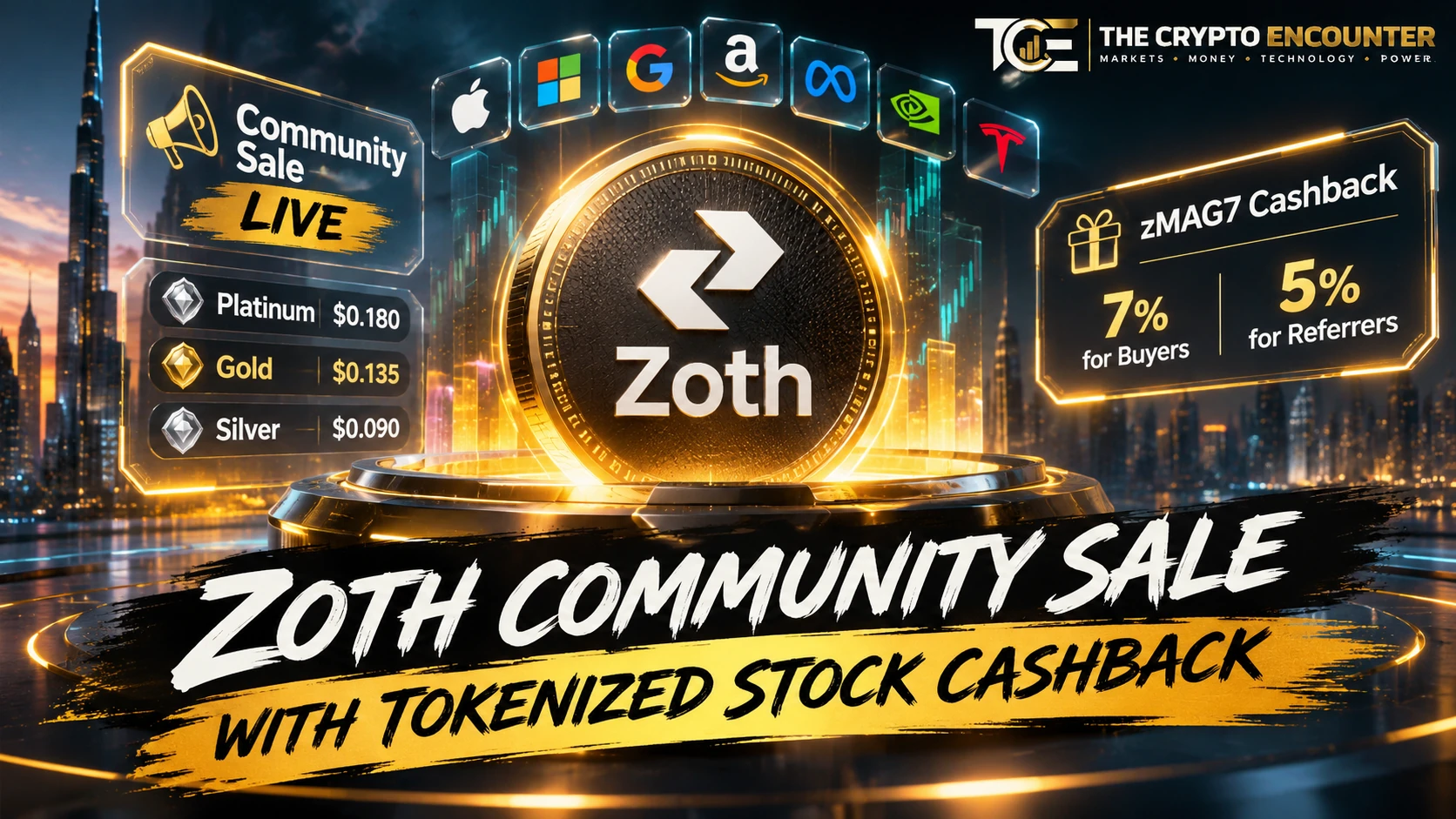
Zoth has opened a $500,000 community token round through Sonar by Echo, with three pricing options and a referral incentive linked to tokenized shares of seven major U.S. technology companies. The sale opened November 16 and is scheduled to close November 29, 2026, subject to eligibility and identity verification.
The Zoth community sale combines a relatively small fundraising target with different token-release schedules and cashback delivered through zMAG7, a basket tracking the Magnificent Seven. The structure makes the timing of token access, the value of the rewards and the distinction between company claims and independently established results especially important.
According to information supplied exclusively to The Crypto Encounter and corroborated by the company’s official sale portal, eligible wallets may contribute between $1 and $500,000 using USDC or USDT on Ethereum. The $500,000 figure is the total round target, not a guaranteed allocation for any individual wallet.
Zoth Community Sale: Three Prices, Three Vesting Schedules
The offering gives eligible participants three options. Each has a different price, stated fully diluted valuation (FDV) and schedule for releasing tokens after the token generation event (TGE). A lower price comes with a smaller immediate unlock and a longer wait for the remainder.
| Option | Token price | Stated FDV | TGE unlock | Remaining release |
|---|---|---|---|---|
| Platinum | $0.180 | $180 million | 35% | Two-month cliff, then five months linear vesting |
| Gold | $0.135 | $135 million | 25% | Three-month cliff, then six months linear vesting |
| Silver | $0.090 | $90 million | 15% | Six-month cliff, then six months linear vesting |
The listed valuations imply a one-billion-token fully diluted supply across all three options: $180 million divided by $0.18, $135 million divided by $0.135, and $90 million divided by $0.09 each produce one billion tokens. This is a calculation from the published terms, not independent confirmation of circulating supply or the token’s eventual trading value.
For example, a $1,000 contribution would correspond to approximately 5,555.56 tokens at Platinum pricing, 7,407.41 at Gold, or 11,111.11 at Silver, before allocation decisions or any rounding rules. Only 35%, 25% or 15%, respectively, would become available at TGE under the stated schedules. The balance remains subject to the applicable cliff and vesting terms.
These differences illustrate why a presale discount cannot be assessed separately from liquidity and lockup risk. The Crypto Encounter’s guide to crypto presales and token generation events explains how token allocation, vesting and liquidity can materially affect a project’s post-launch structure.
How Zoth Community Sale Allocations Will Be Finalized
Zoth’s published timetable schedules a review from November 30 through December 4, with allocations finalized December 5. If eligible demand exceeds the round target, the company says priority rules will determine allocations and unallocated contributions will be refunded under the sale terms. The TGE is planned for the first quarter of 2027, without a confirmed day.
This means a submitted contribution should not be confused with a final token allocation. Participants also face uncertainty about when trading liquidity may become available and at what price, if any, the token eventually trades.
How the zMAG7 Cashback Arrangement Works
Zoth describes the incentive as 12% combined cashback, but that percentage is divided between two different recipients. A qualifying buyer using a referral link receives 7% of the eligible purchase value in zMAG7, while the referrer receives 5%. The buyer does not receive both portions.
Existing zMAG7 holders may also qualify for 7% cashback and a guaranteed allocation when they participate with the same verified wallet holding zMAG7. Using a referral link does not double the buyer’s reward: the company caps buyer cashback at 7%.
On a $100,000 qualifying allocation, the company’s example produces $7,000 in zMAG7 for the buyer and $5,000 for the referrer. These are advertised incentive amounts, not guaranteed cash proceeds or investment returns. The market value and redemption characteristics of tokenized assets may differ from a simple dollar-denominated promotional illustration.
zMAG7 is described as an onchain basket holding tokenized exposure to Apple, Microsoft, Alphabet, Amazon, Meta, Nvidia and Tesla through Coinbase Tokenized Stocks on Base. Zoth says the underlying tokenized stocks are backed by listed shares. That statement should not be read as establishing that every holder has the same direct shareholder rights, custody protections or redemption access as an owner of conventional exchange-traded stock.
Importantly, tokenized-stock cashback is restricted to eligible non-U.S. participants. Zoth says U.S. participants receive equivalent rewards in Zocta Points. Other restricted jurisdictions are excluded, and KYC or KYB checks apply. The company explains the referral eligibility and timetable in its published materials.
What ZOTH and sZOTH Are Intended to Do
According to Zoth, token holders will be able to stake ZOTH to receive sZOTH. The sZOTH balance is intended to determine membership tiers in Zoth Club, which the company associates with reduced payment, minting, redemption and foreign-exchange fees; additional zVaults incentives; onchain-credit terms; and access to selected products.
The roadmap also mentions AI-related credits for automated payments and invoice management through a CFO Agent. These are stated utility plans. The supplied materials do not independently establish that every benefit is currently operational or available in every jurisdiction.
The emergence of crypto-linked payment products provides another example of digital assets being integrated with consumer financial services. The model brings together token incentives and ordinary financial services, but the relationship between a token’s utility and its market price is not automatic. Customers still depend on product availability, counterparties, payment processing, regulatory permissions and usable settlement infrastructure. Those dependencies are examined in The Crypto Encounter’s analysis of tokenized payments and legacy financial systems.
Zoth’s Business Claims and the Evidence Still Needed
Zoth says it has secured $21.5 million in venture funding and liquidity facilities, handles approximately $55 million in monthly payments across 172 countries, supports more than $115 million in strategy assets under management, has onboarded over two million wallets and has generated $5.5 million in revenue. These are company-reported figures. The supplied announcement does not include audited statements or a standardized methodology sufficient to independently verify them.
The company also cites a reported memorandum of understanding with Bakkt, FINTRAC money-services-business registration in Canada, a strategic funding round, and inclusion in the CB Insights Fintech 100. These developments should not be treated as equivalent to authorization for every financial product in every market. Registration, partnerships, product availability and regulatory permissions each require separate assessment.
Founder and CEO Pritam Dutta said in the supplied announcement: “Our investors bet on Zoth before the market did. The people who use Zoth every day deserve that same seat. From 16 Nov, they have it.”
The stated long-term plan is to integrate payments, yield products, liquidity, tokenized assets and treasury services for consumers, businesses and AI agents. Its first strategic phase targets $1 billion in monthly payment volume by 2029. That is a forward-looking company objective, not a forecast independently validated by The Crypto Encounter.
The claimed payment volume also raises a practical question about how digital dollars reach end users. As explained in our coverage of the remaining barriers to everyday crypto payments, settlement speed does not eliminate access, redemption or consumer-protection risks.
What the Sale Means for Tokenized Stocks and Consumer Risk
A distinguishing aspect of the Zoth community sale is the use of a tokenized-equity basket as a promotional reward for a separate cryptocurrency token sale. That creates two exposures: the buyer’s ZOTH allocation, governed by vesting and future token-market conditions, and the zMAG7 reward, whose value depends on the underlying equity exposure and tokenization arrangements.
Neither exposure is equivalent to a cash rebate that can necessarily be withdrawn immediately at face value. Tokenized securities may involve additional questions about custody, issuer rights, redemption procedures, transfer restrictions and market liquidity. The Crypto Encounter has examined related issues in who holds the assets behind digital-dollar products and what happens when crypto payments require refunds.
Another distinction concerns the funding assets. USDC and USDT are both dollar-linked stablecoins, but their issuers, reserve disclosures, redemption terms and operational risks are not identical. The payment method should not be mistaken for a guarantee that the purchased token or reward will preserve its value.
Participants also face phishing and wallet-approval risks around token sales. The company identifies sale.zoth.io as its official sale portal. Readers can review The Crypto Encounter’s presale security and compliance framework for the broader risks associated with connected wallets, token approvals and distribution schedules.
What Happens After the Token Sale
The immediate milestones are the November 29 closing date, the allocation review, December 5 finalization and the planned first-quarter 2027 TGE. Longer-term evidence will come from actual token distribution, enforceable vesting, functioning utility, transparent financial reporting and whether the company’s payment and asset-management products deliver the results it describes.
The Zoth community sale is therefore more than a conventional token-pricing announcement. It tests whether a stablecoin-focused financial platform can connect community fundraising with tokenized equity rewards and meaningful product access. The sale terms are published, but its eventual economic outcome remains uncertain.
Editorial disclosure: This report is based on information supplied to The Crypto Encounter and cross-checked against Zoth’s official sale materials. It is coverage of a company announcement, not an endorsement of the token offering. Operational figures and future targets are attributed to Zoth unless independently substantiated.
Risk disclaimer: Digital assets and tokenized financial products can lose value, including the entire amount committed. Eligibility, legal rights, allocation, custody, vesting and redemption terms vary. This report provides information and analysis, not personalized financial, investment or legal advice.