

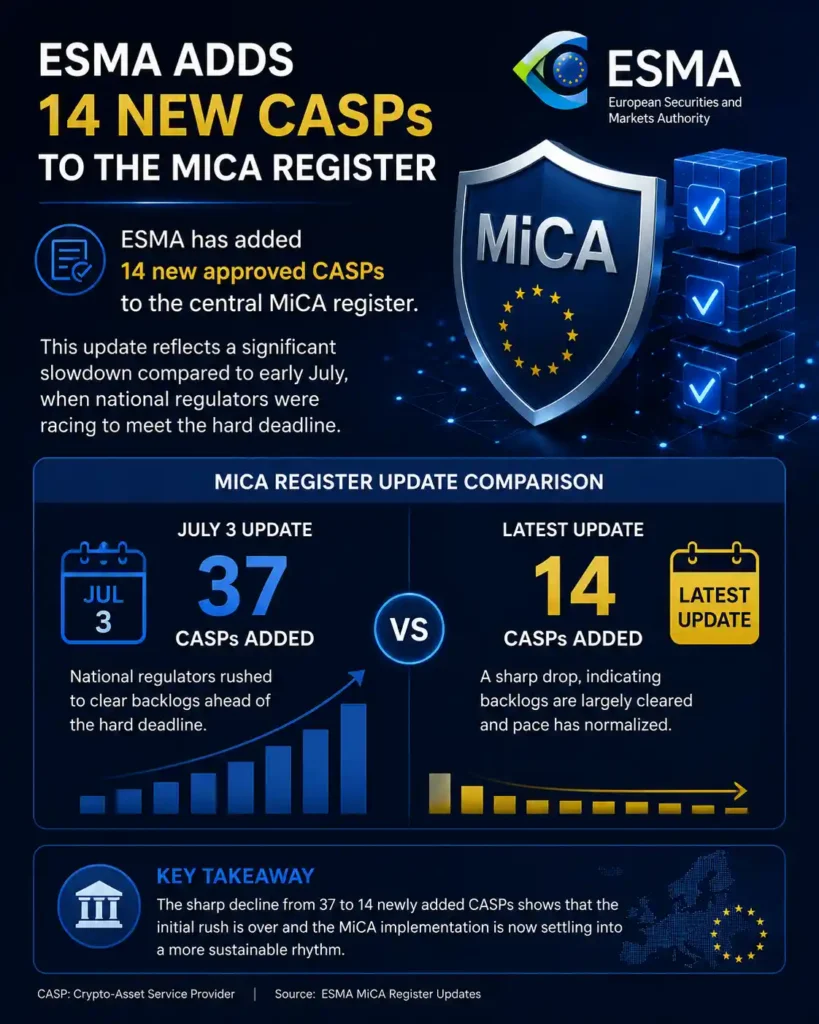
The European Securities and Markets Authority (ESMA) has added 14 new Crypto-Asset Service Providers (CASPs) to the MiCA register, its central regulatory database, signalling a notable deceleration in Europe’s digital asset licensing momentum.
This second post-deadline update brings the total number of fully authorized firms on the MiCA register to 294, according to the latest regulatory records. Following the hard July 1, 2026, expiration of the European Union’s Markets in Crypto-Assets (MiCA) transitional window, the industry has transitioned from a frantic compliance rush to a much steadier, more deliberate onboarding phase.
Among the newly registered entities are prominent global blockchain networks, sovereign state banks, and regional co-operative lenders. For market participants, the latest update indicates that while the regulatory doors remain open, the bar for entry under the uniform European framework remains exceptionally high.
Why This Story Matters
For years, operating a digital asset business in Europe meant navigating a fragmented patchwork of 27 distinct national frameworks, varying from simple Anti-Money Laundering (AML) registries to robust custody licenses. The implementation of MiCA changed the landscape by introducing a single, unified rulebook.
The state of the MiCA register is now the primary health indicator for the European digital asset market. A place on this register grants companies a “passporting” right to legally offer their services across the entire 30-nation European Economic Area (EEA) under a single regulatory license. Conversely, exclusion from the register represents a legal barrier; post-deadline, firms without full authorization are barred from soliciting or serving EU clients.
This update reveals two vital trends: traditional finance (TradFi) continues to absorb crypto market share, and the initial wave of compliance applications has officially crested, leaving a tighter, more consolidated ecosystem.
MiCA Register: The July Post-Deadline Update
In its second major update since the transitional grandfathering period ended, ESMA added 14 new approved CASPs to the central MiCA register. This is a sharp drop from the previous update on July 3, which saw 37 CASPs added as national regulators rushed to clear backlogs ahead of the hard deadline.
The latest batch of approvals features some of the industry’s most recognizable names alongside traditional banking institutions:
- Ripple Payments Europe: The European payments arm of blockchain company Ripple secured its entry, strengthening its regulatory foundation for fiat-to-crypto settlement rails across the EEA.
- Sovereign & Private Banking: Portugal’s Bison Bank, Croatia’s state-owned bank Hrvatska poštanska banka (HPB), and Liechtenstein’s Kaiser Partner Privatbank were officially authorized.
- German Co-operative Banks: Highlighting Germany’s localized crypto banking push, Volksbank Schwarzwald-Donau-Neckar and Raiffeisenbank Auerbach-Freihung secured their spots.
Notably, the registers for Asset-Referenced Tokens (ARTs) and Electronic Money Tokens (EMTs)—the two classes of stablecoins regulated under MiCA—remained entirely unchanged in this update.
Market and Industry Context: The Great Consolidation
The slow down in approvals highlights a dramatic consolidation in the European digital asset landscape. Before MiCA took effect, an estimated 3,000 entities operated under various legacy national Virtual Asset Service Provider (VASP) registries.
Today, the MiCA register sits at just 294 approved firms.
This represents an approximate 90% contraction in the number of legally operating service providers in the bloc. According to industry data, only a fraction of the world’s top 100 centralized crypto exchanges by volume currently hold a valid MiCA authorization.
This stark disparity exists because a legacy VASP registration was primarily an administrative AML check. A CASP license under MiCA, however, requires rigorous audits of corporate governance, capital reserves, custody safety, transaction monitoring, and operational resilience.
Risks, Limits, and Unanswered Questions
While the expansion of the MiCA register provides clarity, it also exposes several legal and operational friction points:
- The Offshore Exchange Gap: Several major offshore exchanges remain missing from the register. While ESMA has made it clear that “reverse solicitation”—where an EU client supposedly seeks out an offshore exchange entirely unprompted—will be interpreted very narrowly, enforcement remains a game of cat-and-mouse.
- The Wind-Down Challenge: Regulators expect unauthorized firms to enact orderly wind-down plans. However, enforcing these closures on foreign-domiciled platforms that continue to accept EU logins remains difficult, putting retail investors’ funds at risk.
- Regulatory Backlogs: For firms with applications still pending, the wait is agonizing. A pending application does not equal authorization, meaning many businesses must pause their EU operations or risk heavy fines.
What to Watch Next
As EU crypto licensing slows to a steady trickle, readers and market participants should monitor three critical developments:
- Enforcement Actions: Watch for national competent authorities (such as Germany’s BaFin or France’s AMF) issuing formal cease-and-desist orders or fines to unregistered platforms still serving European users.
- Stablecoin Integration: With the stablecoin register remaining static, the market is waiting to see if major global issuers can successfully restructure their reserves to meet the strict EMT and ART standards.
- The Next Update Cycle: Keep an eye on ESMA’s weekly register updates. The arrival of any major global exchange on the list could shift market share overnight.
FAQS
What is the MiCA register?
The MiCA register is a centralized, public database maintained by the European Securities and Markets Authority (ESMA). It lists all entities authorized to act as Crypto-Asset Service Providers (CASPs), as well as compliant stablecoin issuers and non-compliant entities, within the European Union.
Why is EU crypto licensing slowing down?
The initial surge in approvals was driven by the July 1, 2026, deadline, which ended the transitional phase for legacy crypto companies. Now that the deadline has passed, the market has entered a business-as-usual phase where applications are processed at a more deliberate, thorough pace.
What happens to crypto platforms that are not on the register?
Under MiCA, any platform without a valid CASP license is legally barred from offering crypto-asset services, marketing, or soliciting users in the EU. Unlicensed platforms must enact orderly wind-down plans and halt EU-directed operations.
Can a non-EU firm be added to the MiCA register?
A non-EU firm cannot directly passport services into the EU. To be listed on the register, a firm must establish a legal entity within an EU member state, secure authorization from that local national regulator, and meet all of MiCA’s structural and capital requirements.
Disclaimer: This article is for informational and educational purposes only. It does not provide financial, investment, legal, tax, or accounting advice. Cryptocurrency and digital asset markets involve risk, including possible loss of capital. Readers should conduct their own research before making any financial decision.