

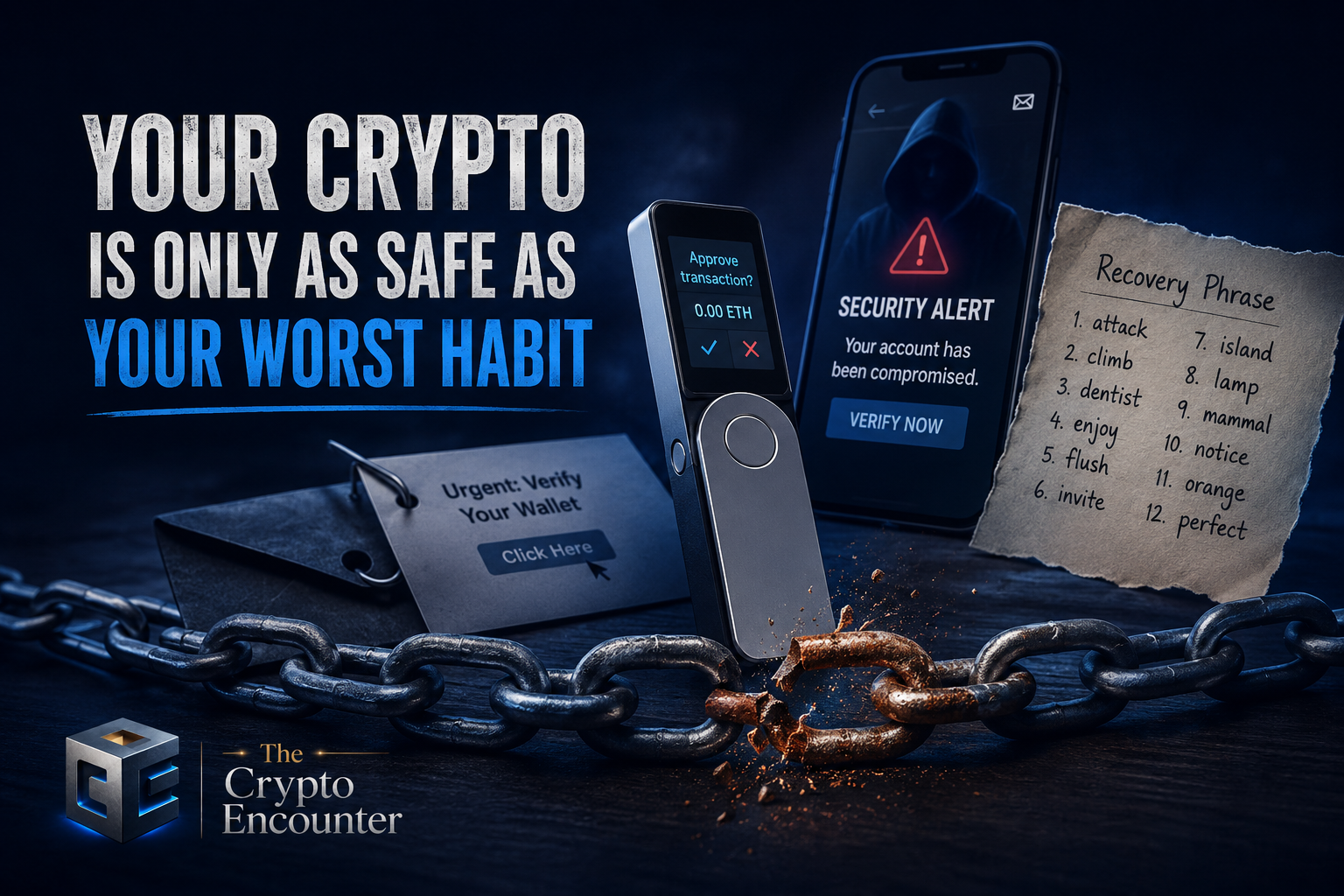
Crypto safety does not fail only when someone breaks a blockchain. More often, money disappears after a user follows a false link, reveals a recovery phrase, installs malicious software, reuses a compromised password, or approves a transaction they do not understand.
Major blockchain networks can remain operational while individual wallets are emptied. That tension explains why your crypto is only as safe as your worst habit. Cryptography can protect a private key from being guessed, but it cannot stop its owner from handing that key to a convincing scammer.
This guide explains where crypto safety commonly breaks down, how criminals exploit ordinary behavior, and which practical routines can reduce your exposure. The goal is not to create fear. It is to show that stronger protection usually begins with a few repeatable decisions.
A blockchain may remain secure while the wallet, device, account, or person using it becomes the real point of failure. Our guide to the crypto security gap between experts and ordinary users explains how those protection layers can break apart.
Key Takeaways
- Crypto safety is a combination of secure technology, careful behavior, and reliable recovery planning.
- Criminals frequently target users because deception can be easier than attacking a blockchain directly.
- A recovery phrase gives control of a wallet, so anyone who obtains it may be able to move the assets.
- Hardware wallets reduce some risks, but they cannot make every transaction safe.
- Urgency, impersonation, guaranteed profits, and requests for secrecy are common scam signals.
- Prevention matters because confirmed cryptocurrency transfers are often difficult or impossible to reverse.
Crypto Safety at a Glance
| Risk | How It Reaches the User | Likely Consequence | Safer Habit |
|---|---|---|---|
| Phishing | Fake email, message, app, or website | Stolen login or wallet access | Open official services independently |
| Recovery phrase theft | Fake support or insecure digital storage | Full wallet compromise | Keep the phrase private and offline |
| Password reuse | Credentials leaked by another service | Exchange or email takeover | Use unique passwords |
| Malicious approval | Deceptive decentralized application | Token loss or ongoing access | Read and limit permissions |
| Device compromise | Malware or fake software | Stolen credentials or altered addresses | Update and verify software |
| Investment scam | Guaranteed returns and emotional pressure | Voluntary transfer to a criminal | Verify independently and reject urgency |
| Recovery scam | Promise to retrieve previously stolen funds | A second financial loss | Do not pay unsolicited recovery agents |
Why Crypto Safety Is Bigger Than Blockchain Security
A blockchain is the shared record that tracks transactions. A wallet, meanwhile, manages the credentials that let a person authorize activity involving assets recorded on that network.
Those two security layers should not be confused.
A blockchain may continue validating transactions correctly even when a criminal controls a victim’s wallet. From the network’s perspective, a transaction signed with the correct private key can appear valid. The system usually cannot determine whether the person signing was deceived, pressured, or using a compromised device.
Therefore, crypto safety involves more than asking whether Bitcoin or Ethereum is secure. It also requires questions such as:
- Is the wallet genuine?
- Is the device clean?
- Is the website authentic?
- Does the user understand the request?
- Is the recovery phrase protected?
- Can an attacker access the user’s email or phone?
- Has the wallet granted unnecessary permissions?
This distinction creates one of crypto’s most important public-safety lessons: technical validity does not always mean informed consent.
A transaction can be valid according to protocol rules and still be disastrous for the person who approved it.
Why Criminals Attack Habits Instead of Blockchains
Directly compromising a mature decentralized network may require enormous technical resources. Persuading one person to click a link can take only a convincing message.
That is why many threats to crypto safety use social engineering. Social engineering means manipulating a person into revealing information or taking an unsafe action. The attacker may impersonate an exchange, wallet provider, government agency, employer, romantic partner, investor, or support representative.
Phishing is one common form. A phishing message tries to make the recipient reveal credentials, install malware, or open a fraudulent website. The US Cybersecurity and Infrastructure Security Agency advises users not to disclose financial or personal information through unsolicited email and to avoid responding to requests for sensitive information.
The message often creates pressure:
- “Your account will be locked.”
- “Verify your wallet immediately.”
- “You have qualified for a limited airdrop.”
- “Your funds are at risk.”
- “Send crypto to protect your account.”
- “Do not tell anyone because the investigation is confidential.”
Urgency matters because it reduces reflection. Once fear or excitement takes control, a person may bypass the habits that normally support crypto safety.
Your Recovery Phrase Is a Master Key
A recovery phrase, sometimes called a seed phrase or secret recovery phrase, is a sequence of words used to restore access to a wallet. It is not an ordinary password.
Ethereum’s official security guidance describes the recovery phrase as the master key to a wallet. Anyone who obtains it may gain access to the associated accounts and drain their assets. The same guidance states that legitimate services and support agents should never request it.
That makes recovery-phrase handling central to crypto safety.
Risky storage methods include:
- Saving a screenshot on a phone
- Uploading the words to cloud storage
- Emailing them to yourself
- Keeping them in an unencrypted notes app
- Sending them through a messaging service
- Entering them into a website after receiving a support message
Ethereum.org advises users to write the phrase down, keep it safe, and avoid storing it on a computer. It also recommends bookmarking legitimate wallet websites to reduce phishing exposure.
An offline backup is not automatically perfect. Paper can burn, metal can corrode, and family members may misunderstand what they find. Still, separating the phrase from internet-connected devices removes a major class of remote attacks.
Good crypto safety also requires a recovery plan. A backup that nobody can find, understand, or lawfully access after the owner dies may protect against theft while creating a different form of permanent loss.
Password Reuse Can Undermine Crypto Safety
A person might use a strong exchange password and still be vulnerable if the same password appears elsewhere. Passwords are only one part of the problem. Crypto’s password problem also involves email accounts, devices, recovery phrases, phishing pages, and the people users decide to trust.
Suppose a gaming site, online shop, or discussion forum suffers a data breach. Criminals can test the exposed email and password combination against other services. This practice is known as credential stuffing.
An email account is especially important because it may control password resets, exchange alerts, identity documents, and account-recovery messages. Consequently, email security is part of crypto safety even when the email provider never holds cryptocurrency.
A safer setup includes:
- A unique password for every important service
- A reputable password manager
- Multifactor authentication
- Backup codes stored safely
- Regular review of active devices and login sessions
- A separate email address for sensitive financial accounts where practical
Text-message verification is generally better than using only a password, but authenticator applications or physical security keys can reduce exposure to certain phone-number takeover attacks.
No single method eliminates risk. Layering protections makes one mistake less likely to become a total compromise.
Crypto Safety Can Fail at the Link
Fraudulent pages can closely reproduce the design of an exchange, wallet, token project, or decentralized application. Logos, colors, support text, and security warnings may all look convincing.
The domain name is often the real clue.
Attackers may replace one letter, use an unfamiliar domain ending, insert extra words, or purchase sponsored advertisements that appear above the legitimate search result. A fake mobile application may also use similar branding while listing a different developer.
Before logging in or connecting a wallet:
- Open the service through a saved bookmark or independently verified official page.
- Read the complete domain, not only the page design.
- Check the application publisher.
- Treat search advertisements as advertisements, not proof of authenticity.
- Avoid opening financial links from unsolicited messages.
- Stop when a page unexpectedly asks for a recovery phrase.
The Federal Trade Commission warns that phishing messages frequently imitate familiar organizations and attempt to obtain personal or financial information.
A polished website does not establish legitimacy. Scam operations can copy visual design far more easily than they can build a trustworthy history.
A Hardware Wallet Improves Crypto Safety, but It Cannot Replace Judgment
A hardware wallet stores or uses private keys in a dedicated physical device, reducing their exposure to an internet-connected computer. That design can strengthen crypto safety against certain malware and key-theft attacks.
However, a hardware wallet is not a truth machine.
It cannot reliably tell you:
- Whether an investment is legitimate
- Whether a token has economic value
- Whether the person messaging you is genuine
- Whether a smart contract serves your interests
- Whether an address belongs to the intended recipient
- Whether a transaction is part of an impersonation scam
If the device displays a transaction and the user approves it, the wallet may sign exactly what it was asked to sign.
This creates the difference between key security and transaction security. The private key may remain protected inside the device while the user authorizes a harmful action.
For stronger crypto safety, verify the destination address and transaction details on the hardware wallet’s own screen. When sending a large amount, consider a small test transfer first. In addition, avoid approving requests you cannot explain in plain English.
Token Approvals Can Create Lasting Exposure
Some decentralized applications ask users to approve a smart contract before it can move a token. That approval may be limited to a specific amount, or it may permit much broader access.
The approval itself is not necessarily a transfer. Instead, it creates permission that may be used later.
This mechanism is useful for decentralized trading, lending, and other onchain activity. Yet it also introduces a hidden crypto safety risk. A malicious or compromised contract may use an existing approval to take tokens after the user has left the website.
Before approving access:
- Confirm which asset is involved.
- Review the spending limit.
- Check whether the permission is necessary.
- Prefer limited amounts when the application allows them.
- Revoke permissions that are no longer needed.
- Use a separate wallet for experimental activity.
Disconnecting a wallet from a website does not always cancel blockchain-level permissions. Users must distinguish between ending a website session and revoking an onchain approval.
That difference is easy to miss, which makes it an important part of practical crypto safety.
Common Scams That Exploit Weak Crypto Safety Habits
Fake Account Alerts
A message claims that someone accessed your exchange account. The link opens a convincing login page, where the attacker captures your credentials.
Safer response: close the message and open the exchange through its official application or a trusted bookmark.
Impersonated Support Agents
A person contacts you after you post a technical question. They offer help, then request a wallet connection, screen-sharing session, private key, or recovery phrase.
Safer response: assume unsolicited support messages are fraudulent and use the provider’s official support channel.
Guaranteed Investment Returns
A platform, influencer, romantic contact, or online “mentor” promises consistent profits with little or no risk. A dashboard may display fictional gains while withdrawals remain blocked.
The FTC states that guaranteed profits or large returns are a clear cryptocurrency-scam warning. It also warns that legitimate businesses do not demand cryptocurrency in advance to protect a consumer’s money.
Safer response: reject guaranteed returns and independently verify the company, registration status, operators, and withdrawal conditions.
Fake Airdrops and Token Claims
A post says you are eligible for free tokens. The connected page asks for broad wallet permissions or presents an unreadable signature request.
Safer response: verify the announcement through multiple official channels and use a low-value wallet for unfamiliar applications.
Address-Replacement Malware
Malware watches the clipboard and replaces a copied wallet address with one controlled by an attacker.
Safer response: verify the beginning, middle, and end of the address on the signing device rather than trusting pasted text.
Recovery Services
After a theft, a person or supposed law firm promises to recover the assets in exchange for an advance payment.
The FTC warns that unsolicited recovery offers are frequently another scam. The FBI has also documented victims being targeted again by fictitious law firms after an initial cryptocurrency loss.
Safer response: do not pay an unknown party that guarantees recovery.
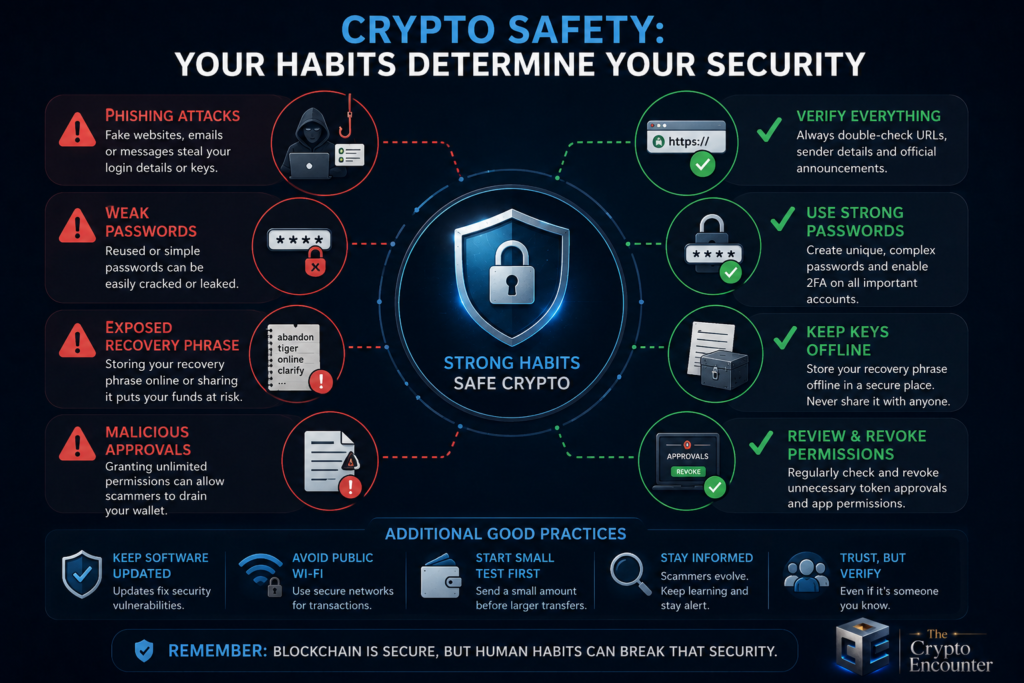
A Practical Crypto Safety Routine
Effective crypto safety should be simple enough to follow under pressure. A complicated plan that disappears during an emergency offers limited protection.
Before Opening a Crypto Account
- Create a unique password.
- Protect the associated email account.
- Enable strong multifactor authentication.
- Download the application from a verified source.
- Store backup codes away from the device.
- Learn the provider’s official support process.
Before Funding a Wallet
- Confirm that the wallet software is authentic.
- Create the wallet in a private environment.
- Record the recovery phrase offline.
- Never photograph or upload the phrase.
- Test wallet recovery with a small balance where appropriate.
- Decide how trusted heirs could obtain access if necessary.
Before Signing Any Transaction
Pause and answer four questions:
- Which wallet initiated this request?
- Which asset or permission is affected?
- Which address or contract will receive access?
- What outcome should occur after signing?
When any answer is unclear, reject the request. This pause may be the most valuable crypto safety habit in the entire process.
Before Sending a Large Transfer
- Verify the destination through a separate channel.
- Compare the complete address.
- Check the correct network.
- Send a small test amount.
- Confirm receipt before sending the remainder.
- Watch for copied-address substitution.
Once Every Month
- Review exchange login history.
- Remove old devices.
- Update wallet and operating-system software.
- Review active token approvals.
- Confirm that backups remain readable and secure.
- Check whether your emergency plan still works.
What to Do After a Suspected Compromise
Speed matters, although no response can guarantee recovery.
When an exchange account may be compromised:
- Open the official service independently.
- Change the password.
- End unknown sessions.
- strengthen multifactor authentication.
- Contact official support.
- Preserve messages, transaction records, and account details.
When a wallet may be compromised:
- Stop interacting with the suspicious page.
- Use a clean device where possible.
- Revoke malicious token approvals when doing so is safe.
- Move remaining assets to a new wallet if the recovery phrase or private key may be exposed.
- Do not reuse the compromised recovery phrase.
- Record transaction hashes and destination addresses.
Victims in the United States can file cryptocurrency-related complaints with the FBI’s Internet Crime Complaint Center. The agency asks complainants to provide available transaction and communication details.
Reporting may not restore funds, but it can support investigations and connect related cases.
Be cautious afterward. Victims frequently receive offers from supposed investigators, lawyers, hackers, or tracing experts. A second scam often succeeds because the victim is desperate to reverse the first loss.
The Hidden Trade-Off in Self-Custody
Self-custody means controlling the credentials needed to move cryptocurrency without depending on an exchange or custodian.
That control can reduce exposure to frozen withdrawals, platform insolvency, or unauthorized institutional decisions. At the same time, the individual accepts responsibilities that a bank or regulated custodian would normally manage.
These responsibilities include:
- Key protection
- Fraud detection
- Software verification
- Transaction review
- Backup maintenance
- Estate planning
- Incident response
Therefore, self-custody should not be presented as automatically safer for every person. It changes the source of risk.
A custodian creates counterparty risk because another organization controls access. Self-custody creates operational risk because the user controls access. Thoughtful crypto safety starts by recognizing which responsibility a person can manage reliably.
For some users, a carefully chosen regulated service with strong account controls may be more practical than managing a recovery phrase. Others may prefer self-custody because they understand its demands and want direct control. Neither arrangement removes every threat.
Crypto Safety Improves When Security Becomes Boring
Scams succeed in moments of unusual emotion: a sudden opportunity, a frightening warning, an unexpected prize, or a private request from someone who appears trustworthy.
Good crypto safety introduces friction into those moments.
A person who always waits, verifies, and uses a second channel may miss an occasional promotion. However, they are also less likely to authorize a permanent loss.
The most protective habits are rarely exciting:
- Use bookmarks.
- Read addresses.
- Reject urgency.
- Keep secrets offline.
- Update software.
- Limit permissions.
- Test transactions.
- Ask for independent verification.
Security improves when these actions become routine rather than exceptional.
Conclusion: Your Worst Habit Sets the Limit
Crypto safety begins with secure technology, but it ends with human behavior.
A blockchain can validate transactions accurately while a scammer manipulates the person authorizing them. A hardware wallet can protect a private key while its owner approves a malicious request. A strong password can secure an exchange while a compromised email account resets it.
That is why your crypto is only as safe as your worst habit.
Fortunately, most users do not need advanced cybersecurity expertise to reduce risk. They need a repeatable system: protect the recovery phrase, use unique credentials, verify every destination, distrust unsolicited contact, limit permissions, and slow down whenever urgency appears.
No routine can promise complete protection. Nevertheless, disciplined crypto safety makes criminals work harder and gives mistakes fewer opportunities to become permanent losses.
Frequently Asked Questions
What does crypto safety mean?
Crypto safety is the set of habits, technologies, and recovery procedures used to protect cryptocurrency accounts, wallets, private keys, devices, and transactions from theft, fraud, unauthorized access, and accidental loss.
Is blockchain technology safe?
Established blockchains use cryptography and distributed validation to protect their transaction records. However, network security does not automatically protect individual users from phishing, stolen credentials, malicious wallet approvals, or investment fraud.
What is the biggest crypto safety mistake?
Sharing a recovery phrase is among the most serious mistakes because anyone who obtains it may control the wallet. Other major risks include approving unknown transactions, reusing passwords, and trusting unsolicited support messages.
Does a hardware wallet guarantee crypto safety?
No. A hardware wallet can reduce private-key exposure, but it cannot verify every investment, website, contract, address, or person. Users can still approve harmful transactions.
Should I store my recovery phrase online?
Official Ethereum guidance recommends writing it down and keeping it safe rather than storing it on a computer. Digital storage increases exposure to account breaches, malware, cloud compromise, and accidental sharing.
Can stolen cryptocurrency be recovered?
Sometimes investigators or exchanges can freeze assets that reach identifiable services, but recovery is not guaranteed. Blockchain transfers are generally difficult to reverse, so prevention and rapid reporting are essential.
Disclaimer
This article is for informational and educational purposes only. It does not provide financial, investment, legal, or cybersecurity advice. Cryptocurrency involves significant risks, including possible loss of funds. Readers should verify information and conduct their own research.