


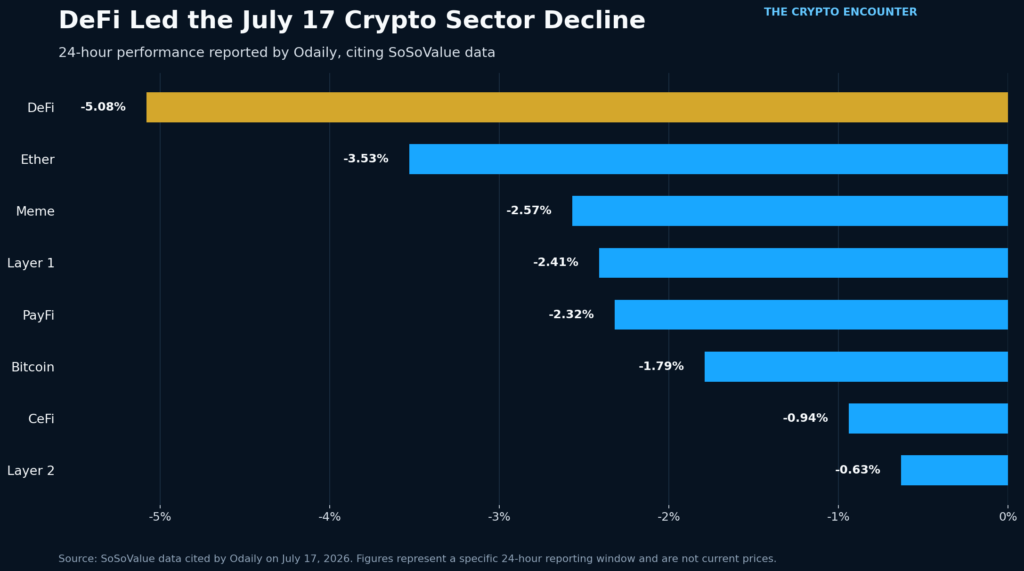
Bitcoin and Ether declined with the wider cryptocurrency market on July 17, 2026, but decentralized finance tokens fell much harder. SoSoValue data cited by Odaily showed the DeFi sector losing 5.08% over 24 hours. Bitcoin fell 1.79% and moved below $64,000, while Ether dropped 3.53% and slipped below $1,900. Hyperliquid, Aave, and DeXe recorded even steeper losses.
The divergence matters because it may reveal where investors see the greatest risk when market conditions weaken. Two days earlier, Summer.fi announced plans to wind down its Labs company after a $6.04 million vault exploit depleted depositor funds and, according to the company, removed the financial runway needed to rebuild. Summer.fi did not cause the broader selloff. Still, its collapse offers a useful case study in why DeFi carries risks that extend beyond token prices.
DeFi Led a Broad Crypto Market Decline
Most major crypto sectors declined during the 24-hour period covered by the July 17 report.
DeFi fell 5.08%, compared with declines of 2.57% for meme coins, 2.41% for Layer 1 assets, 2.32% for PayFi, 0.94% for centralized finance tokens, and 0.63% for Layer 2 assets. The figures reflect one specific market window and should not be treated as current prices after that period.
Within DeFi, Hyperliquid’s HYPE token fell 10.28%. AAVE declined 6.12%, while DEXE lost 4.83%. Beldex gained 6.61%, providing a notable exception to the sector-wide weakness.
Broader thematic indexes showed a similar ranking. The ssiDeFi index dropped 5.97%, compared with declines of 4.24% for ssiSocialFi and 3.56% for ssiAI.
These figures confirm that DeFi underperformed during the reported session. They do not, by themselves, explain why.
Why the Gap Between Bitcoin and DeFi Matters
Bitcoin remains volatile and can suffer severe drawdowns. However, its risk structure is easier to identify than that of many DeFi protocols.
Bitcoin holders primarily face market, custody, network, liquidity, and regulatory risks. A DeFi participant may face those same risks plus smart-contract failures, oracle problems, governance disputes, liquidity shortfalls, treasury concentration, front-end disruption, and dependency on third-party protocols.
That added complexity can matter when traders reduce risk.
Bitcoin also has deeper liquidity and a more established market structure than most DeFi tokens. Those characteristics may make it easier for some investors to retain Bitcoin exposure while cutting positions in smaller or more complex assets. This is a plausible interpretation of the July 17 divergence, not a verified explanation for investor behavior.
The market move also fits a broader pattern discussed in TCE’s analysis of why Bitcoin remains sensitive to Federal Reserve policy and global liquidity. When financial conditions tighten, the effects are rarely distributed evenly across crypto assets. Smaller, less liquid, or more operationally complex sectors may react more sharply.
Summer.fi Turned a Technical Failure Into a Business Crisis
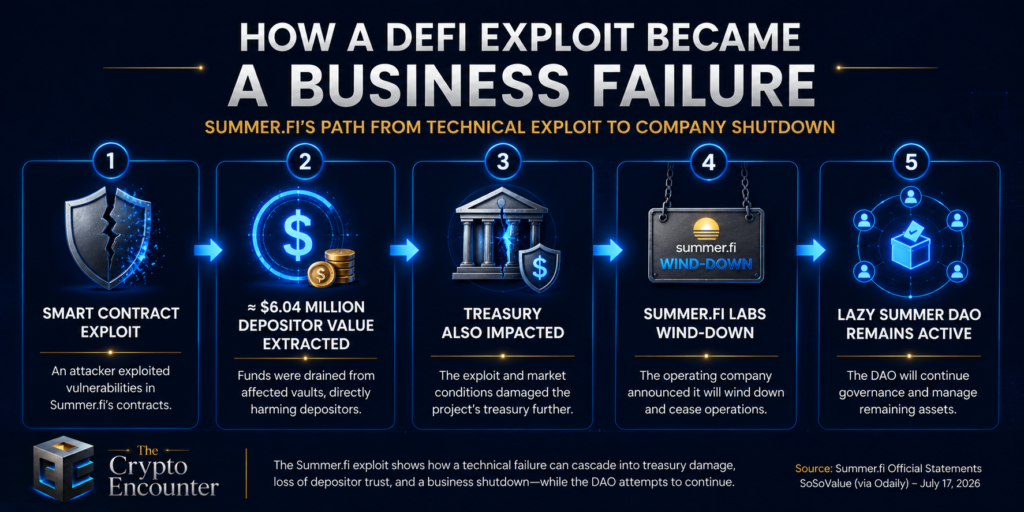
According to the protocol’s official post-mortem, an attacker manipulated the share price of two USDC vaults on Ethereum mainnet and extracted approximately $6.04 million in depositor value through a single atomic transaction.
TokenPost reported that the lower-risk vault lost approximately 5.64 million USDC and the higher-risk vault lost about 400,000 USDC. Those figures add up to the approximately $6.04 million total reported by Summer.fi, but the vault-level split comes from secondary reporting rather than the wind-down announcement itself.
Summer.fi said a meaningful portion of the team’s own capital had been placed in the affected vaults. According to the company, that loss removed the runway required to rebuild and continue operating.
The exact treasury value, the proportion lost, and the company’s remaining resources were not disclosed.
This detail is central to the story. The same incident harmed depositors and weakened the organization expected to finance the response. As a result, a vault exploit became a business-continuity crisis.
The Company Is Closing, but the Protocol Question Is More Complex
Summer.fi’s announcement does not describe an immediate shutdown of every smart contract or governance function.
The company said the Summer.fi application would remain live until August 31, 2026. It also said the Lazy Summer Protocol is governed by the Lazy Summer DAO, which must decide the protocol’s future. The DAO was working through the steps required to resume withdrawals and redemptions for all vaults, including the two affected by the exploit.
No guaranteed recovery date was provided.
Therefore, it would be misleading to say that full vault functionality is certain to return by August 31. The defensible position is that the DAO is attempting to restore access, while the outcome and timing remain unresolved.
The distinction between a front-end company, a protocol, and a DAO is important for users. A protocol may continue existing on-chain even when the company that built its interface and supported development winds down. Yet continued technical existence does not guarantee maintenance, liquidity, user support, or successful recovery.
For a broader explanation of these overlapping vulnerabilities, TCE’s guide to the security risks surrounding cryptocurrencies explains why on-chain settlement does not remove operational, custody, or platform risk.
DeFi Risk Layers and Reader Takeaways
A reader-focused summary of the market, technical, and organizational risks discussed in the article.
| Risk layer | Verified development | Why it matters | What remains unresolved |
|---|---|---|---|
| Market risk | DeFi fell 5.08% over the reported 24-hour window, compared with Bitcoin’s 1.79% decline. | The gap shows that losses were uneven and that DeFi absorbed more selling pressure than Bitcoin. | The available data does not identify who sold or prove a single cause for the divergence. |
| Smart-contract risk | Summer.fi reported that an attacker extracted about $6.04 million in depositor value from two Ethereum USDC vaults. | A technical flaw can directly affect depositor value and force emergency recovery work. | The final recoverable amount and timing of restored access were not confirmed. |
| Treasury concentration | Summer.fi said a meaningful portion of team capital was held in the affected vaults. | The same incident can weaken both users and the organization expected to finance the response. | The company did not disclose the exact treasury value or percentage affected. |
| Governance continuity | Summer.fi Labs planned to wind down, while the Lazy Summer DAO retained authority over the protocol’s future. | A protocol can continue on-chain even when its development company closes. | On-chain continuity does not guarantee maintenance, liquidity, user support, or successful recovery. |
| Business continuity | Summer.fi said the exploit removed the runway needed to rebuild and continue operations. | The cost of an exploit can include lost operating capacity, not only the amount initially extracted. | The statement reflects the company’s explanation and was not independently audited. |
Source note: Market figures are from SoSoValue data cited by Odaily on July 17, 2026. Summer.fi figures and operational statements come from the protocol’s official post-mortem and wind-down announcement.
The July selloff and Summer.fi’s wind-down point to two different forms of DeFi risk.
Market risk
Token prices can fall because of weaker liquidity, macroeconomic pressure, changing sentiment, leverage, or sector rotation. The July 17 data confirms the price movement, but it does not identify a single cause.
Protocol and organizational risk
Users can also lose access or value because of contract exploits, flawed accounting, governance failures, concentrated treasuries, or an operator’s inability to fund recovery.
The second category can reinforce the first. A security incident may reduce deposits, weaken liquidity, increase operating costs, and make fresh financing harder to obtain. Still, the available evidence does not prove that Summer.fi’s announcement caused the wider DeFi decline.
The stronger conclusion is narrower: DeFi investors must assess both asset-market exposure and the resilience of the systems behind those assets.
Summer.fi Is Not an Isolated Business-Continuity Case
Radiant Capital offers a relevant comparison, although the timeline must be stated correctly.
Radiant suffered an approximately $50 million exploit in October 2024. In June 2026, the protocol moved toward winding down after it failed to recover meaningful funds, raise sufficient new capital, or establish a sustainable operating path. The exploit and the closure were separated by roughly 18 months.
Both cases show how an exploit can create prolonged financial and organizational consequences. However, they should not be treated as identical. The attack methods, governance structures, affected assets, recovery periods, and financial positions differed.
The comparison supports a limited but important point: an incident’s full cost can include more than the amount initially stolen. Recovery expenses, lost confidence, lower deposits, constrained liquidity, and depleted operating capital can also threaten a project’s survival.
At the same time, new DeFi products continue to target institutional use cases, including privacy, tokenized assets, and managed vaults. TCE’s coverage of confidential DeFi infrastructure on Ethereum shows why security, privacy, and operational controls are becoming central to institutional product design.
Risks, Limits, and Unanswered Questions
One weak trading session cannot establish a structural decline in DeFi.
Crypto sectors can reverse quickly, and the reported percentages cover only a 24-hour period. DeFi’s underperformance may reflect temporary positioning, leverage, liquidity, or broader risk reduction. The available sources do not provide fund-flow or wallet-level evidence showing who sold or why.
Summer.fi also represents one project, not the entire sector. Its wind-down does not prove that other protocols face the same treasury exposure or operating constraints.
Several questions remain open:
- How much depositor value will ultimately be recoverable?
- When will withdrawals and redemptions resume?
- What will the Lazy Summer DAO decide about the protocol?
- Will more projects separate operating treasuries from protocol vault exposure?
- Will users demand clearer disclosures about incident-response funding?
- Will DeFi continue underperforming Bitcoin after the July 17 reporting window?
The available evidence does not answer these questions yet.
What to Watch Next
The most useful monitoring framework does not rely on a price prediction.
Readers should watch the Lazy Summer DAO’s governance updates, the status of vault withdrawals, and any verified recovery figures. Changes in total value locked may also show whether users are removing capital from affected or comparable vault products.
At the sector level, the key measure is relative performance. Continued DeFi weakness against Bitcoin, Ether, Layer 1 tokens, and Layer 2 assets would provide stronger evidence of a sustained risk rotation. A single session does not.
Security disclosures also deserve attention. Projects that publish treasury policies, audit histories, dependency maps, emergency controls, and recovery funding arrangements may be easier to evaluate than protocols that disclose only token incentives or headline yields.
Finally, regulators and institutional participants will continue examining who controls DeFi interfaces, how governance operates, and who remains accountable when software, organizations, and DAOs overlap. No specific regulatory action has been shown to drive this selloff, but these questions remain material to the sector’s long-term credibility.
Frequently Asked Questions
Why did DeFi fall more than Bitcoin?
SoSoValue data cited by Odaily showed DeFi falling 5.08% over 24 hours, compared with Bitcoin’s 1.79% decline. The sources confirm the difference but do not establish a single cause. Lower liquidity, greater complexity, and broader risk reduction are possible explanations.
Did Summer.fi cause the DeFi selloff?
There is no evidence that Summer.fi caused the sector-wide decline. Its wind-down is relevant as a case study in protocol and operational risk, not as a confirmed market catalyst.
How much was lost in the Summer.fi exploit?
Summer.fi’s official post-mortem reported approximately $6.04 million in depositor value extracted from two Ethereum USDC vaults on July 6, 2026.
Is Summer.fi shutting down completely?
The Summer.fi Labs company is winding down, and the application is scheduled to remain live through August 31. The Lazy Summer DAO governs the protocol and is deciding its future. Withdrawals and redemptions were still being restored at the time of the announcement.
What should DeFi users monitor?
Users should monitor official governance updates, withdrawal access, verified recovery amounts, treasury disclosures, smart-contract dependencies, audit histories, and whether the protocol retains enough financial and technical resources to operate during a crisis.
Disclaimer
This article is for informational and educational purposes only. It does not provide financial, investment, legal, tax, or accounting advice. Cryptocurrency and digital asset markets involve risk, including possible loss of capital. Readers should conduct their own research before making any financial decision.