

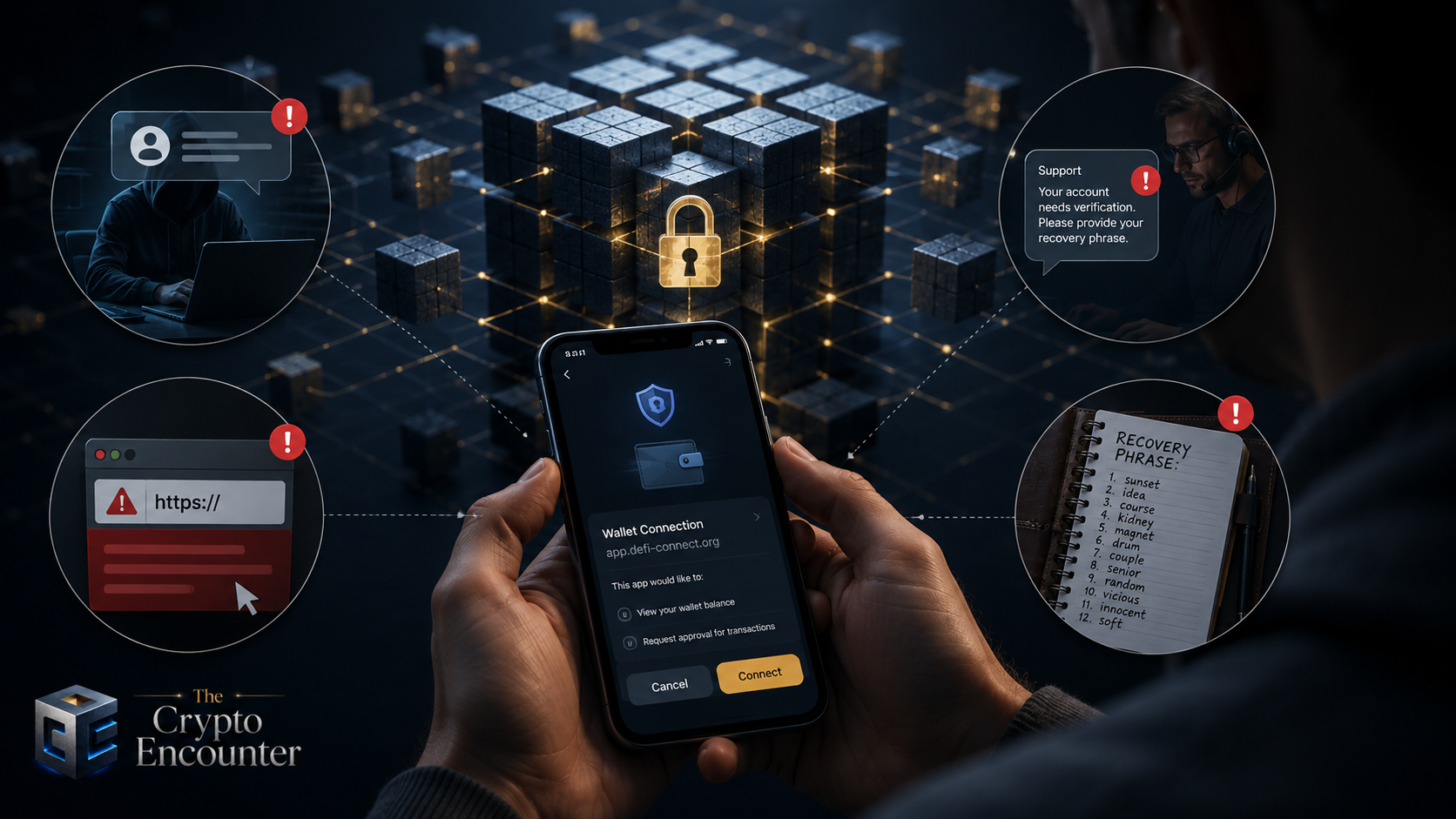
Crypto safety begins with a difficult fact: a blockchain can work exactly as designed while a person still loses money. The network may validate every transaction correctly. Its cryptography may remain intact. Yet a fake website, stolen recovery phrase, compromised device, misleading wallet prompt, or trusted stranger can still move funds beyond the owner’s control. That is why crypto safety depends on more than secure code. It also depends on how people store keys, verify links, protect devices, judge claims, and respond to pressure. This guide explains the gap in plain English, shows where ordinary users face real danger, and offers practical steps that reduce preventable losses.
Crypto Safety in One Minute
- Protocol security protects a blockchain’s rules and transaction history.
- Crypto safety protects the person using wallets, exchanges, devices, and applications.
- A valid transaction can still result from deception, malware, or a stolen recovery phrase.
- Strong crypto safety combines secure tools with verification, caution, and deliberate habits.
- No wallet, exchange, or blockchain can remove every human risk.
The Simple Difference Between Security and Crypto Safety
Security asks whether the system follows its rules. Crypto safety asks whether the person using that system avoids harm.
A blockchain can securely confirm that a valid private key authorized a transfer. However, it cannot confirm that the owner understood the request. It cannot know that a scammer created the website. Nor can it detect that fear, urgency, or false trust influenced the decision.
Therefore, technical security and crypto safety overlap, but they are not identical. The protocol protects the ledger. Meanwhile, users must protect the path that leads to the ledger. If you want a broader explanation of how blockchain security differs from everyday user protection, read our guide on the security of cryptocurrencies.
| Layer | What It Protects | Common Failure |
|---|---|---|
| Blockchain protocol | Transaction rules and ledger integrity | Protocol exploit or consensus failure |
| Wallet | Private keys and transaction approval | Seed phrase theft or malicious signature |
| Exchange account | Custodied funds and account access | Password theft, takeover, or platform failure |
| Device | Wallet apps, browsers, and communications | Malware, fake software, or clipboard replacement |
| Human decision | Trust, verification, and judgment | Impersonation, pressure, or false claims |
In other words, crypto safety can fail at several points even when the blockchain remains secure.
Why Crypto Safety Matters More Than Many Users Expect
Crypto transactions often lack the protections people associate with banks and payment cards. Depending on the network and service, users may have no central operator who can cancel a completed transfer.
Ethereum.org warns that transactions cannot easily be reversed and that wallets may not be recoverable if users lose access. It also advises users to keep seed phrases offline, bookmark wallet websites, and check transaction details carefully.
As a result, crypto safety must begin before a transaction, not after it. A payment mistake may settle in seconds or minutes. Likewise, a leaked recovery phrase may let another person recreate the wallet elsewhere.
Understanding technology is only one part of responsible investing. Market conditions also matter, as we explain in Why Bitcoin Moves With the Fed, When It Claims to Be Independent.
The scale of reported harm shows why this distinction matters. The FBI’s 2025 Internet Crime Report recorded 181,565 complaints with a cryptocurrency connection and $11.366 billion in reported losses. It also identified cryptocurrency investment fraud as the largest source of financial losses reported by Americans that year, with approximately $7.2 billion in losses.
Those figures do not mean blockchains failed. Instead, they show that crypto safety often breaks around the technology.
Wallet Protection Is Only One Part of Crypto Safety
A wallet does not usually hold coins like a leather wallet holds cash. Instead, it manages the keys that let a user control assets recorded on a blockchain.
That distinction matters. Anyone who obtains a recovery phrase may gain the ability to rebuild the wallet and control its assets. The Ethereum wallet security guide also explains why recovery phrases should never be shared or stored in insecure online locations.Consequently, crypto safety requires users to treat the phrase as a master key.
Never share a recovery phrase with:
- Wallet support
- Exchange support
- A supposed investigator
- A social media administrator
- A recovery company
- A friend offering technical help
Legitimate support workers do not need the phrase to diagnose a problem. Moreover, entering it into an unknown website can surrender control of the wallet immediately.
For stronger crypto safety, write the phrase down and store it in a secure offline location. Avoid screenshots, cloud notes, email drafts, and messaging apps. In addition, consider whether one physical copy creates too much risk from theft, fire, water, or loss.
The correct storage method depends on the amount involved and the user’s circumstances. However, the central crypto safety rule remains simple: anyone who knows the recovery phrase may control the wallet.
Phishing Attacks Target Crypto Safety, Not the Blockchain
Phishing uses a fake message, webpage, or identity to steal information or influence an action. The US National Institute of Standards and Technology defines phishing as a fraudulent solicitation in which an attacker pretends to be a reputable person or business to obtain sensitive information.
In crypto, the message may claim:
- Your wallet needs urgent verification
- An exchange has frozen your account
- A token claim expires today
- A security update requires your recovery phrase
- A support agent needs remote access
- A celebrity or project founder is offering a giveaway
Although the story changes, the goal stays similar. The attacker wants the target to click, sign, reveal, or send.
Therefore, crypto safety improves when users stop navigating through unsolicited links. Open the official application directly. Alternatively, use a bookmark that you created from a verified source. Then, inspect the complete domain name before entering credentials or connecting a wallet.
Search advertisements also deserve caution. A polished page can copy a real brand’s colors, logo, wording, and layout. Visual similarity does not prove ownership.
For that reason, crypto safety depends on verifying where a link leads, rather than trusting how the page looks.
A Valid Wallet Signature Can Still Be Dangerous
Wallets ask users to sign transactions and messages. However, many prompts remain difficult for general readers to interpret. A user may approve token access without understanding its scope. In some cases, a malicious request can grant broad permission to move assets.
The blockchain sees valid authorization. Yet the user may have seen only a friendly button marked “Connect,” “Verify,” or “Claim.”
That gap creates a central crypto safety problem. Cryptographic proof shows that a key approved an action. It does not show that the person received honest information.
Before signing, check:
- Which website requested the action?
- Which wallet account is connected?
- Which asset does the request affect?
- Will the request transfer funds or grant spending permission?
- Is the permission limited or unlimited?
- Can you explain the action in one clear sentence?
Reject the request when the answer remains unclear. Good crypto safety allows time for understanding.
A legitimate service should not need users to act before they can read or verify the request. Therefore, pressure and confusion should both trigger a pause.
Devices and Email Accounts Can Undermine Crypto Safety
A secure wallet still runs on a phone, computer, browser, or hardware device. Meanwhile, exchange accounts often depend on email for password resets and security alerts.
Consequently, weak email protection can weaken crypto safety across several services. An attacker who controls the inbox may reset passwords, approve devices, hide warnings, or impersonate the owner.
Malware creates another risk. It can capture keystrokes, alter copied wallet addresses, display fake browser windows, or install fraudulent wallet extensions.
Use a unique password for the primary email account. Then, enable multifactor authentication. The US Cybersecurity and Infrastructure Security Agency states that MFA adds another identity check and recommends phishing-resistant methods when available.
For better crypto safety:
- Update the operating system and browser
- Install wallet software only from verified sources
- Remove unused browser extensions
- Review active account sessions
- Keep financial activity separate from risky downloads
- Avoid remote-access tools unless you fully understand the request
- Compare wallet addresses after pasting them
- Lock devices with a strong passcode
- Protect the email account linked to exchanges
A hardware wallet can reduce key exposure. Still, it cannot protect a user who approves a malicious transaction on the device screen.
Therefore, crypto safety requires secure devices and careful decisions at the same time.
False Trust Is One of the Biggest Crypto Safety Risks
Many losses begin with a relationship rather than a technical exploit.
A stranger may offer trading help. A romantic contact may introduce an investment platform. An impersonator may claim to represent an exchange, tax authority, police department, or utility provider. Over time, the target may trust the person more than the evidence.
The FTC cryptocurrency scam guidance provides additional examples of common fraud tactics, including fake investment platforms, romance scams, and impersonation schemes that target cryptocurrency users.
The US Federal Trade Commission warns that crypto investment scams often start through unexpected messages, social media, or dating platforms. Scammers may direct victims to fake investment websites, display invented profits, and demand additional payments when the victim tries to withdraw. The agency also states that legitimate businesses and government agencies do not demand cryptocurrency to protect money or solve an urgent problem.
This is where crypto safety becomes behavioral. A real cryptocurrency purchase can still fund a fake opportunity. The exchange may work correctly. The blockchain may send the exact amount to the exact address. Nevertheless, the recipient may be a criminal.
Pause when someone uses:
- Guaranteed returns
- Secret investment methods
- Emotional pressure
- Sudden romantic interest
- Urgent tax or legal threats
- Requests for secrecy
- Extra fees to release profits
- Instructions to use a crypto ATM
- Claims that withdrawal requires another deposit
Trust should follow verification. It should never replace it.
Furthermore, screenshots of profits, account balances, licenses, celebrity endorsements, or successful withdrawals do not prove that an investment exists. Scammers can fabricate each one.
Why Crypto Safety Requires Independent Verification
Verification means checking a claim through a separate and trusted route.
Suppose someone contacts you while pretending to represent an exchange. Do not call the number inside the message. Instead, open the official exchange application or visit the verified help center independently.
Likewise, when a friend sends an unusual investment link, contact that friend through another channel. Their messaging account may have been compromised.
This habit strengthens crypto safety because it breaks the scammer’s control over the information. If the same person provides the warning, link, phone number, evidence, and solution, the user has not independently verified anything.
Use at least two sources when a decision involves substantial money. In addition, check whether a regulator, company, or project has published an official warning.
Strong crypto safety requires users to verify the source, the destination, and the requested action.
Recovery Scams Can Defeat Crypto Safety a Second Time
After a loss, victims often feel urgency, shame, anger, and hope. Recovery scammers exploit those emotions.
They may pose as lawyers, blockchain investigators, hackers, or government partners. Then, they promise to retrieve stolen funds after an upfront payment.
The FBI warned that fictitious law firms had targeted cryptocurrency scam victims and reported more than $9.9 million in additional losses between February 2023 and February 2024. The agency advised victims not to send money or personal information to unknown recovery contacts.
The FBI’s 2025 report later recorded 10,516 recovery-scam complaints associated with about $1.4 billion in reported losses. However, the report notes that this total may include losses from the earlier scams that led victims to the recovery service.
Therefore, crypto safety must continue after the first incident. No private company can simply reverse a confirmed blockchain transfer.
Some firms may provide legitimate tracing or legal services. Even so, a promise of guaranteed recovery should trigger immediate suspicion.
Law-enforcement agencies do not charge victims a fee to investigate a crime. Likewise, an unknown person who asks for banking details, identity documents, wallet credentials, or advance taxes may be attempting another scam.
A Practical Crypto Safety Check Before Every Transaction
A short pause can prevent an expensive mistake. Use this crypto safety check before sending funds or approving wallet activity.
1. Define the action
Ask what the request will do. Are you sending money, connecting a wallet, signing a message, approving token access, or changing account security?
2. Verify the destination independently
Open the official application or a saved bookmark. Avoid direct-message links, unsolicited support replies, unexpected emails, and search advertisements.
3. Check the address carefully
Compare several characters at the beginning and end. For a new destination, consider a small test transfer.
However, remember that a successful test confirms the address. It does not prove that the recipient is honest.
4. Read the complete wallet prompt
Do not approve a request because the website looks familiar. Check the asset, amount, network, permission, and destination.
5. Remove urgency
Scammers benefit from speed. Meanwhile, crypto safety improves when users stop, verify, and ask another trusted person to review the situation.
6. Separate different activities
Use one wallet for long-term holdings and another for routine applications. This separation can limit exposure when a website or token approval becomes malicious.
7. Record important transactions
Save the recipient, purpose, amount, date, and transaction hash. Accurate records support crypto safety and make reporting easier if something goes wrong.
Crypto Safety Habits That Reduce Common Losses
No single tool creates complete crypto safety. Instead, several controls must work together.
Use these habits consistently:
- Keep recovery phrases offline
- Never share private keys or seed phrases
- Use unique passwords
- Enable phishing-resistant MFA where possible
- Bookmark official services
- Verify support contacts independently
- Review token approvals
- Test unfamiliar addresses with small amounts
- Separate savings from experimental activity
- Update devices and wallet software
- Ignore guaranteed profits
- Refuse urgent crypto payment demands
- Keep transaction records
- Report suspicious activity quickly
In addition, explain these habits to relatives who use cryptocurrency. Scammers often target confusion, isolation, and embarrassment. A calm conversation can strengthen crypto safety across an entire household.
Families should also agree on a simple rule: no one sends cryptocurrency in response to an unexpected call, message, or relationship without speaking to another trusted person first.
That pause creates a powerful crypto safety barrier because manipulation works best when victims feel alone.
What to Do After a Crypto Safety Failure
Act quickly, but avoid panic.
First, stop sending money. Scammers often claim that one more payment will unlock a withdrawal, settle a tax, or activate recovery. That payment usually deepens the loss.
Next, preserve evidence. Save transaction hashes, wallet addresses, screenshots, messages, usernames, phone numbers, email addresses, receipts, and website details.
Then, secure unaffected accounts. Change compromised passwords, end unknown sessions, and review email recovery settings.
When someone obtains the wallet’s recovery phrase, treat the wallet as compromised. Create a new wallet through verified software on a clean device. Afterward, secure the new phrase offline.
You may also need to revoke suspicious token approvals or transfer unaffected assets. However, proceed carefully because rushed actions can create another mistake.
Finally, contact the relevant exchange, bank, payment provider, and law-enforcement reporting channel. The FBI’s Internet Crime Complaint Center asks cryptocurrency victims to include transaction dates, amounts, account details, and receiving wallet addresses when filing a complaint.
Reporting does not guarantee recovery. Even so, fast and detailed reports can help investigators connect cases and identify related infrastructure.
After reporting, remain alert for follow-up contact. A scammer may return under a new identity. Therefore, post-incident crypto safety should include stronger privacy settings and skepticism toward unsolicited recovery offers.
Why Better Technology Cannot Guarantee Crypto Safety
Developers can improve wallet warnings, transaction simulations, permission controls, domain verification, account recovery, and fraud monitoring. Exchanges can add withdrawal delays, device checks, and stronger authentication.
Those changes matter. However, crypto safety will still depend partly on human judgment.
A person can override a warning. A trusted contact can invent a believable story. A fake platform can show false profits for months. Moreover, a victim may understand technical security while underestimating emotional manipulation.
For that reason, the most useful crypto safety education connects technology with behavior. It teaches people how systems work, how scammers create pressure, and how to verify before acting.
Clearer wallet prompts would help. So would better scam reporting and faster cooperation between platforms. Nevertheless, no interface can guarantee that every user will understand every risk.
Crypto safety must therefore operate as a shared responsibility. Developers should design safer products. Platforms should respond to fraud. Regulators and investigators should pursue offenders. At the same time, users must protect credentials, question claims, and verify important actions.
Conclusion: Secure Protocols Still Need Human Crypto Safety
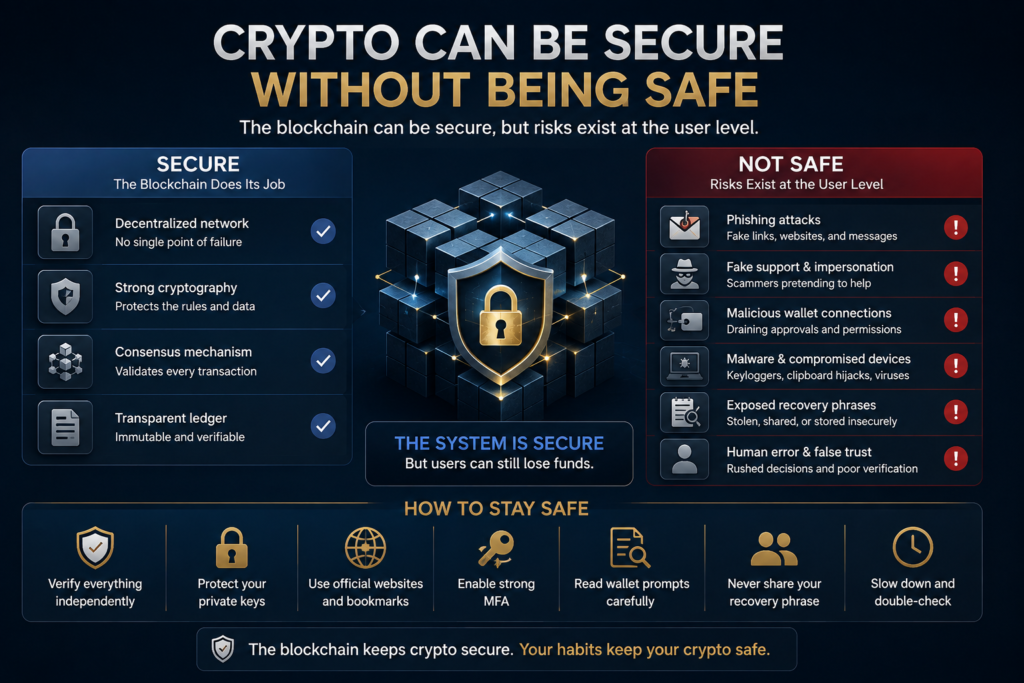
Crypto can be secure without being safe because a secure blockchain protects only the protocol layer. Ordinary users still depend on wallets, devices, email accounts, exchanges, websites, support channels, and personal judgment.
Therefore, crypto safety requires more than choosing a respected network or buying a hardware wallet. It requires deliberate habits. Verify links independently. Protect recovery phrases. Read wallet prompts. Use strong account security. Question guaranteed returns. Slow down when someone creates urgency.
Most importantly, ask two questions before every significant action: “What am I authorizing?” and “How did I verify the person, platform, or address?”
Cryptography can protect the rules. Practical crypto safety protects the person using them.
Frequently Asked Questions
What does “crypto can be secure without being safe” mean?
It means a blockchain can function correctly while a user loses money through phishing, stolen keys, fake investments, compromised devices, or mistaken approvals. Protocol security cannot prevent every human or account-level failure.
What is the most important crypto safety rule?
Never share a recovery phrase or private key. In addition, never enter a recovery phrase into a website because a supposed support agent requested it.
Does a hardware wallet guarantee crypto safety?
No. A hardware wallet can protect keys from some forms of exposure. However, it cannot stop the owner from approving a malicious transaction or sending funds to a scammer.
How can beginners improve crypto safety?
Start with a protected email account, unique passwords, strong MFA, verified wallet software, offline recovery-phrase storage, saved official links, and small test transactions.
Can stolen cryptocurrency be recovered?
Sometimes authorities or exchanges can freeze identifiable funds, but recovery is never guaranteed. Victims should report quickly, preserve evidence, and avoid services that promise certain recovery for an upfront fee.
Why do scammers prefer cryptocurrency?
Cryptocurrency can move quickly across borders, while some transfers offer limited reversal options. Scammers also exploit public confusion about wallets, investment platforms, crypto safety, and blockchain transactions.