

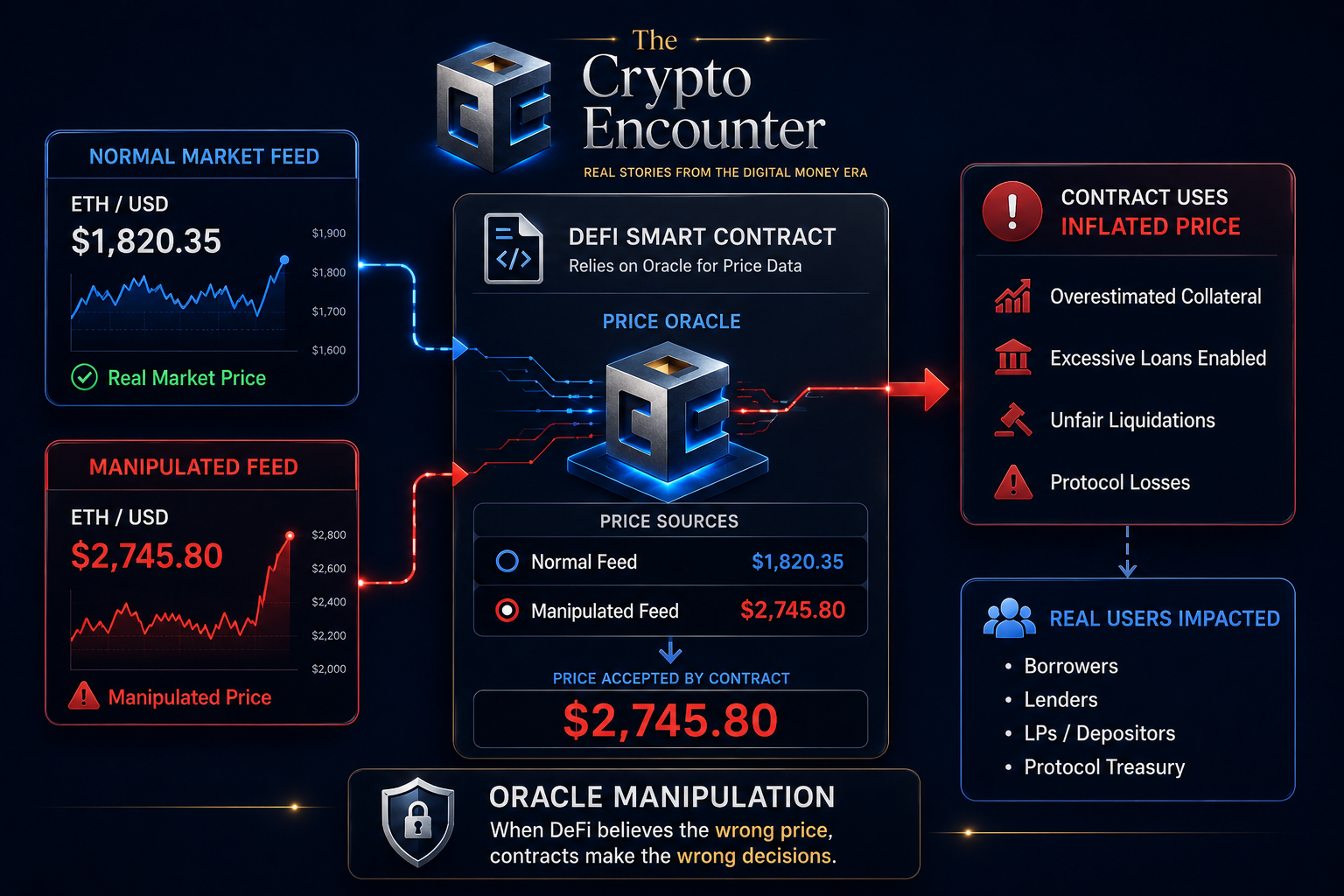
Decentralized finance can remove a bank, broker, or centralized exchange from a transaction. However, the smart contract still needs to know what assets are worth. That creates a less visible dependency. If the protocol receives a bad price, it can make a perfectly automatic decision based on false information. This is the core danger of oracle manipulation.
Oracle manipulation can distort collateral values, trigger unfair liquidations, create undercollateralized loans, or leave a protocol with losses that ultimately affect users and liquidity providers. The code may execute exactly as designed. The price feeding that code is the problem.
For ordinary users, that distinction matters. Self-custody can remove one form of counterparty risk. It does not remove smart contract, liquidity, oracle, approval, or market-structure risk. Understanding oracle manipulation therefore means understanding where trust still exists inside supposedly trust-minimized finance.
What Is Oracle Manipulation in DeFi?
An oracle is a system that gives a blockchain application information it cannot reliably determine for itself.
For example, a lending protocol may need to know that one ETH is worth a certain number of dollars. A smart contract cannot simply open a financial website and check the current market price. Instead, it relies on an oracle or another on-chain pricing mechanism.
Oracle manipulation happens when a protocol receives or relies on a price that does not properly represent the asset’s economic value, and someone can exploit that discrepancy.
Ethereum’s official smart contract security documentation warns that incorrect oracle inputs can cause smart contracts to execute using erroneous information. It also specifically identifies manipulable DEX spot prices as a DeFi security concern.
Importantly, oracle manipulation does not always mean someone hacked the oracle software itself.
Sometimes the oracle works exactly as designed. The attacker instead manipulates the market that the oracle watches.
That distinction is crucial.
A price source can faithfully report, “This token costs $20 in this pool right now,” while the broader market still values it near $10. If a DeFi protocol accepts that isolated $20 price without enough protection, the protocol may act on a temporary distortion.
As a result, oracle manipulation can exploit the gap between a price that exists somewhere and a price that safely represents the market.
Why DeFi Needs Oracles in the First Place
Blockchains are deliberately limited systems. Smart contracts can inspect data available on their blockchain, but external facts do not automatically enter the network.
Consequently, many DeFi applications need price feeds.
A lending market may use them to calculate collateral. A derivatives protocol may use them to settle positions. A stablecoin system may use them to monitor backing ratios. Meanwhile, vaults may rely on prices to calculate asset values.
The Bank of Canada described this dependency in a 2024 research paper on DeFi oracles. Its researchers examined how protocols behave when a price oracle supplies a deliberately skewed input, highlighting how important oracle values can become to smart contract security.
Therefore, oracle manipulation matters because the price is rarely decorative information.
The price often controls money.
If a protocol thinks your collateral is worth $10,000, it may let you borrow against that value. If the same system suddenly believes the collateral is worth $20,000, the borrowing limit can rise dramatically.
Likewise, if the oracle suddenly undervalues legitimate collateral, the protocol may decide that a healthy loan has become unsafe.
The smart contract does not know that the market looks strange. It follows its rules.
How Oracle Manipulation Can Turn a Wrong Price Into Real Losses
Consider a simplified lending protocol.
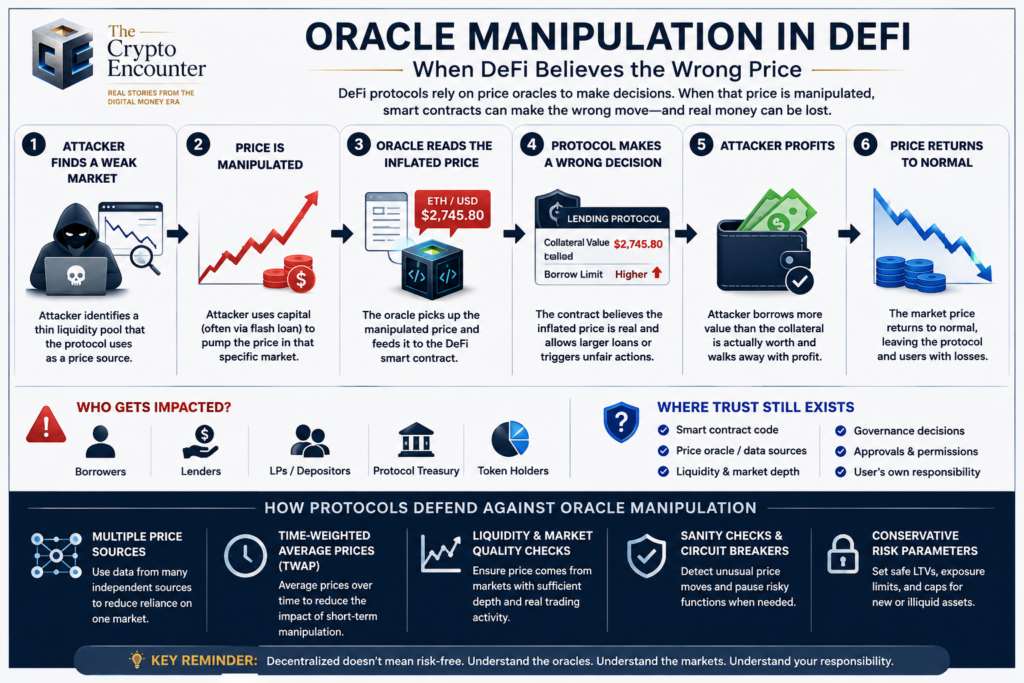
A token normally trades for $10. The protocol accepts 100 units as collateral. Therefore, it sees $1,000 of collateral.
Now imagine an attacker finds a thinly traded liquidity pool that the protocol uses as its price source.
The attacker makes a very large trade. Because that pool has limited liquidity, the trade pushes the displayed token price from $10 to $25.
The broader market has not suddenly decided the token deserves a $25 valuation. Yet the protocol sees $25 because its chosen source says $25.
At that moment, oracle manipulation changes the protocol’s view of reality.
The attacker deposits 100 tokens. Instead of valuing them at $1,000, the lending contract values them at $2,500. Depending on the protocol’s collateral rules, the attacker may then borrow substantially more valuable assets than the collateral could genuinely support.
Afterward, arbitrage traders may return the manipulated pool toward the broader market price.
However, the loan already exists.
Now the protocol may hold a debt worth more than the collateral supporting it.
That is how oracle manipulation can transform a temporary pricing distortion into a permanent balance-sheet problem.
Why Flash Loans Can Make Oracle Manipulation More Dangerous
A flash loan lets someone borrow assets without posting traditional collateral, provided the borrower repays the loan within the same blockchain transaction.
Flash loans have legitimate uses. Traders can use them for arbitrage, refinancing, or other complex transactions.
However, they can also supply enormous temporary purchasing power.
That matters for oracle manipulation.
An attacker may borrow a large amount, use that capital to distort a thin DEX market, exploit another protocol that trusts the distorted price, reverse part of the trade, repay the flash loan, and keep the remaining profit.
All of those steps can happen within one transaction.
Chainlink’s educational documentation describes this attack pattern and emphasizes an important point: the flash loan itself is not necessarily the vulnerability. Rather, it provides capital that can expose a weak pricing design, particularly when a protocol depends on a manipulable DEX spot price.
Academic researchers reached a similar conclusion while studying early DeFi attacks. A Financial Cryptography paper analyzed how flash-loan transaction atomicity could magnify attack opportunities across interconnected protocols.
So, oracle manipulation becomes especially dangerous when three conditions meet: deep temporary borrowing power, shallow target liquidity, and a protocol willing to trust the resulting price.
The bZx Incident Shows What a Wrong Price Can Do
One of the clearest historical examples came from bZx in February 2020.
Researchers studying the incident found that an attacker used a flash loan and manipulated pricing around sUSD before borrowing ETH against collateral whose value the protocol had effectively overestimated.
The academic analysis of the attack found that the attacker generated roughly 2,381 ETH in profit from the oracle-related transaction, worth about $635,000 at the ETH price used in the study. Researchers also concluded that better-optimized attack parameters could theoretically have produced even more.
The episode became important because it demonstrated how oracle manipulation could exploit more than one DeFi component at once.
The lending contract did not exist in isolation.
A DEX supplied market information. A flash loan supplied temporary capital. Another protocol used the reported price to make a collateral decision.
That composability is one of DeFi’s strengths. However, it also means a weakness in one dependency can travel into another application.
The lesson from bZx was therefore broader than one protocol failure.
Oracle manipulation can turn interoperability into a transmission mechanism for risk.
Oracle Manipulation Is Not Always the Same as Market Manipulation
These concepts often get mixed together.
However, the difference matters.
Market manipulation means someone artificially moves the market price.
Oracle manipulation means a DeFi system relies on inaccurate, inappropriate, stale, distorted, or otherwise unsafe price information.
Sometimes both happen together.
For example, an attacker may manipulate one liquidity pool and then exploit a protocol that treats that pool as authoritative. In that situation, the attacker manipulates the market source in order to achieve oracle manipulation.
In another case, the market itself may remain healthy while an oracle reports an incorrect price because of faulty data, compromised infrastructure, or misconfiguration.
Chainlink describes this distinction directly: market manipulation changes the relevant market price, while an oracle exploit involves incorrect data that fails to reflect genuine pricing conditions.
For users, the outcome can look similar. A protocol makes a financial decision using a price that should not have been trusted.
Still, understanding the cause helps explain why defenses differ.
Why Low Liquidity Makes Oracle Manipulation Easier
Liquidity describes how easily someone can buy or sell an asset without moving its price dramatically.
A deep market can absorb a large trade.
A shallow market cannot.
Suppose a pool contains millions of dollars in actively traded liquidity. Moving its price substantially may require significant capital.
Now compare that with a tiny pool containing only a small amount of liquidity. One large transaction may dramatically change the token ratio and, therefore, the quoted price.
This is why oracle manipulation often becomes more dangerous around thin markets, obscure assets, or poorly designed price feeds.
Ethereum’s security guidance specifically warns developers about using DEX spot prices and notes that attackers can temporarily move prices before interacting with a lending contract.
Furthermore, research on DeFi oracle design has found that time-weighted and liquidity-aware approaches can reduce the effect of short-lived price distortions.
In other words, decentralization does not automatically make a price robust.
A decentralized exchange can still have weak liquidity.
How Oracle Manipulation Can Hurt Users Who Never Attacked Anything
The attacker may target a protocol. However, ordinary users can carry the consequences.
Consider lending first.
If oracle manipulation lets an attacker borrow too much against inflated collateral, the protocol can end up with bad debt. Depending on the system, reserve funds, liquidity providers, governance participants, or other stakeholders may absorb the loss.
Liquidations create another route.
If oracle manipulation pushes a collateral price artificially low, a lending system may consider a healthy account undercollateralized. The contract could then allow liquidators to close that position according to protocol rules.
Derivatives introduce additional exposure. A manipulated reference price may affect settlements, margin requirements, or liquidations.
Meanwhile, automated vaults can execute trades because their logic interprets the bad data as genuine market information.
Therefore, oracle manipulation does not only threaten people making risky bets.
It can affect users who simply supplied liquidity, borrowed conservatively, deposited into a vault, or interacted with a protocol whose dependencies they never examined.
That is one of DeFi’s hardest risk problems.
The interface can look simple while the dependency graph underneath it remains complex.
Self-Custody Does Not Remove Oracle Manipulation Risk
Self-custody gives a user direct control over private keys.
That can reduce one major form of risk. A centralized exchange cannot simply freeze assets held inside the user’s independent wallet.
However, self-custody and safe protocol interaction are different questions.
Once users deposit assets into a DeFi smart contract, they expose themselves to that contract’s design and dependencies.
Those dependencies can include:
smart contract code, governance controls, token approvals, liquidation rules, bridge infrastructure, liquidity conditions, and oracle systems.
Consequently, oracle manipulation illustrates a wider principle: removing corporate custody does not remove trust. It changes where trust sits.
Instead of trusting an exchange to maintain accurate internal records and honor withdrawals, a DeFi user may trust code, market structure, governance, liquidity, price feeds, and their own operational decisions.
The Crypto Encounter’s own risk policy makes the same broader distinction by warning that self-custody users remain responsible for wallet security and that smart contract exploits can cause permanent losses.
That tradeoff deserves more attention whenever “decentralized” gets treated as a synonym for “safe.”
How Protocols Reduce Oracle Manipulation Risk
No single defense removes every oracle problem.
Still, developers can make oracle manipulation significantly harder.
Use Multiple Reliable Price Sources
A protocol can avoid depending on one thin exchange or one easily influenced source.
Aggregating data across multiple markets makes it more expensive to create a false market-wide signal.
Moreover, independent sources reduce the danger of one pricing venue becoming a single point of failure.
Avoid Raw Spot Prices When They Are Easy to Move
A spot price tells the protocol what an asset costs at that moment.
That immediacy can become dangerous when an attacker can temporarily distort the market.
Therefore, some systems use time-weighted average prices, or TWAPs. Instead of trusting one instant, the oracle considers pricing across a longer period.
Ethereum’s developer guidance recommends considering TWAP mechanisms when protocols use on-chain prices because longer observation windows can reduce the influence of sudden large trades.
However, TWAPs are not magic. Their security still depends on the averaging window, liquidity, implementation, market conditions, and the attacker’s resources.
Add Sanity Checks and Circuit Breakers
A protocol can question extreme price movements rather than blindly accepting them.
For instance, developers may compare independent feeds, limit how quickly accepted prices can move, pause sensitive functions during anomalies, or reject values that diverge sharply from reference markets.
These controls add friction.
That friction can be useful when the alternative is allowing oracle manipulation to immediately control borrowing or liquidation logic.
Treat New Collateral Conservatively
An illiquid token may look valuable based on its quoted market price. Yet liquidating a large position may reveal that the market cannot support that valuation.
Therefore, collateral limits, conservative loan-to-value ratios, liquidity requirements, and exposure caps can matter as much as the oracle itself.
Oracle manipulation becomes harder to monetize when a protocol limits how much damage one distorted asset can cause.
What Users Can Check Before Trusting a DeFi Protocol
Most users cannot audit oracle code.
They can still ask better questions.
First, identify the protocol’s price source. Documentation should explain how it values collateral and positions.
Next, look for concentration. Does the protocol depend on one exchange, one pool, or one provider?
Then, consider liquidity. A token with limited trading depth deserves additional caution, especially when the protocol allows users to borrow significant value against it.
Also examine protocol documentation for oracle safeguards, emergency controls, audits, and historical incidents.
Finally, remember that yield does not describe risk.
A 15% annual yield tells you what the protocol may pay under stated conditions. It does not tell you how vulnerable the smart contracts, oracle design, collateral model, liquidity, approvals, or governance system may be.
Oracle manipulation makes that gap especially important.
High yield can compensate users for taking risk. It does not make the underlying risk disappear.
What Oracle Manipulation Reveals About the Meaning of “Trustless”
DeFi often aims to minimize reliance on financial intermediaries.
This tension between technical independence and continued external dependencies appears elsewhere in crypto too. As our analysis of why Bitcoin still moves with the Fed explains, removing direct institutional control does not necessarily remove exposure to the wider systems surrounding an asset.
That goal has genuine value.
Yet smart contracts still require assumptions.
A lending protocol assumes its collateral rules work. Users assume contracts behave as documented. Liquidators assume the oracle price is meaningful. Meanwhile, the protocol may assume that external markets cannot be cheaply distorted.
Oracle manipulation attacks the assumption underneath the transaction.
That makes it a useful lens for understanding DeFi more broadly.
Decentralization can remove a bank manager from the process. Nevertheless, software still needs inputs. Markets still need liquidity. Governance still makes decisions. Users still approve transactions. Developers still choose dependencies.
Therefore, “trustless” usually means reducing or redistributing trust rather than eliminating every dependency.
Oracle manipulation shows what happens when one of those dependencies fails at exactly the wrong moment.
Oracle Manipulation and the Risk Ordinary Users Actually Carry
For general users, the most important lesson is simple.
Owning your keys gives you control over your wallet. It does not guarantee that every contract you connect to will value assets correctly.
Likewise, using a DEX removes the need to leave funds with a conventional exchange operator. However, it can introduce smart contract, liquidity, slippage, approval, MEV, and oracle risks.
Oracle manipulation sits inside that wider transfer of responsibility.
With centralized finance, customers often rely on institutions to manage pricing systems, custody infrastructure, risk controls, and operational mistakes.
With DeFi, users gain more direct control. At the same time, they may inherit risks that institutions previously handled behind the scenes.
That does not make DeFi inherently worse.
It does make due diligence more important.
Conclusion: Oracle Manipulation Is a Price Problem With a Trust Problem Underneath
Oracle manipulation becomes dangerous when DeFi accepts a price without enough protection and then uses that price to move real money.
The smart contract may execute correctly. The blockchain may remain secure. The user’s wallet may never be hacked. Yet the protocol can still suffer losses because its financial logic believed the wrong number.
That is why oracle manipulation matters far beyond developers.
It exposes a central tension in decentralized finance. Users can remove corporate custody and gain greater control, but they also take on new forms of smart contract, liquidity, approval, pricing, and self-responsibility risk.
The most useful question is therefore not simply whether a protocol is decentralized.
Users should also ask what information the protocol trusts, where that information comes from, how easily someone can distort it, and what happens if the price is wrong.
When money depends on software, the quality of the input can matter just as much as the quality of the code.
Frequently Asked Questions
What is oracle manipulation in simple terms?
Oracle manipulation happens when a DeFi protocol makes financial decisions using a misleading or unsafe price. An attacker may manipulate the market supplying that price, exploit a weak oracle design, or take advantage of stale or incorrect information.
Can oracle manipulation happen without hacking a blockchain?
Yes. Oracle manipulation often does not require breaking Ethereum or another blockchain. An attacker may instead manipulate a thin market or exploit the way a protocol reads prices. The blockchain can continue working normally while the application receives bad financial information.
Are flash loans responsible for oracle manipulation?
Not by themselves. Flash loans provide temporary capital. However, attackers can use that capital to amplify oracle manipulation when a protocol relies on a market that can be moved cheaply. The weakness usually lies in the protocol’s pricing or risk design.
Can an oracle manipulation attack liquidate ordinary users?
Potentially, yes. If a protocol accepts an artificially low collateral price, its liquidation logic could treat some positions as undercollateralized. The exact outcome depends on the protocol’s oracle design, thresholds, safeguards, and market conditions.
Do decentralized oracles eliminate oracle manipulation?
No system removes all risk. Multiple data sources, robust aggregation, TWAPs, liquidity checks, circuit breakers, and conservative collateral settings can reduce oracle manipulation risk. However, developers still need to evaluate market quality, implementation risk, and unusual conditions.
How can DeFi users reduce their exposure to oracle manipulation?
Users can review how a protocol sources prices, avoid assuming high yield means low risk, examine the liquidity of supported collateral, check audits and incident history, diversify exposure, and avoid committing funds they cannot afford to lose.
Disclaimer
This article is for informational and educational purposes only. It does not provide financial, investment, legal, tax, or accounting advice. Cryptocurrency and digital asset markets involve risk, including possible loss of capital. Readers should conduct their own research before making any financial decision.