

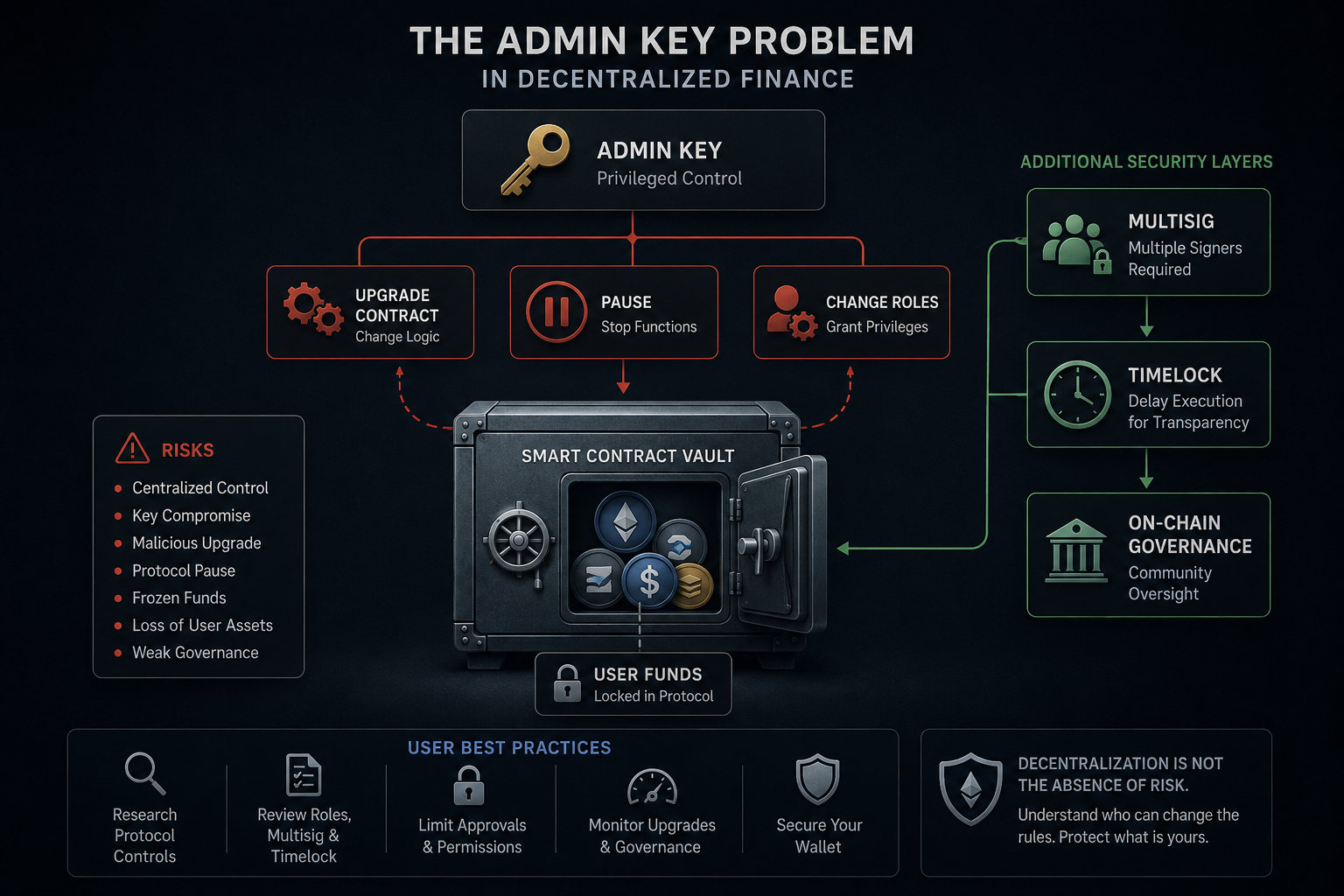
Decentralized finance gives users direct access to trading, lending, borrowing, staking, and liquidity tools without depositing assets with a traditional financial intermediary. However, the admin key problem in decentralized finance shows why “non-custodial” does not mean “no trusted parties.” Many protocols still give privileged wallets or governance systems the power to upgrade contracts, pause functions, change parameters, or manage critical roles. If attackers capture that authority, users can lose money even while the blockchain works exactly as designed. Understanding the admin key problem in decentralized finance therefore starts with one simple question: who can still change the rules after users deposit funds?
Key Facts: The Admin Key Problem in Decentralized Finance
| Risk area | Plain-English meaning | What users should check |
|---|---|---|
| Admin role | A privileged address can perform actions ordinary users cannot | Who controls it and what it can do |
| Upgradeability | Authorized actors can change contract logic | Multisig, timelock, and upgrade process |
| Emergency powers | A role may pause markets or alter key settings | Scope, transparency, and speed |
| Token approvals | A user lets another contract spend tokens | Amount, spender, and old approvals |
| Liquidity | Exiting may become expensive or difficult | Pool depth and asset quality |
| Self-custody | You control your wallet credentials | Wallet security and transaction review |
The admin key problem in decentralized finance is a control problem, not merely a password problem. In simple terms, the admin key problem in decentralized finance asks whether privileged access can override the assumptions ordinary users make about a protocol.
OpenZeppelin’s smart-contract documentation explains that ownership and role-based access systems can let selected accounts mint tokens, freeze transfers, manage roles, or perform other restricted actions. It also warns that a default administrator role carries significant risk because it can control other permissions.
What the Admin Key Problem in Decentralized Finance Actually Means
An “admin key” is often shorthand. One private key may control an administrator wallet. Yet a multisignature wallet, governance contract, security council, or access-control contract can also hold privileged authority.
The important issue is what that authority can do. That is the core of the admin key problem in decentralized finance.
For example, a normal user may only deposit, withdraw, swap, or borrow. An administrator may have permission to pause a market, change a collateral parameter, replace contract logic, grant another account a sensitive role, or trigger an emergency function.
Therefore, the admin key problem in decentralized finance exists whenever a small set of actors can materially change a system that users may assume runs only according to fixed code.
That does not automatically make a protocol unsafe. Still, the admin key problem in decentralized finance requires users to treat privileged authority as part of the protocol’s security model.
Administrative controls can help teams patch bugs and react to emergencies. However, those controls create a trust assumption. Users need to know it exists.
OpenZeppelin’s smart contract access control documentation shows how privileged roles can govern sensitive functions and explains why administrator permissions require additional security controls
Why Upgradeable Contracts Deepen the Admin Key Problem in Decentralized Finance
Upgradeable smart contracts are common because developers sometimes need to fix bugs or improve protocol logic. Proxy designs make that possible without forcing every user to move to a new contract address.
OpenZeppelin explains that proxy systems separate the contract that stores state from the implementation contract that provides the logic. An authorized upgrader can point the proxy toward new implementation code. As a result, users may keep interacting with the same address while the code governing that address changes.
This flexibility makes the admin key problem in decentralized finance more important. If one account controls upgrades, whoever controls that account may be able to replace trusted logic with malicious logic.
OpenZeppelin specifically cautions that an attacker who gains control of an upgrade administrator can change contracts across the system. Its mainnet guidance recommends stronger arrangements, including transferring administrative ownership to a multisignature wallet rather than leaving it with a single externally owned account.
Consequently, an audit alone cannot answer every control question. The admin key problem in decentralized finance survives a code audit whenever administrators retain powers that can later alter the reviewed system.
An audit can examine the code deployed at a point in time. Still, an authorized upgrade path may later change that code.
That difference matters. A protocol may pass a technical review today. Yet users can remain exposed to tomorrow’s administrative decisions.
Zoth Showed the Admin Key Problem in Decentralized Finance in Practice
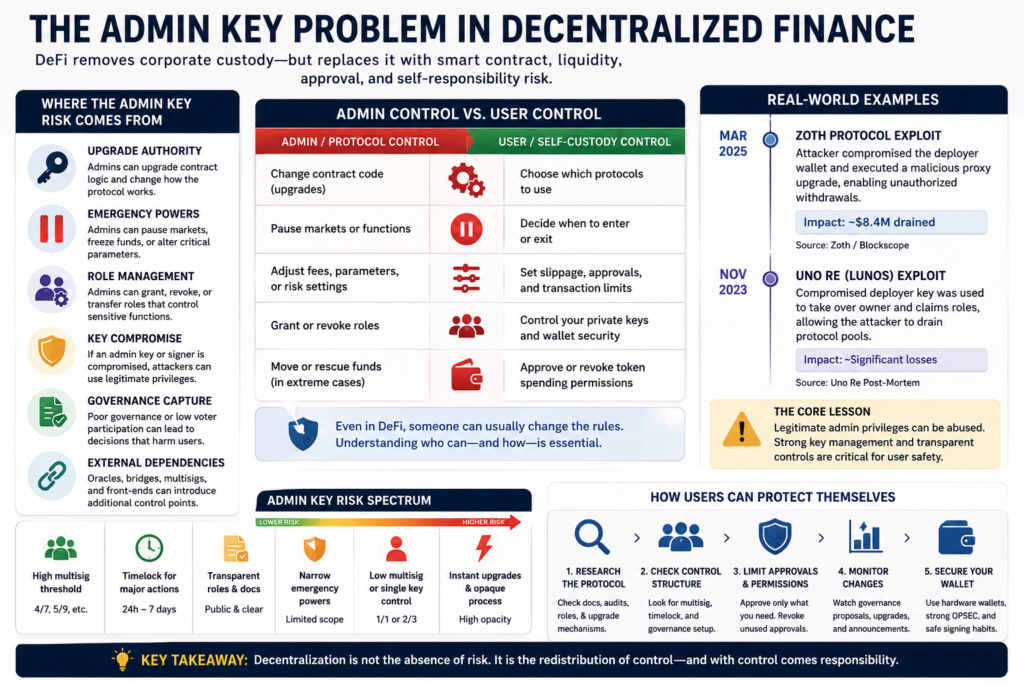
A March 2025 incident at Zoth provides a concrete example. Zoth said an attacker gained unauthorized access to its deployer account and used that access to perform a malicious proxy upgrade. The upgrade enabled unauthorized withdrawals from a segregated vault.
Blockscope’s technical analysis traced the incident to the compromised deployer wallet and reported that the attacker installed malicious implementation logic before withdrawing about $8.4 million worth of USD0++ tokens.
The lesson is direct. The admin key problem in decentralized finance can turn control of one privileged credential into control over an entire upgrade path.
The attacker did not need Ethereum itself to fail. Instead, the attacker used administrative authority that the protocol already recognized.
That distinction matters for ordinary users. In this sense, the admin key problem in decentralized finance can convert operational security failures into user losses.
A smart contract can execute exactly as programmed and still produce a disastrous outcome when the wrong party gains legitimate-looking privileges.
Therefore, “the blockchain worked” does not necessarily mean “user funds were safe.”
Uno Re Exposed Another Version of the Admin Key Problem in Decentralized Finance
The same pattern appeared in a different form in November 2023. Uno Re, later rebranded as Lunos, published a post-mortem after a deployer wallet suffered a private-key compromise.
According to the project, that wallet held the owner role. The attacker transferred ownership, altered a claims-related role, and used privileged functions to drain assets from protocol pools. The team also said the relevant claims role had not been moved to a multisignature setup.
Again, the admin key problem in decentralized finance came from authority concentration. The attacker did not discover a normal user function that anyone could abuse. Instead, compromised credentials unlocked powers reserved for trusted operators.
Therefore, readers should distinguish smart-contract bugs from privileged-access failures. The admin key problem in decentralized finance belongs to the second category when the loss path begins with trusted administrative authority.
Both problems can destroy user funds. However, they require different defenses.
Code audits target software weaknesses. Strong key management, role design, multisigs, timelocks, and governance controls address privileged-access risk.
Multisigs Reduce the Admin Key Problem in Decentralized Finance, but Do Not Erase It
A multisignature wallet requires several approved signers to authorize an action. A 3-of-5 arrangement, for instance, needs three signatures from five designated signers.
That structure reduces the chance that one stolen key can control the protocol. Therefore, the admin key problem in decentralized finance becomes partly a question of how authority is distributed.
OpenZeppelin describes multisig ownership as a way to add stronger access control instead of leaving ownership with a single externally owned account.
Even so, the admin key problem in decentralized finance remains. Attackers could compromise enough signers. Signers could collude. Operational procedures could also undermine the design if one organization effectively controls several keys.
For that reason, the threshold matters. The admin key problem in decentralized finance becomes harder to exploit when control genuinely requires independent approvals.
Signer independence matters too.
For example, a 4-of-7 multisig sounds stronger than a single admin wallet. However, it offers less protection if one person manages four signer devices.
Therefore, users should look beyond the label “multisig.” They should ask how the multisig actually distributes power.
Timelocks Make the Admin Key Problem in Decentralized Finance Easier to Observe
A timelock adds a delay between approving a sensitive action and executing it. That delay can give users, researchers, and governance participants time to inspect a planned upgrade.
OpenZeppelin’s TimelockController documentation explains that delayed execution gives users time to review maintenance operations and exit when they believe a proposed change creates unacceptable risk.
Therefore, a timelock can reduce the admin key problem in decentralized finance by making major changes visible before they take effect.
However, the trade-off is real.
During an active exploit, a protocol may need to pause or react quickly. A long delay could prevent developers from responding before attackers cause further damage.
Good control design separates those powers. That separation can narrow the admin key problem in decentralized finance by preventing one emergency role from becoming a universal administrator.
Routine upgrades can move slowly. Emergency powers can remain narrow.
In addition, protocols can disclose exactly which functions bypass a delay.
This gives users a clearer picture of which actions require patience and which actions administrators can execute immediately.
Token Approvals Add User-Controlled Risk to the Admin Key Problem in Decentralized Finance
Administrative control is only one layer. Even so, the admin key problem in decentralized finance often interacts with risks created by user permissions.
Token approvals create one of those risks.
Under Ethereum’s ERC-20 model, a wallet can approve another address or smart contract to spend tokens up to an allowed amount. Ethereum’s documentation explains that the approve, allowance, and transferFrom mechanisms make this delegated spending possible.
As a result, a user can retain the private key to a self-custody wallet while still giving a DeFi contract spending authority.
If that contract becomes unsafe later, a broad approval can increase exposure.
This point broadens the admin key problem in decentralized finance. Protocol teams control privileged roles, while users control wallet permissions. Both sets of permissions matter.
Before approving a token, users should check the spender address and amount. This user-side discipline matters because the admin key problem in decentralized finance can overlap with approval risk after a protocol or spender becomes compromised.
Moreover, users should remove stale approvals when they no longer need them.
Unlimited approvals may offer convenience. However, they also expand the amount a compromised spender could potentially access.
Self-custody therefore requires more than protecting a seed phrase.
Liquidity Changes What the Admin Key Problem in Decentralized Finance Means for Exits
Even perfect key management cannot remove market risk. For that reason, the admin key problem in decentralized finance should never be assessed in isolation.
A decentralized exchange depends on liquidity.
If a pool becomes shallow or heavily imbalanced, users may face severe slippage. Likewise, a lending market can become stressed when collateral falls quickly and available liquidity disappears.
Therefore, the admin key problem in decentralized finance belongs inside a wider risk map.
Smart-contract risk, oracle risk, bridge risk, governance risk, liquidity risk, approval risk, and wallet risk can exist together.
This is especially important when users chase high yields. The admin key problem in decentralized finance can sit underneath an attractive yield without appearing in the headline return.
A high yield does not explain which risks generate that return.
For instance, a liquidity provider may earn substantial incentives while also accepting smart-contract exposure, volatile assets, thin exit liquidity, token approval risk, and governance risk.
Consequently, yield should never serve as a substitute for risk analysis.
Self-Custody Does Not Solve the Admin Key Problem in Decentralized Finance
Self-custody means a user controls the credentials that authorize transactions from a wallet. However, the admin key problem in decentralized finance remains relevant after a user takes custody.
Self-custody does not guarantee that every protocol connected to that wallet has no trusted administrators.
Users may still depend on upgrade controllers, governance mechanisms, oracles, bridges, liquidity providers, front-end infrastructure, and token issuers.
Consequently, the admin key problem in decentralized finance shows that decentralization often redistributes trust rather than eliminating every form of it.
The practical difference is responsibility.
A centralized exchange may hold the user’s assets directly. In DeFi, the user may hold the wallet key but still rely on external contracts and systems to behave as expected.
This shift becomes easier to understand by looking at how decentralized exchanges work, where users can trade from their own wallets while still interacting with smart contracts and liquidity infrastructure.
It also gives users more security decisions.
Therefore, “not your keys, not your coins” captures only part of DeFi risk. Holding your own keys does not protect you from every contract, approval, governance, or liquidity failure.
How to Evaluate the Admin Key Problem in Decentralized Finance Before Depositing
A user does not need to read Solidity to ask useful questions.
First, check whether the protocol can upgrade its contracts. If it can, identify who authorizes those upgrades.
Next, look for a multisig. Then check the signing threshold and, where disclosed, whether independent parties control the signers.
After that, look for a timelock. A visible delay gives users more time to react to major changes.
Also, read the protocol’s documentation for emergency powers. Ask whether administrators can pause, freeze, withdraw, change collateral settings, or grant new roles.
Then review token approvals. Limit allowances where practical and remove permissions that no longer serve a purpose.
Finally, examine liquidity. A technically available withdrawal offers little comfort if exiting requires extreme slippage.
These steps do not eliminate the admin key problem in decentralized finance. In fact, the admin key problem in decentralized finance is best treated as an ongoing due-diligence question, especially after upgrades or governance changes.
However, these checks help reveal where control sits and how quickly that control can affect user funds.
A Simple Admin Key Problem in Decentralized Finance Risk Spectrum
| Lower apparent control risk | Higher apparent control risk |
| Multiple independent signers | One externally owned admin wallet |
| Higher multisig threshold | One-key approval |
| Timelock for major upgrades | Immediate upgrades |
| Narrow emergency powers | Broad emergency powers |
| Publicly documented roles | Undocumented roles |
| Transparent governance process | Opaque control process |
| Clear upgrade history | Unclear upgrade authority |
The admin key problem in decentralized finance is not binary. Instead, the admin key problem in decentralized finance sits on a spectrum shaped by permissions, thresholds, delays, transparency, and operational security.
A multisig does not make a protocol automatically safe.
Likewise, an admin role does not prove a protocol is dangerous.
Instead, users need to evaluate the full control design.
They should also revisit that analysis when the protocol upgrades contracts, changes governance, rotates signers, or introduces new emergency powers.
Can Protocols Remove the Admin Key Problem in Decentralized Finance Completely?
Some protocols can remove or reduce privileged control.
For example, an owner can sometimes renounce ownership. OpenZeppelin notes that this makes owner-protected administrative functions unavailable afterward.
That can reduce the admin key problem in decentralized finance. Even then, the admin key problem in decentralized finance may reappear elsewhere if governance, oracles, bridges, or other privileged components retain concentrated control.
Moreover, immutability introduces another trade-off.
If developers discover a serious bug later, they may no longer have an upgrade path to fix it.
Therefore, the better question is not simply, “Does this protocol have an admin key?”
Users should ask whether the remaining control matches the protocol’s claims. They should also check whether authority is distributed, whether major changes face delays, and whether emergency powers remain proportionate.
The admin key problem in decentralized finance becomes easier to assess when protocols publish those answers clearly.
Conclusion: The Admin Key Problem in Decentralized Finance Is Really About Visible Trust
The admin key problem in decentralized finance explains why a “non-custodial” label should never end a risk review. Users can control their wallets while privileged actors still control upgrades, emergency functions, governance roles, or critical settings.
At the same time, users carry responsibility for approvals, wallet security, transaction signing, and liquidity decisions.
Therefore, the strongest DeFi designs make control visible, distribute sensitive authority, delay major changes, and narrow emergency powers.
For ordinary users, understanding the admin key problem in decentralized finance comes down to three questions: who can change the system, how quickly can they act, and what can you do before that change reaches your funds?
Those questions do not remove risk. However, they reveal where trust actually lives.
FAQs
What Is an Admin Key in DeFi?
An admin key is a private key or privileged control mechanism that authorizes restricted protocol actions. Depending on the design, it may control upgrades, pauses, parameters, emergency functions, or other roles.
Why Is the Admin Key Problem in Decentralized Finance Dangerous?
The admin key problem in decentralized finance can create a concentrated point of failure. If an attacker gains privileged credentials, the attacker may use valid administrative functions to alter protocol behavior.
Does a Multisig Solve the Admin Key Problem in Decentralized Finance?
A multisig reduces single-key risk because several signers must approve an action. However, compromised signers, collusion, weak procedures, or a low signing threshold can still create exposure.
Are Immutable Smart Contracts Safer?
Immutable contracts remove certain upgrade-authority risks. However, they may also prevent developers from patching serious bugs through upgrades. The security trade-off depends on the protocol’s design and purpose.
Can Token Approvals Put a Self-Custody Wallet at Risk?
Yes. ERC-20 approvals allow a designated spender to transfer tokens up to the approved amount. A self-custody user therefore needs to manage both wallet keys and spending permissions.
How Can Users Reduce Exposure to the Admin Key Problem in Decentralized Finance?
Users can favor transparent control structures, multisignature administration, timelocks, narrow emergency powers, documented upgrades, limited token approvals, and sufficient liquidity. These measures reduce risk but cannot guarantee safety.
Disclaimer:
This article is for informational and educational purposes only. It does not provide financial, investment, legal, tax, or accounting advice. Cryptocurrency, decentralized finance, and digital asset markets involve significant risks, including smart contract vulnerabilities, liquidity risk, governance risk, security breaches, and possible loss of capital. Readers should conduct their own research, assess the risks carefully, and seek qualified professional advice where appropriate before making any financial decision.